|
| Newtown Pippins from North Star Orchards |
When it comes to antique (a.k.a. heirloom) varieties, North Star always has a few surprises. This week I picked up an apple I've been waiting for: the Newtown Pippin. This is a green but sweet-tart apple native to the Mid-Atlantic region (it's named after Newtown, which is a neighborhood deep in the heart of Queens: perhaps you've crossed Newtown Creek while snailing along the Brooklyn Queens Expressway en route to a Phillies-Mets game.
The beauty of the Newtown Pippin is its storage quality, indeed, this apple improves with age. North Star's Ike Kerschner said he picked his crop a month ago, but is only now bringing them to market because they weren't ready to eat then. But they'll get even better in a few months. Kept loosely bagged in the refrigerator these will make especially fine eating come January and February when most other apples will be well-passed peak flavor.
Another interesting variety from North Star this week was the Reinette Simerenko, a tart Eastern European variety for a welcome change of taste. North Star has a fine web site that includes spot-on descriptions of their apple varieties.
Golden Russet is yet another variety you are unlikely to find at the Acme, or even Wegman's. I bought some more this week from North Star. They are far from the classic red apple, but well worth seeking out, with a pear-like flavor and texture. Great with a good cheese, like Birchrun Hill's Fat Cat washed rind comestible.
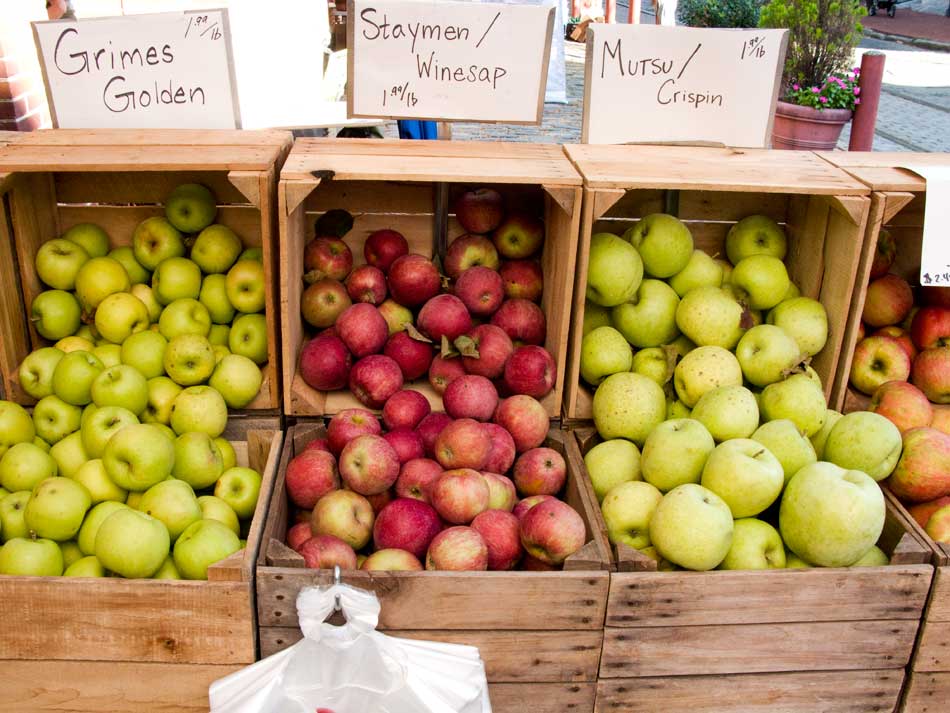
Over at Beechwood Orchards (they also have a website with apple descriptions worth consulting) Stayman Winesap and Northern Spy were my apples of choice. Both are older commercial varieties (19th century). Although either can be eaten either raw or cooked, I find the former tops for consuming fresh, the latter best for pies, tarts and other applications involving heat.
Beechwood also had the original Winesap, which is a tad tarter than its Stayman offspring. I like it better for cooking than eating though it can be used either way. It's also a good "keeper" for two or three months. If you're into drying your own fruit, sliced Winesaps are ideal for schnitz.
Three Springs Fruit Farm isn't into the antiques, but Ben Wenk and family still offer a nice selection of commercial varieties. I'm not a big fan of Honeycrisp (too one-dimensionally sweet to me taste), but it's a favorite among a lot of apple shoppers, and Three Springs has them as well as Staymans and other popular varieties. (And if you want a taste of summer through the winter, buy some of their canned peaches: delicious.)
About apple storage: As mentioned earlier, I keep my Newtown Pippins in the fridge, along with all other apples. While some fruits improve with room temperature storage to come to proper ripeness, apples don't and will deteriorate. Keep them in the crisper either loose or very loosely bagged, allowing them to breath. If you like to eat your apple at room temperature, take them out no more than a day before you intend to consume them.