Brewer's Plate Expands, Moves
The Brewer's Plate, an annual fund-raiser for the Fair Food Project, will change its venue and alter its structure slightly this year.
For the fourth edition of the foodbrew fest, the schedule was moved up month, from April to March, to coordinate with Philly Beer Week, said Kathryn Hauge, event coordinator. That means it will take place on Sunday, March 9 which, coincidentally or not, is also the last day of the Philadelphia Flower Show.
Hauge said that with more brewers and restaurants on tap than last year, growing attendance, and the overlap with the humongous horticultural event at the convention center, White Dog sought a larger, more workable venue, hence this year's event moves over to the Independence Visitor Center from the Reading Terminal Market, site of the previous three Brewer's Plates.
The basic idea is unchanged: brewers will be paired with restaurants, whose chefs will match food to the brews offered. In past years, two different beers were offered for each restaurant. This year, with the number of participating brewers and restaurants growing to 21 apiece (not counting DiBruno Bros. – more about that later) each brewer will present one beer paired to one restaurant's dish.
Tickets are $50. That gets you general admission, all the food and beer you can consume (without becoming inebriated) and a souvenir tasting cup. Designated drivers pay $40.
But for the price of a VIP ticket ($100, or $80 for designated drivers) you get admission a half hour earlier, so you can attack the food and beer stalls in a slightly more leisurely environment, live music on the heated, tented terrace, special seating in the ballroom (vs. crowded high top tables on the grand hall), live jazz, gift bag to take home (along with specially selected beers to take home, too). Also, a curated beer list, different from those available in the main hall, and additional food catered by DiBruno's will be served.
If your thirst extends to knowledge, VIP ticket holders can have it quenched it can be quenched through beer tutorials led by Marnie Olds and Garrett Oliver. Olds is a regarded as one of Philadelphia's top wine educators who has extended her expertise to beer. Oliver is brewmaster of Brooklyn Brewery and the author of "The Brewmaster's Table".
Details – including list of the 21 participating brewers and 21 participating restaurants – can be found at The Brewer's Plate website. If you want to find out what else is happening beer-wise that week, visit the Philadelphia Beer Week website.

Monday, January 28, 2008


Sunday, January 27, 2008
Brisket and Fastnachts
With the Home Show finishing up today, the RTM lunch merchants are looking forward to the new convention and show season, with the auto show opening on Groundhog Day, the big crafts buyers show in mid-February and the Flower Show two weeks later in early March. If you want to avoid the crowds, stay away from the RTM during lunch hours those days!
Folks have been asking for platters at Hershel's East Side Deli, so they are obliging. You can get that brisket on a plate with mashed potatoes and other veggies or starches, instead of on a sandwich or accompanied by slaw or salad. If you haven't tried the brisket, do. It's moist and flavorful, and Andy will cut it for you lean or fatty, as your preference dictates. (Andy cooks his brisket whole, not just the lean flat portion, so if you like the fatty deckel like I do, you can get it.)
Speaking of fatty food, expect to see Fastnachts, a pre-Lenten South German/Pennsylvania Dutch donut, at Dutch Country Meats by next weekend. The Fastnachts will come from Haegele's and are traditionally made with mashed potatoes added to the flour, and frequently prepared hole-less.
Jake Fisher, the shop's proprietor, told me he plans to go whole hog into German foods. Although the Dutch Country Meats has de-emphasized fresh pork cuts and only displays a limited selection, you will occasionally spy a piggy item that's otherwise hard to find. This week it was salt-cured pork belly. (Okay, that's really not a fresh cut, but it wasn't smoked so it's close enough.) If you don't see something, ask. Not all the available cuts are in the display cases; they might have what you want in their walk-in fridge.
This week I purchased the Wien Kuchen, Bienstiche Kuchen, Zweibel Kuchen (all from Haegele's), double-smoked pork butt (from Rieker's), and sauerkraut. The Zweibel Kuchen from Haegele's was unexpected, since it wasn't a sweet treat. Instead, a savory egg-onion-sour cream pie (in this version, sans-crust). I'll re-heat the Zweibel Kuchen to go along with the Carbonnade Flammande I braised yesterday from Harry Och's lean chuck.
With the Home Show finishing up today, the RTM lunch merchants are looking forward to the new convention and show season, with the auto show opening on Groundhog Day, the big crafts buyers show in mid-February and the Flower Show two weeks later in early March. If you want to avoid the crowds, stay away from the RTM during lunch hours those days!
Folks have been asking for platters at Hershel's East Side Deli, so they are obliging. You can get that brisket on a plate with mashed potatoes and other veggies or starches, instead of on a sandwich or accompanied by slaw or salad. If you haven't tried the brisket, do. It's moist and flavorful, and Andy will cut it for you lean or fatty, as your preference dictates. (Andy cooks his brisket whole, not just the lean flat portion, so if you like the fatty deckel like I do, you can get it.)
Speaking of fatty food, expect to see Fastnachts, a pre-Lenten South German/Pennsylvania Dutch donut, at Dutch Country Meats by next weekend. The Fastnachts will come from Haegele's and are traditionally made with mashed potatoes added to the flour, and frequently prepared hole-less.
Jake Fisher, the shop's proprietor, told me he plans to go whole hog into German foods. Although the Dutch Country Meats has de-emphasized fresh pork cuts and only displays a limited selection, you will occasionally spy a piggy item that's otherwise hard to find. This week it was salt-cured pork belly. (Okay, that's really not a fresh cut, but it wasn't smoked so it's close enough.) If you don't see something, ask. Not all the available cuts are in the display cases; they might have what you want in their walk-in fridge.
This week I purchased the Wien Kuchen, Bienstiche Kuchen, Zweibel Kuchen (all from Haegele's), double-smoked pork butt (from Rieker's), and sauerkraut. The Zweibel Kuchen from Haegele's was unexpected, since it wasn't a sweet treat. Instead, a savory egg-onion-sour cream pie (in this version, sans-crust). I'll re-heat the Zweibel Kuchen to go along with the Carbonnade Flammande I braised yesterday from Harry Och's lean chuck.
Saturday, January 19, 2008
Haegele's Baked Goods Now At RTM
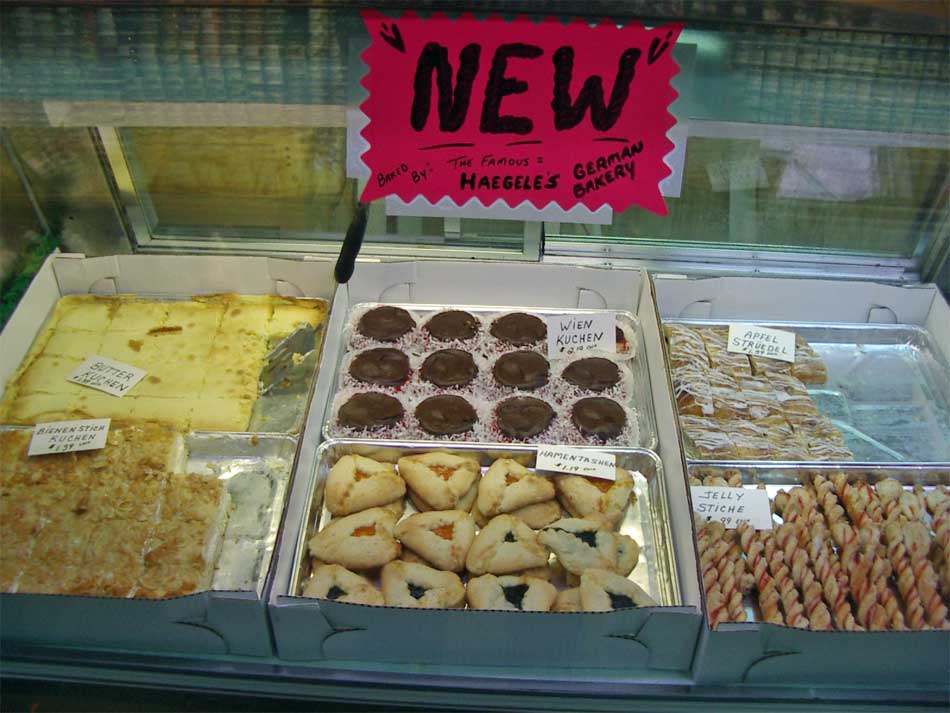
Earlier this week I wrote of Dutch Country Meats' de-emphasis of fresh pork products in favor of German-style deli goods and other prepared foods, including a nice selection from Rieker's, the sausage and deli emporium in the Far Northest. The shop has taken another big step away from fresh pork with the addition of this week of baked goods from Haegele's, a superior bakery in another Northeast neighborhood, Tacony.
Today they featured six of Haegele's product seen below: butter kuchen (butter cake), bienenstich kuchen (bee sting cake, with a custardy filling, and a sugar or honey almond topping), Wien kuchen (Vienna cake, which appears to be chocolate with a filling I couldn't identify just by looking at it -- a taste test is in order!), hamantaschen, apple strudel, and jelly stiche (jelly stings?).

Across the aisle, at Kauffman's Lancaster County Produce, Benuel Kauffman is now selling unpasteurized cup cheese, made by a neighbor from his two Jersey cows. Ben explained that it's used as a spread, usually on bread of crackers with some jam or preserves. I've checked recipes to find out exactly what it is, but the ones I googled were quite different, though many involve heating milk, adding butter and egg and finishing with cream. The consistency is more liquid than sour cream, hence it is served in cups. I tried a sample from Ben on a cracker with jam, and it was quite pleasant. He's selling it for about $4 a container (I didn't check the per pound price).
 A mushroom I've only occasionally seen in stores made an appearance today at the Fair Food Farmstand. It's the "pom pom" pictured here from Oley Valley Mushroom Farm. Pom pom is just one of the names this fungus goes by. It's scientific name is Hericium erinaceus. Less marketable names (hence the use of "pom pom" in retail settings) this delicate fungus goes by include lion's mane, monkey's head, elf abalone, Bear's Head, Old Man's Beard, and Satyr's Beard. I've enjoyed this choice mushroom sliced and sauteed, and I wouldn't argue with those who think its taste suggests mild seafood, like lobster or scallop. It was available today for $14/pound.
Oley Valley Mushrooms was among the winners at this year's Pennsylvania Farm Show, as was the Livengood Family Farm, which sells at its own center court stand on Saturdays.
Joyce Livengood bested competitors in four vegetable sub-categories to win the Grand Champion Vegetable Market Basket, repeating her victory of last year. Her Grand Champion entry was in the subcategory for eight-piece displays of in- and out-of-season vegetables. She aslo took home second place for her entry in the sub-category for five-item, in-season, Pennsylvania grown vegetables.
Oley Valley earned first and second place in two different shitake categories, first and third place in two different oyster mushroom categories, and second place in the "other" mushroom category.
Fair Food Farmstand can't find room for the boxes used by farmers to deliver their goods (photo below), so they're stacked along the perimeter of the stall. Seems now that winter is here, the farmers haven't been around to pick up their wooden containers. Co-manager Sarah Cain says visitors to the Home Show have sought to purchase them. Just make her an offer and see if she'll bite.

Fair Food's space problems aren't limited to storing wooden boxes. They'd love more refrigerated storage space and additional selling space. Expansion into the adjacent seating area or a move within the market is within the realm of possibility (though by no means a certainty) by the peak of the 2008 season growing.
La Cuchina expects Electrolux to install the new kitchen appliances within the next two weeks, and will open its cooking class schedule shortly thereafter.
Earlier this week I wrote of Dutch Country Meats' de-emphasis of fresh pork products in favor of German-style deli goods and other prepared foods, including a nice selection from Rieker's, the sausage and deli emporium in the Far Northest. The shop has taken another big step away from fresh pork with the addition of this week of baked goods from Haegele's, a superior bakery in another Northeast neighborhood, Tacony.
Today they featured six of Haegele's product seen below: butter kuchen (butter cake), bienenstich kuchen (bee sting cake, with a custardy filling, and a sugar or honey almond topping), Wien kuchen (Vienna cake, which appears to be chocolate with a filling I couldn't identify just by looking at it -- a taste test is in order!), hamantaschen, apple strudel, and jelly stiche (jelly stings?).
Across the aisle, at Kauffman's Lancaster County Produce, Benuel Kauffman is now selling unpasteurized cup cheese, made by a neighbor from his two Jersey cows. Ben explained that it's used as a spread, usually on bread of crackers with some jam or preserves. I've checked recipes to find out exactly what it is, but the ones I googled were quite different, though many involve heating milk, adding butter and egg and finishing with cream. The consistency is more liquid than sour cream, hence it is served in cups. I tried a sample from Ben on a cracker with jam, and it was quite pleasant. He's selling it for about $4 a container (I didn't check the per pound price).
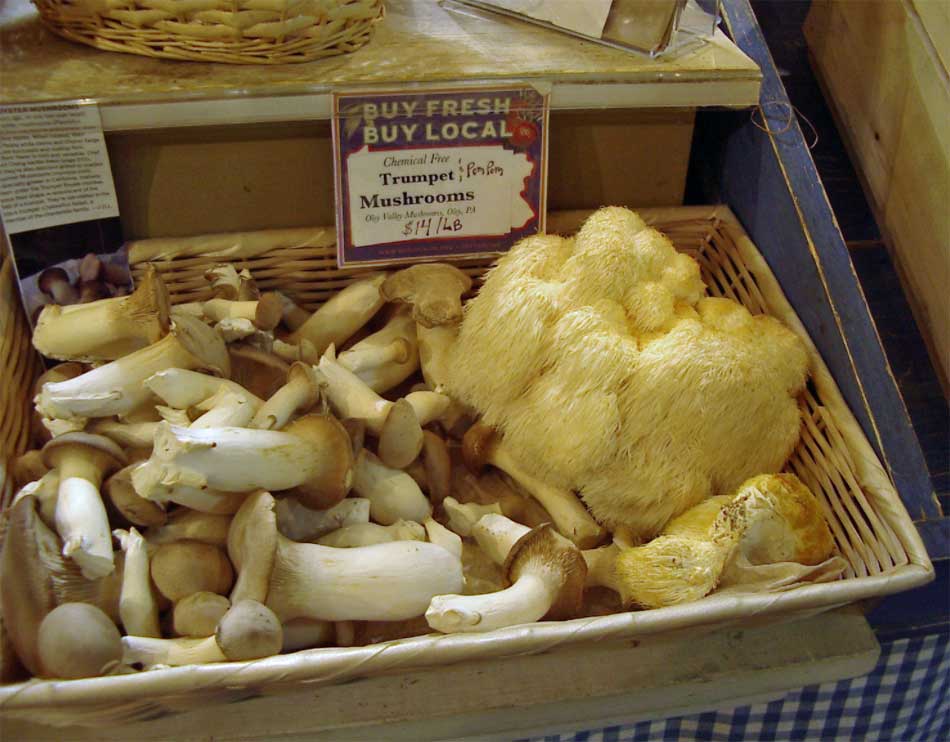 A mushroom I've only occasionally seen in stores made an appearance today at the Fair Food Farmstand. It's the "pom pom" pictured here from Oley Valley Mushroom Farm. Pom pom is just one of the names this fungus goes by. It's scientific name is Hericium erinaceus. Less marketable names (hence the use of "pom pom" in retail settings) this delicate fungus goes by include lion's mane, monkey's head, elf abalone, Bear's Head, Old Man's Beard, and Satyr's Beard. I've enjoyed this choice mushroom sliced and sauteed, and I wouldn't argue with those who think its taste suggests mild seafood, like lobster or scallop. It was available today for $14/pound.
Oley Valley Mushrooms was among the winners at this year's Pennsylvania Farm Show, as was the Livengood Family Farm, which sells at its own center court stand on Saturdays.
Joyce Livengood bested competitors in four vegetable sub-categories to win the Grand Champion Vegetable Market Basket, repeating her victory of last year. Her Grand Champion entry was in the subcategory for eight-piece displays of in- and out-of-season vegetables. She aslo took home second place for her entry in the sub-category for five-item, in-season, Pennsylvania grown vegetables.
Oley Valley earned first and second place in two different shitake categories, first and third place in two different oyster mushroom categories, and second place in the "other" mushroom category.
Fair Food Farmstand can't find room for the boxes used by farmers to deliver their goods (photo below), so they're stacked along the perimeter of the stall. Seems now that winter is here, the farmers haven't been around to pick up their wooden containers. Co-manager Sarah Cain says visitors to the Home Show have sought to purchase them. Just make her an offer and see if she'll bite.

Fair Food's space problems aren't limited to storing wooden boxes. They'd love more refrigerated storage space and additional selling space. Expansion into the adjacent seating area or a move within the market is within the realm of possibility (though by no means a certainty) by the peak of the 2008 season growing.
La Cuchina expects Electrolux to install the new kitchen appliances within the next two weeks, and will open its cooking class schedule shortly thereafter.
Thursday, January 17, 2008
Visit Eastern Europe . . . Without a Passport
I made another trip to Bell's Market in Northeast Philadelphia this morning and left wishing I had a lot more refrigerator and pantry space.
A main attraction for me is the wide expanse of deli cases filled with all manner of Eastern European salamis, sausages, pressed and rolled meats, hams, bacons, etc. The photos below (please excuse the fluorescent glare) provide some idea of the variety.
 Salami central. I left with half a pound of a sliced Ukrainian salami, a fat-studded, emulsified and medium smoky stick sliced at an extreme diagonal for a lengthy oval.
 Various pressed and rolled cold cuts are available, so I purchased a veal breast roll, which I have yet to taste.
 Yummmm, bacon! The lady behind the counter offered me a sample of the fully-cooked Hungarian bacon when I asked what it was compared to others; that was much simpler for her than trying to describe it in English. Very mildly smoked and seasoned, but pleasant. I bought a pound for $3.99. From a self-serve deli case I picked up a pack of Russian-style knockwurst made by a wurstgeschaeft I used to frequent, Gaiser's Pork Store of Union, N.J.
I restrained myself at the smoked fish counter, filled with fish you never heard of as well as whitefish, trout, mackerel, salmon, etc. This is the place for hard-core smoked and preserved fish lovers like me. I'll save major fish buying for my next visit, but I needed some herring so picked up a small jar of Canadian fillet tidbits marinated in dill sauce. There must have been eight or nine different brands/sizes of matjes herring.
The only other fish product I bought was small jar of taramasalata. Here, the jar that would set you back $6 or $7 at Whole Foods sells for $3.50.
Packaged grocery goods offer savings, too. The cocktail-size packages of Rubschlager rye and pumpernickel go for $1.79 and $1.89, vs. $2.50 at supermarkets and $3 at specialty stores like the Reading Terminal Market's Downtown Cheese.
An entire aisle of pickled vegetables and related condiment is a veritable preserved garden. I escaped with one of my more extravagant purchases, an $8.79 large glass jar filled with marinated bolete mushrooms (porcini, just from Latvia instead of Italy) and a jar of red pepper-eggplant spread.
She Who Must Be Obeyed spent most of her time in the chocolate and cookie aisle where a full complement of European staple sweets can be had. SWMBO walked away with a box of Fidelios (hazelnut-encrusted cylindrical cookies), a box of waffle cakes (napoleon-type cookies), industrial packaged croissants filled with apricot jam, and some German chocolates. I couldn't resist a 700 gram (1.5 pound) box of Turkish halvah with pistachios, priced at $6.59. Lots of different varieties of Turkish delights, too.
From the bakery (just around the corner from the salads and smoked fish) I purchased a slab of what appears to be a variety of Dobish torte, $5.95/pound. Across from there was a variety of packaged breads and breads from other bakeries, including a full range of Teixiera portuguese rolls. I found a round Turkish bread topped with white and black sesame seeds, still warm from the oven.
Among the items I want to try in the future are the various dumplings from the salad cases, especially the pelmeni (a Siberian style meat dumpling) and the cherry dumplings. Bell's Crossing also offers a wide variety of yogurts and other dairy products and beverages that you'll be hard-pressed to find anywhere else in town.
Since many of the ladies behind counters have only rudimentary English skills (though their English is far superior to my Russian), finding out what intriguing-looking items are can sometimes be a challenge. But even if you're mistaken and find out what you've taken home isn't quite what you thought it was, it's still going to be delicious. Since it wasn't too busy this morning the staff, which can occasionally be brusque, tried to help when they could.
I made another trip to Bell's Market in Northeast Philadelphia this morning and left wishing I had a lot more refrigerator and pantry space.
A main attraction for me is the wide expanse of deli cases filled with all manner of Eastern European salamis, sausages, pressed and rolled meats, hams, bacons, etc. The photos below (please excuse the fluorescent glare) provide some idea of the variety.
 Salami central. I left with half a pound of a sliced Ukrainian salami, a fat-studded, emulsified and medium smoky stick sliced at an extreme diagonal for a lengthy oval.
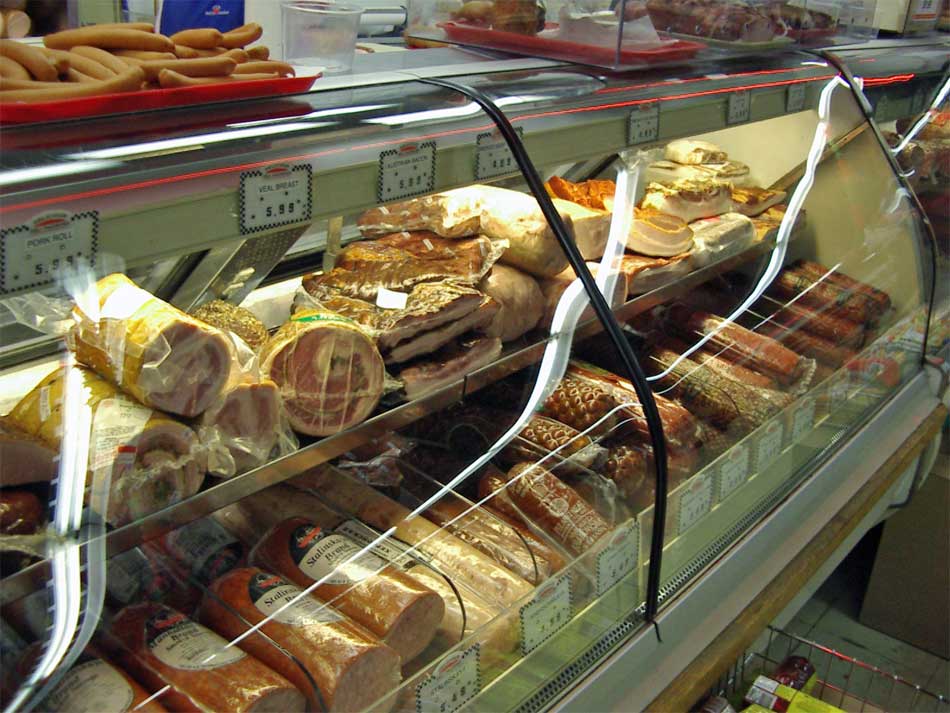 Various pressed and rolled cold cuts are available, so I purchased a veal breast roll, which I have yet to taste.
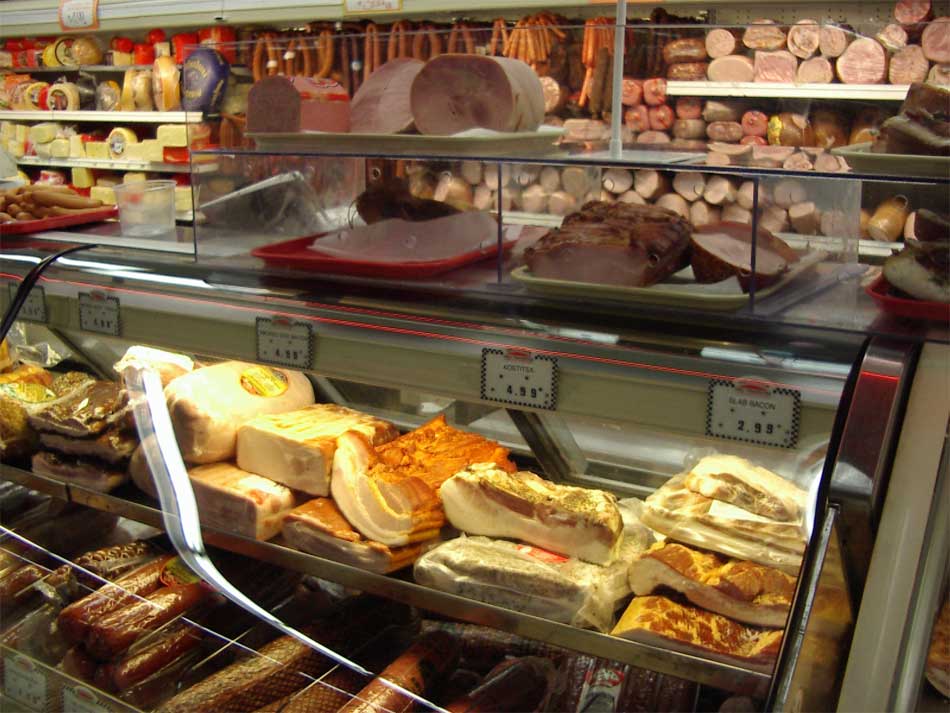 Yummmm, bacon! The lady behind the counter offered me a sample of the fully-cooked Hungarian bacon when I asked what it was compared to others; that was much simpler for her than trying to describe it in English. Very mildly smoked and seasoned, but pleasant. I bought a pound for $3.99. From a self-serve deli case I picked up a pack of Russian-style knockwurst made by a wurstgeschaeft I used to frequent, Gaiser's Pork Store of Union, N.J.
I restrained myself at the smoked fish counter, filled with fish you never heard of as well as whitefish, trout, mackerel, salmon, etc. This is the place for hard-core smoked and preserved fish lovers like me. I'll save major fish buying for my next visit, but I needed some herring so picked up a small jar of Canadian fillet tidbits marinated in dill sauce. There must have been eight or nine different brands/sizes of matjes herring.
The only other fish product I bought was small jar of taramasalata. Here, the jar that would set you back $6 or $7 at Whole Foods sells for $3.50.
Packaged grocery goods offer savings, too. The cocktail-size packages of Rubschlager rye and pumpernickel go for $1.79 and $1.89, vs. $2.50 at supermarkets and $3 at specialty stores like the Reading Terminal Market's Downtown Cheese.
An entire aisle of pickled vegetables and related condiment is a veritable preserved garden. I escaped with one of my more extravagant purchases, an $8.79 large glass jar filled with marinated bolete mushrooms (porcini, just from Latvia instead of Italy) and a jar of red pepper-eggplant spread.
She Who Must Be Obeyed spent most of her time in the chocolate and cookie aisle where a full complement of European staple sweets can be had. SWMBO walked away with a box of Fidelios (hazelnut-encrusted cylindrical cookies), a box of waffle cakes (napoleon-type cookies), industrial packaged croissants filled with apricot jam, and some German chocolates. I couldn't resist a 700 gram (1.5 pound) box of Turkish halvah with pistachios, priced at $6.59. Lots of different varieties of Turkish delights, too.
From the bakery (just around the corner from the salads and smoked fish) I purchased a slab of what appears to be a variety of Dobish torte, $5.95/pound. Across from there was a variety of packaged breads and breads from other bakeries, including a full range of Teixiera portuguese rolls. I found a round Turkish bread topped with white and black sesame seeds, still warm from the oven.
Among the items I want to try in the future are the various dumplings from the salad cases, especially the pelmeni (a Siberian style meat dumpling) and the cherry dumplings. Bell's Crossing also offers a wide variety of yogurts and other dairy products and beverages that you'll be hard-pressed to find anywhere else in town.
Since many of the ladies behind counters have only rudimentary English skills (though their English is far superior to my Russian), finding out what intriguing-looking items are can sometimes be a challenge. But even if you're mistaken and find out what you've taken home isn't quite what you thought it was, it's still going to be delicious. Since it wasn't too busy this morning the staff, which can occasionally be brusque, tried to help when they could.
Wednesday, January 16, 2008
No Meatballs No More
I've been neglectful in posting notes and news of the RTM lately, so it's catch-up time.
DiNic's has given up on Meatball Sundays. Too much work for too little profit, according to Joe.
Michael Pollan, in town last week to promote his new book with a talk in the Free Library author series, visited the Reading Terminal Market in the tow of the Inky's Rick Nichols. Sarah Cain, co-manager of the Fair Food Farmstand, reports in her weekly newsletter that Pollan visited the stand "goofing around with [our] Hubbard squash".
Contessa's French Linens, which set up in the temporary "Christmas Market" area, has decided to make a permanent go at it. Right now they are located in the former Amy's Place stall. If RTM Manager Paul Steinke gets a new vendor to take over that space and the adjacent former Le Bus stall (he says he's got a likely prospect, but no deal yet), Contessa's would move to another spot.
Under its new ownership, Dutch Country Meats continues to de-emphasize fresh pork products in favor of smoked, cured and prepared offerings. The selection of German-style provisions from Rieker's has expanded nicely and even includes their Snapper Soup, a decidedly Philadelphia, rather than German, dish. Fresh pork products represent no more than one-quarter of their case space, perhaps less. The only fresh pig they were selling last Saturday were center cut chops, baby back ribs, tenderloin, city dressed pork belly, and feet. Didn't see any shoulders or butt portions in the display cases, nor any variety in the types of chops.
Electrolux, the Swedish appliance manufacturer (famous for their vacuum cleaners!) is making a push to sell their consumer ovens, cook-tops, refrigerators and dishwashers in the U.S. That's why they will be re-equipping the market' s kitchen. The kitchen will serve as both a demonstration area and as a cooking school. The school will open soon as La Cuchina and will be operated as a separate business by an instructor from Temple; as of last Saturday it looked like that had a little work to do before they could open for classes.
My cooking extravaganza during the holidays was duck-induced. I started out with two Peking ducks from Giunta's Prime Shop, which set me back about $35 (about $3.50/pound).
The ducks came from the Joe Jurgielewicz & Son Farm in Berks County. The Jurgielewicz family started out raising ducks in the 1930s on Long Island, and one branch of the family continues to operate a major duck farm there. Another of the founder's grandsons, veterinarian Joe Jurgielewicz, established the Pennsylvania operation where the company breeds, hatches, raises and processes their own ducks on the farm, rather than contracting with other farmers to supply them with harvestable birds.
From these two plump birds I butchered out the breasts and the legs, with the breasts going into the freezer for future use and the legs and wings reserved for confit/rillettes. The fat from the two birds rendered into enough for the confit which now sits in the fridge as rillettes. The carcass was roasted, then turned into stock with a small onion and celery stalk. I used the livers, hearts and gizzards, along with pickings from the carcass, to create a variation of Jerusalem Grill for a couple of lunches. Jerusalem Grill is fatty lamb trimmings and chicken innards griddled with onions, garlic and various seasonings (cumin, coriander, black and red pepper, allspice, etc.), then served on or with a pita, perhaps with a smear of hummus. I didn't have lamb trimmings, so I just used the duck innards and trimmings. Delish.
I've been neglectful in posting notes and news of the RTM lately, so it's catch-up time.
DiNic's has given up on Meatball Sundays. Too much work for too little profit, according to Joe.
Michael Pollan, in town last week to promote his new book with a talk in the Free Library author series, visited the Reading Terminal Market in the tow of the Inky's Rick Nichols. Sarah Cain, co-manager of the Fair Food Farmstand, reports in her weekly newsletter that Pollan visited the stand "goofing around with [our] Hubbard squash".
Contessa's French Linens, which set up in the temporary "Christmas Market" area, has decided to make a permanent go at it. Right now they are located in the former Amy's Place stall. If RTM Manager Paul Steinke gets a new vendor to take over that space and the adjacent former Le Bus stall (he says he's got a likely prospect, but no deal yet), Contessa's would move to another spot.
Under its new ownership, Dutch Country Meats continues to de-emphasize fresh pork products in favor of smoked, cured and prepared offerings. The selection of German-style provisions from Rieker's has expanded nicely and even includes their Snapper Soup, a decidedly Philadelphia, rather than German, dish. Fresh pork products represent no more than one-quarter of their case space, perhaps less. The only fresh pig they were selling last Saturday were center cut chops, baby back ribs, tenderloin, city dressed pork belly, and feet. Didn't see any shoulders or butt portions in the display cases, nor any variety in the types of chops.
Electrolux, the Swedish appliance manufacturer (famous for their vacuum cleaners!) is making a push to sell their consumer ovens, cook-tops, refrigerators and dishwashers in the U.S. That's why they will be re-equipping the market' s kitchen. The kitchen will serve as both a demonstration area and as a cooking school. The school will open soon as La Cuchina and will be operated as a separate business by an instructor from Temple; as of last Saturday it looked like that had a little work to do before they could open for classes.
My cooking extravaganza during the holidays was duck-induced. I started out with two Peking ducks from Giunta's Prime Shop, which set me back about $35 (about $3.50/pound).
The ducks came from the Joe Jurgielewicz & Son Farm in Berks County. The Jurgielewicz family started out raising ducks in the 1930s on Long Island, and one branch of the family continues to operate a major duck farm there. Another of the founder's grandsons, veterinarian Joe Jurgielewicz, established the Pennsylvania operation where the company breeds, hatches, raises and processes their own ducks on the farm, rather than contracting with other farmers to supply them with harvestable birds.
From these two plump birds I butchered out the breasts and the legs, with the breasts going into the freezer for future use and the legs and wings reserved for confit/rillettes. The fat from the two birds rendered into enough for the confit which now sits in the fridge as rillettes. The carcass was roasted, then turned into stock with a small onion and celery stalk. I used the livers, hearts and gizzards, along with pickings from the carcass, to create a variation of Jerusalem Grill for a couple of lunches. Jerusalem Grill is fatty lamb trimmings and chicken innards griddled with onions, garlic and various seasonings (cumin, coriander, black and red pepper, allspice, etc.), then served on or with a pita, perhaps with a smear of hummus. I didn't have lamb trimmings, so I just used the duck innards and trimmings. Delish.
Tuesday, December 18, 2007
Night of the Seven Fishes
The goods are in for the Night of the Seven Fishes at the Reading Terminal Market. Both Golden and John Yi featured fresh sardines (herring) at $3 and $3.99/pound, respectively, though at least by today's display, Golden's were superior creatures. Yi also had spearling at $4.99, Golden some rather large langoustines, a.k.a. Dublin prawns. All the other usual suspects, too, including bacalao.
I've been having a blast enjoying fresh oysters now that I've purchased an oyster knife and learned to use it (very carefully). The oysters available at the RTM fishmongers are all from Virginia and the Chesapeake, the usually price being 50-cents apiece; I've only seen oysters from Maine, Massachusetts and Canadian Maritime waters at Wegman's in Cherry Hill, where they are nearly twice that price, but worth it. (When I asked one RTM vendor which oyster he had, he said they were Blue Points . . . from Virginia. Which, of course, is an impossibility. Since the HAACP tag said Virginia, they weren't Blue Points, which only come from Long Island.)
If you need a fruitcake, either as a gift or a weapon, Iovine Brothers Produce has Claxton cakes in the reefer case by the checkout closest to Filbert Street. Only the regular version, not the dark (which I prefer). Priced at $3.99 per one-pound brick. These fruitcakes are more fruit and nut than cake by a wide margin.
Although Iovine had Hass avocados available at a buck apiece, they were either far from ready or over-the-hill. Instead, I picked up one of the Florida/Carribean fruits, which tend to be considerably larger. I'm not sure they'd make as good a guacamole, because they tend to be less rich/buttery, but they are excellent in salads. I used some tonight in a tortilla wrap with chicken, Mexican white cheese, cilantro, lettuce and salsa.
Ducks and geese: Nice selections at a number of butchers. Godshall's has both (including Eberly's geese), L. Halteman has Muscovy ducks, Giunta's Prime Shop Long Island (Peking) ducks and can order the Eberly's geese. If the dark meat birds don't interest you, yet you want a big bird but not turkey, consider a capon from Godshalls or Giunta's. The latter carries surgically caponized birds from Eberly; I don't know whether Godshall's are surgically or chemically caponized. In either case, capons are larger chickens (ex-roosters, actually) that tend to run about 8-12 pounds and have a preponderence of breast meat, which stays moister than the usual chicken's.
The goods are in for the Night of the Seven Fishes at the Reading Terminal Market. Both Golden and John Yi featured fresh sardines (herring) at $3 and $3.99/pound, respectively, though at least by today's display, Golden's were superior creatures. Yi also had spearling at $4.99, Golden some rather large langoustines, a.k.a. Dublin prawns. All the other usual suspects, too, including bacalao.
I've been having a blast enjoying fresh oysters now that I've purchased an oyster knife and learned to use it (very carefully). The oysters available at the RTM fishmongers are all from Virginia and the Chesapeake, the usually price being 50-cents apiece; I've only seen oysters from Maine, Massachusetts and Canadian Maritime waters at Wegman's in Cherry Hill, where they are nearly twice that price, but worth it. (When I asked one RTM vendor which oyster he had, he said they were Blue Points . . . from Virginia. Which, of course, is an impossibility. Since the HAACP tag said Virginia, they weren't Blue Points, which only come from Long Island.)
If you need a fruitcake, either as a gift or a weapon, Iovine Brothers Produce has Claxton cakes in the reefer case by the checkout closest to Filbert Street. Only the regular version, not the dark (which I prefer). Priced at $3.99 per one-pound brick. These fruitcakes are more fruit and nut than cake by a wide margin.
Although Iovine had Hass avocados available at a buck apiece, they were either far from ready or over-the-hill. Instead, I picked up one of the Florida/Carribean fruits, which tend to be considerably larger. I'm not sure they'd make as good a guacamole, because they tend to be less rich/buttery, but they are excellent in salads. I used some tonight in a tortilla wrap with chicken, Mexican white cheese, cilantro, lettuce and salsa.
Ducks and geese: Nice selections at a number of butchers. Godshall's has both (including Eberly's geese), L. Halteman has Muscovy ducks, Giunta's Prime Shop Long Island (Peking) ducks and can order the Eberly's geese. If the dark meat birds don't interest you, yet you want a big bird but not turkey, consider a capon from Godshalls or Giunta's. The latter carries surgically caponized birds from Eberly; I don't know whether Godshall's are surgically or chemically caponized. In either case, capons are larger chickens (ex-roosters, actually) that tend to run about 8-12 pounds and have a preponderence of breast meat, which stays moister than the usual chicken's.
Saturday, December 15, 2007
We made our annual trip to The Great Northeast yesterday in search of holiday baked goods and a few other delectables. For those who do not reside in Philadelphia, The Great Northeast is a wide swath of the furthest reaches of the city, halfway to Trenton, where a great many of its residents reside. The Great Northeast is to Philadelphia what Queens is to New York City, and the size and design of the homes isn't much different from a Forest Hills rowhouse.
Click on "View Larger Map" for a key to the push pin symbols, which reflect both the vendors we visited and others we have tried in the past or are on our list for a future trip.
View Larger Map
Our first stop was to try and find Moish's Addision Bakery from a previous trip a few years back. Alas, it appears to be of of business, even though there's a web site. We journeyed all the way up to Red Lion Road in search of this classic kosher bakery, which to our taste did onion rolls and salt sticks as well as it did babka and rugelach.
Disappointed, we headed south and detoured off Bustleton Avenue to the Krewstown Shopping Centger and Steve Stein's Famous Deli. It was late on a busy Friday morning and you had to take a number for servide, but that only gave us about five minutes to peruse the plethora of smoked fishes and salads in the cases. We walked out the door with whitefish salad, lox, red potato salad, hummus with pine nuts (pre-packaged), and a Bartlett pear from the produce aisle. The whitefish salad was quite good, but a bit too smooth and low in fish flavor to my taste, though I think many would be find these characteristics to their liking; I just prefer mine fish salads fishy. The very good price of $3.99/pound probably accounts for the high proportion of mayo to fish. I am saving the lox I purchased until Sunday morning, but it looks like it was carved expertly. I selected regular (salty) lox, and both regular and nova are available in either belly or regular cuts; the belly cut is fattier and prices, $9.99/half pound, vs. $7.99 for regular cut.
Back on Bustleton and heading south, we passed Bell's Market, saving this palace of all tasty things Eastern European for another trip, and switched over to Castor Avenue. We made two quick stops at Lipkin's and Hesh's Eclair Bakery, finding nothing compelling (other than challahs, which we wern't in the market for today) at Lipkin's, and limiting ourselves to some stick raspberry sticks and onion board (a flatbread which I used to hold the whitefish salad when I got home)at Hesh's. At Weiss, Bakery which I think is the best of the Kosher bakeries along this stretch of the Northeast, we picked up seven layer cake (a variant on Doboshtort) and some assorted cookies.
Our last stop was in the Northeast's Tacony section, at a German old-style, neighborhood bakery, Haegele's. You can find photos and notes from last year's visit here. This year we walked off with assorted Christmas cookies, anise springerle, and a brownie for She Who Must Be Obeyed. I had to restrain myself from also purchasing one of their evil buttercakes.
Click on "View Larger Map" for a key to the push pin symbols, which reflect both the vendors we visited and others we have tried in the past or are on our list for a future trip.
View Larger Map
Our first stop was to try and find Moish's Addision Bakery from a previous trip a few years back. Alas, it appears to be of of business, even though there's a web site. We journeyed all the way up to Red Lion Road in search of this classic kosher bakery, which to our taste did onion rolls and salt sticks as well as it did babka and rugelach.
Disappointed, we headed south and detoured off Bustleton Avenue to the Krewstown Shopping Centger and Steve Stein's Famous Deli. It was late on a busy Friday morning and you had to take a number for servide, but that only gave us about five minutes to peruse the plethora of smoked fishes and salads in the cases. We walked out the door with whitefish salad, lox, red potato salad, hummus with pine nuts (pre-packaged), and a Bartlett pear from the produce aisle. The whitefish salad was quite good, but a bit too smooth and low in fish flavor to my taste, though I think many would be find these characteristics to their liking; I just prefer mine fish salads fishy. The very good price of $3.99/pound probably accounts for the high proportion of mayo to fish. I am saving the lox I purchased until Sunday morning, but it looks like it was carved expertly. I selected regular (salty) lox, and both regular and nova are available in either belly or regular cuts; the belly cut is fattier and prices, $9.99/half pound, vs. $7.99 for regular cut.
Back on Bustleton and heading south, we passed Bell's Market, saving this palace of all tasty things Eastern European for another trip, and switched over to Castor Avenue. We made two quick stops at Lipkin's and Hesh's Eclair Bakery, finding nothing compelling (other than challahs, which we wern't in the market for today) at Lipkin's, and limiting ourselves to some stick raspberry sticks and onion board (a flatbread which I used to hold the whitefish salad when I got home)at Hesh's. At Weiss, Bakery which I think is the best of the Kosher bakeries along this stretch of the Northeast, we picked up seven layer cake (a variant on Doboshtort) and some assorted cookies.
Our last stop was in the Northeast's Tacony section, at a German old-style, neighborhood bakery, Haegele's. You can find photos and notes from last year's visit here. This year we walked off with assorted Christmas cookies, anise springerle, and a brownie for She Who Must Be Obeyed. I had to restrain myself from also purchasing one of their evil buttercakes.
Sunday, December 09, 2007
Headhouse season nears close
Today's Headhouse Square Market doubled the number of vendors from last week, when only seven braved the snow to trek into the depths of Philadelphia. Showing up this week were:
Noel Margerum was selling fall veggies as well as preserves, relishes and dried herbs. Noel and her sister Carole rotate among the city's farm markets, including Clark Park and Fairmount.
Although the market continues for the next two Sundays, this week was probably the last of the season for Three Springs Fruit Farm (the Wenk family). Their orchard fruit is also available at the Fair Food Farmstand. Today I bought a couple of huge Rome apples which I plan to simply bake with some brown sugar or honey.
Old Earth Farm is out of stock of meat, at least for a month or so until their piglets reach market size. Since Headhouse will be closed then, you can call the farm or get on its mail list to be notified when their Tamworth porkers are is available: www.oldearthfarm.com or 610 779-9035.
If you've become hooked on those pot pies from Griggstown, fear not when Headhouse Square closes for the season. Like the output of many other vendors, these, too, are available at Fair Food Farmstand.
What I won't be able to find elsewhere once the market closes for the season are the wonderful baguettes and croisssants from Versailles Baking. The Pennsauken boulanger only sells retail at the Headhouse and Haddonfield markets. Otherwise all their customers are wholesale accounts.
Today's Headhouse Square Market doubled the number of vendors from last week, when only seven braved the snow to trek into the depths of Philadelphia. Showing up this week were:
- A.T. Buzby, produce
- Birchrun Hills Farm, cheese
- Betty's Tasty Buttons, fudge
- Demarah, soaps
- Griggstown Quail Farm & Market
- Hillacres Cheese
- Queens Farm, produce
- Margerum's Herbs
- Mountain View Poultry
- Old Earth Farm, produce
- Stargazer Vineyard
- Three Springs Fruit Farm
- Versaille Baking
- Woodland Produce
Noel Margerum was selling fall veggies as well as preserves, relishes and dried herbs. Noel and her sister Carole rotate among the city's farm markets, including Clark Park and Fairmount.
Although the market continues for the next two Sundays, this week was probably the last of the season for Three Springs Fruit Farm (the Wenk family). Their orchard fruit is also available at the Fair Food Farmstand. Today I bought a couple of huge Rome apples which I plan to simply bake with some brown sugar or honey.
Old Earth Farm is out of stock of meat, at least for a month or so until their piglets reach market size. Since Headhouse will be closed then, you can call the farm or get on its mail list to be notified when their Tamworth porkers are is available: www.oldearthfarm.com or 610 779-9035.
If you've become hooked on those pot pies from Griggstown, fear not when Headhouse Square closes for the season. Like the output of many other vendors, these, too, are available at Fair Food Farmstand.
What I won't be able to find elsewhere once the market closes for the season are the wonderful baguettes and croisssants from Versailles Baking. The Pennsauken boulanger only sells retail at the Headhouse and Haddonfield markets. Otherwise all their customers are wholesale accounts.
Saturday, December 08, 2007
Orange you glad it's citrus season?
Good citrus fruit is back in force. Jim Iovine of Iovine Brothers Produce said the grapefruit he was selling at three for a dollar (medium sized) was the best of the bunch, though he said the other citrus fruit have finally reached high-season flavor, too. I picked up some four-for-a-buck navel oranges, but the sample tangerine sections also tasted good. Limes continue at 10/$1, though lemons are 3/$1.
Over at the Fair Food Farmstand I couldn't resist trying a watermelon radish. Not at all peppery, even slightly sweet and carrot-like. Made an intersting contrast on the plate. Earl Livengood's curly endive ($2.50/head) made a great salad to go along with that radish.
The first of the holiday seasonal fish has started to appear. Both Golden and Wan are selling fresh whole sardines (herring) for $3.99 and $3.49/pound, respectively. Last year they sold for $1.99-$2.99. Maybe the price will come down after New Year's. Expect to see greater variety as we get closer to Christmas. What I'd love to see would be the Maine shrimp johnnyd touts on eGullet; I'll have to check Whole Foods which sometimes gets them.
DiNic's began extended hours to 6 p.m. this past week, so if you're craving a roast pork sandwich after work or for a late afternoon snack, you can satisfy your hunger.
Good citrus fruit is back in force. Jim Iovine of Iovine Brothers Produce said the grapefruit he was selling at three for a dollar (medium sized) was the best of the bunch, though he said the other citrus fruit have finally reached high-season flavor, too. I picked up some four-for-a-buck navel oranges, but the sample tangerine sections also tasted good. Limes continue at 10/$1, though lemons are 3/$1.
Over at the Fair Food Farmstand I couldn't resist trying a watermelon radish. Not at all peppery, even slightly sweet and carrot-like. Made an intersting contrast on the plate. Earl Livengood's curly endive ($2.50/head) made a great salad to go along with that radish.
The first of the holiday seasonal fish has started to appear. Both Golden and Wan are selling fresh whole sardines (herring) for $3.99 and $3.49/pound, respectively. Last year they sold for $1.99-$2.99. Maybe the price will come down after New Year's. Expect to see greater variety as we get closer to Christmas. What I'd love to see would be the Maine shrimp johnnyd touts on eGullet; I'll have to check Whole Foods which sometimes gets them.
DiNic's began extended hours to 6 p.m. this past week, so if you're craving a roast pork sandwich after work or for a late afternoon snack, you can satisfy your hunger.
Wednesday, December 05, 2007
Fair Food Farmstand news
Two items about the Fair Food Farmstand at the Reading Terminal Market to pass along:
Country Time pork will be delivered tomorrow (Thursday, Dec. 6) for the first time in more than a month, when the owners, the Crivellaros, were involved in a traffic accident.
This week's farmstand e-mail newsletter includes fascinating information from manager Sarah Cain about integrated pest management. I learned an awful lot about the subject from it. I couldn't find a link to a web archive of the article, so below are the relevant portions.
Fair Food Farmstand newsletter, Dec. 4-9
At the Farmstand, we have always used the term 'Low Spray' in our signage as a way of signifying that a farm is using sustainable, but not organic, growing practices. However, the correct term for the growing method these farms use is IPM, or Integrated Pest Management, and we are now going to be using this term in our signage instead of 'Low Spray.'
IPM was developed in the late 1950's as a response to a boll weevil outbreak in the southern United States. It was found that by interrupting the life cycles of pests and diseases, farmers could control breeding and proliferation and dramatically reduce crop damage. The IPM program is multi-faceted, and the last resort is the spraying of any chemicals. The four main controls are Mechanical, Biological, Cultural and Chemical. Mechanical controls include the continual scouting for pests and damage, trapping with simple glue traps, hand picking, providing barriers of mesh or agricultural fabric to protect the crop, and pheromone lures to disrupt pest mating patterns. Besides scouting on the individual farm, there's some pretty hi-tech help out there. The Penn State Entomology Department even has a real-time radar system that tracks the migration across the state of different pests, called Insect Prediction Maps, it's fascinating. Biological controls involve the use of beneficial insects (think the hard working Lady Bug, who is a ferocious eater, see above), the natural predators, who help to keep the pest insect population down. Actually, "of the [more than] 7 million species of insects in the world, only 350 are considered pests," says the Pennsylvania Integrated Pest Management Program Program. The Cultural control involves giving your plant or crop the inputs it needs to thrive -improved soil, correct amounts of water and light, etc. The best defense against pests is a plant with a healthy immune system, so to speak.
The spraying of chemicals is mandated to be the last control, and all non-toxic methods have to have been exhausted before the use of any herbicide or pesticide. Once chemicals are introduced, they have to be done so in stages, starting with the least toxic option, and then gaining in strength. Though there is currently no certification that growers are required to have as IPM practitioners, they do keep their own records. At the bottom of this email you can read a quick interview I did with Ben Wenk, of Three Springs Fruit Farm, about his experiences with IPM.
IPM is not just practiced in agricultural production either, but also in decorative landscaping, on municipal lands and by home gardeners. It gives the grower many tools that are environmentally sensitive, but does not tie them to strictly organic methods should a grower feel he is in danger of loosing his crop to infestation or disease. We're proud to offer many products that are sustainably raised using IPM methods, and hope that you appreciate our new, more accurate labeling.
Sarah Cain interviews farmer Ben Wenk about IPM
Sarah: Could you give me a few quotes about some of the methods you use within the program?
Ben: Gladly. We strive to be able to look our customers in the eye and confidently and truthfully tell them that we grow everything in a responsible and sustainable way. And what this means specifically is practices like extensive monitoring of disease and insects (one of my jobs on the farm). We sync my findings with models of the lifecycles of the pests that affect our crops so that our sprays are as few as possible and as effective as possible (we can wait till populations are most vulnerable).
In regards to what we spray, our first choice would be a product that uses more environmentally friendly or "soft" modes of action. A mode of action is the chemistry term for what is eliminating the pest. Older products (and usually cheaper products) are simply neurotoxins and will affect all of the members of the agroecosystem. When such a product is available, we'll use a product that will affect the morphology or fecundity of a specific organism that's a pest of our crop. In other words, if we detect a large population of Tufted Apple Budmoth, we have a product that will keep its mouthparts from forming – problem solved, they can't eat our apples, they're eliminated while all the other members of the ecosystem thrive (including the ones who are natural enemies of the moth and who will tolerate the application and be abundant when the moth population rebounds – biological control!)
We also work hand in hand with research in innovative and sustainable research being done at Penn State, working as a cooperating grower in a few of their experiments. One project is devoted to studying the area-wide effects of what's called "mating disruption". This pest control disperses naturally-occurring insect sex pheromones all over the orchards, causing the male moths to be very "confused" and unable to mate. No mating = no moths. No spraying = win, win. After all, spraying is costly and time-consuming, and if it were all the same to us, we wouldn't do it. However, the eastern U.S. climate all but requires that we must spray (rain = rot).
Sarah: Who do you show your records to?
Ben: All of our processing fruit buyers receive our spray records and our larger, local wholesale accounts do as well. We stand behind what spraying we do (see above).
Sarah: What are some of the challenges your orchard has faced over the last few years?
Ben: We've been fortunate to have had a consistent pool of labor so far, but that's certainly the biggest challenge that awaits not only us, but everyone in American agriculture.
Our fields were quarantined as part of the state and federal program to quarantine the Plum Pox virus (PPV). Plum pox is a virus that causes a fruit finish problem in some stone fruits (peaches, plums, nectarines, etc.) but poses no threat to human health. I actually had a job testing imported Chilean stone fruits for PPV as an undergrad, so I'm particularly familiar with it. It's a very significant pest in Europe and there is no treatment. PPV was found in a neighbor's orchard and this prevented us from planting new peach trees for a number of years (when we really wanted to be planting peach trees). That's just one example – this job is a new challenge every day.
Two items about the Fair Food Farmstand at the Reading Terminal Market to pass along:
Country Time pork will be delivered tomorrow (Thursday, Dec. 6) for the first time in more than a month, when the owners, the Crivellaros, were involved in a traffic accident.
This week's farmstand e-mail newsletter includes fascinating information from manager Sarah Cain about integrated pest management. I learned an awful lot about the subject from it. I couldn't find a link to a web archive of the article, so below are the relevant portions.
* * *
Fair Food Farmstand newsletter, Dec. 4-9
At the Farmstand, we have always used the term 'Low Spray' in our signage as a way of signifying that a farm is using sustainable, but not organic, growing practices. However, the correct term for the growing method these farms use is IPM, or Integrated Pest Management, and we are now going to be using this term in our signage instead of 'Low Spray.'
IPM was developed in the late 1950's as a response to a boll weevil outbreak in the southern United States. It was found that by interrupting the life cycles of pests and diseases, farmers could control breeding and proliferation and dramatically reduce crop damage. The IPM program is multi-faceted, and the last resort is the spraying of any chemicals. The four main controls are Mechanical, Biological, Cultural and Chemical. Mechanical controls include the continual scouting for pests and damage, trapping with simple glue traps, hand picking, providing barriers of mesh or agricultural fabric to protect the crop, and pheromone lures to disrupt pest mating patterns. Besides scouting on the individual farm, there's some pretty hi-tech help out there. The Penn State Entomology Department even has a real-time radar system that tracks the migration across the state of different pests, called Insect Prediction Maps, it's fascinating. Biological controls involve the use of beneficial insects (think the hard working Lady Bug, who is a ferocious eater, see above), the natural predators, who help to keep the pest insect population down. Actually, "of the [more than] 7 million species of insects in the world, only 350 are considered pests," says the Pennsylvania Integrated Pest Management Program Program. The Cultural control involves giving your plant or crop the inputs it needs to thrive -improved soil, correct amounts of water and light, etc. The best defense against pests is a plant with a healthy immune system, so to speak.
The spraying of chemicals is mandated to be the last control, and all non-toxic methods have to have been exhausted before the use of any herbicide or pesticide. Once chemicals are introduced, they have to be done so in stages, starting with the least toxic option, and then gaining in strength. Though there is currently no certification that growers are required to have as IPM practitioners, they do keep their own records. At the bottom of this email you can read a quick interview I did with Ben Wenk, of Three Springs Fruit Farm, about his experiences with IPM.
IPM is not just practiced in agricultural production either, but also in decorative landscaping, on municipal lands and by home gardeners. It gives the grower many tools that are environmentally sensitive, but does not tie them to strictly organic methods should a grower feel he is in danger of loosing his crop to infestation or disease. We're proud to offer many products that are sustainably raised using IPM methods, and hope that you appreciate our new, more accurate labeling.
Sarah Cain interviews farmer Ben Wenk about IPM
Sarah: Could you give me a few quotes about some of the methods you use within the program?
Ben: Gladly. We strive to be able to look our customers in the eye and confidently and truthfully tell them that we grow everything in a responsible and sustainable way. And what this means specifically is practices like extensive monitoring of disease and insects (one of my jobs on the farm). We sync my findings with models of the lifecycles of the pests that affect our crops so that our sprays are as few as possible and as effective as possible (we can wait till populations are most vulnerable).
In regards to what we spray, our first choice would be a product that uses more environmentally friendly or "soft" modes of action. A mode of action is the chemistry term for what is eliminating the pest. Older products (and usually cheaper products) are simply neurotoxins and will affect all of the members of the agroecosystem. When such a product is available, we'll use a product that will affect the morphology or fecundity of a specific organism that's a pest of our crop. In other words, if we detect a large population of Tufted Apple Budmoth, we have a product that will keep its mouthparts from forming – problem solved, they can't eat our apples, they're eliminated while all the other members of the ecosystem thrive (including the ones who are natural enemies of the moth and who will tolerate the application and be abundant when the moth population rebounds – biological control!)
We also work hand in hand with research in innovative and sustainable research being done at Penn State, working as a cooperating grower in a few of their experiments. One project is devoted to studying the area-wide effects of what's called "mating disruption". This pest control disperses naturally-occurring insect sex pheromones all over the orchards, causing the male moths to be very "confused" and unable to mate. No mating = no moths. No spraying = win, win. After all, spraying is costly and time-consuming, and if it were all the same to us, we wouldn't do it. However, the eastern U.S. climate all but requires that we must spray (rain = rot).
Sarah: Who do you show your records to?
Ben: All of our processing fruit buyers receive our spray records and our larger, local wholesale accounts do as well. We stand behind what spraying we do (see above).
Sarah: What are some of the challenges your orchard has faced over the last few years?
Ben: We've been fortunate to have had a consistent pool of labor so far, but that's certainly the biggest challenge that awaits not only us, but everyone in American agriculture.
Our fields were quarantined as part of the state and federal program to quarantine the Plum Pox virus (PPV). Plum pox is a virus that causes a fruit finish problem in some stone fruits (peaches, plums, nectarines, etc.) but poses no threat to human health. I actually had a job testing imported Chilean stone fruits for PPV as an undergrad, so I'm particularly familiar with it. It's a very significant pest in Europe and there is no treatment. PPV was found in a neighbor's orchard and this prevented us from planting new peach trees for a number of years (when we really wanted to be planting peach trees). That's just one example – this job is a new challenge every day.
Sunday, December 02, 2007
Seven vendors brave weather
Only seven vendors braved the weather today at Head House Square: one baker, three produce sellers, a coffee seller, a confectioner and one other I can't recall. I was glad to see the baker, Versailles; they make the most authentic baguettes around, and their pastries ain't chopped liver, either. Market Manager Nicky Uy expects a more complete roster next Sunday and other Sundays through Dec. 23.
RTM's Paul Steinke believes the addition of the model train display in the terminal's headhouse, organized by the RTM, boosts overall traffic at the market itself.
Bill Kingsley, who was a leader in efforts to preserve the market in the 1980s when its existence was threatened by the then-proposed convention center died last week. Steinke said he was a regular visitor at the market until he took ill. Kingsley was 73.
To my mind, the building of the convention center has been a mixed blessing for the RTM. The push to build the center directly led to the availability of funds to rehabilitate the market (before the rebuilding water leaked from the trainshed above and puddled all over the market floor, among other significant structural problems), and the presence of conventineers has provided a good source of revenue for many of the merchants; at the same time, this has created pressure for more lunch stands and trinket-sellers rather than the market's traditional vendor base of butchers, bakers, fish mongers, cheese mongers and produce sellers and other fresh food purveyors. The convention center's impact on Center City, including the Reading Terminal Market, will be explored by reporter Tom Belden in an Inquirer article in the near future.
RTM Briefs
It's not exactly margarita weather, but this was the week to buy limes at Iovine Brothers Produce: 10 for a buck. Recently they've been three for a buck . . . . I'm still waiting for the expanded variety of seafood to start showing up for the holiday among the fish mongers . . . . Stephen Starr stopped by Hershel's and proclaimed the corned beef sandwich the best he's ever had. He instructed five of his chefs to stop there to learn how to make a proper sandwich. (If they add it to the menu at Jones, it might hurt Kibbitz across the street.) . . . . Hershel's expects to start carrying Gus's pickles and kraut this week or next . . . . Amy's is open at the new location, and nearly half a dozen stalls have replaced it and other relocated vendor to form a holiday market selling gift item through the holidays. They include The Clay Place (pottery), Desert Designs (Egyptian imports), Contessa's French Linens, Jootz (glass giftware and pet beds), Nimba Traders (decor items from Indonesia and Thailand), and Siberia Creations (birch bark boxes, etc.) . . . . Charles Giunta of Giunta's Prime Shop is complaining that he's having difficulty selling veal because not enough people are willing to pay the price he needs to carry it . . . . DiNic's probably will extend its hours to 6 p.m. weekdays this week . . . . Hendricks Farm and Griggstown Quail Farm didn't make it to Headhouse Square this week, but you can find their cheese and pot pies, respectively, at the Fair Food Farmstand, which is open every day but Monday at the RTM . . . .
Only seven vendors braved the weather today at Head House Square: one baker, three produce sellers, a coffee seller, a confectioner and one other I can't recall. I was glad to see the baker, Versailles; they make the most authentic baguettes around, and their pastries ain't chopped liver, either. Market Manager Nicky Uy expects a more complete roster next Sunday and other Sundays through Dec. 23.
RTM's Paul Steinke believes the addition of the model train display in the terminal's headhouse, organized by the RTM, boosts overall traffic at the market itself.
Bill Kingsley, who was a leader in efforts to preserve the market in the 1980s when its existence was threatened by the then-proposed convention center died last week. Steinke said he was a regular visitor at the market until he took ill. Kingsley was 73.
To my mind, the building of the convention center has been a mixed blessing for the RTM. The push to build the center directly led to the availability of funds to rehabilitate the market (before the rebuilding water leaked from the trainshed above and puddled all over the market floor, among other significant structural problems), and the presence of conventineers has provided a good source of revenue for many of the merchants; at the same time, this has created pressure for more lunch stands and trinket-sellers rather than the market's traditional vendor base of butchers, bakers, fish mongers, cheese mongers and produce sellers and other fresh food purveyors. The convention center's impact on Center City, including the Reading Terminal Market, will be explored by reporter Tom Belden in an Inquirer article in the near future.
RTM Briefs
It's not exactly margarita weather, but this was the week to buy limes at Iovine Brothers Produce: 10 for a buck. Recently they've been three for a buck . . . . I'm still waiting for the expanded variety of seafood to start showing up for the holiday among the fish mongers . . . . Stephen Starr stopped by Hershel's and proclaimed the corned beef sandwich the best he's ever had. He instructed five of his chefs to stop there to learn how to make a proper sandwich. (If they add it to the menu at Jones, it might hurt Kibbitz across the street.) . . . . Hershel's expects to start carrying Gus's pickles and kraut this week or next . . . . Amy's is open at the new location, and nearly half a dozen stalls have replaced it and other relocated vendor to form a holiday market selling gift item through the holidays. They include The Clay Place (pottery), Desert Designs (Egyptian imports), Contessa's French Linens, Jootz (glass giftware and pet beds), Nimba Traders (decor items from Indonesia and Thailand), and Siberia Creations (birch bark boxes, etc.) . . . . Charles Giunta of Giunta's Prime Shop is complaining that he's having difficulty selling veal because not enough people are willing to pay the price he needs to carry it . . . . DiNic's probably will extend its hours to 6 p.m. weekdays this week . . . . Hendricks Farm and Griggstown Quail Farm didn't make it to Headhouse Square this week, but you can find their cheese and pot pies, respectively, at the Fair Food Farmstand, which is open every day but Monday at the RTM . . . .
Sunday, November 18, 2007
You may have read Friday's Philadelphia Inquirer article about the food shortfall at Philabundance, which serves about 600 regional food banks, soup kitchens, shelters and other relief organizations. In particular, they had a critical need for turkey.
Reading Terminal merchants came to the rescue, donating 25 turkeys. Contributing were all the RTM's butcher shops (Dutch Country Meats, Giunta, Godshall's, Harry Ochs, Martin's, and L. Halteman) as well as Hershel's Deli and The Original Turkey. If you'd like to find out how to donate food, contact Philabundance at 215 339-0900 or surf to www.philabundance.org.
Terminal briefs
Something I've missed before but won't in the future: anise biscotti at Termini's, $15/pound . . . . Have I not being paying attention or has the price of eggs jumped? Over at Hatville Deli a dozen large whites cost me $2; just a few months ago they were selling for $1.50. Still, that's less than supermarkets are charging . . . . Hershel's Deli plans to bring in Gus's Pickles (and sauerkraut, too) for retail sale . . . . Amy's Place was supposed to have opened at its new location Saturday, but when I left the market at 10 a.m. they were still moving stock over from the old space . . . . The market didn't seem crowded when I was there from 8 to 10 a.m. Saturday, except for Iovine Brothers Produce, which was overflowing half an hour after opening with pre-holiday shoppers . . . . Charles Giunta of Giunta Prime Shop says he can special order goose from Eberly's for your Christmas dinner.
Tom Nicolosi says DiNic's will only offer meatballs on Sunday, so as not to compete with Spataro's across the aisle, which has meatballs on the menu full time, but is closed on Sundays. For today Tom was preapring beef-pork meatballs . . . . The 50-cent apiece Hass avocados at Iovine's last week were awful: they seemed not too far gone when examined in the bins, but once opened at home the same day as purchased they were clearly over-the-hill. No wonder they were priced so cheaply. This week a Hass avocado will cost you $1.99 . . . . Among the items purchased yesterday on my menu last night: Short ribs (English cut) from Harry Ochs, braised in red wine/beef stock with a mirepoix; leeks from Earl Livengood cooked au gratin in a bechamel sauce; fingerling potatoes from Livengood.
Reading Terminal merchants came to the rescue, donating 25 turkeys. Contributing were all the RTM's butcher shops (Dutch Country Meats, Giunta, Godshall's, Harry Ochs, Martin's, and L. Halteman) as well as Hershel's Deli and The Original Turkey. If you'd like to find out how to donate food, contact Philabundance at 215 339-0900 or surf to www.philabundance.org.
Terminal briefs
Something I've missed before but won't in the future: anise biscotti at Termini's, $15/pound . . . . Have I not being paying attention or has the price of eggs jumped? Over at Hatville Deli a dozen large whites cost me $2; just a few months ago they were selling for $1.50. Still, that's less than supermarkets are charging . . . . Hershel's Deli plans to bring in Gus's Pickles (and sauerkraut, too) for retail sale . . . . Amy's Place was supposed to have opened at its new location Saturday, but when I left the market at 10 a.m. they were still moving stock over from the old space . . . . The market didn't seem crowded when I was there from 8 to 10 a.m. Saturday, except for Iovine Brothers Produce, which was overflowing half an hour after opening with pre-holiday shoppers . . . . Charles Giunta of Giunta Prime Shop says he can special order goose from Eberly's for your Christmas dinner.
Tom Nicolosi says DiNic's will only offer meatballs on Sunday, so as not to compete with Spataro's across the aisle, which has meatballs on the menu full time, but is closed on Sundays. For today Tom was preapring beef-pork meatballs . . . . The 50-cent apiece Hass avocados at Iovine's last week were awful: they seemed not too far gone when examined in the bins, but once opened at home the same day as purchased they were clearly over-the-hill. No wonder they were priced so cheaply. This week a Hass avocado will cost you $1.99 . . . . Among the items purchased yesterday on my menu last night: Short ribs (English cut) from Harry Ochs, braised in red wine/beef stock with a mirepoix; leeks from Earl Livengood cooked au gratin in a bechamel sauce; fingerling potatoes from Livengood.
Tuesday, November 13, 2007
Raspberries? In November?
The last of the summer wine? Not quite, but Earl Livengood had what has to be the last of the raspberries Saturday. Couldn't bring myself to buy any given the month of the year and the temperatures.
Exceptionally large chestnuts are available at Iovine Brothers in their refrigerated case by the checkout closest to Filbert Street. They are U.S. chestnuts and priced at $5.99 a pound in one-pound clamshells. I've been roasting them for more than a week and they are very good, rot-free with a high yield. Better than what I bought earlier from Earl Livengood.
Mackeral are back, $2.49 at John Yi's. In a few weeks we should start seeing a wider variety of fish for the holiday season.
Before the end of the week, Amy's Place will move to its new location (the former Foster's, opposite Fair Food Farmstand and Pennsylvania General Store) offeriing an expanded stock of practical kitchen hard goods to go along with decorative items.
To fill temporarily the space Amy is vacating the market has attracted seven vendors to a "Christmas Market" similar to the temporary gift stalls that sprout up this time of year in Mittel Europa. To accomodate all seven the market will also place them in the adjacent space occupied by Le Bus before it moved.
Behind the new Amy's is the market's demonstration kitchen, which should see increased activity beginning in the new year. In addition to Temple classes, instructor Ann Florio will begin a full schedule of classes under the name La Cucina. Florio is a proponent of "learn Italian while you cook".
The market was scheduled to start a recycling program this week, with receptacles for customers to recycle paper, aluminum cans, and plastic.
Pork Catastrophe
An accident on the Schuylkill Expressway has put a major dent in the availability of high-quality pork in Philadelphia.
About two weeks ago Country Time Farm's owners Paul and Ember Crivellaro were injured when their truck was rammed from behind by a tractor-trailer on the expressway. Both were hospitalized overnight in ICU, but the injuries turned out to be less severe than initially feared. For that, we are all grateful.
The pork they were bringing to town wound up cushioning the blow and may have helped save them from more serious injury or death. But the pork was lost. And there's no word on how soon the Crivellaros will be able to produce, butcher and distribute more product.
In the meantime, stocks are low. At the Fair Food Farmstand at the RTM Saturday only a handful of packages of boneless cutlets and one pack of chops were available.
The Crivellaros also supply a number of restaurants with their pork.
Meatballs On Sundays
In my Philadelphia neighborhood, London Grill in Fairmount has "Meatball Mondays".
Now DiNic's has "Meatball Sundays".
Tommy DiNicolosi is experimenting with meatballs at his Reading Terminal Market landmark. I caught Tommy Saturday shaping a beef-pork-veal mix. Before leaving the market about an hour later, I tasted one. It was quite nice, and the sauce was even better. Tom said he used skin from a fresh ham to help flavor the tomato-based sauce.
Tommy insists he's just "playing" with meatballs and hasn't added them to the regular menu. But you can expect to see them on Sundays. Last week he tried a beef-lamb meatball which he said turned out well (just a little bit of lamb; mostly beef). If you want to try them, get there early: for this past Sunday Tommy only prepared 10 pounds of meat.
Olde Earth Farm
Mary and Stuart Salen, who operate four-year-old farm Olde Earth Farm in Berks County, have been selling at the Headhouse Square market all season long. In addition to various greens they sell meat products raised on their farm, including Tamworth pigs, Suffolk lamb and Scottish Highland beef. I've tried the bacon (available in both nitrite and nitrite-free versions) and it is excellent. Tonight I'll be grilling their ham steak (nitrite-free). They are considering expanding their Philadelphia presence to the Reading Terminal Market next season. In the meantime, they'll be at Headhouse on Sundays through the end of its season. Most of Olde Earth Farm's vegetable production goes to its 100-member CSA, so not much gets sold at the stand. Mary makes up for that with homemade baked goods and jams.
Also considering adding the RTM to their venues is Hendricks Farms and Dairy.
The Headhouse market will be open the Wednesday before Thanksgiving, closed the Sunday after Thanksgiving but then open every Sunday through Dec. 23 before shutting down until next spring, probably reopening in May.
The last of the summer wine? Not quite, but Earl Livengood had what has to be the last of the raspberries Saturday. Couldn't bring myself to buy any given the month of the year and the temperatures.
Exceptionally large chestnuts are available at Iovine Brothers in their refrigerated case by the checkout closest to Filbert Street. They are U.S. chestnuts and priced at $5.99 a pound in one-pound clamshells. I've been roasting them for more than a week and they are very good, rot-free with a high yield. Better than what I bought earlier from Earl Livengood.
Mackeral are back, $2.49 at John Yi's. In a few weeks we should start seeing a wider variety of fish for the holiday season.
Before the end of the week, Amy's Place will move to its new location (the former Foster's, opposite Fair Food Farmstand and Pennsylvania General Store) offeriing an expanded stock of practical kitchen hard goods to go along with decorative items.
To fill temporarily the space Amy is vacating the market has attracted seven vendors to a "Christmas Market" similar to the temporary gift stalls that sprout up this time of year in Mittel Europa. To accomodate all seven the market will also place them in the adjacent space occupied by Le Bus before it moved.
Behind the new Amy's is the market's demonstration kitchen, which should see increased activity beginning in the new year. In addition to Temple classes, instructor Ann Florio will begin a full schedule of classes under the name La Cucina. Florio is a proponent of "learn Italian while you cook".
The market was scheduled to start a recycling program this week, with receptacles for customers to recycle paper, aluminum cans, and plastic.
Pork Catastrophe
An accident on the Schuylkill Expressway has put a major dent in the availability of high-quality pork in Philadelphia.
About two weeks ago Country Time Farm's owners Paul and Ember Crivellaro were injured when their truck was rammed from behind by a tractor-trailer on the expressway. Both were hospitalized overnight in ICU, but the injuries turned out to be less severe than initially feared. For that, we are all grateful.
The pork they were bringing to town wound up cushioning the blow and may have helped save them from more serious injury or death. But the pork was lost. And there's no word on how soon the Crivellaros will be able to produce, butcher and distribute more product.
In the meantime, stocks are low. At the Fair Food Farmstand at the RTM Saturday only a handful of packages of boneless cutlets and one pack of chops were available.
The Crivellaros also supply a number of restaurants with their pork.
Meatballs On Sundays
In my Philadelphia neighborhood, London Grill in Fairmount has "Meatball Mondays".
Now DiNic's has "Meatball Sundays".
Tommy DiNicolosi is experimenting with meatballs at his Reading Terminal Market landmark. I caught Tommy Saturday shaping a beef-pork-veal mix. Before leaving the market about an hour later, I tasted one. It was quite nice, and the sauce was even better. Tom said he used skin from a fresh ham to help flavor the tomato-based sauce.
Tommy insists he's just "playing" with meatballs and hasn't added them to the regular menu. But you can expect to see them on Sundays. Last week he tried a beef-lamb meatball which he said turned out well (just a little bit of lamb; mostly beef). If you want to try them, get there early: for this past Sunday Tommy only prepared 10 pounds of meat.
Olde Earth Farm
Mary and Stuart Salen, who operate four-year-old farm Olde Earth Farm in Berks County, have been selling at the Headhouse Square market all season long. In addition to various greens they sell meat products raised on their farm, including Tamworth pigs, Suffolk lamb and Scottish Highland beef. I've tried the bacon (available in both nitrite and nitrite-free versions) and it is excellent. Tonight I'll be grilling their ham steak (nitrite-free). They are considering expanding their Philadelphia presence to the Reading Terminal Market next season. In the meantime, they'll be at Headhouse on Sundays through the end of its season. Most of Olde Earth Farm's vegetable production goes to its 100-member CSA, so not much gets sold at the stand. Mary makes up for that with homemade baked goods and jams.
Also considering adding the RTM to their venues is Hendricks Farms and Dairy.
The Headhouse market will be open the Wednesday before Thanksgiving, closed the Sunday after Thanksgiving but then open every Sunday through Dec. 23 before shutting down until next spring, probably reopening in May.
Saturday, November 03, 2007
Pictures and Shin
Much of what I have to report today can be said in pictures. So here goes:
 White and red cranberries at Fair Food Farmstand.
 Riekers German style products available at Dutch Country Meats.
 Diversity of cauliflower at Benuel Kauffman's Lancaster County Produce.
 Radicchio at Fair Food Farmstand.
I erred in my pricing report Friday on the Fair Food Farmstand cranberries. They are $6 for white and $4.50 for red per quart not, as previously reported, per pint.
Harry Ochs had some exceedingly good looking lean beef in his display case today, simply marked for either cubing or grinding, priced at, iirc, $4.49 (or was it $4.99?) a pound. Nick said it was shin with the bone removed. I picked up a pound and a half, single grind, and made it into a beef base for a cottage pie I'll finish making tomorrow. The braised ground meat (with onions, beef bouillion, thyme, worcestershire sauce, Kitchen Bouquet for color) was nicely beefy with a tender yet toothsome texture, probably because shin has some decent colagen content. I think this meat would be all wrong for hamburger (much too lean), but great for chili and other ground beef dishes that should simmer on a low flame for a while. The ultra lean meat ultra caused me to add a little extra oil to the pan while browning. Although it was more expensive per pound that the ground sirloin, it was nearly as economical because the sirloin is somewhere around 17-20 percent fat; if the shin was 5 percent fat I'd be surprised. The only other time I've used shin was to cook it whole Chinese style (that, too, was delicious).
Vendor news
Don't be surprised if one or two of the vendors from Headhouse Square set up shop at the RTM in the future, either during the winter and/or other days of the week when Headhouse isn't operating. Hendricks Farm and Old Earth Farm are prime candidates, according to market GM Paul Steinke.
Steinke also said he has vendors lined up for the "Christmas Market" which will occupy the space being vacated by Amy's Kitchen in their move to the old Foster's store. If he gets additional interest, he'll expand the seasonal vendors to the old Le Bus space.
Much of what I have to report today can be said in pictures. So here goes:
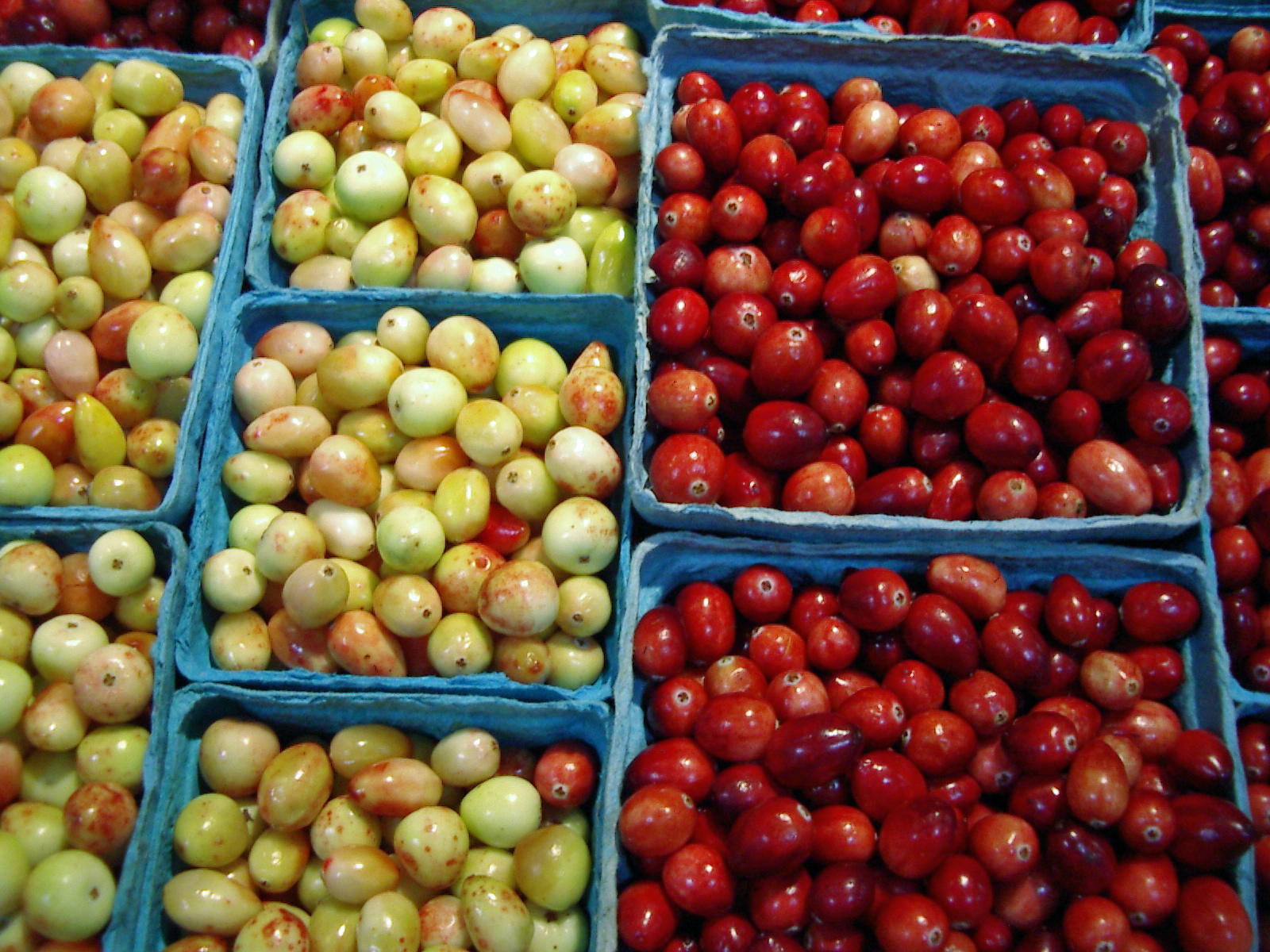 White and red cranberries at Fair Food Farmstand.
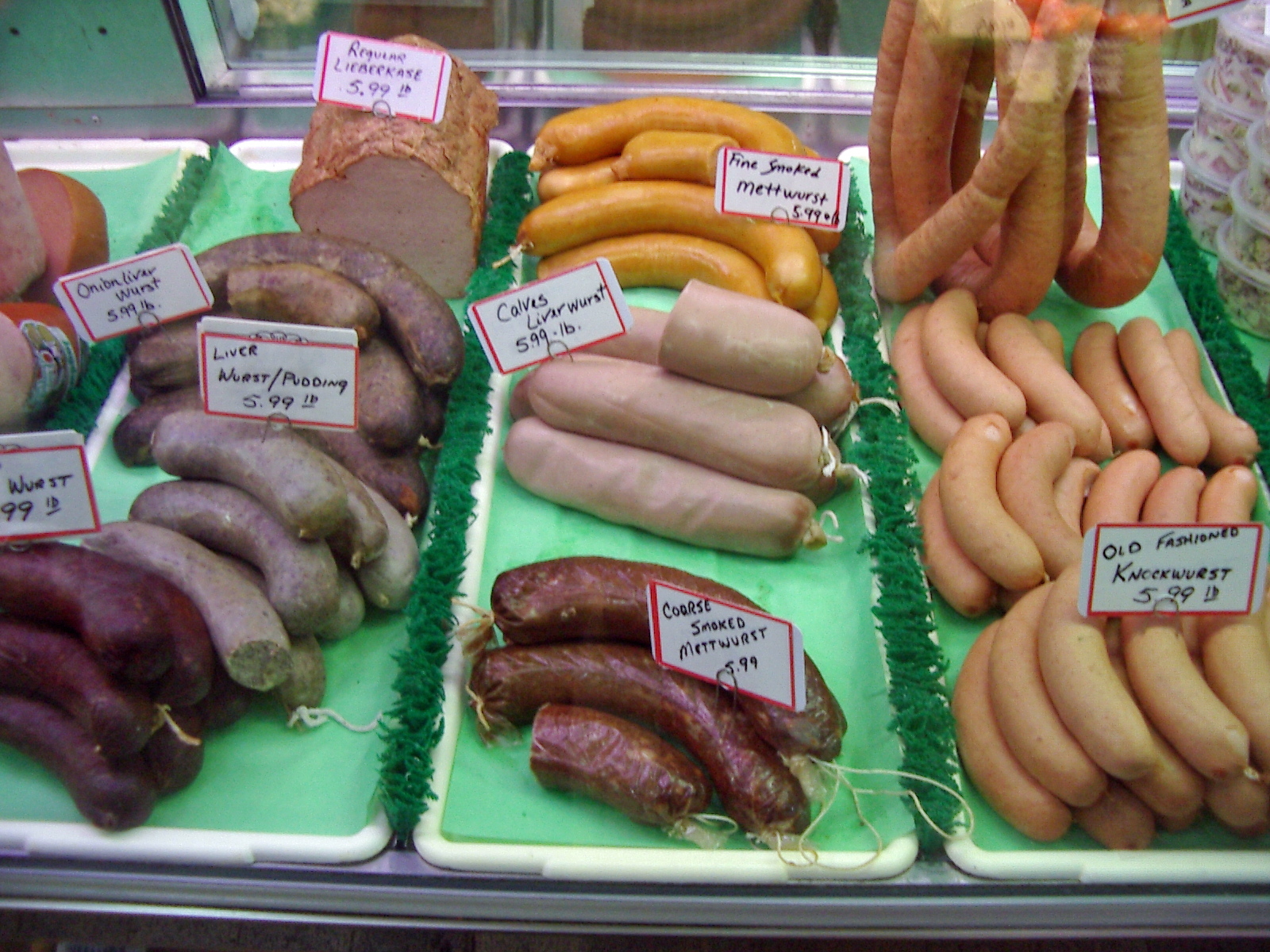 Riekers German style products available at Dutch Country Meats.
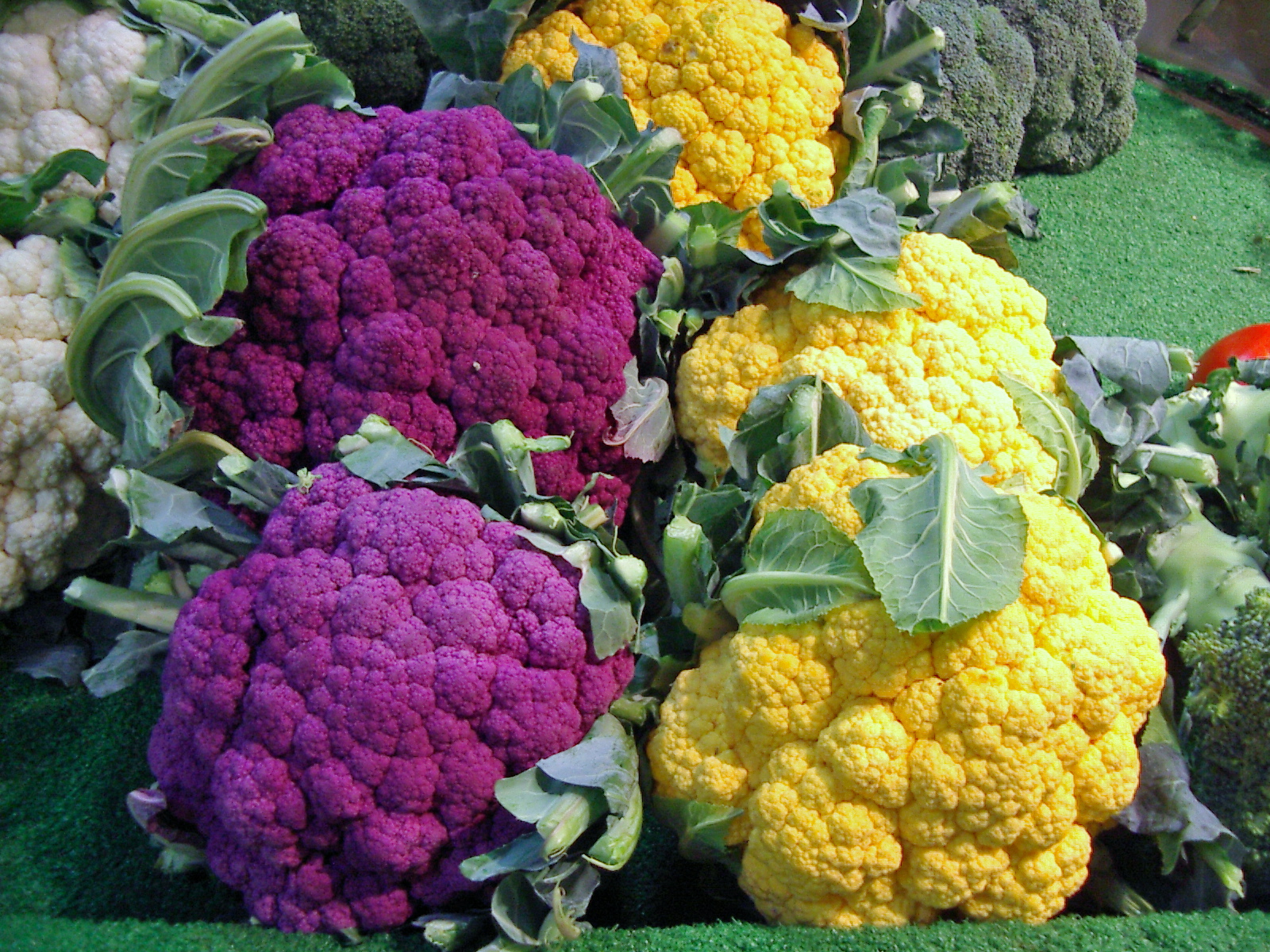 Diversity of cauliflower at Benuel Kauffman's Lancaster County Produce.
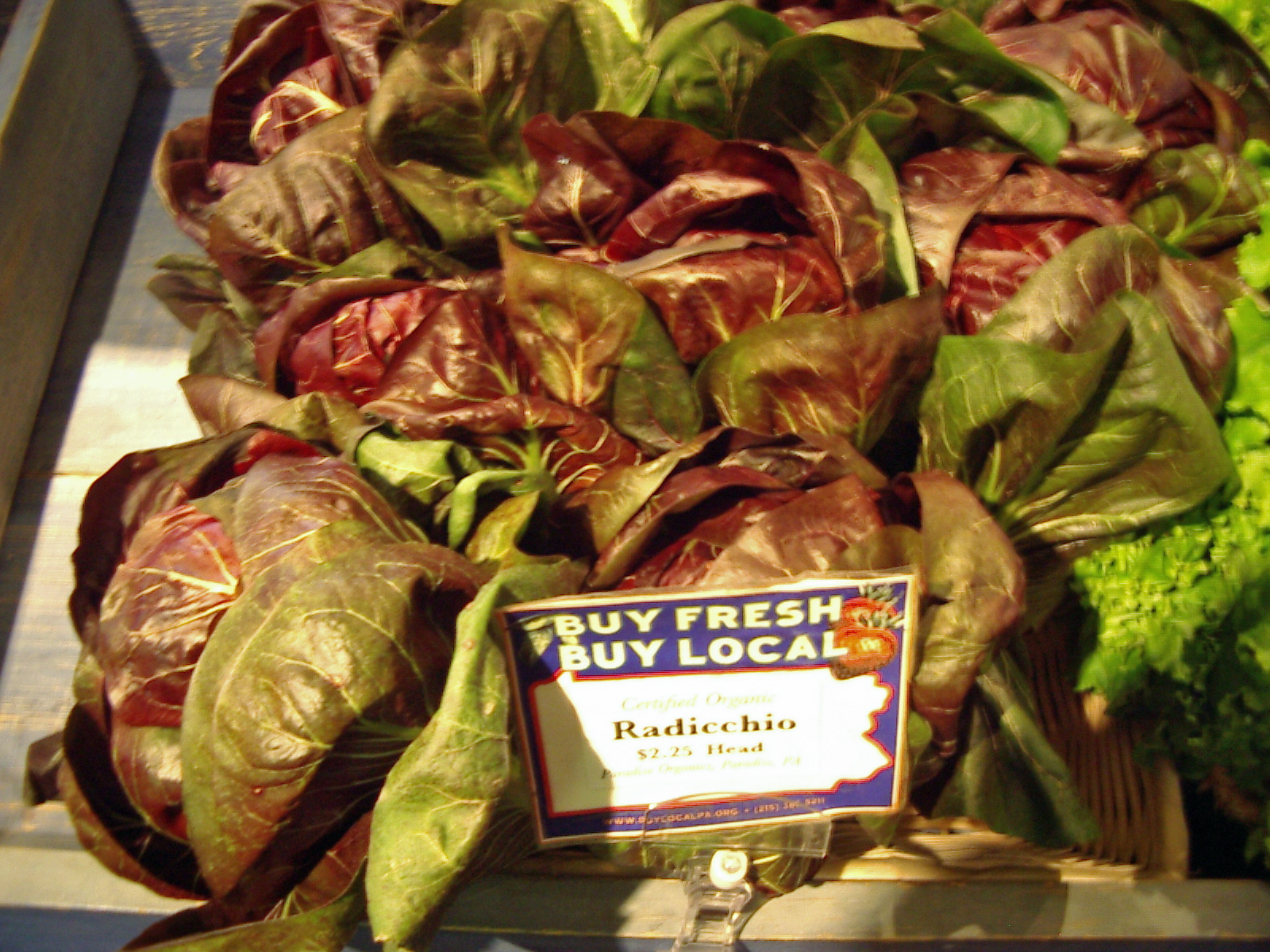 Radicchio at Fair Food Farmstand.
I erred in my pricing report Friday on the Fair Food Farmstand cranberries. They are $6 for white and $4.50 for red per quart not, as previously reported, per pint.
Harry Ochs had some exceedingly good looking lean beef in his display case today, simply marked for either cubing or grinding, priced at, iirc, $4.49 (or was it $4.99?) a pound. Nick said it was shin with the bone removed. I picked up a pound and a half, single grind, and made it into a beef base for a cottage pie I'll finish making tomorrow. The braised ground meat (with onions, beef bouillion, thyme, worcestershire sauce, Kitchen Bouquet for color) was nicely beefy with a tender yet toothsome texture, probably because shin has some decent colagen content. I think this meat would be all wrong for hamburger (much too lean), but great for chili and other ground beef dishes that should simmer on a low flame for a while. The ultra lean meat ultra caused me to add a little extra oil to the pan while browning. Although it was more expensive per pound that the ground sirloin, it was nearly as economical because the sirloin is somewhere around 17-20 percent fat; if the shin was 5 percent fat I'd be surprised. The only other time I've used shin was to cook it whole Chinese style (that, too, was delicious).
Vendor news
With a new hire, DiNic's is expanding its hours. They'll start slowly beginning tomorrow, Nov. 4, with Sunday hours. Eventually the goal is to extend weekday hours until the market's 6 p.m. closing.
Don't be surprised if one or two of the vendors from Headhouse Square set up shop at the RTM in the future, either during the winter and/or other days of the week when Headhouse isn't operating. Hendricks Farm and Old Earth Farm are prime candidates, according to market GM Paul Steinke.
Steinke also said he has vendors lined up for the "Christmas Market" which will occupy the space being vacated by Amy's Kitchen in their move to the old Foster's store. If he gets additional interest, he'll expand the seasonal vendors to the old Le Bus space.
Friday, November 02, 2007
Persimmons and cheese
Emily Teel of the Fair Food Farmstand is pushing the persimmons. They're grown by the same South Philly amateur orchardist who supplied the stand with figs about a month or so ago. Also at the farmstand, white cranberries. They are not a different variety, just an immature berry and, because of that, tarter, so add extra sugar. The white cranberries were selling for $6 a pint vs. $4.50 for the red.
Earl Livengood had fantastic red beets last week. They appear to be a similar variety to the cylindrical beets Benuel Kauffman sometimes features. I roasted Earl's in the oven (400F for about 50 minutes) and they are as sweet as any beet I've ever had.
Now's the season for pumpkin ravioli. Pasta By George has a nice pumpkin-riccotta version, though they aren't cheap: $10.99 for 12 raviolis (yielding two portions for an entree, four for appetizer course). I made a simple sage brown butter sauce for them.
Jeffrey Roberts, author of the Atlas of American Artisinal Cheese (Chelsea Green, White River Junction, Vermont, 464 pp, $35), was selling and signing copies of his book last Saturday in the same table spot formerly occupied by Green Valley Dairy, next to the Fair Food Farmstand. Roberts, a former Philadelphian who's been in Vermont doing his cheese thing, was fascinating to talk with. If anyone is interested in finding great American cheeses, or just has a hankering to learn more, buy this book. In it he profiles more than 350 American cheesemakers and includes info on how to order, whether on line, by phone or at the farmstand. He tells of one cheesemaker who sells her entire output only once a year at a Maryland sheep and wool gathering. Although it's designed as a reference book, it was pure pleasure to go through entire sections of the book, which is arranged geographically by region, and then by state. It opened me up to lots of new cheesemakers, and told me things I didn't know about some of my favorites. On my next trip to Wisconsin to visit the in-laws, I'm going to plan our excursions around this book!
Green Valley is among the cheesemakers profiled in the book, but they no longer sell direct to the customer at the market. However, you can purchase their cheese at the Fair Food Farmstand. The Amish producer is concentrating on restaurants and the wholesale business. If you haven't tried it, their Pennsylvania Noble is a wonderful cheddar.
Over at the former Foster's space, shelving and display units have been delivered for Amy's Kitchen, which hopes to open in its new space a week before Thanksgiving.
Emily Teel of the Fair Food Farmstand is pushing the persimmons. They're grown by the same South Philly amateur orchardist who supplied the stand with figs about a month or so ago. Also at the farmstand, white cranberries. They are not a different variety, just an immature berry and, because of that, tarter, so add extra sugar. The white cranberries were selling for $6 a pint vs. $4.50 for the red.
Earl Livengood had fantastic red beets last week. They appear to be a similar variety to the cylindrical beets Benuel Kauffman sometimes features. I roasted Earl's in the oven (400F for about 50 minutes) and they are as sweet as any beet I've ever had.
Now's the season for pumpkin ravioli. Pasta By George has a nice pumpkin-riccotta version, though they aren't cheap: $10.99 for 12 raviolis (yielding two portions for an entree, four for appetizer course). I made a simple sage brown butter sauce for them.
Jeffrey Roberts, author of the Atlas of American Artisinal Cheese (Chelsea Green, White River Junction, Vermont, 464 pp, $35), was selling and signing copies of his book last Saturday in the same table spot formerly occupied by Green Valley Dairy, next to the Fair Food Farmstand. Roberts, a former Philadelphian who's been in Vermont doing his cheese thing, was fascinating to talk with. If anyone is interested in finding great American cheeses, or just has a hankering to learn more, buy this book. In it he profiles more than 350 American cheesemakers and includes info on how to order, whether on line, by phone or at the farmstand. He tells of one cheesemaker who sells her entire output only once a year at a Maryland sheep and wool gathering. Although it's designed as a reference book, it was pure pleasure to go through entire sections of the book, which is arranged geographically by region, and then by state. It opened me up to lots of new cheesemakers, and told me things I didn't know about some of my favorites. On my next trip to Wisconsin to visit the in-laws, I'm going to plan our excursions around this book!
Green Valley is among the cheesemakers profiled in the book, but they no longer sell direct to the customer at the market. However, you can purchase their cheese at the Fair Food Farmstand. The Amish producer is concentrating on restaurants and the wholesale business. If you haven't tried it, their Pennsylvania Noble is a wonderful cheddar.
Over at the former Foster's space, shelving and display units have been delivered for Amy's Kitchen, which hopes to open in its new space a week before Thanksgiving.
Saturday, October 13, 2007
Livengood adds unpasteurized cider
There's another vendor selling unpasteurized apple cider at the RTM: Earl Livengood. The cider, pressed from Earl's own organic apples, sells for $2.85 a half gallon. The other vendor of unpasteurized cider is Benuel Kauffman's Lancaster County Produce. (Didn't check if Fair Food Farmstand has any; if anyone else does, they're the most likely.) Earl has an outside mill press his cider, but since that's done on Wednesdays he may not have any for this Tuesday's Passyunk & South Market, though he will at Fairmount Thursday and the RTM again next Saturday.
Bought a half-pint box of chestnuts from Earl to roast, if not on an open fire, in the toaster oven. $1.25.
Now that summer is definitely over, there's a minor glut of soft shell crabs, at least judged by the 17 percent price reduction at John Yi's: $5 apiece rather than $6.
Nonetheless, signs of both summer and autumn abound. Very late season tomatoes still available at the various farm stands, though the end is well nigh. Lots of good deals at Iovine Brothers Produce this week, including Hass avocados continuing at 50-cents apiece, mineola oranges at five for a buck, and red, yellow and orange bell peppers all 99-cents a pound. And a nice variety of apples at all fruit vendors, including Macouns at L. Halteman.
Now that Hatville Deli has moved their egg sales back into the main store, rather than the stall now occupied by AJ's Pickle Patch, you can no longer buy a half dozen. Sales by the dozen only.
The RTM's annual Harvest Festival started today, and it appeared to be drawing extra crowds. Down Home Diner, Harry Ochs, Giunta's Prime Shop, Nanee, Kamal and other vendors set up shop on a hay-strewn Filbert Street ("Harry Ochs Way") as blue grass music played and Vinnie Iovine drove a tractor around the block pulling wannabe hayseeds. Also participating was at least one of the Pennsylvania Dutch vendors, Fisher's, selling fresh made nut brittles. The festival continues tomorrow (minus the Pennsylvania Dutch participants, who don't participate in Sunday hours).
There's another vendor selling unpasteurized apple cider at the RTM: Earl Livengood. The cider, pressed from Earl's own organic apples, sells for $2.85 a half gallon. The other vendor of unpasteurized cider is Benuel Kauffman's Lancaster County Produce. (Didn't check if Fair Food Farmstand has any; if anyone else does, they're the most likely.) Earl has an outside mill press his cider, but since that's done on Wednesdays he may not have any for this Tuesday's Passyunk & South Market, though he will at Fairmount Thursday and the RTM again next Saturday.
Bought a half-pint box of chestnuts from Earl to roast, if not on an open fire, in the toaster oven. $1.25.
Now that summer is definitely over, there's a minor glut of soft shell crabs, at least judged by the 17 percent price reduction at John Yi's: $5 apiece rather than $6.
Nonetheless, signs of both summer and autumn abound. Very late season tomatoes still available at the various farm stands, though the end is well nigh. Lots of good deals at Iovine Brothers Produce this week, including Hass avocados continuing at 50-cents apiece, mineola oranges at five for a buck, and red, yellow and orange bell peppers all 99-cents a pound. And a nice variety of apples at all fruit vendors, including Macouns at L. Halteman.
Now that Hatville Deli has moved their egg sales back into the main store, rather than the stall now occupied by AJ's Pickle Patch, you can no longer buy a half dozen. Sales by the dozen only.
The RTM's annual Harvest Festival started today, and it appeared to be drawing extra crowds. Down Home Diner, Harry Ochs, Giunta's Prime Shop, Nanee, Kamal and other vendors set up shop on a hay-strewn Filbert Street ("Harry Ochs Way") as blue grass music played and Vinnie Iovine drove a tractor around the block pulling wannabe hayseeds. Also participating was at least one of the Pennsylvania Dutch vendors, Fisher's, selling fresh made nut brittles. The festival continues tomorrow (minus the Pennsylvania Dutch participants, who don't participate in Sunday hours).
Sunday, October 07, 2007
Headhouse gives up winter plan
The Headhouse Farmers Market had hoped to find a way to stay open all winter, but is pulling back from that plan for this winter. But there are two year-round farmers' markets, sponsored by the Food Trust (as is Headhouse): Clark Park (Saturdays, 10 a.m.-2 p.m.) and Fitler Square (Saturdays, 10 a.m. - 1 p.m.)
The Headhouse Market will remain open through the Sunday before Christmas, Dec. 23, according to Nicky Uy, market manager. The only Sunday they'll miss between now and then will be the Sunday after Thanksgiving, since the market will be open on the day before Thanksgiving. Expect the seasonal shutdown to end when the market reopens next spring on May 4.
I stopped by the Hendricks Farm stall today and, after sampling, picked up their Tomme. Telford, Pennsylvania, may not be the Franco-Swiss Alps, but this cheese is worthy of the name. I also bought a pound of their bacon.
My most exciting find, however, was over at Old Earth Farm where the sign said they had lamb ribs for $5/pound. If these were rib chops (as the young man serving me said they were), that is a bargain price. But I doubted it and, sure enough, they weren't chops. I could hardly be disappointed, however, since the product available at this price was breast of lamb, commonly called "riblets" and, in this case, mis-labeled as "rack of lamb" (rack of lamb usually refers to rib chops which have not been separated). Lamb breast is one of my favorite cuts, so I bought the package of frozen meat and stuck it in the freezer for future use. For you hard-core sheep meat lovers me like, be aware that Old Earth Farms plans to produce some mutton, too. They also raise Tamworth hogs, a heritage breed from the U.K. which is noteworthy for its meaty, relatively lean bacon. (I think I'll special order a couple of pounds of fresh belly for roasting this winter!)
North Star Orchards had some interesting varieties of apples, all at $1.79, iirc. I purchased a couple of golden and razor russets. I enjoyed the razor russet at lunch today: nice and crisp, just sweet enough without being cloying, with sufficient tart bite to make it interesting. A very worthy apple. If my fridge's produce bin did not already have a full peck remaining of Cox Orange Pippins purchased in Massachusetts last month, I would have bought more. (The man who served me at North Star said the reason he and other Pennsylvania growers don't do Cox Orange is because it's still warm when they ripen here in early to mid-September, and they turn to mush when it's warm. Upstate New York and New England offer more favorable weather during harvest. See, you learn something new every day!)
The Headhouse Farmers Market had hoped to find a way to stay open all winter, but is pulling back from that plan for this winter. But there are two year-round farmers' markets, sponsored by the Food Trust (as is Headhouse): Clark Park (Saturdays, 10 a.m.-2 p.m.) and Fitler Square (Saturdays, 10 a.m. - 1 p.m.)
The Headhouse Market will remain open through the Sunday before Christmas, Dec. 23, according to Nicky Uy, market manager. The only Sunday they'll miss between now and then will be the Sunday after Thanksgiving, since the market will be open on the day before Thanksgiving. Expect the seasonal shutdown to end when the market reopens next spring on May 4.
I stopped by the Hendricks Farm stall today and, after sampling, picked up their Tomme. Telford, Pennsylvania, may not be the Franco-Swiss Alps, but this cheese is worthy of the name. I also bought a pound of their bacon.
My most exciting find, however, was over at Old Earth Farm where the sign said they had lamb ribs for $5/pound. If these were rib chops (as the young man serving me said they were), that is a bargain price. But I doubted it and, sure enough, they weren't chops. I could hardly be disappointed, however, since the product available at this price was breast of lamb, commonly called "riblets" and, in this case, mis-labeled as "rack of lamb" (rack of lamb usually refers to rib chops which have not been separated). Lamb breast is one of my favorite cuts, so I bought the package of frozen meat and stuck it in the freezer for future use. For you hard-core sheep meat lovers me like, be aware that Old Earth Farms plans to produce some mutton, too. They also raise Tamworth hogs, a heritage breed from the U.K. which is noteworthy for its meaty, relatively lean bacon. (I think I'll special order a couple of pounds of fresh belly for roasting this winter!)
North Star Orchards had some interesting varieties of apples, all at $1.79, iirc. I purchased a couple of golden and razor russets. I enjoyed the razor russet at lunch today: nice and crisp, just sweet enough without being cloying, with sufficient tart bite to make it interesting. A very worthy apple. If my fridge's produce bin did not already have a full peck remaining of Cox Orange Pippins purchased in Massachusetts last month, I would have bought more. (The man who served me at North Star said the reason he and other Pennsylvania growers don't do Cox Orange is because it's still warm when they ripen here in early to mid-September, and they turn to mush when it's warm. Upstate New York and New England offer more favorable weather during harvest. See, you learn something new every day!)
Corn and cauliflower
It's that wonderful time of year when some summer produce can still be found yet autumn bounty is in full harvest. Benuel Kaufman, for example, still offers cherry tomatoes and corn (both bicolor and white) along with cauliflower (orange and white) and apples. Earl Livengood featured concord grapes, heirloom tomatoes, and sweet potatoes to demonstrate bi-seasonality.
I would have indulged in what is for me a fall classic -- pumpkin ravioli from Pasta by George served with a sage-inflected brown butter -- but the weather forecast says wait. Instead, it will be hanger steak (from Giunta's prime shop) on the grill with Ben's corn to match the 85-degree daytime temperatures.
Among the apple varieties available Ben sells Macouns at $1.49 as well as Asian pears at $1.99. And unpasteurized apple cider, too.
Over at Iovine Brothers Produce a new addition are matsutake mushrooms, $41.99 if you can afford them. If you haven't read last month's food issue of The New Yorker magazine, find it -- a fascinating article about the PNW's mushroom foraging industry centered on this fungi delecti.
Also at Iovine's, Hass avocados back down to $1 apiece. Limes and lemons were three for a buck. Over at O.K. Lee, the limes were 4/$1, and you could also buy a bag of seven for a buck. OKL's cactus pears, ripe and ready, were 50 cents apiece.
In addition to the usual varieties and sources of salmon, John Yi featured king salmon from "chili" this week, $11.99. I always thought king (a.k.a. "chinook") salmon was strictly a wild product, but that's not the case. Although most of Chile's salmon aquaculture is devoted to the Atlantic salmon, it also exports farm-raised king and coho salmon. (King salmon was also the main salmon farm-raised in British Columbia, but Atlantic salmon now dominates the industry.) In other fishy news, Boston mackeral has pretty much disappeared, but Spanish mackeral is abundant at prices of $2.49-$2.99 for this delicious fish. We should start seeing fresh sardines (juvenile herring, actually) in the RTM fish shops soon.
Musical stalls
Amy's will move into the former Foster's space to sell kitchen hardware, though the inventory will be more practical and design-centric than the merchandise Ken Foster sold there. The new stall is projected to open Nov. 15, but it will only occupy the front half of the space.
The rear portion of the space will remain the market's demonstration kitchen, which will lose its side walls in order to open up the space (though it will still remain a bit hidden from the market's flow, unless you're heading to the ladies' room). RTM GM Paul Steinke says a Temple instructor is considering moving into the kitchen to operate for-profit classes there.
In the space Amy will vacate Steinke hopes to lure short-term vendors in 10-foot stalls selling "Christmas market" type items. One seller of linens is among those he's courting. He says it would represent a return to what once was one of the market's mainstays: day-stall vendors who leased space by the day. Day-stall rents are $35-$150/day, varying by day of the week.
Steinke also reports he has one party interested in the Natural Connection space to sell groceries and sustainable/natural household products. No deal yet, however.
Between the slices...
Attention Roast Pork Sandwich Fans: Expect DiNic's to expand its hours to RTM closing within the next week or two, as soon as Tommy Nicolosi can hire an additional staffer. His new ovens were delivered and installed recently, capable of roasting a total of nearly 500 pounds of meat simultaneously (though he's not figuring on using all of that capacity most of the time). The expansion also required moving most of his refrigerator capacity out of the stall.
While most everyone laments the Phillies' loss Saturday night in Colorado, there's a bright side as far as some of the RTM sandwich vendors are concerned: When the Phillies played their first day game against the Rockies at home last Wednesday, business was off considerably. Tommy said he did one-third less volume, and Hershel's reported similar numbers.
It's that wonderful time of year when some summer produce can still be found yet autumn bounty is in full harvest. Benuel Kaufman, for example, still offers cherry tomatoes and corn (both bicolor and white) along with cauliflower (orange and white) and apples. Earl Livengood featured concord grapes, heirloom tomatoes, and sweet potatoes to demonstrate bi-seasonality.
I would have indulged in what is for me a fall classic -- pumpkin ravioli from Pasta by George served with a sage-inflected brown butter -- but the weather forecast says wait. Instead, it will be hanger steak (from Giunta's prime shop) on the grill with Ben's corn to match the 85-degree daytime temperatures.
Among the apple varieties available Ben sells Macouns at $1.49 as well as Asian pears at $1.99. And unpasteurized apple cider, too.
Over at Iovine Brothers Produce a new addition are matsutake mushrooms, $41.99 if you can afford them. If you haven't read last month's food issue of The New Yorker magazine, find it -- a fascinating article about the PNW's mushroom foraging industry centered on this fungi delecti.
Also at Iovine's, Hass avocados back down to $1 apiece. Limes and lemons were three for a buck. Over at O.K. Lee, the limes were 4/$1, and you could also buy a bag of seven for a buck. OKL's cactus pears, ripe and ready, were 50 cents apiece.
In addition to the usual varieties and sources of salmon, John Yi featured king salmon from "chili" this week, $11.99. I always thought king (a.k.a. "chinook") salmon was strictly a wild product, but that's not the case. Although most of Chile's salmon aquaculture is devoted to the Atlantic salmon, it also exports farm-raised king and coho salmon. (King salmon was also the main salmon farm-raised in British Columbia, but Atlantic salmon now dominates the industry.) In other fishy news, Boston mackeral has pretty much disappeared, but Spanish mackeral is abundant at prices of $2.49-$2.99 for this delicious fish. We should start seeing fresh sardines (juvenile herring, actually) in the RTM fish shops soon.
Musical stalls
Amy's will move into the former Foster's space to sell kitchen hardware, though the inventory will be more practical and design-centric than the merchandise Ken Foster sold there. The new stall is projected to open Nov. 15, but it will only occupy the front half of the space.
The rear portion of the space will remain the market's demonstration kitchen, which will lose its side walls in order to open up the space (though it will still remain a bit hidden from the market's flow, unless you're heading to the ladies' room). RTM GM Paul Steinke says a Temple instructor is considering moving into the kitchen to operate for-profit classes there.
In the space Amy will vacate Steinke hopes to lure short-term vendors in 10-foot stalls selling "Christmas market" type items. One seller of linens is among those he's courting. He says it would represent a return to what once was one of the market's mainstays: day-stall vendors who leased space by the day. Day-stall rents are $35-$150/day, varying by day of the week.
Steinke also reports he has one party interested in the Natural Connection space to sell groceries and sustainable/natural household products. No deal yet, however.
Between the slices...
Attention Roast Pork Sandwich Fans: Expect DiNic's to expand its hours to RTM closing within the next week or two, as soon as Tommy Nicolosi can hire an additional staffer. His new ovens were delivered and installed recently, capable of roasting a total of nearly 500 pounds of meat simultaneously (though he's not figuring on using all of that capacity most of the time). The expansion also required moving most of his refrigerator capacity out of the stall.
While most everyone laments the Phillies' loss Saturday night in Colorado, there's a bright side as far as some of the RTM sandwich vendors are concerned: When the Phillies played their first day game against the Rockies at home last Wednesday, business was off considerably. Tommy said he did one-third less volume, and Hershel's reported similar numbers.
Friday, September 28, 2007
Pawpaws and Pickled Kielbasa
Pawpaws were available Thursday at Earl Livengood's when he appeared at the Fairmount & 22nd market. Earl's buddy Sam had a bunch of small, very ripe ones on display, but had some larger, not quite as ripe (but still ready) specimens in the truck available. I took three and let them sit on the counter overnight, then turned them into pawpaw chiffon pie, which was smooth, perfume-y and rich (pureed pawpaws and gelatin mixed in after custard had thickened, then whipped egg whites and cream folded in after the mix began to set). Since the three large pawpaws I purchased were a bit shy of a full cup, I pureed a banana to stretch it out. The resulting product still had a pronounced pawpaw aroma and taste which, after all, is banana-like.
Maybe Earl will have some Saturday at the RTM. If it does, grab them. Pawpaws make great ice cream, too.
The corn we picked up from Earl was still quite nice, especially considering the season is basically over. The Brandywine tomatoes were still tasty, too. He also has chestnuts available.
Today I introduced an English friend to the wonders of Tommy DiNic's roast pork (rabe and cheese); she was instantly won over, both by the sandwich and the variety of foods available at the RTM. She's got some great seafood in North Devon, along with lamb, but nowhere near the diversity of fresh food products as here. She observed, however, that the shrimps and other shellfish back home would cost in pounds sterling what we pay in dollars -- in other words, twice the price.
Since it's apple season I invested in some sharp Canadian cheddar ("rat cheese") and brie at Downtown Cheese. Either will go well with the Cox Orange Pippins I brought back from my New England trip.
A key focus of the RTM's marketing plan in coming months is to target new condo residents in Center City. They've identified 5,000 such households and will be sending them oversized promotional postcards now, before Thanksgiving and Christmas, and again in the spring, coupled with a giveaway. The idea is to make sure they are aware of the market, especially the Sunday hours.
Signs posted in the former Foster's space would lead one to believe the market has found a tenant ("Coming Soon..." but without any additional hint.) RTM General Manager Paul Steinke has been trying to lure another kitchen hard goods retailer and indicated a couple of weeks ago he was negotiating with one which would enable the market to retain the show kitchen space as a separate entity.
Benuel Kauffman has got unpasteurized apple cider again. As well as orange and white cauliflower, and those elongated red beets about which I always rave.
AJ's Pickle Patch featured pickled kielbasa today. Great beer food. It brought back great memories: a mere four decades ago I regularly consumed the vinegared sausage at an off-campus Irish bar ("Terry's") with draught PBR.
Pawpaws were available Thursday at Earl Livengood's when he appeared at the Fairmount & 22nd market. Earl's buddy Sam had a bunch of small, very ripe ones on display, but had some larger, not quite as ripe (but still ready) specimens in the truck available. I took three and let them sit on the counter overnight, then turned them into pawpaw chiffon pie, which was smooth, perfume-y and rich (pureed pawpaws and gelatin mixed in after custard had thickened, then whipped egg whites and cream folded in after the mix began to set). Since the three large pawpaws I purchased were a bit shy of a full cup, I pureed a banana to stretch it out. The resulting product still had a pronounced pawpaw aroma and taste which, after all, is banana-like.
Maybe Earl will have some Saturday at the RTM. If it does, grab them. Pawpaws make great ice cream, too.
The corn we picked up from Earl was still quite nice, especially considering the season is basically over. The Brandywine tomatoes were still tasty, too. He also has chestnuts available.
Today I introduced an English friend to the wonders of Tommy DiNic's roast pork (rabe and cheese); she was instantly won over, both by the sandwich and the variety of foods available at the RTM. She's got some great seafood in North Devon, along with lamb, but nowhere near the diversity of fresh food products as here. She observed, however, that the shrimps and other shellfish back home would cost in pounds sterling what we pay in dollars -- in other words, twice the price.
Since it's apple season I invested in some sharp Canadian cheddar ("rat cheese") and brie at Downtown Cheese. Either will go well with the Cox Orange Pippins I brought back from my New England trip.
A key focus of the RTM's marketing plan in coming months is to target new condo residents in Center City. They've identified 5,000 such households and will be sending them oversized promotional postcards now, before Thanksgiving and Christmas, and again in the spring, coupled with a giveaway. The idea is to make sure they are aware of the market, especially the Sunday hours.
Signs posted in the former Foster's space would lead one to believe the market has found a tenant ("Coming Soon..." but without any additional hint.) RTM General Manager Paul Steinke has been trying to lure another kitchen hard goods retailer and indicated a couple of weeks ago he was negotiating with one which would enable the market to retain the show kitchen space as a separate entity.
Benuel Kauffman has got unpasteurized apple cider again. As well as orange and white cauliflower, and those elongated red beets about which I always rave.
AJ's Pickle Patch featured pickled kielbasa today. Great beer food. It brought back great memories: a mere four decades ago I regularly consumed the vinegared sausage at an off-campus Irish bar ("Terry's") with draught PBR.
Saturday, September 08, 2007
Fava or Lima? Livengood grows from customer seed
 Fava beans come in number of varieties, including this purple-blotched bean which was being sold this morning next to its legume cousin, the lima, at Livengood Produce. Earl said he was given the seeds by a customer who told him he was a fava bean, but he wasn't sure what it was since it had the same shape and similar taste, eaten raw, to a lima. (I Googled fava images, and found some that looked like Earl's, so that's what it appears to be.) I never much cared for limas as a kid, since they always came out of a can, but the fresh version sauteed in butter or good olive oil, seasoned as you like, makes a nice change in vegetables.
Harry Ochs was featuring dry aged Delmonico steaks (rib eye) for $10.99/pound today. That's about what I paid last week for the same cut (wet aged) at Giunta's Prime Shop. Giunta's were excellent, and I would expect Ochs' to be their equal, at the very least.
Mammoth cauliflower heads competed for space with the corn at Kauffman's Lancaster County Produce. The Frankenstein-sized veggies were priced at $4.95 apiece. Benuel still doesn't have unpasteurized apple cider. (Benuel will be closed next Saturday because of a family wedding.)
Apple varieties are still fairly limited, but we should start to see a diversity of America's favorite pome fruit soon. Iovine Brothers Produce offered local apples from its contract grower, Shady Brook, for 99-cents; the variety was not noted, but they might have been Honey Crisps from the shape and color. (I'll be traveling to Maine and New England until the end of the month, but I've already contacted a Massachusetts orchard which says my favorite dessert apple, the Cox Orange Pippin, should be ready when I'm in the neighborhood. Few orchards grow this variety in the U.S., because it isn't a particularly prolific cultivar, but it's a favorite in the UK, which gets much of its COPs from South Africa.)
Smallish Hass avocados on sale at Iovine's today for 99-cents apiece, just in time for football season guacamole dips. Local Shady Brook corn at Iovine was 25-cents an ear, vs. four for a buck at OK Lee. Lee's had a better bargain in lemons, with bagged fruit (seven to a bag) selling for $1; both produce vendors were selling loose lemons at 3/$1.
Sam Consylman, who sells foraged finds as well as fruit and veggies from his garden at Livengood's, is still waiting for pawpaws to drop from trees along the riverbank, but if you have a hankering for this most American of fruits you could meander down to southeast Ohio next weekend for the ninth annual Ohio Pawpaw festival. It's at Lake Snowden, just a few miles outside of Athens. The pawpaw eating contest will be held just before dinnertime Saturday.
I've been cooking up peppers and onions (with some sliced garlic thrown in) like mad the last week or so. Just love the combination, especially with red meat (so far I've served them with those Delmonico steaks, burgers and bratwursts) though it works well with heartier fishes as well as on its own. Today I picked up some sweet red frying peppers from Benuel, but last week I used very flavorful Cubanelles from the Fair Food Farmstand.
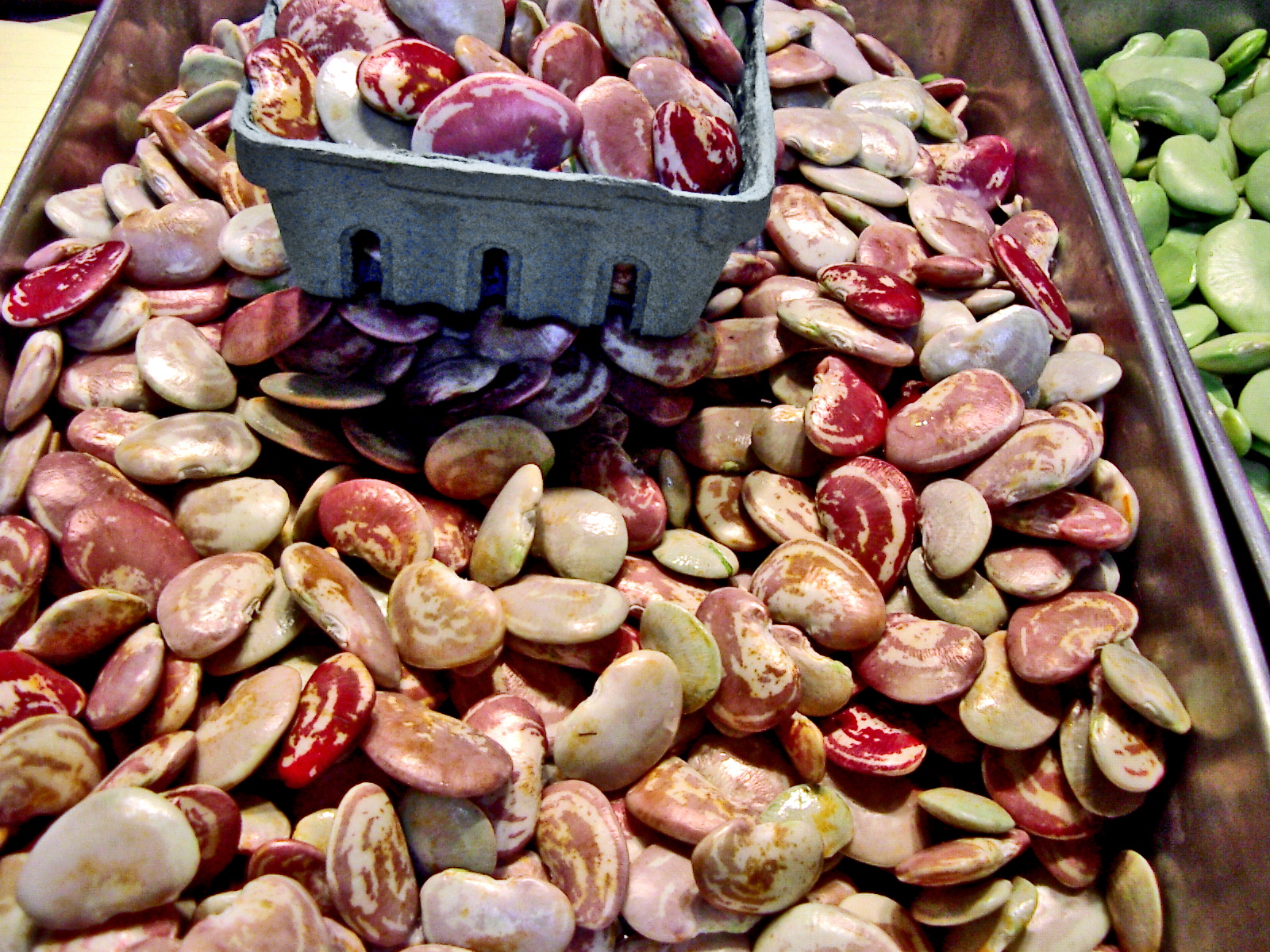 Fava beans come in number of varieties, including this purple-blotched bean which was being sold this morning next to its legume cousin, the lima, at Livengood Produce. Earl said he was given the seeds by a customer who told him he was a fava bean, but he wasn't sure what it was since it had the same shape and similar taste, eaten raw, to a lima. (I Googled fava images, and found some that looked like Earl's, so that's what it appears to be.) I never much cared for limas as a kid, since they always came out of a can, but the fresh version sauteed in butter or good olive oil, seasoned as you like, makes a nice change in vegetables.
Harry Ochs was featuring dry aged Delmonico steaks (rib eye) for $10.99/pound today. That's about what I paid last week for the same cut (wet aged) at Giunta's Prime Shop. Giunta's were excellent, and I would expect Ochs' to be their equal, at the very least.
Mammoth cauliflower heads competed for space with the corn at Kauffman's Lancaster County Produce. The Frankenstein-sized veggies were priced at $4.95 apiece. Benuel still doesn't have unpasteurized apple cider. (Benuel will be closed next Saturday because of a family wedding.)
Apple varieties are still fairly limited, but we should start to see a diversity of America's favorite pome fruit soon. Iovine Brothers Produce offered local apples from its contract grower, Shady Brook, for 99-cents; the variety was not noted, but they might have been Honey Crisps from the shape and color. (I'll be traveling to Maine and New England until the end of the month, but I've already contacted a Massachusetts orchard which says my favorite dessert apple, the Cox Orange Pippin, should be ready when I'm in the neighborhood. Few orchards grow this variety in the U.S., because it isn't a particularly prolific cultivar, but it's a favorite in the UK, which gets much of its COPs from South Africa.)
Smallish Hass avocados on sale at Iovine's today for 99-cents apiece, just in time for football season guacamole dips. Local Shady Brook corn at Iovine was 25-cents an ear, vs. four for a buck at OK Lee. Lee's had a better bargain in lemons, with bagged fruit (seven to a bag) selling for $1; both produce vendors were selling loose lemons at 3/$1.
Sam Consylman, who sells foraged finds as well as fruit and veggies from his garden at Livengood's, is still waiting for pawpaws to drop from trees along the riverbank, but if you have a hankering for this most American of fruits you could meander down to southeast Ohio next weekend for the ninth annual Ohio Pawpaw festival. It's at Lake Snowden, just a few miles outside of Athens. The pawpaw eating contest will be held just before dinnertime Saturday.
I've been cooking up peppers and onions (with some sliced garlic thrown in) like mad the last week or so. Just love the combination, especially with red meat (so far I've served them with those Delmonico steaks, burgers and bratwursts) though it works well with heartier fishes as well as on its own. Today I picked up some sweet red frying peppers from Benuel, but last week I used very flavorful Cubanelles from the Fair Food Farmstand.
Subscribe to:
Posts (Atom)