Showing posts with label celery. Show all posts

Monday, July 01, 2013

More Fruit and Veg Photos

From the last two Sundays at Headhouse:

Rainbow Chard from Blooming Glen
Red and Green Kohlrabi, grate and it makes a nice slaw
Or make potato salad from these Savoie Farms gems
Or these Happy Cat 'taters
On to the fruit. Beechwood had the season's first apricots Sunday
Red raspberries and cherries at Beechwood
Culton's $5 beans
Tom Culton obscured by his produce
Culton has also featured celery the last two weeks

A.T. Buzy was first to market with local corn a few weeks
ago, but I think I'll wait until later in July


Sunday, October 17, 2010


A Brief Vacation

Nothing demarcates the seasons quite as much travelling afar and returning home.

After a sojourn to the rocky coast of Down East Maine for much of the first half of October, I returned to Philadelphia this past week. At both the Reading Terminal Market Friday and the Headhouse Square farmers' market today I was innundated by the foods (and colors, like those of Margerum's preserves at Headhouse) or fall produce. Herewith, some photos and thoughts.

Brassicas, Brassicas, Brassicas

Autumn is prime time for cruciferious vegetables, which get their name from a resemblance, somewhere in their visible anatomical structure, to a cross. Most of the cruciferous veggies we see in the markets are brassicas (the few that aren't brassicas include wasabi, horseradish, radishes, arugula and the various cresses).


Broccoli and cauliflower, whatever the color, as well as the pointy romanesco, are all variations of brassica oleracea. These specimens were found at Benuel Kauffman's Lancaster County Produce at the Reading Terminal Market Friday.


Kale and collards (though not the chard in the foreground) are also cruciferous veggies. These could be purchased today at the North Star stall at the Headhouse market.


Cabbages galore at Iovine Brother's Produce Friday at the RTM. The plain green cabbage, at left, was selling for 50 cents a pound while the red and savoy were priced at 69 cents. All were from local farms in South Jersey.

Peppers Are Better In October


I think of peppers as a summer vegetable, even if they are, like tomatoes, technically fruits. Yet, the peppers I've tasted both in Maine and since returning are sweeter and more flavorful than those I sampled in August and September. Maybe it's those extra days in the sun.  The green frying peppers (left) and red varities pictured above at Iovine's all hail from South Jersey farms.


These peppers (as well as eggplants and tomatoes) filled the Three Springs Fruit Farm stall at Headhouse, along with lots of apples. Farmer Ben Wenk thinks the cooler weather of fall may cut down on the rate of water absorption by produce, making them sweeter ans more intense. He thinks its definitely true of the peaches, and probably for the eggplant and peppers as well.

That may have been the reason why the plum tomatoes I purchased at the Bar Harbor farmers' market two weeks were the best I've had all year: the naturally cooler climate of Maine coupled with long days of sun. Those tomatoes made the best pasta sauce I've prepared all season long.

Roots: Beets and Carrots


Weaver's Way, with some floral help, provided a colorful display of carrots and beets today at Headhouse. The carrots I bought at Bar Harbor also seemed particularly sweet and flavorful, again, perhaps due to the cooler climate and longer days of sunlight in more northerly climes.

Another Fall Veggie Standout


Blooming Glen Farm displayed these tender stalks of flavorful today, and I was quick up a bunch, both for the leaves and the ribs. I can't think of making tuna salad without copious amount of finely diced celery rib with added leaves. But tonight I may braise some stalks to accompany grilled chicken. Celery is a vegetable we don't usually think of cooking with, other than in soups or stews, but it's superb as a standalone side dish.

Quince: The Original Marmalade


The things you learn on Wikipedia! Quince (here displayed in the case at Beechwood Orchard's stall at Headhouse) is called Marmelo in Portoguese, hence, the jam made from it was called marmalade. Quince is a great addition to apple pies, providing even more pectin as well as a slightly different type of tartness. Quince marmalade is a traditional accompaniment to sharp cheeses.

Saturday, October 17, 2009

Jujubes and Kaffir Limes

When I think of Jujubes, I think of the tiny gummy candies from Heide's I would buy during my pre-adolescent years at the Saturday matinees at the Elmora Theater in Elizabeth, New Jersey, where I saw such classics as "X the Unknown" and "The Blob".

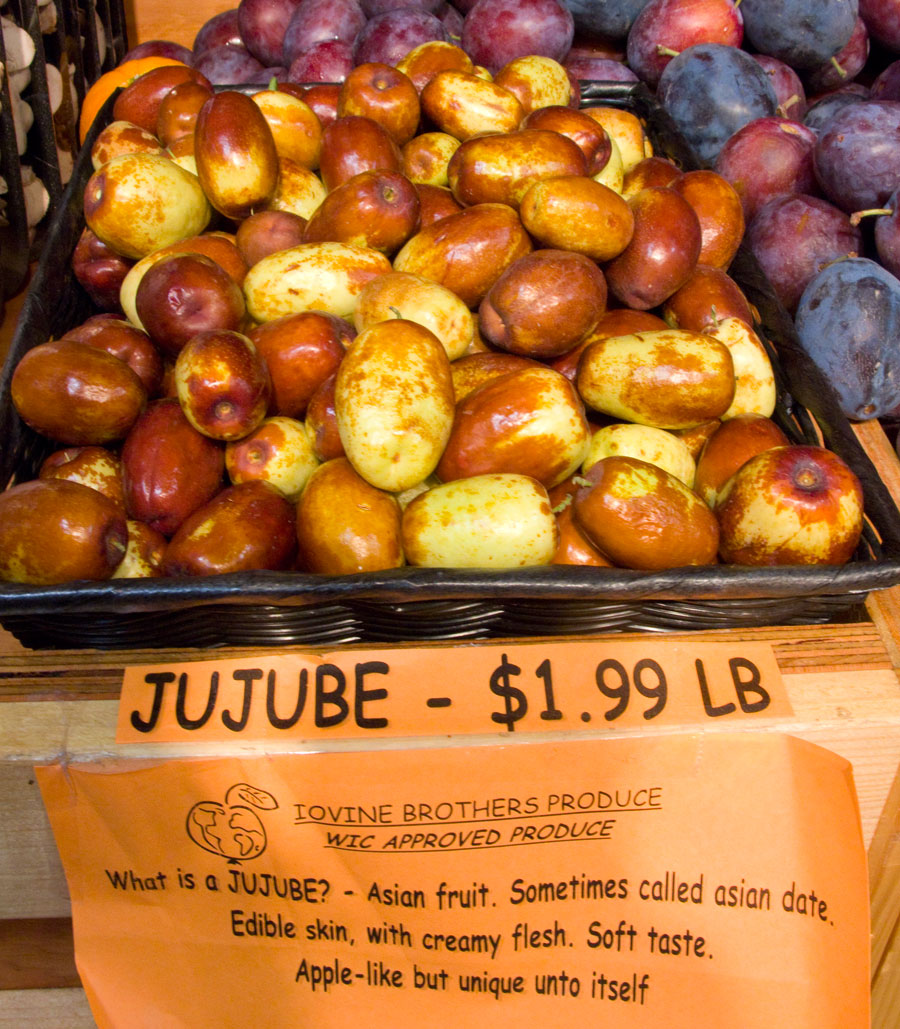
Little did I know there was another Jujube, which I found recently at Iovine Brothers' Produce at the Reading Termninal Market (photo top right). Unlike the sweet, sugary little pellets of my childhood, these Jujubes are alleged to have medicinal properties, as well as a more adult taste. They somewhat resemble dates and, indeed, are sometimes called Red Dates or Chinese Dates, though their origin is probably India. They have a wonderful scientific name: Ziziphus zizyphus. For those interested here's the Wikipedia entry.

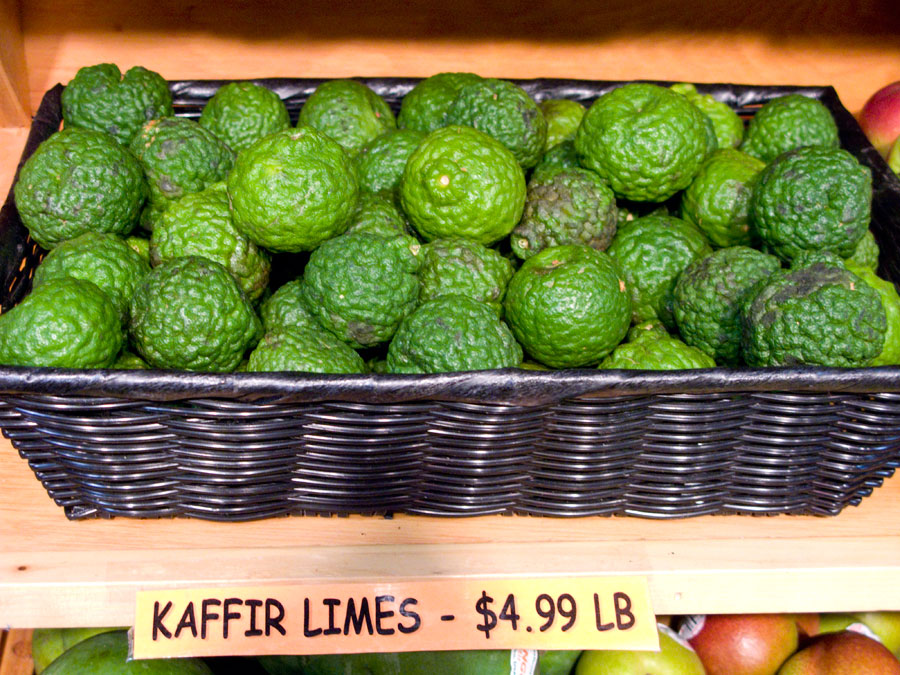
The kaffir limes (photo at right) are also purportedly medicinal and are primarily used in Southeast Asian and Indonesian cuisines, frequently in a curry paste. They are also available at Iovine's.

With the coming of winter (it sure seems close with our recent weather) Iovine's is bringing in more citrus fruit. This past week Valencia oranges were available in bags at a bargain price of $1.99 for a four-pound bag. Tangerines were six for a buck, and Florida navels were five for $2. Cara Cara oranges were 3 for $1. Limes were a bit less pricey today, 5 for a buck. Lemons were 3/$1, but they were heavy with juice. After a hiatus of a week or so, red and green cactus pears are back in stock.

Figs remain available, at least those from California. A pint box of about a dozen brown figs was selling for $4.99 at Iovines. Chile, which dominates the out-of-season fruit market in Philadelphia, is expanding into avocados to compete with Mexico. Iovines was selling medium sized fruits this week, 2 for $1.49; smaller ones were in a separate bin for a quarter apiece.

For as long as I've been shopping there Iovines has sold tofu, but only the medium firm type they package into plastic containers in water. This week they expanded tofu offerings to include three or four additional firm and super firm versions, including a "tofu cutlet" ready for cooking. You can find them in the refrigerated cases by the Filbert Street checkout.

Unpasteurized cider is back in stock at Kauffman's Lancaster County Produce, available in pints and half-gallons. (In the past Ben Kauffman has also sold it in quarts; maybe he'll have those next week).

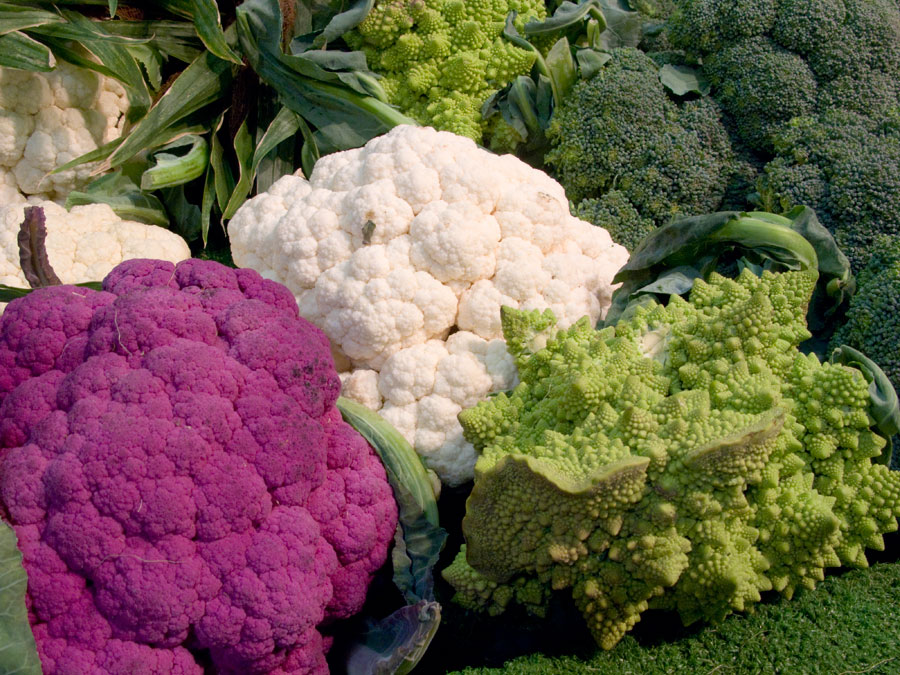
Kauffman's always has a nice selection of brassicas each fall, and this year is no exception, as demonstrated by the purple and white cauliflower, romanesco and broccoli in the photo at left.

One of the joys of Lancaster County in the fall is the appearance of local celery. Livingood's had them at the RTM this morning, $2 a bunch. The celery grown in Lancaster County is a tad less stalky and more leafy, but it's crispy freshness (versus the trans-continental California product) and deep green color make it welcome. I'll put some stalks on an old-fashioned relish tray, with a selection of olives, at dinner tonight. (Drat! I forgort to buy some fresh radishes to complete that tray.)

If we're lucky when we get closer to Thanksgiving we might see some white celery, which is the same thing as green celery except that the stalks are buried so they aren't exposed to light; the process is the same that produces white asparagus. This labor-intensive celery makes a wonderful side when braised in butter with a little white wine

Wednesday, November 05, 2008

Celery Time

As Thanksgiving nears, local celery begins to hit area farmers' markets. Here are meter-long samples of red celery found Sunday at Tom Culton's Headhouse Square stall. Soon we'll see blanched celery, which is grown (mostly) under dirt to prevent the stalks from turning green.

Don't limit yourself to raw celery. This red celery, with thin, tough stalks and coarse leaves, is much more suitable for cooking, with a more intense flavor than the common celery. Braised celery (especially the blanched variety) makes an interesting veggie alternative; you can up the interest even more by finishing with some cream. I used the red celery as the major component in a vegetable stock (along with leek, carrrots and a whole head of garlic). Most of that stock is waiting in the freezer, but I used some last night to create an ersatz caldo verde, adding diced carrots, shredded kale and chorizo, but skipping the potato.

Culton recently returned from Slow Food's Salone del Gusto 2008 in Turin, where he was bowled over by everything, but especially the prosciutto produced from a southern Italian breed of goat. Culton hopes to begin raising the breed here. (No doubt Marc Vetri, who travelled to Turin with Tom, would be interested in Culton's animal husbandry.) Because Culton's pulled out his field crops to concentrate on vegetables, he's got the acreage to create room for ruminants to ruminate. Also impressing him was Eataly, the Turin warehouse food emporium inspired by and associated with the Slow Food movement. Culton said the display of various artichokes (a crop he grows here) was as long as the Headhouse shambles.

About that cream . . .

Most of the heavy cream you come across is ultra-pasteurized for a long, stable, boring shelf life. But you can find good, old fashioned regular pasteurized cream, which hasn't been subjected to the flavor-destroying high temperatures necessary for that longevity. It's been a couple of decades since supermarkets sold the regular stuff, but you can find it at Whole Foods and at the Reading Terminal Market (Lancaster County Dairy).

Jonathan Best

The Reading Terminal Market's web site says Jonathan Best, the grocer and soup purveyor, opened this morning.