Showing posts with label iovine. Show all posts

Saturday, April 16, 2016

Signs of Spring

Photo © Robert Libkind 2016
I thought asparagus was at least a few more weeks away, but it appeared at two stalls at the Reading Terminal Market today, along with two other sure signs of spring: morels and ramps.

Over at Iovine Brothers Produce, pencil-thin asparagus from Mexico stood side-by-side with heftier (but by no means excessively large or woody) stalks from Sun Valley Orchards in Swedesboro, N.J. Tough choice: 2,300 miles from Mexico or 30 miles from Swedesboro? The Fair Food Farmstand also had asparagus today from a producer on the other side of the Delaware.

Expect to see lots more asparagus in the next few weeks. I hope they hold out for the opening of Headhouse Square and other farmers' markets in early May.

Iovine's morels no doubt came from a greater distance that the Swedesboro asparagus. I didn't ask, but my guess is the Pacific Northwest. Still, the plastic and tray wrapped fungi hadn't dried out, and there was only one soft spot showing signs of deterioration. Hardly locally foraged like I used to get from the late Sam Consylman or found at the Dane County Farms Market in Wisconsin, but they'll work.

I passed by the ramps at Iovine's (too expensive) but quickly grabbed a $4.95 bag of them at Fair Food: excellent quality and at about half the price.

I didn't get a chance to visit the Rittenhouse Square Farmers' Market today, but its weekly newsletter said to expect local fiddleheads and watercress in addition to ramps.

I'll be using the asparagus, morels and ramps to replicate a dish first enjoyed nearly 20 years ago at L'Etoile, the shining star of the restaurant renaissance in Madison, Wisconsin. There, asparagus, mushrooms and shallots were scattered about a plate centered by a ring of savory custard and adorned with a light butter sauce. I'll go the same route tonight, wih both morels and oyster mushrooms in the mix and ramps replacing the shallots. A crusty baguette and a glass or two of chilled Alsatian Riesling will complete the meal.

Saturday, June 28, 2014

Cherries a tad less dear


Fruit at Kauffman's Lancaster County Produce, Reading Terminal Market
Cherries remain dear, but at least the price is heading down. Last week Kauffman's Lancaster County Produce at the Reading Terminal market asked $9.99 for a pound of sweet cherries; today it's two bucks cheaper. A pound of cherries will fill up about a one and one-third pints. Ben Kauffman also had some early sour cherries at $8.99/pound and blues at $4.95/pint.

Over at the Fair Food Farmstand there was a sign proclaiming sour cherries for $7.49/quart, but all had been swooped up by 9:30 a.m. Fair Food's sweet cherries were $5.49/pint. So its prices, when converted to pounds, were in line with Kauffman's.

As I said in a previous post, and many others, the best deals on local fruits can frequently be found at L. Halteman Country Foods. Today's prices: strawberries $4.99 quart or $3.19/pint, vs. $5.95/pint at Kauffmans.

Black raspberries are making their debut this week, $4.19 for half a pint at Halteman's, $4.95 at Kauffman's.

The downward trend in lime prices continued today. They're now 6 /$1 at Iovine Brothers Produce, which also had avocados at a buck apiece, but don't wait to use them: the avocados are on the edge ove over-ripe. Perfect for guac.

Taste of Norway appeared to be doing good business in center court with its smoked salmon sale (two eight-ounce packs for $10). Half of the proceeds will go to the market's pilot program in nutrition education for children.


Thursday, June 26, 2014

Cherries, Blueberries, Raspberries Arrive

Beechwood Orchards
On the first Headhouse Farmers Market after summer solstice produce stalls were full with cherries, blueberries and even a few raspberries.

The sweet cherries were a bit of a surprise, given that this year's crop will be lean. Prices hovered around $8.50 a quart (at the Reading Terminal Market, Ben Kauffman's Lancaster County Produce was asking $9.99).

Although the red cherries tasted bright, sweet and fresh, they weren't 60 percent better than the $2.99/pound commercial Washington State Bings purchased later in the week at the Cherry Hill Wegman's. While the store-bought fruit wasn't quite as intense in flavor, it was close enough and just as sweet; the individual fruits were also larger, though that's a tertiary consideration as far as I'm concerned. The sweet cherry, it appears, is one of those fruits that can be shipped cross-country, when properly packaged, successfully.

The local orchardists say the sour cherry crop is also slim and hence will be pricey, too, when it shows up in another week or so. Dave Garretson of Beechwood Orchards said he has a too few early variety sour cherries to make harvesting worthwhile, but expects to bring in mid-season Montmorency pie cherries when they're ripe. Beechwood also offered Rainier sweet cherries last Sunday, priced slightly higher than the sweet reds.

Queens Farm tomatos
Wanna buy some superfruit? Well, blueberries are back, $4.75/pint at Beechwood. Three Springs Fruit Farm had them, too, along with the season's first red raspberries. I've been enjoying the blues in yogurt for breakfast this week. Ben Wenk of Three Springs expects good crop of raspberries this year, especially the black variety. He cultivates both but said the wild raspberry patches he's seen are full of fruit.

The early tomato crop from Queens Farm remains tasty. Although pricey at $3.60/pound for its mixed heirloom varieties, they are a pure taste of summer.

Just in time for gin and tonic season, limes continue their downward price trend. Over at the Reading Terminal Market this week Iovine Brothers Produce has been selling nice-sized and heavy fruits at 20 cents a piece, a far cry from the buck (or more) apiece limes commanded in early spring.

Another crop making its seasonal debut at Headhouse Sunday: sweet corn. South Jersey farmer A.T. Buzby was selling its at 75 cents an ear.

Last Sunday may have been the last we'll see of English peas and strawberries, but there's a chance some farmers in cooler climes may have them. I took the $5 pint of sweet and fresh shelled peas purchased from Tom Culton and turned them (after the briefest boiling and then shocking in ice water) into a salad with some diced and well-fried Irish bacon, thinly sliced shallot rings, shredded gruyere cheese and homemade ranch dressing.

Here's a quick tour of some of the more photogenic produce seen at Headhouse last Sunday:

Summer yellow cukes from Savoie Organic Farm
Radishes in two colors from, iirc, Weaver's Way
Chard from Blooming Glen Farm

Red onions from Tom Culton


Sunday, May 25, 2014

Melon Bargain at Reading Terminal


Buck-a-melons at Iovine Brothers Produce


They came cross country from Arizona, just long enough to ripen by the time they reached the Philadelphia Regional Produce Market on Essentington Avenue, hard by the auto dealers' strip. The wholesaler had to get rid of them, fast, before they rotted in their cases.

Coming the rescue, Jimmy Iovine of Iovine Brothers Produce, who took them off the wholesaler's hands dirt cheap and passes along the savings to us, the happy Reading Terminal Market shopper.

Jimmy was personally hawking these 'lopes yesterday morning like an old-fashioned street vendor, offering plenty of samples, assured after tasting that most shoppers would buy at least one.

I bought two. At a buck apiece, it was hard to resist. I should have bought four. They were dead ripe and as sweet and flavorful as late summer local melons. Two-thirds of the cut up fruit has already been consumed.

Iovine's still had the melons today, but with luck (as far as the merchant is concerned) they'll be gone by the time the market closes at 5 p.m. today. A perfect refresher for any Memorial Day picnic.


Sunday, May 11, 2014

Melon Roulette

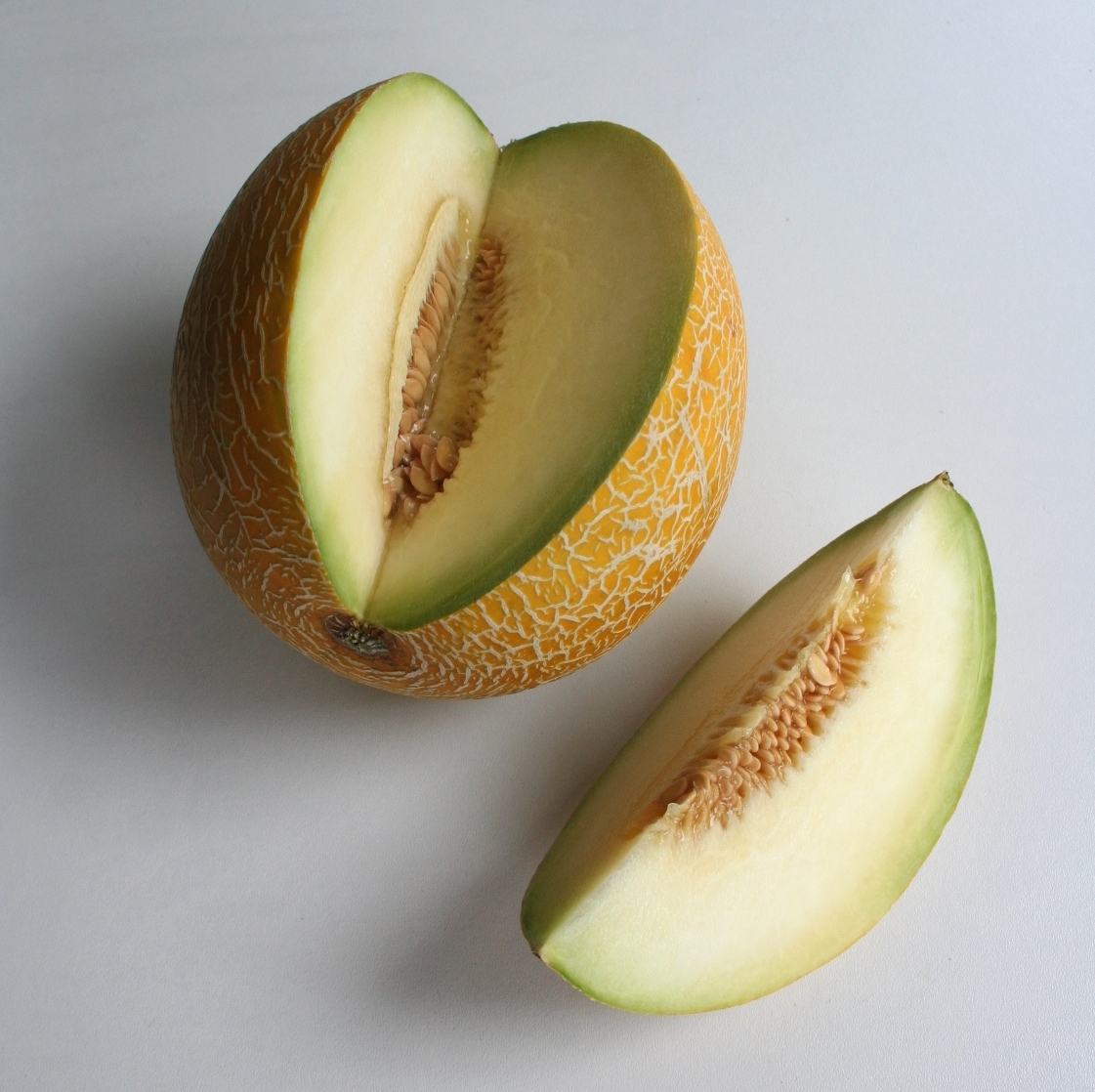
Galia melon
One of the more difficult produce-buying challenges is to pick a ripe melon. Even in late summer, when local muskmelons (canteloupes) and honeydews proliferate, selecting a ripe melon remains, at least to me, a crap shoot. I've read all about thumping, netting, color, smell and every other method of melon selection, but picking the perfect melon can still elude me.

It's even more of a challenge when local melons are not in season. But I still love them, so I'll frequently pick up a container of cut up mixed melons at Iovine Brothers Produce at the Reading Terminal Market. The out-of-season watermelons are almost always sub-par, but occasionally the canteloupes and honeydews are sweet and less than rock-hard.

So it was with trepedation that I picked up a Galia melon yesterday at Iovine's for $1.99. Today I cut it up this Israel-created hybrid now grown worldwide, especially Central America where this specimen came from. I detected only a little aroma from the melon, but the netting was distinct and developed, so I gave it a shot. Success! The Galia is sweet with subtle flavor, and soft, ripe flesh. It should hold up in its container in the fridge for two or three days, but my guess is it will be gone by tomorrow night.

My go-to fruit between apple and strawberry season in recent months has been pineapple. I buy the trimmed, ready-to-eat whole pineapples packed in plastic bags at Iovine's, and they hold up for more than a week in the fridge. I just knife slices off the top as I want them. With rare exceptions these pineapples have been sweet throughout, with no woody flesh.

Besides oranges, the only other fruit regularly in my diet over winter and early spring are frozen blueberries, particularly the "wild" low-bush "arboreal" berries from Canada and Maine. They have the same nutritional content and benefits as the commercial high-bush berries, but a slightly different flavor, which I prefer. I find the best deals on the frozen wild berries at Trader Joe's and usually consume them mashed into plain Greek yogurt.

Still, as much as I like these fruits, I look forward to the local berries; local strawberries should start appearing in farmers markets before the end of the month, given that most crops are running about a week or so behind normal after this year's harsh winter.

Today at Headhouse I picked up about a pound of rhubarb from Tom Culton. I stringed it (as you would celery), cut it into two-inch lengths then cooked it for about 15-20 minutes with a pint of water, half a cup of sugar, and the zest and juice from one juice orange. It's now in the fridge and I'll enjoy it for dessert after whisking the "soup" to break up the remaining soft chunks of rhubart and top it with some fresh whipped cream. The recipe comes courtesy of Mark Bittman.

Monday, February 17, 2014

Winter Vegetable, Hungarian Accent


Green cabbages at Iovine Brothers' Produce
It's soup weather, an ideal vehicle for that sturdiest of winter vegetables: cabbage. It's cheap, easy to prep, nutritious and satisfying.

First, let's deal with price. At the Reading Terminal Market today OK Lee had a special on green cabbage, 39 cents a pound -- half the price Iovine Brothers was charging, although even at 79 cents cabbage will hardly bust a budget. (Red and savoy cabbages are a tad more expensive: this week they were 99 cents at Iovine.)

I found a small cabbage weighing in at a pound and a half (most heads of green cabbage are between two and three pounds) and decided an Eastern European style soup was the way to go. I found lots of recipes on the web, and they were fairly similar, but the one I settled upon -- with two significant tweaks -- is attributed to Mel Markon's, a defunct Jewish deli in Chicago with a credit to the recipe's original appearance in the December 1980 issue of Gourmet magazine.

In addition to scaling the recipe down from a three pound head of cabbage, I took advantage of some homemade Hungarian sausages made by a neighbor's father in Budapest and smuggled back here about four or five years ago. Yes, the sausage is that old, but I've been using it as a flavoring agent in soups and stews and have lived to tell the tale. It replaces the sweet paprika called for in the sausage-less original recipe (find it here), but you could use smoked paprika instead.

My second tweak beyond the sausage was to add some barrel sauerkraut lurking in the back of my fridge. I used about a cup, rinsed, because that's all I had. If I had a quart, I would have used it all.

The most expensive part of the recipe is the meat, since it calls for one and a half pounds of short ribs; I used a little over a pound since I was dealing with a lesser quantity of cabbage.

Finished soup
Start by putting 12 cups of water in your stock or soup pot, then adding the beef before turning the heat to medium high. Once the water starts bubbling, cut back the heat to maintain a steady but minimal simmer. Do not add salt or any other seasoning at this point. When the meat is tender (which might take about an hour) remove it to a platter and let it cool. Make sure to skim the surface of the stock as it cooks to remove scum, and after removing the meat also skim off any fat globules you can find on the surface. (If you wind up boiling rather than simmering the broth, the fat will be emulsified into it, and that's yucky.)

While the meat simmered I attacked the cabbage. After discarding the outer leaves and coring the cabbage I cut it into roughly one-inch pieces. A medium onion got the same treatment. Although the recipe doesn't call for it I added half of an exceedingly large carrot (about one medium carrot) cut into slightly smaller than spoon-sized chunks.

Next, remove the meat from the bone and cut away any identifiable unrendered fat and gristle, then cut the meat into small bits, half-inch at the most.

Take the meat and veggies and add them to the pot, along with three-quarters of a cup of ketchup, a cup of chopped, drained canned tomatoes, a quarter cup of sugar, and a quarter cup of lemon juice (cider or white vinegar could be used in a pinch). If you are fortunate enough to have Hungarian sausage (a Spanish chorizo or Portuguese chouriço would also work) chop up about two ounces worth and add it to the pot. With sausage there's no need for additional seasonings. If you have no suitable sausage go with four or five teaspoons of paprika, plus salt to taste.

The soup should gently simmer (only the barest of bubbles should break on the surface) for 30 to 60 minutes. But don't be tempted to cook longer: overcooking is what leads to cabbage emitting a sulfurous and off-putting odor.

Like many soups and braises it improves with an overnight stay in the refrigerator, which will also allow you to remove congealed fat that might accumulate on top. I froze about half of it and have been enjoyably consuming the remainder. With a slice of good rye bread or pumpernickel and sweet butter you've got yourself a great meal.


Saturday, February 01, 2014

Price Drop on Temples; No More Buck-a-Shuck

The price of temple oranges at Iovine Brothers Produce dropped a bit this week. Today they were four for a buck; last week it was $3. The oranges are a tad smaller, but they weigh out at about a pound and a half for four fruits.

On the other side of the Reading Terminal Market, Pearl's Oyster Bar discontinued the late afternoon Buck-a-Shuck deal. Operator David Braunstein said not many eaters took advantage of the offering, and the few who did rarely ordered anything else. Since Pearl's doesn't offer alcoholic beverages, it was tough to justify continuing.

Meanwhile, Pearl's started work this week on a refurbishing of the restaurant. The walls will get a new treatment, as will the signage, there will be new butcher block tables (though the counter will remain unchanged for now) and the colorful figurehead will be moved to a more prominent position.

Today was the last day for the old information booth at the 12th near Filbert entrance to the market. It will be replaced with a new stall where volunteers will answer questions from tourists, like, "Where is the Convention Center?"

Tuesday, January 28, 2014

Sweet and Tangy: Temple Oranges

To the orange connoisseur, there's no finer specimen than the temple orange. a older mandarin-sweet orange hybrid that's both sweet and tangy. It has a complexity of flavor that no other orange can match.

Alas, because it has seeds many folks avoid the temple orange. That's their ill-fortune and your good luck. And at three for a buck at Iovine Brother's Produce at the Reading Terminal Market these large oranges are a good buy.

Though the skin is tight to the flesh, Temples can be easily peeled and sectioned by hand, much like its tangerine ancestor.

As with any other citrus fruit, you want it to feel heavy in the hand for its size -- that means there's plenty of juice inside. The thin skin will be shiny but not without some spotting

Whether eaten out-of-hand, juiced, sectioned for salads or used in baking the temple orange is a stand-out winter fruit. But get them now: the season is short, less than two months from late-January until March.

Sunday, July 14, 2013

Won't You Be My Melon-craving Baby?


Local muskmelons -- usually called cantaloupes because marketers consider "musk" off-putting -- can be found at local farmers' markets, like Headhouse Square where A.T. Buzby, the South Jesey grower, displayed these giants at $4 apiece.

The same variety of local melon has been available on and off for the last week or so at Iovine's Urban Produce at the Reading Terminal market at half the price for a similar-sized melon. I purchased one of Iovine's a few days ago: good flavor, moderate sweetness with a sea-salt tang, all-in-all, an enjoyable melon to eat.

Although I'm not a stickler for washing produce, I always scrub melons in the sink: they're more apt than most other fruits to pick up pathogens in the soil. A quick, warm, slightly soapy scrub to the exterior before cutting does wonders. If you don't wash melons, any baddies on the surface will work their way inside when you slice it open.

Friday, July 12, 2013

Peachy-Keen

Peaches and pineapples at Iovine's: only one is local.

Ben Wenk restocks peaches
Time to shift to peach pie from cherry.

With the sour cherry season essentially over (you might find a few quarts this weekend if you're lucky) peaches have taken over the fresh produce stalls at area farmers markets. Local peaches can even be found at Iovine's Urban Produce at the Reading Terminal Market, where Jersey peaches were selling for 99 cents a pound recently.

Ben Wenk of Three Springs Fruit Farm had them at his family's stall last Sunday at Headhouse Square, and all the other orchardists are likely to show off their whites and yellows this weekend. Nectarines won't be far behind, and apricots have already made their appearance. Plums of various persuasions (and perhaps even early apples, like Lodi) will show up in the stalls over the next few weeks.


Saturday, May 25, 2013

Strawberries and Snap Peas

Lettuce deal at Iovine Brothers, Reading Terminal
For the past two Sundays there have been strawberries at the Headhouse Square Farmers Market, courtesy of South Jersey grower A.T. Buzby. They've been deep red, inside and out, with decent but not knock-your-socks-off flavor. I've had some leftover in the 'fridge for nearly a week, without too much deterioration.

The relative refrigerator longevity derives from the design of the berry, introduced about a dozen years ago in Florida for its commercial industry. It was created for its ability to withstand the rigors of long-distance shipping and still retain good color, shape and flavor.

In coming weeks we'll see plenty of other stawberries with deeper flavor, if sometimes less perfect shape and a more diminutive size. But as a harbinger of things to come, Buzby's product was much welcomed, and delicious atop fresh-baked Bisquik short cakes with fresh whipped cream.

Asparagus has come into its own, and what I've had has been good. Two weeks ago Tom Culton had both cultivated and wild asparagus. Tender spring greens are easy to find, too, including dandelion greens suitable for adding raw to salads or cooking.

Another welcome returnee at last Sunday's Headhouse market was a snow pea variety of sugar snap peas at Culton's stall. The regular sugar snaps should be appearing soon, too.

Farmers' markets don't have a monopoly on local produce. At the Reading Terminal Market Iovine Brothers Produce has been featuring local lettuces. Earlier this week there were gorgeous heads of Boston lettuce for 89 cents a pound. Today I spied baby romaine heads at 99 cents. Both come from Flaim Farm, a large grower in South Jersey. In addition, the Fair Food Farmstand at the RTM offers plenty of local produce, including those strawberries from A.T.Buzby.

Monday, April 08, 2013

Another Sign of Spring at Reading Terminal


About five thin stalks of ramps will set you back $3.99. This sure sign of spring was prominently displayed in front of the checkout lines at Iovine Brothers Produce, Reading Terminal Market.

Saturday, March 09, 2013

Winter Doldrums

Besides my own personal inertia, one reason this blog hasn't been updated regularly has been the lack of excitement in what's available at the produce markets. It is, after all, late winter, with no local produce (except for what's coming out of hydroponic growers), and the opening of farmers' markets is about two months away.

Even the citrus fruit offerings haven't been inspiring.

And while I like greens, there's a limit to how much kale I want to eat. (Has anyone else notice what a "hot" food item kale as become this year?)

Still there is some interesting produce out there, so long as you're willing to open up your wallet and let the food miles pile up, especially for items coming in from Mexico and South America.

Iovine's Produce, for example, had some asparagus today. And the bagged red and green seedless grapes are nice and reasonably priced at $2.99 for a two-pound bag. Fresh chickpeas (garbanzos) in the shell remain on Iovine's shelves for $3.99/pound. Alas, frying peppers, which for the last three weeks have been priced at a bargain 79 cents a pound, have nearly doubled to $1.49. Green bell peppers, though, were 99 cents today.

Any decent sized orange will set you back 50 cents, though smaller ones can be had at three for a buck. Florida juicers are 4/$1. A dollar's worth of lemons (3) can probably be squeezed enough to generate enough juice for a lemon meringue pie (it did for me a few weeks ago).

I'm not a big egg eater, but the difference between what supermarkets sell and what's available at the Fair Food Farmstand is amazing. Fair Food's are considerably fresher, with deep orange yolks that hold their shape. Yes, they are pricier -- even Fair Food's non-organic eggs are $3.50/dozen -- but when you've got eggs this fresh and good available it's worth the premium. They made a rich lemon curd and pristine meringue for that pie.

Though still a bit dear, the price of broccoli rabe has eased a tad, much to the relief of Joey Nicolosi of Tommy DiNic's. Joey experimented with other greens, and especially liked the way Swiss chard worked with the sandwiches, but he's sticking with rabe and spinach as the offered greens.

Saturday, January 19, 2013

Broccoli Rabe Crisis - Part 2

Broccoli rabe can be had, but it's expensive. The wholesale price has nearly doubled, ranging from $50 to nearly $70 for a 20-pound case; it's usually about $32-35, reports Jimmy Iovine of Iovine Brothers Produce in the Reading Terminal Market. He isn't carrying it at all right now, because the wholesale price translates to a retail price of $3.99-$4.99 a bunch. It usually retails for $1.99-$2.99.

Joe Nicolosi of Dinic's at said he couldn't obtain rabe at all for a day or two, and now he's paying upwards of $65 a case. Joe tried red Swiss chard as a substitute, which he said worked well, though it's more sweet than the slightly bitter rabe. But since spinach is also dear these days, along with other vegetable crops from Southern California's Imperial Valley and Arizona growing areas, the chard may have to do. Although he hasn't tried it yet, Joe is thinking about cooking chopped Brussels sprouts with pancetta as another roast pork topping alternative.

Sunday, November 18, 2012

Life intervenes

Culton's Leaning Tower of Pumpkins
Life has intervened in my blogging pasttime since late September, but I'm back, at least for this pre-Thanksgiving missive.

It's hard to pass up taking a photo of Tom Culton's produce displays at the Headhouse Square Farmers Market. Today he featured a Leaning Tower of Pumpkins. However, Tom actually asked me to take a picture of his nuts . . . that is, his English walnuts.

Culton's produce will be around all winter long this season, since he plans to participate in the year-round Tuesday market at Rittenhouse Square.

North Star Orchards made their last appearance of the season at Headhouse today (the market continues on Sundays until just before Christmas, plus it will be open this Wednesday). Among the apples available was Caville Blanc d'Hiver, a French dessert apple: definitely on the tart side, but tasty and best eaten fresh out-if-hand. Expect Beechwood Orchards, however, to stick around until the market closes for the season; they had a great variety of apples today, including some Newtown Pippins. I had five pounds of Winesaps in the fridge from last week' market visit that I had planned to turn into pie; I was too lazy, however, and made applesauce instead. Three Springs had a "crate" offer today: fill up a crate with the apples of your choice (except Honeycrisp) for $25.

Reading Terminal Market News 

Work in progress: Valley Shepherd Creamery
Lots has transpired at the RTM since I last wrote, including the opening of Wursthaus Schmitz. Plenty of brats to choose from, most made by Rieker's of Northeast Philadelphia, except for the solitary hausgemacht (home-made) brat. You'll have to bring them home to cook, however, since the stall's exhaust system isn't complete yet. When it is, they'll be selling them hot and ready to eat. Nice, if limited, selection of salads, cold cuts, and German grocerty items. (I've got to pick up a bottle or curry ketchup to use on my tater tots.) Although some of the Pennsylvania Dutch delis and butchers have had some traditional German items over the years, I've sorely missed the selection that had been offered by Siegfried's when he was in business at the RTM. Wursthaus Schmitz doesn't have quite the selection that Siegfried offered, but it comes close.

Valley Shepherd Creamery hopes to be open for business by Christmas, but it will be close. Tiling of the cheese-making room is scheduled to start this week.

The great publicity continues to roll in for DiNic's. In addition to being featured in a recent Inquirer article on meatballs, the Cooking Channel will bring in its HD cameras in a few weeks to feature the sandwicherie at the Reading Terminal.

Hershel's East Side Deli has been doing boffo breakfast business. This past Saturday, at least in the early morning hours, the line was longer there than at DiNic's! I like the French toast, but Andy Wash makes an attractive omelet, too, and the potato pancakes are solid (they are the thick variety, rather than the lacy style).

Fresh chick peas at Iovine's
How many truckloads of collard greens will Iovine Brother's Produce sell before Thanksgiving? To use a fine accounting term: lots. Come Wednesday they'll have a 5 a.m. delivery from the produce center, then get another in mid-morning.

A non-traditional Thankgiving food would be fresh chick peas, which are back in stock at Iovine's. At $3.99/pound, however, a bit dear.

The annual holiday model railroad exhibit at the Reading Terminal Market opens Friday, which means Steve Bowes and his organic produce will be displaced to center court for the duration.

After New Year's you can expect work to start on the move of two stalls within the market. Downtown Cheese will shift its operations to the piano court, across from Golden Seafood and Metropolitan Bakery. And Nanee's, the South Asian samosa emporium, will move to the spot formery occupied by Coastal Cave. Taste of Norway, selling smoked salmon, temporarily occupies that spot now as a day stall; co-owner Erik Torp is mulling whether not to seek a permanent location at the market or simply close after the holidays.

The Downtown Cheese and Nanee moves promoted RTM General Manager Paul Steinke to pass up his initial plan to lease what is now a small seating area off center court between Wursthaus Schmitz and La Cucina at the Market. With seating to be sacrified at the Piano Court due to the Downtown Cheese move, now's not the time to cut back seating capacity further.

No word yet on when KeVen Parker of Miss Tootsie's will begin work on his soul food eatery to replace Delilah's. He still has to come up with a new name, since Marion Iovine uses Tootsie's for her salad bar/cafeteria.

Saturday, September 08, 2012

Autumn Arrives at Iovine's Produce


Pumpkins and winter squash filled a market cart at Iovine Brother's Produce by one of their Reading Terminal Market checkout lanes. The cart is alongside the Filbert Street (Harry Ochs Way) windows until Tuesday, when new refrigeration units for mushrooms and other items are installed.

Produce from warmer climes made its way to Iovine's shelves this week, too. It's the end of the season for citrus fruits in South Africa, so the Iovine's are selling large, juice-laden Mineola oranges at three for a buck.

Dragonfruit from tropical lattitudes and prickly pear (cactus pear) from the arid deserts of the southwest U.S. and Mexico also made their appearance this week, as in photo below.


Wednesday, September 05, 2012

Catching Up: Reading Terminal Market

More catch-up by way of photos at Reading Terminal Market over the past month.

Iovine's had some of the nicest looking savoy cabbage I've seen in a while in early August.
Acorn squashes, at Iovine's in late August, herald autumn's arrival
Fair Food has featured a nice variety of onions. Cippolinis could also be found at Headhouse.
Peppers in profusion have been available both at the RTM and farmers' markets.
These were on display at Fair Food.
Nothing says summer like a tomato. And no one displays them better than Ben Kauffman.
Ben also knows how to display corn.

Sunday, July 01, 2012

Veggie City at Markets


A.T. Buzby's summer squashes and eggplants
Buzby's carrots
Summer vegetables are hitting their peak at local farmers' markets. Today at Headhouse Square was no exception.

Corn is coming into its own, though prices can vary widely. Over at the Reading Terminal Market Ben Kauffman was selling his Lancaster County ears for 75 cents apiece, but Iovine's has Bucks County corn for less than half that price: three ears for a buck.

Tomatoes are also starting to taste real. Blooming Glen, one of the Headhouse vegetable stalwarts, had field tomatoes for $3/pound, and a few heirloom varieties for $4.

Those cheap frying peppers I found at Iovine Brother's Produce over the last few weeks have gone up in price to $1.49/pound; they were 99 cents. But we're starting to see bell peppers at the farmers' markets: Tom Culton had green peppers today, and Weaver's Way purples.

Cultton's cornichons
I've making my third batch of kosher pickles of the season right now, using Mark Bittman's recipe which is nothing but cucumbers, salt, garlic and coriander seeds (you could use fresh or dried dill if you prefer). I wasn't going to make the third batch, but Tom Culton's gherkins just looked too good to pass up. Although at $5 for a box with a net weight of one pound, six ounces they were priced considerably more than full sized kirby cukes, I think they'll make great crisp pickles. Culton, who is into all things French these days (just take a look at his new sign, here) calls them cornichons.

Among the other interesting veggies Culton had this week were chickpeas in the shell ($7 a box) and good looking red and golden beets, sans leaves. Here are the pix:

Culton's chick peas
Beets from Tom Culton

Friday, June 22, 2012

Bargains, Rarities at Reading Terminal Market

Frying peppers, cheap
If there's a pepper surplus when the season comes to a close, you might see frying peppers sell for as little as 50 cents a pound. But that's then. Now you can buy them at Iovine Brother's Produce for 89 cents a pound, a clear bargain since just a month or so they were priced as high as $1.99.

I couldn't resist buying a bunch, as well as Italian sausage from Martin's Quality Meats at the Reading Terminal Market. Sauté the peppers with some onions, cook the sausage, and put it all on a good hoagie roll and you've got a fine meal. All the basic food groups are covered except beer.

Peaches have made an early arrival at the market. Benuel Kaufman has some early varities for $2.49/pound, while Halteman is selling them for $2.19. Other good buys at Halteman's: blueberries $3.29 a pint (though Iovine's has Jerseys at $1.99), black raspberries $4.99/pint, sweet cherries $5.99/quart.

Iovine has donut peaches (I didn't ask, but I expect they're from California) for 99-cents pound. They also have a good deal on Vidalia onions, 50 cents pound (normally anywhere from 69-cents to a buck).

Ben Kauffman's Lancaster County Produce boasts another produce item that's a few weeks earlier than normal: corn. I'll pass on that for another week or two, but I can't resist his long, red beets which I find sweeter than the more traditional round beet.

The best deals on cherries I've seen has been at the Fair Food Farmstand, where sour pie cherries have been going for $6/quart, nearly three bucks less than Ben Kauffman asks. I turned two quarts into sorbet last week. Buy them now, because the sour cherry season is incredibly short.


Wednesday, June 06, 2012

Iovine's Goes Local at Reading Terminal Market

Iovine's uses old-fashioned carts to feature local produce
Local produce is hardly a new thing for Iovine Brothers Produce at the Reading Terminal Market. But earlier this spring they positioned two old-fashioned carts near the front of their space to emphasize the local connections.

These days the carts are loaded with lettuces, radishes, cooking greens, summer squashes, mushrooms, scallions and lots more from nearby farms, primarily southern New Jersey, but Bucks County, too.

Jimmy and Vinnie Iovine have long-standing relationships with a number of local farms, including Shady Brook Farm in Yardley, especially for corn.

But even more produce comes from the larger, commercial South Jersey operations, like Vineland's Flaim Farm in Cumberland County. While Flaim is a larger operation than the typical boutique farmer you'll find at the Headhouse Square or Rittenhouse Square farmers' markets, the produce is just as fresh and nutritious, and usually considerably less expensive. Iovine takes deliveries direct from the farms, avoiding the middle-man stop at the wholesale produce market, which speeds the product from farm to shopping cart. And although Flaim and other local farms supplying Iovine are big in comparison with a Tom Culton or Earl Livengood, they're still small potatoes when put up against the agribusinesses in California and Mexico supplying your local Acme.

Iovine's regularly sends out emails (see the latest here) showcasing their specials, including locally grown items. This week they're featuring blueberries. Although the blues brought up from the Carolinas are less expehsive ($1.99 a pint), they've got the first of the South Jersey crop at $3.99. Expect the price to decline in coming weeks as the local product comes into full harvest.

Iovine's is hardly the only option for local produce at the Reading Terminal Market:
  • O.K. Lee, the other large full-range greengrocer at the market, also brings in local produce, including from Lancaster County.
  • Kauffman's Lancaster County Produce, in the market's Pennsylvania Dutch area, features fruits and vegetables from Amish country Wednesdays through Saturday.
  • L. Halteman Family, primarily a deli and butcher, offers a limited selection of seasonal produce from their Pennsylvania Dutch country neighbors, Monday through Saturday.
  • Bowes Family Farm from Milton, Pennsylvania, offering organic produce, can usually be found Thursday through Saturday in the Piano Court (near Metropolitan Bakery). His prices, though, rival those at the high-end farmers' markets.
  • Fair Food Farmstand has been pioneering selling local produce at the market for about a dozen years, often at prices that rival Iovine's. Much of their produce comes from the same producers you'll find at local farmers' markets.