Showing posts with label steinke. Show all posts

Saturday, March 24, 2012

Things Change: Expected and Unexpected

You go away for a week and things change.

Like the sudden pullout of Delilah Winder from the Reading Terminal Market. Or the arrival of spring.

Officially, the market hopes to welcome back Delilah when her bankruptcy/financial issues are resolved. Market GM Paul Steinke would love to see Delilah back -- the bankruptcy court told him Delilah's could be re-open in just a few weeks -- given Delilah's high visibility through her Oprah connection and Food Network exposure. But he's got to be thinking of bringing in another soul food restauranteur if that doesn't happen.

Another change, this one no surprise: Flying Monkey Bakery moved to its new location in the former Spataro's spot this past week. Which reminds me: I neglected to pick up some whoopie pies this morning!

Flying Monkey's move clears the way for a faster pace of work on the remainder of the Avenue D improvement project at the market, especially the Rick Nichols Room, the multi-purpose room to be located behind the bakery's old spot and adjacent to La Cuchina at the Market, Anna Florio's institution of higher culinary education.

Work should begin next month on Wursthaus Schmitz in what's now seating space behind Flying Monkey, with opening hoped for before Memorial Day, the official start of grilling season. The connection? Bratwurst!

A bit later on the schedule will be Valley Shepherd Creamery, which will locate along Avenue D across from Molly Molloy's. They aim to open in late spring. Chief Shepherd Eran Wajswol and crew are busy right now with lambing. They expect 800 little ones to join the flock this spring.

Another sure sign of spring is the arrival of ramps. Iovine's had them today, $1.99 for a small bunch (enough for two servings as a flavor accompaniment to your eggs or just about anything other protein. Alas, they had traveled too far and were in less than pristine condition. I'll wait a few weeks.
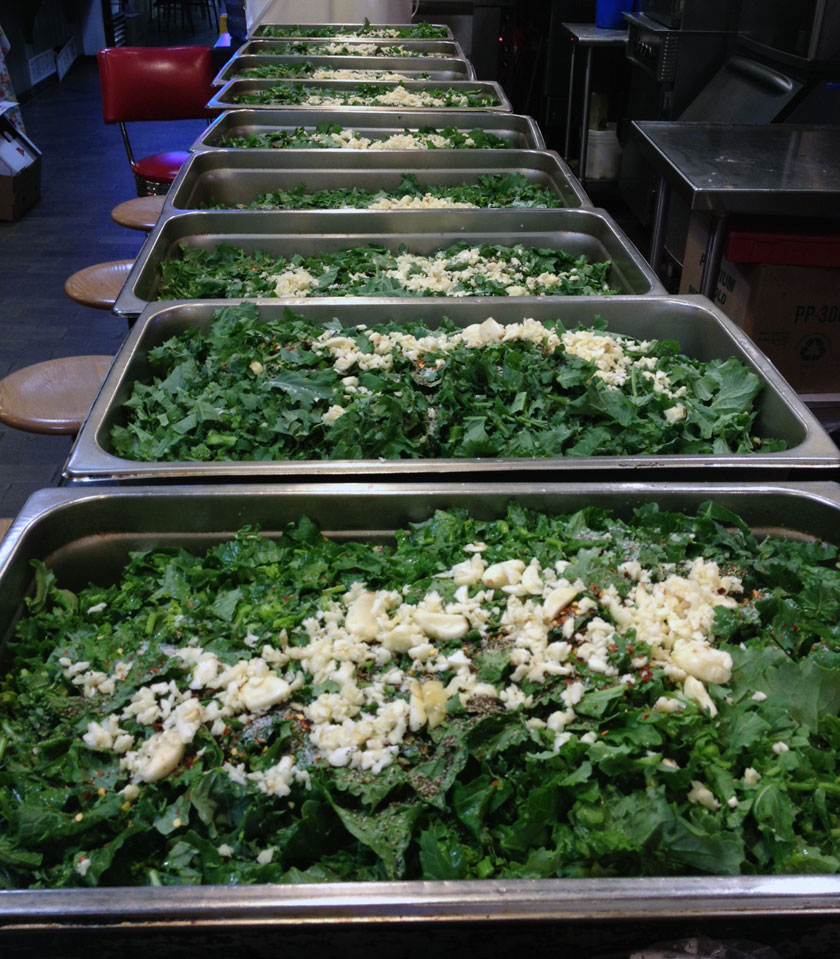
Greens and garlic await oven at Dinic's
Dinic's has got new menu boards up and, as reported earlier, scallopine is gone and meatballs are in. Joe Nicolosi says they pretty much have the meatballs every day, though they might occasionally skip a day.

Bobby Fisher, chef at Molly Molloy's, has been missing in action due to surgery, according to Jim Iovine, proprietor. Best wishes for a speedy recovery, Bobby.

Like J.P. Morgan's yacht, if you have to ask the price you probably can't afford it, but the jamón ibérico de bellota (Spanish acorn ham) at Jack Morgan's Downtown Cheese is like eating ham butter. It puts the best prosciutto to shame.

The American version of dry aged ham can be obtained at L. Halteman Family. It's also priced dearly (though not nearly as high as the Spanish pig). You can buy some of the Smithfield ham slices (vacuum packed on premises) for a bit over $5, enough to make three or four sandwiches. The Riehl family, operators of the stall, will be shifting their footprint closer to Avenue C next month, also part of the market's current improvement project.

Steinke will be off to Los Angeles late next week for the annual conference of National Association of Produce Market Managers, the professional association of managers of permanent wholesale produce markets, retail farmers' markets, and public markets. He'll make a presentation about the RTM's current Avenue D improvement project.

Thursday, February 09, 2012

RTM's Leasing Strategy Works Against Rick's Return

With the market's renovation program centered along Avenue D opening up space for four new merchants, General Manager Paul Steinke's emphasis has been to fill those slots with "purveyors" who primarily sell foods for cooking or eating at home. That's why the chances of any new pure lunch vendor of getting one of the two remaining stalls is slim at best and why Rick Olivieri's attempt to reenter the market with his Rick's Steaks business will fail.

It's certainly possible, though, that a vendor selling for both on- and off-premises consumption could get that nod. I think the only chance for a new vendor to primarily sell for on-premises consumption would be to offer something not now available from other lunch counters. Hot donuts, anyone?

Only one of the three new vendors announced so far will sell food for eating within the market, but it will also offer groceries and other food products to take home: Wursthaus Schmitz would carry German groceries and cold cuts as well as hot foods for eating either within the market or at home.

The second new vendor would be artisinal cheese maker Valley Shepherd Creamery, which is expected to sign a letter of intent within a few weeks. The latter's product would be overwhelmingly for off-premises consumption, though there's no reason why someone couldn't have a sheep milk yogurt for lunch in center court. A third new vendor, The Head Nut will essentially replicate the offerings of The Spice Terminal, which declined to renew its lease.

That leaves two remaining spaces for new vendors: one along the Avenue D wall, another in a small space on center court adjacent to where Wursthaus Schmitz will be located.

The market's operating policy guidelines require that no more than the greater of one-third of the number of vendors or one-third of the floor space go to businesses "which offer food intended primarily or exclusively for consumption within the Market."

While Steinke is comfortable that the current breakdown of merchants is well within that restriction, by my subjective count 36 of the 77 existing merchants exclusively or primarily fall into the "on-premises consumption" category.

Let me emphasize the subjective nature of determining whose "primary" business is for off-premises consumption or not. As an example, take 12th Street Cantina, which I consider among those who "primarily" sell for on-premises conception but Steinke does not. Steinke says this business a "two-sided" purveyor that doesn't count against the operating policy ratios because of the many take-home Mexican groceries and prepared foods they sell. My opinion is influenced by the fact that 12th Street Cantina has a seating area for diners. (I've got to admit, though, nearly all of my purchases there have been for ingredients to use at home.)

The same debate could be held about any number of other vendors, from Kamal's Middle Eastern Specialties to By George! Pizza, Pasta and Cheeseteaks, both of which also sell plenty of items for consumption and/or cooking at home, but also earn money as lunch vendors. (Indeed, the line for cheese steaks at By George! at lunchtime frequently blocks the aisle.) The key metric in making any such determination as to whether a business is "primarily" engaged in sales for off-premises consumption would be to know the revenue breakdowns, but neither Steinke nor I have access to that proprietary information.

Getting back to Olivieri, another factor why he has little chance of reestablishing his cheese-steakerie in the market are the three existing vendors who depend upon cheese steak sales, and two others who find it a highly profitable sideline. Although Steinke said he couldn't give a "blanket answer" to a hypothetical question about allowing a new merchant to compete with the same product of five existing merchants, it's hard to imagine him adding another tourist-centric cheese steak stall. He acknowledged to Dan Gross of the Daily News, who broke the Olivieri story Wednesday, that cheese steaks were not the market's "highest priority".

When Olivieri's lease was not renewed in 2008, the market allowed two additional vendors to sell cheese steaks: Carmen's Famous and By George! (Spataro's earlier had been permitted to add cheese steaks when they moved to a new center court location.) Today all three businesses incorporate "cheese steaks" into their formal names. In addition, the Down Home Diner sells cheese steaks, as does the new Molly Molloy's.

Rick's Steaks loss of its lease in 2008 followed Olivieri's vociferious leadership of the Reading Terminal Market Merchants Association when the market was restructuring lease agreements and fee structure. You can find earlier stories about the Olivieri-RTM clash here and here.

Saturday, January 22, 2011

Mid-Winter Catch-Up

It's been two months since my last report, due to some family health issues (well on their way to a successful outcome), holiday hectic-ness and my own laziness. I'll try to make up for it with this and subsequent reports.

Terre Madre Festival


On December 10 the RTM held its inaugural Terre Madre Day, named after the huge, artisinal food celebration/convention held every other year in Turin, Italy. Since Paul Steinke, the market's general manager, attended last fall's event in Italy, he brought a bit of it backby organizing a day to show off local foods here.

In the photo, food author Aliza Green, ably assisted by Betty Kaplan, cook up some flank steak from local beef for tasters, while Mike Holahan of Pennsylvania General Store passed out some of Uncle Jerry's Pretzels. Among the other participants: Bee Natural, Blue Mountain Vineyards, Metropolitan Bakery, Birch Run Hills Farm, Earth Bread + Brewing, and Cope’s Dried Corn.

Wednesday, September 22, 2010

POTUS @ RTM


White House Photo/Pete Souza

President Barack Obama fit in a quick, under 15-minute visit to the Reading Terminal Market Monday, including a meet and greet with Golden Bowl owner Sun Mun, who was snapped with him by stall worker Kwok Wong.

Steinke, who usually takes off on Mondays after working weekends, got the call from his office at about 3:50 p.m. that the President would be making the stop before his fund-raising appearance on behalf of Senate candidate Joe Sestak. Steinke quickly donned his suit and rushed in from his West Philly abode, just in time for the photo at right (courtesy of Bassetts Ice Cream) with Obama and, at right, Steve Safron of Hershel's East Side Deli.

In his 4:30-4:45 p.m. visit, the President grabbed an ice cream cone at Bassetts (mint chocolate chip), a cheese steak at Carmen's and four apples from the Fair Food Farmstand, all along the market's Avenue A, the aisle closest to 12th Street. The Secret Service narrowed the President's visit to that small area of the market to provide better security.

Although market personnel weren't alerted to the visit until about 45 minutes beforehand, Secret Service and White House staff had been casing the RTM the previous week, so the stop was no spur-of-the-moment cheese steak fix.

Monday, August 30, 2010

-
RTM Acquiring Farmers' Markets Operator

Farm to City, which operates more than a dozen farmers’ markets in Philadelphia and its suburbs, plans a return to its roots at the Reading Terminal Market.

Farm to City's history with the RTM goes back to 1992 after Bob Pierson and a couple of friends started one of the city’s first contemporary farmers’ markets at South and Passyunk, a market which still flourishes under the auspices of Farm to City. That same year Duane Perry, then executive director of the Reading Terminal Market Merchants’ Association, hired Pierson to develop neighborhood markets for its newly-formed Reading Terminal Market Farmers’ Market Trust, which later evolved into today’s The Food Trust. Pierson left The Food Trust in 2002 to begin Farm to City.

If the negotiations are concluded successfully Pierson and the rest of his small staff will become employees of the Reading Terminal Market. The planned reconfiguration of vendor and office space at the RTM includes accommodations for Farm to City staff.

Both Pierson and Paul Steinke, general manager of the RTM, see two primary benefits to the merger: co-branding and funding. It would also provide a stable base under the wings of a larger organization for the farmers' markets.

“It's a co-branding that's attractive to Farm to City, aligning us with a well-known Philadelphia icon, a landmark known for its food. And the Reading Terminal Market is a non-profit corporation which would allow us to extend some of our programming by seeking and receiving grants,” said Pierson. Because Farm To City is structured as a for-profit limited liability company it does not benefit from foundation largesse.

“The acquisition of Farm to City by RTM is good match,” said Mike Holahan, president of the Reading Terminal Market Association. “We share similar values as to the importance of nurturing the local food system. But as in all mergers the devil is in the details.”

Those details include making sure the farmers’ markets continue to limit their vendor list to farmers and food producers, not middlemen. That’s the main concern of Jimmy Iovine of Iovine Brothers’ Produce, who otherwise is supportive of the acquisition. He sees the merger as contributing to public perception of the Reading Terminal Market as a great place to shop, which can only lead to more volume for his greengrocer’s business. Another purveyor, butcher Charles Giunta, expressed concern that by expanding outward the market would lose focus on growing the business of existing merchants.

Steinke sees an acquisition of Farm to City as a way to protect and build the market's existing business because it would “attach the Reading Terminal Market brand to the grower movement.”

Even though the RTM is technically a public market, not a farmers’ market, “most people think of us as a farmers’ market already, as a showcase for local food,” Steinke said. The RTM is one of the few public markets without an associated farmers’ market, he said. Among the public markets with farmers’ markets are Cincinnati’s Findlay Market, Milwaukee Public Market, North Market in Columbus, Ohio, Capital Market in Charlestown, West Virgiia, and Pike Place in Seattle.

Steinke said Farm to City’s markets in Philadelphia’s urban and suburban neighborhoods will be branded as an arm of the Reading Terminal, much like the Pike Place Express farmers markets in Seattle.

James Haydu, Pike Place’s Director of Communictions, said the two Seattle satellite markets were organized last year to provide additional selling opportunities for about a dozen farmers who sell at the main market once a week.

“We created Pike Place Express to offer our farmers another venue to sell. While Pike Place is located in the city’s downtown people may not have time to walk down here during lunch. We wanted to give them an opportunity to buy closer to where they are,” Haydu said. “By affording farmers additional venues, it creates a domino effect that’s good for the agricultural economy in the state of Washington.”

Steinke said that until a few years ago “farmers’ markets pretty much weren’t on the radar, but we’ve seen growth in markets like Headhouse. Acquiring Farm to City creates a ready-made pipeline to the farming community for us.”  When the market carves out additional vendor space through its proposed reconfiguration of Avenue D along the east side of the RTM, Steinke plans to take advantage of that pipeline.

Farm to City’s neighborhood markets, winter market and community supported agriculture (CSA) program “complement the products we have at the Reading Terminal Market” Steinke said.

The merger had its genesis this past spring when, in an attempt to replace the departing Livengood Family Farm Saturday stall and secure its reputation as a mecca for locally-produced foods, the Reading Terminal Market asked Pierson to organize an outdoor farmers' market across the street.

The results of that collaboration – a Saturday farmers’ market opposite the RTM on 12th Street – fizzled but it led to the current merger path. Steinke credited the idea of an RTM acquisition of Farm to City to Ann Karlen, executive director of Fair Food, which operates a stall at the market selling products from dozens of regional farmers.

According to its web site, farmers markets operated this season by Farm To City are located at Rittenhouse Square, South & Passyunk, Fountain Square in South Philly, Mount Airy, 36th & Walnut, Love Park, Girard & 27th, Oakmont in Havertown, Suburban Station, Jefferson Hospital (10th & Chestnut), Bala Cynwyd, East Falls, Chestnut Hill, Manayunk, Swarthmore, and Bryn Mawr.

Most of the city's other farmers' markets, including Headhouse, Fairmount, and Clark Park, are operated by The Food Trust. In all, that organization manages nearly 30 markets in Philadelphia and its suburbs.

Sunday, June 06, 2010

Reading Terminal Market Expansion
More room for more vendors in planned $4.5 renovation

With all possible space completely leased for the first time in more than 16 years and other entrepreneurs wanting to join its roster of vendors the Reading Terminal Market Corporation has drawn up plans for carving out about 3,500 square feet of additional retail space from its existing footprint. It would expand the selling floor by nearly 9 percent from the current 40,000 square feet.

Closer collaboration with Bob Pierson's Farm To City, which operates many of the area's farmers' markets (including the recently inaugurated Sunday market outside the RTM) is part of the plan; that organization is expected to move its staff to enlarged office space at the market.

A Farm-to-City/RTM collaboration augers well for the market's desire to bring some farmers back into the market for direct sales to shoppers. (For more on that see Replacements for Livengoods, below).

Paul Steinke, now in his eighth year as the market's general manager, hopes funding for the expansion and related renovations can be secured by the end of the year and work begin in 2011.

Another benefit from the expansion will be larger restrooms, with a significant number of added stalls for the ladies who form a long line in the aisles when market traffic is heavy.

The genesis of the project was the need to rehabilitate the existing obstreperous freight elevator, which had merchants accessing basement storage areas cursing. The additional retail footage will be created by relocating to the basement current storage and prep space on the market's east side after the existing elevator is fixed and a second elevator installed in an existing unused shaft.

The market's Avenue D aisle, which provides access to the current storage areas, restrooms, and two vendors (Miscellanea Libri and the shoeshine stand) would be moved further west to create the retail space.

The new restrooms would occupy space currently occupied by the market's floor operations staff, La Cucina at the Market and part of the aisle known as 11th Street. Seating and event space would be added next to the relocated La Cucina along Avenue D.  More retail space would be carved out on both sides of the new Avenue D.

The additional office space for market office staff and Farm to City would be created by extending the existing office loft over the remainder of Tootsie's Salad Express.

The expansion would take place in phases, starting with the elevator work, after which storage would be moved to the basement. Restrooms would then be expanded, followed by the new retail space and the extention of market office space.

The new Avenue D would temporarily jog around the rear of Flying Monkey Patisserie and L. Halteman Family's meat, deli and produce stall. Eventually, after their leases come up for renegotiation in a few years, Avenue D could be straightened out.

Replacements for Livengoods

No doubt about it, both market shoppers and managers miss Earl Livengood's Saturday-only produce standing selling fresh Lancaster County produce from his farm in center court. Earl declined to return this year, favoring his existing presence at the Bryn Mawr farmers' market and adding King of Prussia on Saturday.

To fill the void Steinke said he is close to adding a rotating series of producers to Livengood's spot. Two produce growers and one non-artisinal cheese-maker are in discussions to occupy the space on Saturdays.

Tuesday, April 13, 2010

Judge backs Giunta in chicken case

The chickens have come home to roast. For Charles Giunta that's a good thing.

A ruling today by Common Pleas Court Judge Mark I. Bernstein gave Giunta the right to sell hot rotisserie chicken from his stall at the Reading Terminal Market, Giunta's Prime Shop.

Giunta had been seeking to sell the cooked birds for more than a year, but was turned down by RTM General Manager Paul Steinke on the basis that Giunta's lease did not permit him to sell hot foods. Giunta sued the market and today Judge Bernstein ruled from the bench that there's nothing in the lease to prevent the butcher from selling the rotisserie chicken.

The market's board holds a regular meeting tomorrow and will consider whether or not to appeal.

Steinke said Giunta's lease was written to allow the vendor to sell pre-cooked meats for consumption at home as well as prepared meats (for instance, stuffed meats) for cooking at home, much as Harry Ochs & Sons does.

Also influencing Steinke's initial rejection of Giunta's request was concern it would harm the existing business of another merchant, Dienner's Bar-B-Q, which deals primarily in rotisserie chicken.

The suit has been simmering for about a year, but unlike the highly publicized and emotional battle with Rick Olivieri of Rick's Steaks, which took on the dimensions of the personalities involved, this was "strictly business". It totally lacked the histrionics of the earlier case which resulted in a settlement in the market's favor in which Olivieri left the market.