I'm not an egg person for breakfast. But I love grilled cheese and I love sausage. Which means I can't wait until two of the newest lunch stands at the Reading Terminal Market start offering food for the barely-awake set.
Valley Shepherd Creamery hopes to open their panini machines for breakfast sometime in the near future, but not quite yet. Right now you can't get a grilled cheese until 11 a.m.
Same goes for Wursthaus Schmitz. I'm told their sausage sandwiches are quite tasty, but I haven't been by at lunchtime yet. Still, I think bratwurst on a roll is a great wake-me-upper.
A third new lunch vendor, Keven Parker's Soul Food Café, has a waffle maker, but that's for chicken and waffles at lunch.
Speaking of breakfast, I regularly buy whole bean mocha java from Old City Coffee and enjoy it most mornings at home. But as much as I enjoy it, and the coffee Old City brews on premises, my fav coffee for sipping on site at the RTM is the java from Flying Monkey Bakery. IIRC, it comes from Vermont Artisan Coffee. Hardly local. But then again, when's the last time you saw a coffee plantation in southeastern Pennsylvania or South Jersey?

Showing posts with label valley shepherd. Show all posts
Showing posts with label valley shepherd. Show all posts
Saturday, January 19, 2013


Saturday, January 12, 2013
Creamery, Soul Fooder To Open This Coming Week
 | ||
| Staff at Valley Shepherd Creamery fits in some training Saturday before stall's opening |
 |
| Eran Wajswol and Jamie Png |
Parker, proprietor of Miss Tootsie's on South Street (he can't use that name at the RTM because Marion Iovine D'Ambrosio already has a claim on Tootsie's for her salad bar), built the stall in record time. There's still more work to be done, but he told RTM General Manager Paul Steinke he'd be open Monday. That should give him enough time to work out at least some of the kinks before the auto show crowds descend next weekend.
Both Parker and Valley Shepherd owner Eran Wajswol received their certifications this past week from the city health department.
Valley Shepherd won't begin cheese-making operations at the stall for another week or so, according to Wajswol's on-site cheese-maker, Jamie Png. But the full range of cheeses made at the creamery in Long Valley, N.J., will be available, along with paninis. Helter Skelter, a raclette-like cheese seen at the bottom right of the photo of Wajswol and Png, will serve as the base for three of the sandwiches.
Monday, December 31, 2012
More Lambs Come To Market
Vegetarian Stall Gives Way to Red Meat
There's an ovine outbreak at the Reading Terminal Market.
In addition to the soon-to-open Valley Shepherd Creamery in newly created Avenue D retail space, a southwestern Virginian sheep meat and wool operation will take over the space vacated by the Basic 4 vegetarian lunch counter.
Border Springs Farm will set up shop selling fresh and frozen lamb as well as prepared lamb-based foods (sausage, shepherd's pie, etc.). Owner Craig Rogers operates a similar stall at Union Market in Washington, D.C., but primarily sells meat to restaurants. The farm is located about halfway between Roanoke, Virginia, and Winston-Salem, North Carolina.
The Philadelphia store will allow Rogers to expand his retail presence and extend his restaurant-supply business into the Philadelphia market.
Two existing butchers at the market -- Charles Giunta of Giunta's Prime Shop and his brother Martin of Martin's Quality Meats -- offer good lamb selection, including three different types of chops, as well as leg, neck and breast cuts. They primarily use domestic sources for lamb, whereas supermarkets use both U.S. and Australian/New Zealand meats. The Fair Food Farmstand sells lamb from producers in both eastern and western Pennsylvania.
 | ||||||
| Valley Shepherd added Krispy Kreme-like neon sign above its cheese-making room |
In addition to the soon-to-open Valley Shepherd Creamery in newly created Avenue D retail space, a southwestern Virginian sheep meat and wool operation will take over the space vacated by the Basic 4 vegetarian lunch counter.
Border Springs Farm will set up shop selling fresh and frozen lamb as well as prepared lamb-based foods (sausage, shepherd's pie, etc.). Owner Craig Rogers operates a similar stall at Union Market in Washington, D.C., but primarily sells meat to restaurants. The farm is located about halfway between Roanoke, Virginia, and Winston-Salem, North Carolina.
The Philadelphia store will allow Rogers to expand his retail presence and extend his restaurant-supply business into the Philadelphia market.
Two existing butchers at the market -- Charles Giunta of Giunta's Prime Shop and his brother Martin of Martin's Quality Meats -- offer good lamb selection, including three different types of chops, as well as leg, neck and breast cuts. They primarily use domestic sources for lamb, whereas supermarkets use both U.S. and Australian/New Zealand meats. The Fair Food Farmstand sells lamb from producers in both eastern and western Pennsylvania.
Saturday, December 22, 2012
2013: More Changes at Reading Terminal Market
 |
| Tile art promotes one of the milk sources for Valley Shepherd Creamery |
In late fall the creamery installed the tile art pictured above. The tiles were manufactured in Bucks County at the former Mercer tile works.
Expect construction to begin soon after the New Year arrives on one relocated stall and a new vendor at the Reading Terminal Market.
Nanee's Kitchen, purveyor of samosas and other South Asian fare, is finishing up details with its contractor so it can begin work on revamping the former Coastal Cave space. In addition to continuing to sell hot items for RTM lunchers, they plan to add some grocery items.
KeVen Parker will be working on his soul food restaurant, carrying on the tradition established in the same spot by Delilah Winder.
A bit further into the future will be the move of Downtown Cheese to what is now the Piano Court.
No announcement yet on what will go into the space formerly occupied by Basic 4 Vegetarian Café. But think meat.
Wednesday, June 27, 2012
More Random Notes on Reading Terminal Market Celebration
It's time to play catch-up with the remaining events at last week's Avenue D Renovation Celebration at the Reading Terminal Market.
Rick Nichols, who planned much of the week's programs along with market officials was quite proud of the title he gave to last Thursday's noontime talk by Eran Wajswol of Valley Shepherd Creamery:
What a Friend We Have in Cheeses
Wajswol, a late-comer to commercial cheese-making after a career as an engineer for nuclear power plant cooling systems, will be joining the list of market vendors this fall when he opens up his shop along Avenue D, where he'll not only sell and serve cheese (serving in the form of cheese paninis), but make it, too. He'll use cow milk from regional dairies (Delaware Valley College's and University of Pennsylvania's veterinary school are likely, but he's got others under consideration) to produce at least one cheese at the terminal, in full view of customers. "Reading Cheddar" will be his first cheese, but you won't be able to buy it for at least eight to twelve months after it's made: that's how long it will take to age in the market's basement where he'll have his aging room as well as milk storage tank. He's also considering making a Stilton-like cheese, and perhaps a fresh mozzarella.
Ellen Yin of Fork was joined by her long-time, but soon-to-be-gone chef, Terrence Feury, for a fish demonstration Friday at noon.
It's unfortunate that in the demonstrate Feury used a fish that's hard for the retail customer to come by: a salmon trout from Loch Duart in Scotland. This farm-raised fish is of superb quality, much better than the typical farm-raised Atlantic salmon. But it's impossible to find in fish stores, and exceedingly pricey even at the wholesale level. Even domestically raised salmon-trout, also known as steelhead, can be difficult (but not impossible) to find in retail stores in the Philadelphia area.
That said, Feury made a tasty dish that could easily be replicated, if not for the fish, at home. (I'd recommend doing it with Alaska king or sockeye salmon, now in season.) Cut a skinned filet into small serving pieces, about 2 ounces and lightly sprinkle with a mix of equal amounts of kosher salt and sugar, then let sit for about 20 minutes. The pieces then get very lightly sautéed in a lightly oiled pan (just warmed through, not cooked, hence the need for the best possible fish), then served with a lemon-oil emulsion (equal parts juice and olive oil, emulsified in the blender). He accompanied the fish with a melange of tiny cubes of cucumber, sun-dried tomato, in a sauce made with verjus and olive oil.
Yin and Feury's presentation was well attended, and among those watching was a Philadelphia restaurant luminary from the past: Kathleen Mulhern. She was another contributor to the city's restaurant renaissance in the 1970s with The Garden, which lasted from 1973 until early in the new millenium.
Sausage, sauerkraut and beer was the focus of Doug Hager, proprietor of Brauhaus Schmitz, and his executive chef, Jeremy Nolan, at Friday's 5 p.m. demonstration. This summer they plan to open their retail outpost at the RTM, Wursthaus Schmitz, where they'll sell sausages for cooking at home, German deli meats, and grocery items imported from the old country. Sausages and salad items they don't make in their own kitchen at the South Street restaurant (now being expanded) will come from Rieker's, the emporium of all goods German in Fox Chase.
As Nolan operated the gleaming sausage stuffer, after mixing ground pork with appropriate seasonings to make bratwurst, Hager, born in northern Bavarian to an American father and German mother, poured the beer. And they weren't tiny samples, either! The beer and cooked brats were accompanied by a sauerkraut (based on imported German wine kraut, but doctored up by Nolan with beer, juniper berries and other seasonings), and German potato salad.
On Saturday at noon, in the week's final demonstration, Aliza Green, the first chef at White Dog Cafe, consultant to many Philadelphia restaurants, and inveterate cookbook author, demonstrated how to use ingredients found at the market with Anna Florio, proprietor of La Cucina at the Market, the demonstration kitchen where she conducts classes and food-related events.
 |
| Eran Wajswol |
What a Friend We Have in Cheeses
Wajswol, a late-comer to commercial cheese-making after a career as an engineer for nuclear power plant cooling systems, will be joining the list of market vendors this fall when he opens up his shop along Avenue D, where he'll not only sell and serve cheese (serving in the form of cheese paninis), but make it, too. He'll use cow milk from regional dairies (Delaware Valley College's and University of Pennsylvania's veterinary school are likely, but he's got others under consideration) to produce at least one cheese at the terminal, in full view of customers. "Reading Cheddar" will be his first cheese, but you won't be able to buy it for at least eight to twelve months after it's made: that's how long it will take to age in the market's basement where he'll have his aging room as well as milk storage tank. He's also considering making a Stilton-like cheese, and perhaps a fresh mozzarella.
 |
| Terrence Feury works salmon as Rick Nichols comments |
It's unfortunate that in the demonstrate Feury used a fish that's hard for the retail customer to come by: a salmon trout from Loch Duart in Scotland. This farm-raised fish is of superb quality, much better than the typical farm-raised Atlantic salmon. But it's impossible to find in fish stores, and exceedingly pricey even at the wholesale level. Even domestically raised salmon-trout, also known as steelhead, can be difficult (but not impossible) to find in retail stores in the Philadelphia area.
That said, Feury made a tasty dish that could easily be replicated, if not for the fish, at home. (I'd recommend doing it with Alaska king or sockeye salmon, now in season.) Cut a skinned filet into small serving pieces, about 2 ounces and lightly sprinkle with a mix of equal amounts of kosher salt and sugar, then let sit for about 20 minutes. The pieces then get very lightly sautéed in a lightly oiled pan (just warmed through, not cooked, hence the need for the best possible fish), then served with a lemon-oil emulsion (equal parts juice and olive oil, emulsified in the blender). He accompanied the fish with a melange of tiny cubes of cucumber, sun-dried tomato, in a sauce made with verjus and olive oil.
Yin and Feury's presentation was well attended, and among those watching was a Philadelphia restaurant luminary from the past: Kathleen Mulhern. She was another contributor to the city's restaurant renaissance in the 1970s with The Garden, which lasted from 1973 until early in the new millenium.
 |
| Jeremy Nolan makes sausage |
As Nolan operated the gleaming sausage stuffer, after mixing ground pork with appropriate seasonings to make bratwurst, Hager, born in northern Bavarian to an American father and German mother, poured the beer. And they weren't tiny samples, either! The beer and cooked brats were accompanied by a sauerkraut (based on imported German wine kraut, but doctored up by Nolan with beer, juniper berries and other seasonings), and German potato salad.
 |
| Anna Florio (left) and Aliza Green |
The centerpiece was handmade pappadelle pasta: she kept on saying how easy it was, but her kneading and rolling obviously required plenty of elbow grease, even if the technique was simple. Although she had semolina for dusting, the primary flour was Daisy, from a mill in Annville, Pennsylvania, which started in 1740. She said the low-protein, extra finely milled flour is ideal for pasta because it easily rolls out and results in soft, tender pasta that readily absorbs sauce or broth. While Green tended to the pasta, Florio worked wonders with zucchini (bought from Iovine's) in the sauté pan. The pasta was served with a simple olive oil sauce enlivened by garlic scapes.
Saturday, March 24, 2012
Things Change: Expected and Unexpected
You go away for a week and things change.
Like the sudden pullout of Delilah Winder from the Reading Terminal Market. Or the arrival of spring.
Officially, the market hopes to welcome back Delilah when her bankruptcy/financial issues are resolved. Market GM Paul Steinke would love to see Delilah back -- the bankruptcy court told him Delilah's could be re-open in just a few weeks -- given Delilah's high visibility through her Oprah connection and Food Network exposure. But he's got to be thinking of bringing in another soul food restauranteur if that doesn't happen.
Another change, this one no surprise: Flying Monkey Bakery moved to its new location in the former Spataro's spot this past week. Which reminds me: I neglected to pick up some whoopie pies this morning!
Flying Monkey's move clears the way for a faster pace of work on the remainder of the Avenue D improvement project at the market, especially the Rick Nichols Room, the multi-purpose room to be located behind the bakery's old spot and adjacent to La Cuchina at the Market, Anna Florio's institution of higher culinary education.
Work should begin next month on Wursthaus Schmitz in what's now seating space behind Flying Monkey, with opening hoped for before Memorial Day, the official start of grilling season. The connection? Bratwurst!
A bit later on the schedule will be Valley Shepherd Creamery, which will locate along Avenue D across from Molly Molloy's. They aim to open in late spring. Chief Shepherd Eran Wajswol and crew are busy right now with lambing. They expect 800 little ones to join the flock this spring.
Another sure sign of spring is the arrival of ramps. Iovine's had them today, $1.99 for a small bunch (enough for two servings as a flavor accompaniment to your eggs or just about anything other protein. Alas, they had traveled too far and were in less than pristine condition. I'll wait a few weeks.
Dinic's has got new menu boards up and, as reported earlier, scallopine is gone and meatballs are in. Joe Nicolosi says they pretty much have the meatballs every day, though they might occasionally skip a day.
Bobby Fisher, chef at Molly Molloy's, has been missing in action due to surgery, according to Jim Iovine, proprietor. Best wishes for a speedy recovery, Bobby.
Like J.P. Morgan's yacht, if you have to ask the price you probably can't afford it, but the jamón ibérico de bellota (Spanish acorn ham) at Jack Morgan's Downtown Cheese is like eating ham butter. It puts the best prosciutto to shame.
The American version of dry aged ham can be obtained at L. Halteman Family. It's also priced dearly (though not nearly as high as the Spanish pig). You can buy some of the Smithfield ham slices (vacuum packed on premises) for a bit over $5, enough to make three or four sandwiches. The Riehl family, operators of the stall, will be shifting their footprint closer to Avenue C next month, also part of the market's current improvement project.
Steinke will be off to Los Angeles late next week for the annual conference of National Association of Produce Market Managers, the professional association of managers of permanent wholesale produce markets, retail farmers' markets, and public markets. He'll make a presentation about the RTM's current Avenue D improvement project.
Like the sudden pullout of Delilah Winder from the Reading Terminal Market. Or the arrival of spring.
Officially, the market hopes to welcome back Delilah when her bankruptcy/financial issues are resolved. Market GM Paul Steinke would love to see Delilah back -- the bankruptcy court told him Delilah's could be re-open in just a few weeks -- given Delilah's high visibility through her Oprah connection and Food Network exposure. But he's got to be thinking of bringing in another soul food restauranteur if that doesn't happen.
Another change, this one no surprise: Flying Monkey Bakery moved to its new location in the former Spataro's spot this past week. Which reminds me: I neglected to pick up some whoopie pies this morning!
Flying Monkey's move clears the way for a faster pace of work on the remainder of the Avenue D improvement project at the market, especially the Rick Nichols Room, the multi-purpose room to be located behind the bakery's old spot and adjacent to La Cuchina at the Market, Anna Florio's institution of higher culinary education.
Work should begin next month on Wursthaus Schmitz in what's now seating space behind Flying Monkey, with opening hoped for before Memorial Day, the official start of grilling season. The connection? Bratwurst!
A bit later on the schedule will be Valley Shepherd Creamery, which will locate along Avenue D across from Molly Molloy's. They aim to open in late spring. Chief Shepherd Eran Wajswol and crew are busy right now with lambing. They expect 800 little ones to join the flock this spring.
Another sure sign of spring is the arrival of ramps. Iovine's had them today, $1.99 for a small bunch (enough for two servings as a flavor accompaniment to your eggs or just about anything other protein. Alas, they had traveled too far and were in less than pristine condition. I'll wait a few weeks.
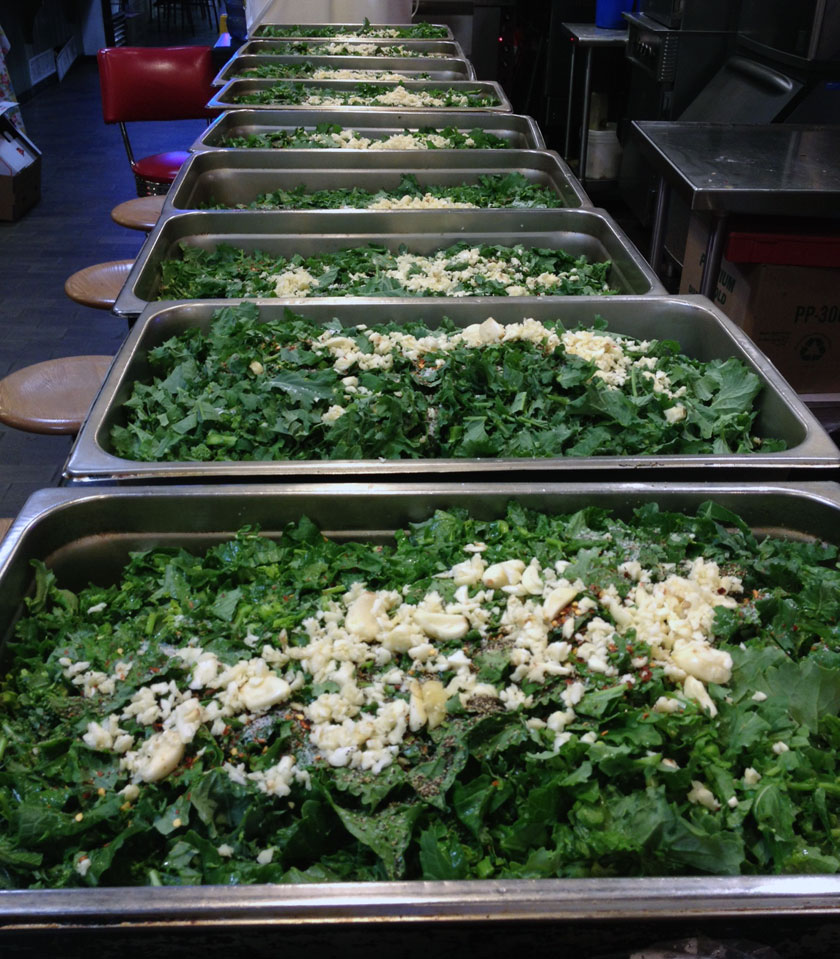 |
| Greens and garlic await oven at Dinic's |
Bobby Fisher, chef at Molly Molloy's, has been missing in action due to surgery, according to Jim Iovine, proprietor. Best wishes for a speedy recovery, Bobby.
Like J.P. Morgan's yacht, if you have to ask the price you probably can't afford it, but the jamón ibérico de bellota (Spanish acorn ham) at Jack Morgan's Downtown Cheese is like eating ham butter. It puts the best prosciutto to shame.
The American version of dry aged ham can be obtained at L. Halteman Family. It's also priced dearly (though not nearly as high as the Spanish pig). You can buy some of the Smithfield ham slices (vacuum packed on premises) for a bit over $5, enough to make three or four sandwiches. The Riehl family, operators of the stall, will be shifting their footprint closer to Avenue C next month, also part of the market's current improvement project.
Steinke will be off to Los Angeles late next week for the annual conference of National Association of Produce Market Managers, the professional association of managers of permanent wholesale produce markets, retail farmers' markets, and public markets. He'll make a presentation about the RTM's current Avenue D improvement project.
Tuesday, February 21, 2012
NJ Creamery To Make, Age Cheese at RTM

Wajswol plans on bringing 24,000 pounds of raw milk to the market each week to make about a ton of hard or semi-soft cheese. With that much cheese, it will age both in the market's basement and back in the creamery's caves in Long Valley, in northwestern New Jersey. In addition to making, aging and selling cheese, Valley Shepherd will serve lunchers cheese paninis and offer an olive bar.
"We are designing and gathering equipment now to determine if we can, indeed, do what we want," Wajswol replied to your blogger's email inquiry. "In a few weeks we will know more."
Friday Architects, the Philadelphia planning and architecture firm which created the market's Avenue D renovation plan, will visit the farm and dairy next week to begin its design work on the RTM outlet, which Wajswol describes as "very complex, because there are four elements to the space, each requiring design, equipment and talented folks."
The first element will be sourcing and transporting the milk to the market in three weekly 8,000-pound shipments. It will be unloaded into basement tanks for storage, then pumped back upstairs as needed in the cheesemaking operations behind glass for visitors to watch.
Wajswol decided against making fresh cheeses, like mozzarella or quark, because a pasteurization system would be required. With only 610 square feet for retail sales, panini-making and cheese-making, there's simply no room.
The lunch menu will be based on paninis or, as Wajswol calls them, Maninis. He said they are "being conceived by some infamous food truck people and will be tested and redesigned by local Philadelphia food talent (which we are finding amazing)."
Using milk from sheep, Jersey and Guernsey cows, and goats, Valley Shepherd's cheeses cover a wide range of styles and traditions: fresh, soft-ripened, blue, hard, semi-hard, and washed-rind. You can read a full menu of the cheeses at Valley Shepherd's website. The store also plans to sell a few cheeses from "several family farms we know and love," Wojswol said.
There will be additional brined products beyond olives on the olive bar, he said, "featuring products from several countries with a strong emphasis on brined products from that most foreign country called Brooklyn."
Brooklyn is no accident, since last year Valley Shepherd opened a retail store in the borough's Park Slope neighborhood after closing a Manhattan outlet.
A limited variety of Valley Shepherd cheeses has been available for the past few years at the Fair Food Farmstand of the Reading Terminal Market. Other than at a few farmers' markets, the Park Slope store, the farm, and a handful of retail outlets in New Jersey and New York City, the only other places you're likely to find its products are cheese plates at upscale restaurants.
Who makes food today at the RTM, besides the restaurants and lunch stalls?
Herschel's East Side Deli takes fresh meat and turns it into brined corned beef and cured pastrami in the basement. And Giunta's produces some of its sausages on site. Otherwise, food production is centered on baked goods and sweets: cookies at Famous Fourth Street and the Pennsylvania General Store, baked goods at Beiler's Bakery and Flying Monkey Bakery, pretzels at Miller's Twist, fudge at Sweet as Fudge Candy Shop, and molded and dipped chocolate items at Chocolates by Mueller.
Thursday, February 09, 2012
RTM's Leasing Strategy Works Against Rick's Return
With the market's renovation program centered along Avenue D opening
up space for four new merchants, General Manager Paul Steinke's
emphasis has been to fill those slots with "purveyors" who primarily sell foods for cooking or eating at home. That's why the chances of any new pure lunch vendor of getting one of the two remaining stalls is slim at best and why Rick Olivieri's attempt to reenter the market with his Rick's Steaks business will fail.
It's certainly possible, though, that a vendor selling for both on- and off-premises consumption could get that nod. I think the only chance for a new vendor to primarily sell for on-premises consumption would be to offer something not now available from other lunch counters. Hot donuts, anyone?
Only one of the three new vendors announced so far will sell food for eating within the market, but it will also offer groceries and other food products to take home: Wursthaus Schmitz would carry German groceries and cold cuts as well as hot foods for eating either within the market or at home.
The second new vendor would be artisinal cheese maker Valley Shepherd Creamery, which is expected to sign a letter of intent within a few weeks. The latter's product would be overwhelmingly for off-premises consumption, though there's no reason why someone couldn't have a sheep milk yogurt for lunch in center court. A third new vendor, The Head Nut will essentially replicate the offerings of The Spice Terminal, which declined to renew its lease.
That leaves two remaining spaces for new vendors: one along the Avenue D wall, another in a small space on center court adjacent to where Wursthaus Schmitz will be located.
The market's operating policy guidelines require that no more than the greater of one-third of the number of vendors or one-third of the floor space go to businesses "which offer food intended primarily or exclusively for consumption within the Market."
While Steinke is comfortable that the current breakdown of merchants is well within that restriction, by my subjective count 36 of the 77 existing merchants exclusively or primarily fall into the "on-premises consumption" category.
Let me emphasize the subjective nature of determining whose "primary" business is for off-premises consumption or not. As an example, take 12th Street Cantina, which I consider among those who "primarily" sell for on-premises conception but Steinke does not. Steinke says this business a "two-sided" purveyor that doesn't count against the operating policy ratios because of the many take-home Mexican groceries and prepared foods they sell. My opinion is influenced by the fact that 12th Street Cantina has a seating area for diners. (I've got to admit, though, nearly all of my purchases there have been for ingredients to use at home.)
The same debate could be held about any number of other vendors, from Kamal's Middle Eastern Specialties to By George! Pizza, Pasta and Cheeseteaks, both of which also sell plenty of items for consumption and/or cooking at home, but also earn money as lunch vendors. (Indeed, the line for cheese steaks at By George! at lunchtime frequently blocks the aisle.) The key metric in making any such determination as to whether a business is "primarily" engaged in sales for off-premises consumption would be to know the revenue breakdowns, but neither Steinke nor I have access to that proprietary information.
Getting back to Olivieri, another factor why he has little chance of reestablishing his cheese-steakerie in the market are the three existing vendors who depend upon cheese steak sales, and two others who find it a highly profitable sideline. Although Steinke said he couldn't give a "blanket answer" to a hypothetical question about allowing a new merchant to compete with the same product of five existing merchants, it's hard to imagine him adding another tourist-centric cheese steak stall. He acknowledged to Dan Gross of the Daily News, who broke the Olivieri story Wednesday, that cheese steaks were not the market's "highest priority".
When Olivieri's lease was not renewed in 2008, the market allowed two additional vendors to sell cheese steaks: Carmen's Famous and By George! (Spataro's earlier had been permitted to add cheese steaks when they moved to a new center court location.) Today all three businesses incorporate "cheese steaks" into their formal names. In addition, the Down Home Diner sells cheese steaks, as does the new Molly Molloy's.
Rick's Steaks loss of its lease in 2008 followed Olivieri's vociferious leadership of the Reading Terminal Market Merchants Association when the market was restructuring lease agreements and fee structure. You can find earlier stories about the Olivieri-RTM clash here and here.
It's certainly possible, though, that a vendor selling for both on- and off-premises consumption could get that nod. I think the only chance for a new vendor to primarily sell for on-premises consumption would be to offer something not now available from other lunch counters. Hot donuts, anyone?
Only one of the three new vendors announced so far will sell food for eating within the market, but it will also offer groceries and other food products to take home: Wursthaus Schmitz would carry German groceries and cold cuts as well as hot foods for eating either within the market or at home.
The second new vendor would be artisinal cheese maker Valley Shepherd Creamery, which is expected to sign a letter of intent within a few weeks. The latter's product would be overwhelmingly for off-premises consumption, though there's no reason why someone couldn't have a sheep milk yogurt for lunch in center court. A third new vendor, The Head Nut will essentially replicate the offerings of The Spice Terminal, which declined to renew its lease.
That leaves two remaining spaces for new vendors: one along the Avenue D wall, another in a small space on center court adjacent to where Wursthaus Schmitz will be located.
The market's operating policy guidelines require that no more than the greater of one-third of the number of vendors or one-third of the floor space go to businesses "which offer food intended primarily or exclusively for consumption within the Market."
While Steinke is comfortable that the current breakdown of merchants is well within that restriction, by my subjective count 36 of the 77 existing merchants exclusively or primarily fall into the "on-premises consumption" category.
Let me emphasize the subjective nature of determining whose "primary" business is for off-premises consumption or not. As an example, take 12th Street Cantina, which I consider among those who "primarily" sell for on-premises conception but Steinke does not. Steinke says this business a "two-sided" purveyor that doesn't count against the operating policy ratios because of the many take-home Mexican groceries and prepared foods they sell. My opinion is influenced by the fact that 12th Street Cantina has a seating area for diners. (I've got to admit, though, nearly all of my purchases there have been for ingredients to use at home.)
The same debate could be held about any number of other vendors, from Kamal's Middle Eastern Specialties to By George! Pizza, Pasta and Cheeseteaks, both of which also sell plenty of items for consumption and/or cooking at home, but also earn money as lunch vendors. (Indeed, the line for cheese steaks at By George! at lunchtime frequently blocks the aisle.) The key metric in making any such determination as to whether a business is "primarily" engaged in sales for off-premises consumption would be to know the revenue breakdowns, but neither Steinke nor I have access to that proprietary information.
Getting back to Olivieri, another factor why he has little chance of reestablishing his cheese-steakerie in the market are the three existing vendors who depend upon cheese steak sales, and two others who find it a highly profitable sideline. Although Steinke said he couldn't give a "blanket answer" to a hypothetical question about allowing a new merchant to compete with the same product of five existing merchants, it's hard to imagine him adding another tourist-centric cheese steak stall. He acknowledged to Dan Gross of the Daily News, who broke the Olivieri story Wednesday, that cheese steaks were not the market's "highest priority".
When Olivieri's lease was not renewed in 2008, the market allowed two additional vendors to sell cheese steaks: Carmen's Famous and By George! (Spataro's earlier had been permitted to add cheese steaks when they moved to a new center court location.) Today all three businesses incorporate "cheese steaks" into their formal names. In addition, the Down Home Diner sells cheese steaks, as does the new Molly Molloy's.
Rick's Steaks loss of its lease in 2008 followed Olivieri's vociferious leadership of the Reading Terminal Market Merchants Association when the market was restructuring lease agreements and fee structure. You can find earlier stories about the Olivieri-RTM clash here and here.
Saturday, February 04, 2012
Vendors Lining Up For RTM: Wursthaus Schmitz, Nut Vendor
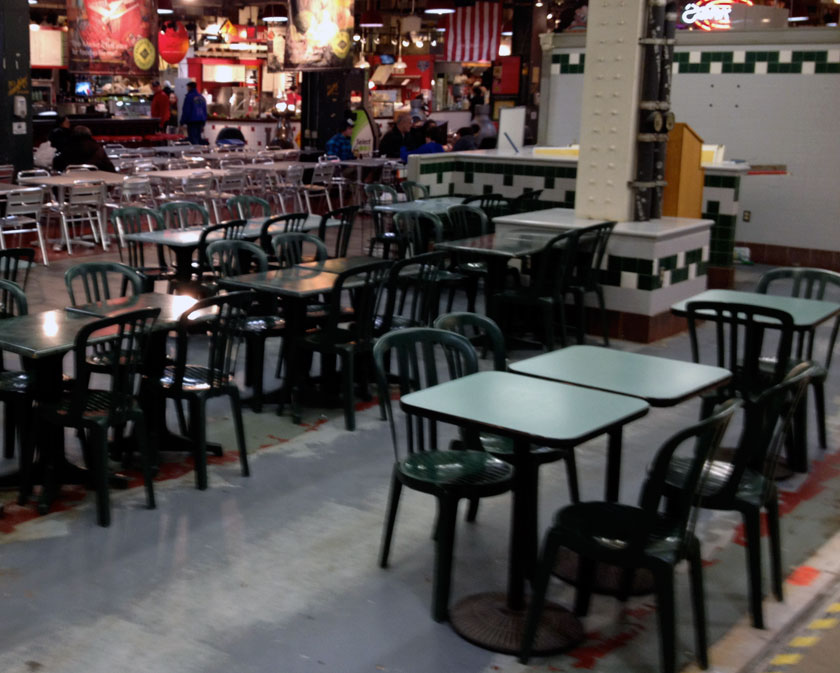 |
| New temporary seating to become Wursthaus Schmitz |
The latest announcement is that the owners of Brauhus Schmitz will open a German food shop -- Wursthaus Schmitz -- in the general area of where the Spice Terminal had been located, at the intersection of Center Court and Avenue D, opposite the new La Cuchina at the Market. They'll sell prepared food for consumption at the market and take-away, deli meats, as well as imported products, including mustards.
The market has been without wide-ranging German food products (beyond the limited Pennsylvania Dutch merchant offerings) since Siegfried's departed in 1990. Steinke has sought to fill that niche for years (Rieker's of Fox Chase declined the opportunity shortly after Siegfried closed).
Owners Kelly Schmitz-Hager and Doug Hager are hot to trot and hope to be open by Memorial Day.
(I heartily welcome the renewal of a German food purveyor at the market, but it raises a question about the sudden mushrooming of German restaurants in center city. Once upon a time the only German restaurant around was Ludwig's Garten on Sansom. When it closed we were Gemütlichkeit-less. Now, however, we've got Brauhaus Schmitz, Frankford Hall, and the newly opened Bierstube in Old City. Even Jose Garces and has threatened to get into the act with a Wurstmacher in the old Letti Deli on 13th Street.)
Spice Terminal Successor Nears Dotted Line
Although negotiations are not completed, Steinke is optimistic to sign a new bulk spice vendor, who would occupy space beneath the market's administrative offices one aisle north of center court. The prospect is a long-standing suburban vendor of nuts, spices, herbs, coffee, grains, and condiments -- the same lines carried by the Spice Terminal. Looking at the potential vendor's existing website, it appears this outfit has greater depth of stock than Spice Terminal's.
Steinke said he decided to go after the suburban vendor because of its 30 years of experience, which trumped an otherwise attractive offer from employees of the Spice Terminal. He acknowledged that part of his decision mix was the tens of thousands of dollars it would cost the market to move the Spice Terminal to a new location, as required by the Avenue D Project. Extensive carpentry for the shelving would have accounted for much of that cost; a new vendor under a new lease is responsible for those costs.
Steinke also expects to sign Valley Shepherd Creamery within the next few week. In addition to selling its great artisinal cheeses (primarily sheep, but some cow and goat and mixed milk cheeses), Valley Shepherd plans to make fresh cheese on-premises.
With Spice Terminal's closing last Sunday, Steinke made quick work to turn it into additional seating, if only on a temporary basis, just in time for the last two days of the auto show. The extra seating will stay in place for the flower show in early March, than give way for Wursthaus Schmitz.
Tuesday, September 13, 2011
BAAH! Cheesemaker Plans RTM Outpost
Fresh Cheeses To Be Made On Site
Valley Shepherd Creamery is expected to be the first new vendor to occupy space along the Reading Terminal Market's Avenue D.
Earlier this month the RTM and cheesemaker Eran Wajswol signed off on a proposal to occupy about 700 square feet across Avenue D from what will soon be Molly Molloy's gastropub.
The shop will be located along the RTM's back wall, where it will be easiest to pipe in fresh milk from delivery trucks. That's necessary because Wajswol plans to make fresh cheese on premises for market shoppers. At Valley Shepherd's farm store in Long Valley, N.J., his fresh offerings include cream cheeses (no gums or additives) and ricotta.
As its name implies, Valley Shepherd specializes in sheep milk cheeses, although some of its products are cow-sheep mixes.
Although Valley Shepherd plans to make fresh cheese at the RTM, its cave-aged product earned the creamery its stellar reputation. Wajswol went so far as to blast an aging cave into a hillside on his farm. One of his cheeses, a Gouda-like product, spends two years in the cave.
If you haven't had a chance to try Wajswol's cheeses, you're missing one of the best artisinal products available. At least one variety is usually in stock at the Fair Food Farmstand at the RTM, often Shepherd's Basket, a Basque style aged for four to five months. With the exception of the fresh cheeses and yogurts, everything else is made from unpasteurized raw milk. You can get an idea of the offerings at Valley Shepherd Creamery's website.
In addition to the store at the northwest New Jersey creamery. Valley Shepherd operates a small store on Sullivan Street in Manhattan's SoHo district, and soon will be opening another in Brooklyn's Park Slope neighborhood. The RTM store will be its third owned and operated retail outlet. In addition to restaurants, like New York City's Le Bernardin, Wajswol sells at various farmers' markets in New York and New Jersey.
If all goes according to plan, you might see Valley Shepherd at the RTM by late spring, according to Paul Steinke, the RTM's general manager.
Fresh Cheeses To Be Made On Site
 |
| Some of the more than 600 sheep in Valley Shepherd's flock |
Earlier this month the RTM and cheesemaker Eran Wajswol signed off on a proposal to occupy about 700 square feet across Avenue D from what will soon be Molly Molloy's gastropub.
The shop will be located along the RTM's back wall, where it will be easiest to pipe in fresh milk from delivery trucks. That's necessary because Wajswol plans to make fresh cheese on premises for market shoppers. At Valley Shepherd's farm store in Long Valley, N.J., his fresh offerings include cream cheeses (no gums or additives) and ricotta.
As its name implies, Valley Shepherd specializes in sheep milk cheeses, although some of its products are cow-sheep mixes.
Although Valley Shepherd plans to make fresh cheese at the RTM, its cave-aged product earned the creamery its stellar reputation. Wajswol went so far as to blast an aging cave into a hillside on his farm. One of his cheeses, a Gouda-like product, spends two years in the cave.
If you haven't had a chance to try Wajswol's cheeses, you're missing one of the best artisinal products available. At least one variety is usually in stock at the Fair Food Farmstand at the RTM, often Shepherd's Basket, a Basque style aged for four to five months. With the exception of the fresh cheeses and yogurts, everything else is made from unpasteurized raw milk. You can get an idea of the offerings at Valley Shepherd Creamery's website.
In addition to the store at the northwest New Jersey creamery. Valley Shepherd operates a small store on Sullivan Street in Manhattan's SoHo district, and soon will be opening another in Brooklyn's Park Slope neighborhood. The RTM store will be its third owned and operated retail outlet. In addition to restaurants, like New York City's Le Bernardin, Wajswol sells at various farmers' markets in New York and New Jersey.
If all goes according to plan, you might see Valley Shepherd at the RTM by late spring, according to Paul Steinke, the RTM's general manager.
Subscribe to:
Posts (Atom)