Friday, May 02, 2008

Reprise on Morels!

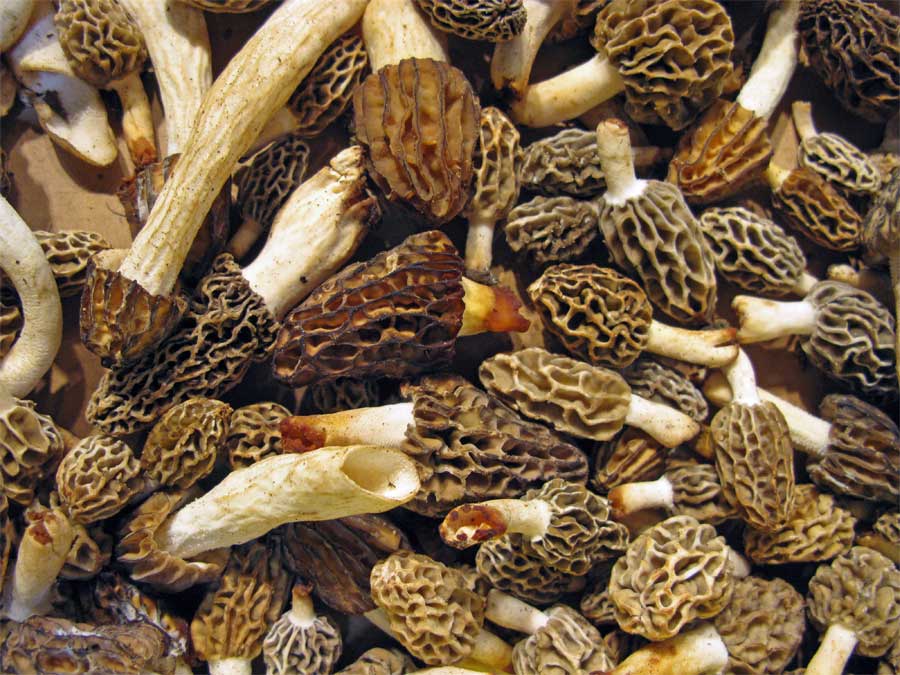
April showers bring May flowers. And May morels.

Sam Consylman called last night to say the heavy rains earlier this week in Lancaster County caused an explosion of morels. Indeed, Sam quipped that he "ate $10,000 worth" over the last few days. At $85/pound, that's a lot of mushrooms (more than 117 pounds' worth). Okay, so maybe Sam was indulging in a bit of hyperbole, at least in terms of his personal mushroom consumption. But I have no doubt of his account of the dramatic increase in morel availability.

Sam said most of what he's picking now are white morels, morella deliciosa (the scientific name says it all), which is the immature version of the yellow morel, morella esculenta. Expect to find them at Earl Livengood's center court stall at the Reading Terminal Market Saturday. You can find my recipe for morel cream sauce at the end of this post.
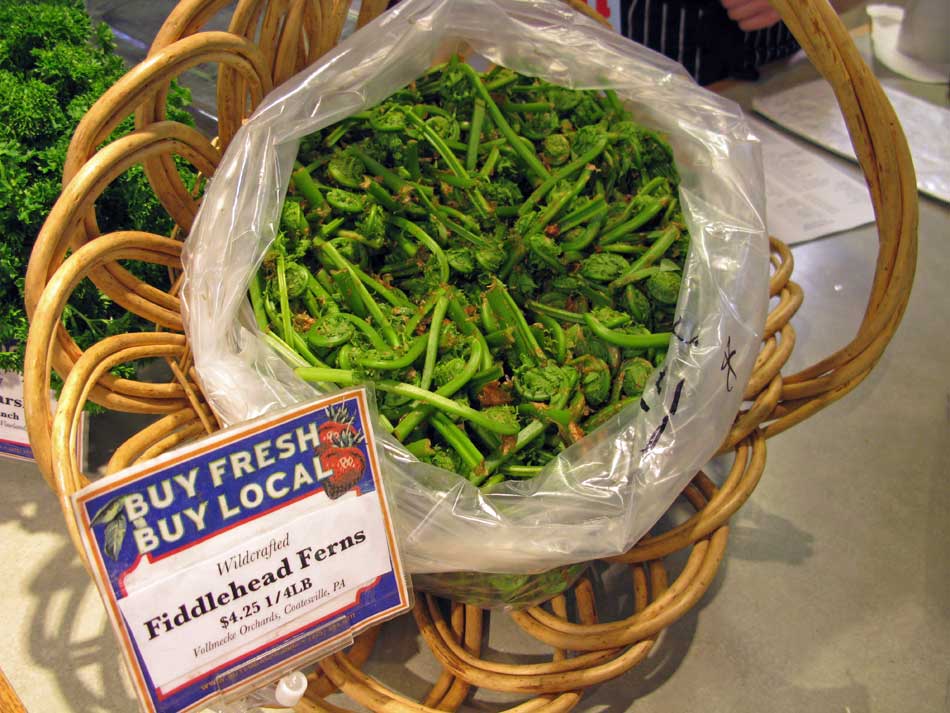
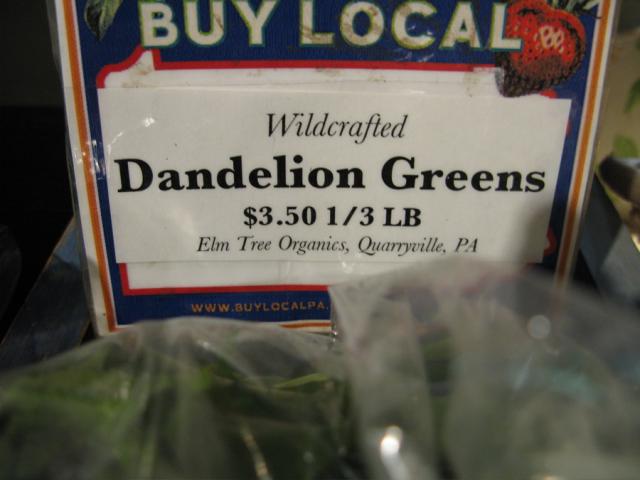
The Fair Food Farmstand does lots of good works, but it loses a gazillion points for murdering the English language when it insists on calling fiddlehead ferns "wildcrafted," just as it labeled dandelions last week. What's wrong with "wild-harvested" or "foraged" or "gathered"? Does everything have to be made? Can't we just have a eureka moment and "find" things? I want to know what, precisely Vollmecke Orchards (the Coatesville CSA which sold the ferns to Fair Food) did to "craft" these lovely spring veggies?

In any event, you can obtain some nice, freshly harvested fiddleheads there. (At least you could Thursday afternoon. Last week the stand sold out its 10-pound allotment in a few hours.) If Fair Food sells out, walk over to Iovine Brothers. Jim Iovine expected to have them on hand this week, although they will be pricey. Fair Foods was selling them for $17/pound. Jim Iovine hadn't received his when we spoke yesterday, so he couldn't quote a firm price, but figured Fair Food's price isn't far off the mark. I serve them steamed or, after parboiling, sautéed, usually with garlic, though combining them with ramps can't be a bad thing. Just go easy on the ramps so as not to overpower the fiddleheads. To prep the fiddleheads, just remove any papery feathers you might find by rubbing them off and rinse.

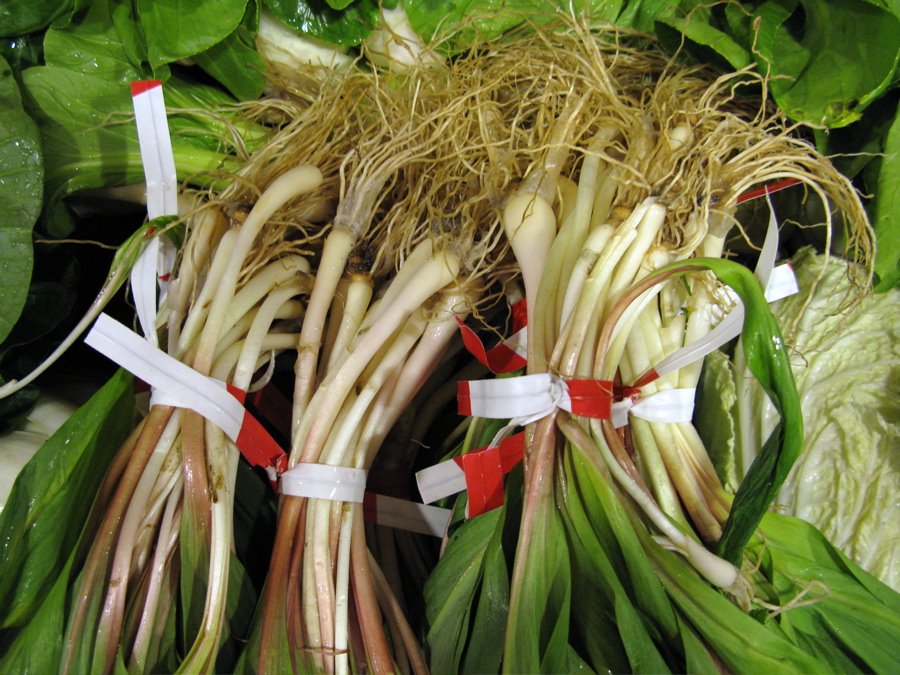
Iovine also expected more deliveries of ramps for this weekend, which have been selling for $3.99 a bunch. That's enough to sauté in bacon fat for home fries with a couple of medium-sized potatoes, though two bunches would be better. Be sure to use the leaves as well as the bulbs.

Headhouse Opens

Reminder: The farmers' market at Head House Square opens for the season this Sunday. Hours are 10 a.m. to 2 p.m.

Morels In Cream Sauce

Serve this over your favorite pasta (I think it works better with vermicelli or linguine rather than thicker ones such as penne). It also works over toast points. A good, crispy Riesling pairs wonderfully with a cream sauce. I enjoyed a Hermann Wiemer 2007 Dry Riesling (Finger Lakes) with this sauce over vermicelli. It's not a cheap dish to make, since the morels for a single serving will set you back $10 or more per person. You can trim the costs by cutting back on morels and adding other mushrooms, fresh or dried. If dried, use the strained reconstituting liquid to provide a flavor boost. (You might be tempted to add some grated cheese to the cream sauce as it finishes; I restrained myself because I think it interferes with the morels' flavor. A little bit of thyme, salt and pepper are all the sauce needs.)

To produce enough for one serving (the recipe scales up easily), I halved three or four ounces of Sam's morels lengthwise and let them sit in some well-salted cold water for a couple of hours, then removed to paper towels to let them air dry a bit. (The soaking helps rid the morels of any tiny litter critters that might linger, though I've yet to see any in Sam's harvest.) Start cooking by sweating a minced shallot in butter over medium-low head, then adding the morels to sauté over a medium-high heat. After four of five minutes, when the morels are just starting to brown, remove them (morels tend to discolor cream when cooked together). To the pan add about four or five ounces of heavy cream with some thyme and reduce over medium-low heat by half, adding salt and pepper to taste toward the end. Return the morels to the pan to reheat, then add drained pasta to the pan and toss, or serve over toast points.

Saturday, April 26, 2008

Morels Arrive!

The phone rang at 6:30 a.m. yesterday, long before I had intended to greet the new day. But Sam Consylman was preparing to go out mushroom foraging and didn't want to wait to relay his news.

The morels have popped in Lancaster County, reported Sam, forager extraordinaire. Not very large, but plentiful enough to pick in the local wood. Earl Livengood would sell what Sam picked the next day at the Reading Terminal Market.

I made sure to set my alarm for the following day (today, Saturday) so I'd be among the first to examine this year's crop. Another fungi lover (who had not received Sam's call) spotted them on her early tour of the market and was starting to pick through the fruiting bodies when I arrived to snap this pic and select some for my own consumption. (She Who Must Be Obeyed avoids all fungi and other "ook".) My fellow urban forager said she had to be sure to set aside some for herself, because her 16-year-old son devours mushrooms of all types. We agreed that even the humble white button mushroom can be cooked superbly (she suggested a Russian dish, sautéed then mixed with sour cream), but that morels were, to use that overused term, "special".

My two-and-a-half-ounce selection of morels (Sam picked black, common and red morels, though I'm told the "red" isn't a true morel but is close enough for culinary purposes) set me back $12.75, based on the $85/pound price. (Last year they were $80). Earl Livengood asked me if he had priced them correct. Alas, he had. Morels imported all the way from the Pacific Northwest, which arrive slightly dry though still quite useable, were selling over at Iovine Brothers Produce for $60, so Earl's price, though considerably higher, wasn't out of line considering the quality and freshness.

By the time I left the market at 10:30, Earl's stock of morels had been depleted by at least 50 percent. I would suspect that they would be totally gone by noontime or shortly thereafter. It's possible Sam will still be picking them next week, but don't count on it. The morel season lasts a nanosecond. They'll be my lunch today, sautéed with shallot, then turned into a cream sauce over toast points. Sautéed morels also work exceedingly well with soft scrambled eggs, or just about any other egg dish. One dish I particularly enjoyed a few years ago was a sauté of morels and asparagus tips surrounded by a ring of savory custard (at L'Étoile in Madison, Wisconsin).
Another sign of spring could be found at Iovine's: ramps. These wonderful examples of a wild allium were fresh, with nearly pristine leaves, were selling for $3.99/bunch. Ramps should be available through much of May. I'll be cooking these pungent wild leeks (both bulbs and greens) with potatoes sautéed in bacon fat to go along with reheated brisket for dinner this evening.

Jim Iovine reports he'll be directly sourcing some of his leafy vegetables this season from a South Jersey grower. This includes scallions, spinach, all varieties of cooking greens, lettuces, as well as radishes and other veggies. He and brother Vin will also continue their contract with Shadybrook, which serves as the vendor's main supplier of local corn in season. Jim said he hopes for another great crop of raspberries this year again from Shadybrook as well.

Fair Food Farmstand briefly featured another veggie foraged in springtime: fiddlehead ferns. They received a 10-pound case earlier this week from a local gatherer, but it sold out the same day. They expect to have them again next week, so, buy early. I know I will. (Try them in Chinese stir-fry dishes where you'd normally add string beans or asparagus for veggie crunch.)

Another foraged food you'll see this year (at both Earl Livengood's and Fair Food Farmstand) is wild dandelion. But I wonder just who "crafted" the wild dandelion greens at Fair Food. The label writer should teach a class in writing oxymorons.

Plentiful sardines still available, at least at John Yi's. Whole sardines (herring) were selling for $3.99 again today. We're still a few weeks away from fresh Alaskan salmon.

For Passover, Flying Monkey had some delicious macaroons, a buck apiece for the large cookies. Lots better than the Manischiewicz version that comes in the equivalent of a coffee can.

Lease negotiations are complete for Jonathan Best, which will operate a high-end grocery in the space formerly occupied by Margerum's and, later, the Natural Foods Connection. All that's left is signing on the dotted line, after which the space will be spruced up and altered before the store opens. RTM General Manager is anxious to place a "tenant obtained" sign over the long-vacant space.

Another problematic space at the market is the stall behind L. Halteman, currently used as exhibit space. Halteman's expansion into that space will be part of their lease renegotiations.

Friday, April 25, 2008

Talula's Table & Other Headhouse News

Talula's Table will among the vendors at the Sunday Headhouse Square market this season. They brought their sausages to the West Chester farmers' market last year and decided to further expand for 2008. The Kennett Square characuterie and market does merguez (lamb sausage), game sausage, parma, salamis and other cured meats, along with dips and mustards.

The Food Trust's Nicky Uy reports these other updates:

Birchrun Hills Dairy and Farm will bring fresh milk from grass fed cows starting in June and veal from humanely raised bull calves.

Tom Sereduk plans to sell five times the volume of last year with 30 different varieties of flowers.

Busy Bee Farm will sell raw and low temperature infused honeys, various types of fresh and dried lavender and a plethora of herb.

It's hard to think about maple syrup in warmer weather, but why not? Spring Hill Farm from Lackawanna will have it.

Another new vendor will be Happy Cat Organics, Berks County, with heirloom vegetables and sells dozens of varieties of heirloom fruit and vegetable seeds.

African greens grown from seeds that come directly from Sierra Leone will be featured by Yoder Heirlooms of Lancaster County, along with other pesticide-free heirloom produce.

The Rodale Institute has its own CSA offering organic produce through its Quiet Creek Farm. They are branching out to farmers' markets this year, including Headhouse.

Farmers' Market Schedule update

The Food Trust still hasn't posted its schedule, but there is one, sent to me by Nicky Uy, project manager. I've created an web version and you can find it here.

Wednesday, April 23, 2008

New Farmers Markets This Season

There will be new markets this season at City Hall and near Jefferson Hospital, sponsored by Farm to City.

FTC's Bob Pierson says he's lined up three "definite" vendors as of earlier this week for City Hall: Fruitwood Orchards (a South Jersey berry, tree fruit, garden vegetable producer), Pumpkin Ridge (cut flowers), and Better Together Bakery (from Havertown). Possible additions include an aquaculturist who grows clams and sea lettuce, a seller of canned/jarred goods (with some fresh veggies), and two youth organizations who are involved in urban gardening. Pierson said that the City Hall market likely wouldn't be much bigger, since space in the venue, the northeast quadrant of the courtyard, is limited.

Full details of the Farm to City markets, including schedules, can be found at FTC's Farmers Market page, but here are some dates worth noting:
  • South & Passyunk Market opens May 6, with vendors to include the Livengoods and the Rineers, among others.

  • The City Hall market opens Wednesday, May 14. No time established yet.

  • Jefferson, Chestnut near 10th, will be held Thursdays from 12 noon to 5:30 p.m., beginning May 22. No vendor lineup yet.
The other major sponsor of area farmers markets, The Food Trust, hasn't posted its schedule yet, except for the hugely successful Headhouse Square venue, which begins its Sunday run May 4. (A reader of this blog, "Sam", contributed a copy of The Food Trust schedule received by email. You can find the schedule, as reported by Sam, here.)

Anyone besides me ever wonder why we've got two separate organizations sponsoring farmers' markets? I don't have all the answers (I wouldn't be surprised if policy/politics and ego had something to do with it), but Farm To City and The Food Trust are coming at it from different angles, though from the consumer's practical point of view it hardly matter. Farm To City is more interested in promoting the economic well-being of small, family farmers and to help preserve vanishing countryside. The Food Trust's goal is to insure that everyone has access to affordable, nutritious food. Now you know.

Monday, April 21, 2008

Asparagus Arrives

Local asparagus made its debut last week at Earl Livengood's, Fair Food Farmstand, and Kauffman's Lancaster County Produce, with prices ranging from $2.25 to $5.99/pound (though it's usually priced by the bunch; I figured the range by weighing some bunches, which usually clocked in at about a pound.

Iovine Brother's Produce carried ramps last week at $3.99/bunch, but by Saturday only a handful were left and their condition had deteriorated a bit (still usable, but the greens were a tad ragged). Go for them when they first get it. Vinnie Iovine complained he couldn't get root parsley, which sometimes appears on seder plates in the karpas role. South American pears are still plentiful, with Bartletts priced at 50-cents/pound, Anjou's at 99 cents.

John Yi offered both organic and wild Alaskan king (chinook) salmon. The organic is farm-raised and was priced at $15.99; the wild (probably frozen since there's only limited trolling permitted in southeast Alaska until the main season begins about mid-May) sold for $20.

Sundays at the RTM largely seem to be a tourist/conventioneer affair, at least based on my visit yesterday, my first in months. Iovine's, though reasonably busy, seemed to have only two-thirds or less the staff they do on Saturdays. Other purveyors appeared to be operating with reduced staffs, too. Bassett's, however, could have used a few more scoopers!

Saturday, April 12, 2008

The Season Inexorably Proceeds

Another sure sign of warmer weather (as if we needed confirmation of what the thermometer says): soft shell crabs. John Yi had them today, at $6 apiece (or two for $10).

As promised in its weekly email, wild garlic could be had at Fair Food Farmstand. Over at Benuel Kauffman's Lancaster County Produce, local greenhouse tomatoes have appeared. Missing in action today, for the second or third Saturday in a row, was Earl Livengood. Apparently, nothing to sell yet other than stores of root vegetables from the fall, though I would imagine his spinach should be ready. We're still a while away from asparagus.

Today I picked up a deli treat I've neglected since Siegfried pulled up stakes: leberkase, the German style veal loaf. I ordered half a pound of the onion-inflected version from Dutch Country Meats and enjoyed some for lunch on rye bread from Le Bus.

I'm looking for some pork belly to braise this week, but it won't be from the RTM. Dutch Country Meats only has the salt pork version. I did spy some unsalted belly from Meadow Run Farm in the frozen case at Fair Food, but found the price (about $8/pound) exorbitant. Yes, I know it's expensive for small scale farmers to raise quality pork, but this was simply too much. You can buy quality apple smoked bacon (which, after all, is pork belly) for less -- and the bacon loses water weight, so it should be even more dear. I think I'll get some pork belly at one of the Chinese supermarkets instead.

Over at Iovine Brothers Produce, the price of some citrus fruits is easing. Limes now three for a buck, lemons four. A three-pound bag of end-of-the-season clementines was $3.99. Small navel oranges were selling for 5/$1, medium ones at 4/$1. Peruvian mangoes looked to be one of the better fruit deals, two for $1. They also had those not-so-bad-for-coming-from-so-far-away Bartlett pears from Argentina (I failed to note the price, but in recent weeks they've been priced at 99-cents to $1.49/pound). Red and green peppers from Mexican greenhouses 89-cents, orange varieties 99-cents.

If the rain stays away (it was thundering when I began writing this missive, but now the sun is peeking through) it will be grill time again for dinner. Over at Giunta's Prime Shop I picked up a hanger steak (total of about 1.25 pounds, priced at $6.99/pound) and a small whole Eberly's organic chicken (sorry, don't recall weight, but cost was less than $4). They'll both on the grill, with the quartered chicken to be consumed tomorrow.

Friendly reminder

We're only three weeks away from the opening of the Sunday Headhouse Farmers Market. (Thanks for reminding me, Moriah.)

Sunday, April 06, 2008

RTM May Get Grocer Again

The new occupant of what was formerly Margerum's and, more recently, The Natural Connection, likely will be Dave Schreiber, owner of Jonathan's Best in Chestnut Hill. As of last week no lease agreement was signed, but the only remaining details to be worked out were some product offering specifics. Although everyone's optimistic, that could be a deal-breaker.

Jonathan Best has been around for about a quarter of a century, selling groceries and "gourmet" products. It's the only seven-day operation at the Chestnut Hill Farmers Market.

Bringing Jonathan Best to the RTM would restore the presence of a grocer in the market, something both management and merchants (even the sandwich vendors) want. Having a grocer with dry and canned goods and other staples means food shoppers don't have to make a separate trip to a supermarket to pick up the one or two extra items they may need for a recipe.

The problem for the grocer is that it's a low-margin business. So Schreiber is looking to add other items for sale which will allow him to earn a reasonable profit; canned goods and packaged grains just don't do it.

That's where the negotiating over product lines becomes complicated. Where Schreiber sells sandwiches at Chestnut Hill, that would be a no-no for a grocer at the RTM. It's hard to avoid overlapping product lines with other merchants entirely. This past winter, when Dutch Country Farms' expanded to baked goods, it caused consternation to an Amish section merchant selling baked goods, resulting in DCM having to pull the line of products from the Northeast's Haegerle's Bakery. Jonathan Best started out as a cheesemonger in Chestnut Hill, but the RTM already has two full-fledged cheesemongers and others who also sell cheese. Just about any higher-margin grocery item Jonathan Best could carry is also sold by another RTM merchant. So RTM management is faced with a delicate task: trying to limit significant competition with other merchants while providing Schreiber with the higher-margin products he needs to sell to be profitable.

At least one veteran merchant suggests lottery tickets might be the answer.

* * *
'Green' Cleaning Supplies at RTM

Household cleaning supplies -- all-purpose cleaners, glass cleaners, dish and hand soaps -- have been added by The Cookbook Stall.

Friday, March 28, 2008

Enjoying the fruit of the South

I'm in Savannah this week, so no Philadelphia-centric market report until after my return.

There's nothing even resembling a public market here. The one place called that, City Market, is an attempt to bring back the days when there was a central gathering place for grocers, produce sellers, etc., and it's a fine place to meander into the souvenir and candy shops, but a public market it ain't.

There was a sure sign of spring in a produce market around the corner from my accommodations: local strawberries. Well, nearly. They came from Metter, about 65 miles west along I-16. Red color nearly all the way through, good strawberry flavor and a touch of sweetness, nothing a minimal addition of sugar couldn't help along. And a $2.50 a pint, not exorbitant. Not peak season berries, just a tad early.

I have been eating a lot of shrimp, even if the local shrimping season doesn't begin for another month with the blessing of the fleet; in the meantime, there's nothing wrong with frozen local shrimp. Tuesday was shrimp, greens and grits (in the form of a fried cake) at a tourst restaurant at City Market, and done very nicely. Yesterday on a trip to Tybee Island, a family beach community about 15 miles west of downtown Savannah, I indulged in a Low Country Shrimp Boil: half a pound of shrimp, half an ear of (frozen) corn on the cob, a couple of red new potatoes, and thick slices of a kielbasa-like sausage (along with a beer). Fun meal to eat by the bay; each table at the restaurant (The Crab Shack) had a hole in the center above a trash can so you could dispose of the shrimp shells.

I've visited three local bakeries with mixed success. The first, Harris Baking, is just a short walk from the flat we're renting in the historic district. Excellent croissants, as good as any I've had in Philadelphia. Very buttery. Good strong coffee, too. Other than the croissants and savory breakfast tarts, though, Harris Baking concentrated on sweets, with the accent on pastries rather than cakes. The concentration on sweets was the case at the two other bakeries visited. Though the Back In The Day Bakery makes an excellent baguette, their bread offerings are limited to just two or three varieties a day (they also had a sourdough round when I stopped by, and would be putting out ciabatta a bit later). Cupcakes, however, are another matter: a rotating variety as well as everyday standards. She Who Must Be Obeyed complained that the Chocolate Dream cupcake (which appears every day) was a bit on the dry side, though the crumb was tender and the frosting rich. Back in the Day also featured plenty of cakes. The third bakery, Baker's Pride, was not worth the visit: again, 90 percent of the items were sweet, and overly sweet at that: it was hard to find an item that wasn't over-sugared, over-glazed and over-frosted.

I occasionally make greens at home and or order them out (at Fran DeBreaux's, for example), but they sure do know how to make them hereabouts. The collards served with my shrimp and grit cakes were as tender as could be and tasty with that decided hint of pork fat. Another restaurant, Sweet Potatoes, showed a lighter touch with the Southland's favorite green vegetable, using lemon to perk them up, but apparently omitting the pork for a lighter touch, which was true in all the dishes we tried there, including the eponymous salad (just like regular potato salad, but lighter and better) and the sweet potato-apple mash. And, this being Georgia, the bbq sauce served on SWMBO's chicken and my meat loaf were both peach-based.

Saturday, March 22, 2008

Spring fever

It's officially spring. No, I don't mean the movement of the tilt of the Earth on its axis to create the vernal equinox.

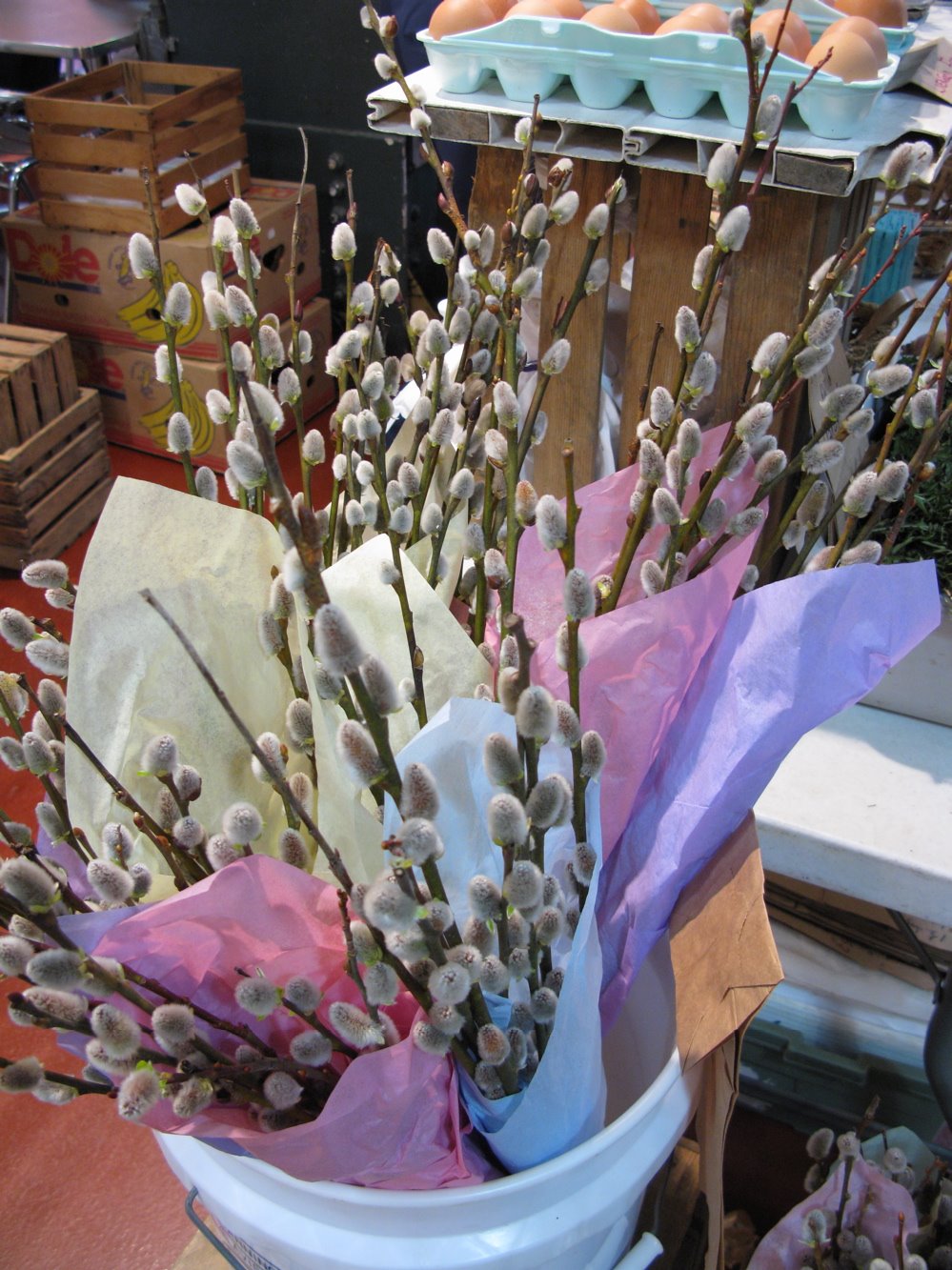
No, the true sign of spring can be found at Earl Livengood's stand at the Reading Terminal Market. To eat, he offered young, tender dandelion greens this morning; to enjoy visually (or tactually) you could purchase pussy willows.

Over at Iovine Brothers, Brother Jim explained how they manage to sell organic green seedless grapes ($1 a bag for a bag that, by my estimate, weighed a pound and a half) for less than the conventional variety ($1.99/pound): A Walmart or other big buyer "kicks" a lot, sticking it to the distributor who has to find another buyer. When a distributor has produce that just has to move, they've got the speed dialer on their phone set to Iovine's. (As always, click on a photo to see a larger version.)

Other relative bargains at Iovine's this morning: bags of California clementines for $3.99 and one-pound clamshells of Florida strawberries for $1.99. Not such a bargain, but still a welcome seasonal addition, were the baby artichokes, $3.99/pound. Lemons and lines still exorbitant at 50 cents each.

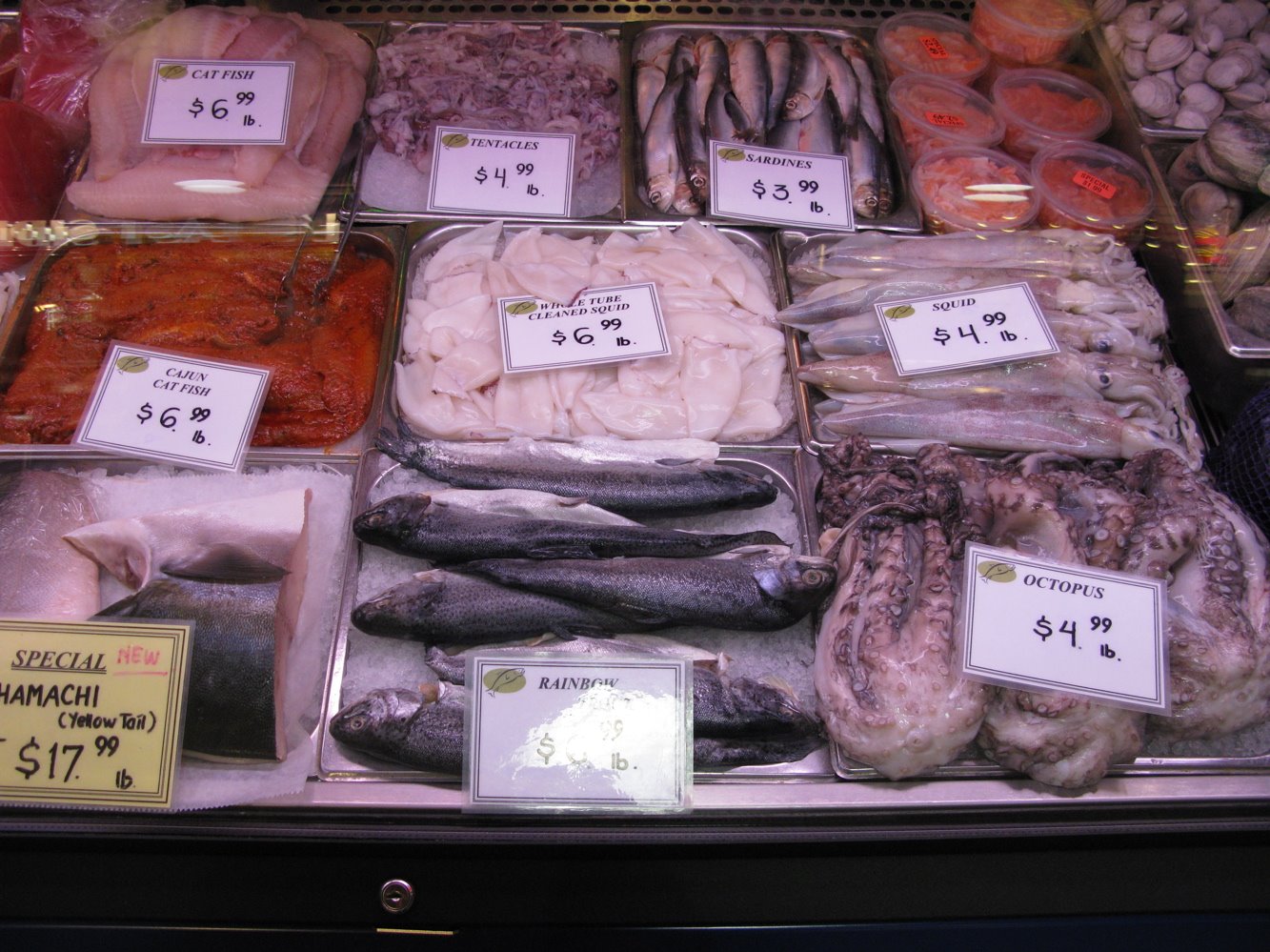
The price of the gutted, headless sardines at Wan's seafood went up to $3.99/pound, but the price of whole sardines at John Yi fell to $2.99. The latter's refrigerator case of cephalopods, fresh water salmonids, and clupea harengus looked particularly attractive today.

Young's Flowers has given up its Saturday daystall in the market due to insurance costs. They are still expected to sell when the Headhouse market gears up later this spring.

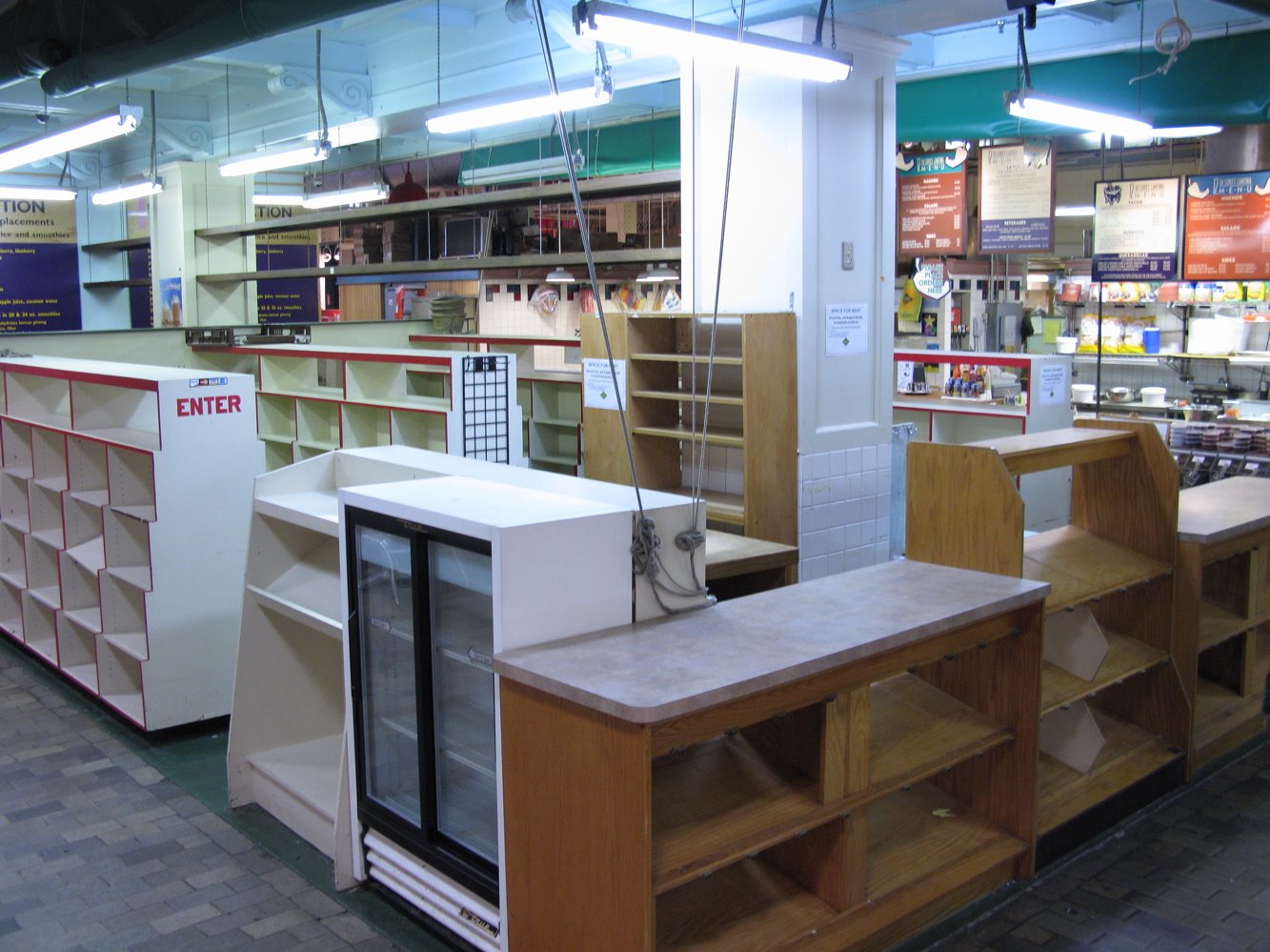
Market management is near a deal to fill the vacant space most recently occupied by the natural food store and, before that, Margerum's. The new vendor will sell a range of packaged grocery items (trending to the gourmet/high priced side), so if you need that canned broth or ketchup to complete your recipe you won't have to make a second stop elsewhere. This will be the vendor's first expansion beyond his current single store in another section of the city.

Thursday, March 13, 2008

It's not spring yet

A couple of interesting veggies popped up in Iovine Brothers' bins this week.

First, asparation. No, not as in a small burst of air, or the entry of secretion into the lungs. That's aspiration. I'm talking about asparation, which is the trademark name for broccolini, a cross between broccoli and Chinese kale. Didn't see a price, but given that it's a trademarked-veggie, I would expect it not to be cheap. But it did look interesting: a stalky broccoli, but of daintier proportions than broccoli rabe.

In the same bin could be found cardoon, a southern European winter vegetable. At first glance it looked like a giant, dull bunch of celery stalks, but botanically it's closer to the artichoke, as it is a kind of thistle. That means it takes a bit to prepare properly: trimming and de-ribbing, cutting and dipping in acidulated water to prevent browning before braising. It's $1.99 a bunch, which looks like it would be enough for four or five servings as an appetizer or side. Bet it would be good in a cream sauce after preliminary cooking.

The Mexican avocado crop has arrived, and that means lower prices. Iovine had medium-sized ones at 50-cents apiece. Limes, alas, are the same price. Outside of the various greens (I picked up some escarole to braise with raisins, capers, pine nuts and olives this week), one of the better veggie values was the frying peppers, $1.49/pound.

I'm still impressed with the South American late summer fruit at Iovine, especially the plums. Domestically, nice navel oranges, medium sized, were selling at 20 cents apiece.

With enough daylight at dinner time to fire up the grill, I picked up some beef (chuck with some short rib) ground to order at Harry Ochs yesterday, but when I passed Wan's Seafood I couldn't resist the sardines. They had already been headed and gutted and were selling for $2.99/pound. I was a tad wary, because other fish mongers were selling them whole for a buck more, but these were firm and smelled fine. They cooked up even better. I had a few right off the grill yesterday as an appetizer, but ate most the rest for dinner tonight after concocting a curry sauce for them to bathe in, trying to duplicate a curried pickled herring I tasted at Aquavit. It tasted delicious but, because of the textural delicacy of the grilled sardines, turned into a spread. Next time I'll also add some beet for color, because when sardines get mashed up, they are decidedly gray. I'll also start with pickled herring: the flesh is firmer and doesn't break up as easily.

I've gotten so used to microwave popcorn that I've forgotten how easy it is to make the old fashioned kind; the pot cleans up easily enough. Ben Kaufman has a couple of different varieties; the "red" popcorn I bought last week popped up fluffy white, with just a speck of red left in the nearly hulless hull.

According to a new video, 16 of the 73 shops at the Reading Terminal Market are owned by immigrants. That's the crucial fact behind the message of a video produced by the U.S. State Department aimed at foreign viewers. Featured are the owners of Nanee's Kitchen, Profi's Creperie, De' Village, and Tokyo Sushi Bar. You can find the two-minute video here.

Want an egg broken over your head? It will bring you good luck and go to a good cause. It's the cascarones tradition, which has been growing in popularity in the Mexican community, especially at Easter. The hollow eggs are filled with confetti then "cracked" over your noggin by a friend. The cascarones decorated by local children will be sold at the market March 19-22 to benefit the Cascarones Por La Vida Art Fund, which benefits children with HIV/AIDS. The project is led by local artist Marta Sanchez.

RTM General Manager Paul Steinke will be co-host with Sonny DiCrecchio of the Philadelphia Regional Produce Market when the National Association of Produce Market Managers holds its annual meeting at the Loew's hotel at the end of the month. Members of the 60-year-old association come from not just public markets and year-round farmers' markets, but wholesale markets, too. Among the speakers will be David O'Neil, who as RTM manager under the Reading Company helped plan its revitalization, and April White of Philadelphia Magazine.

Kelly Novak, the RTM's marketing and event coordinator, is leaving at the end of the month, so the search is on for a replacement. If you're interested in the job, check out the market's website for details.

Tuesday, February 26, 2008

Sam's slow-poke poke

In an earlier entry (Feb. 24) I stated: "we soon might start seeing the pokeweed Earl[Livengood]'s friend Sam Consylman buries in sand each fall."

Well, we won't.

Sam reports that the poke crop he set out in his cold basement in the fall has failed to send up much in the way of shoots for harvesting. Where he had expected to get five pounds a week right now he's barely reaping a pound.

Sam isn't sure why but suspects the lack of a strong cold spell in the fall is responsible. He speculates that the poke needs the cold to snap them into the dormant stage for the rest of the winter.

What little supply of poke Sam does have is earmarked for Farm To City's Winter Harvest program. Sam does have plenty of Jerusalem artichoke, however.

In the fall, Sam digs up pokeweed from his favorite Lancaster County foraging grounds and stores them on two six-foot long shelves in his basement. He stacks them tightly to preserve moisture and waters them daily to "mimic the same way they'd get moisture in the wild."

By January they start to send out edible shoots (the leaves, berries, taproot and older shoots are poisonous) which Sam harvests and usually sells through Earl Livengood and Farm To City. This year, however, no shoots appeared until February, and the crop has been meager.

If you do happen to find Sam's poke, treat it as you would spinach or asparagus. The new growth poke has a bleached appearance because it's not been in the sun; according to Sam, "the wild stuff has a little bitterness because it gets some sun; with what I have you don't need to boil it twice and discard the water" as you would with poke shoots that haven't been coaxed out of the darkness in Sam's cellar.
Asian market impresses

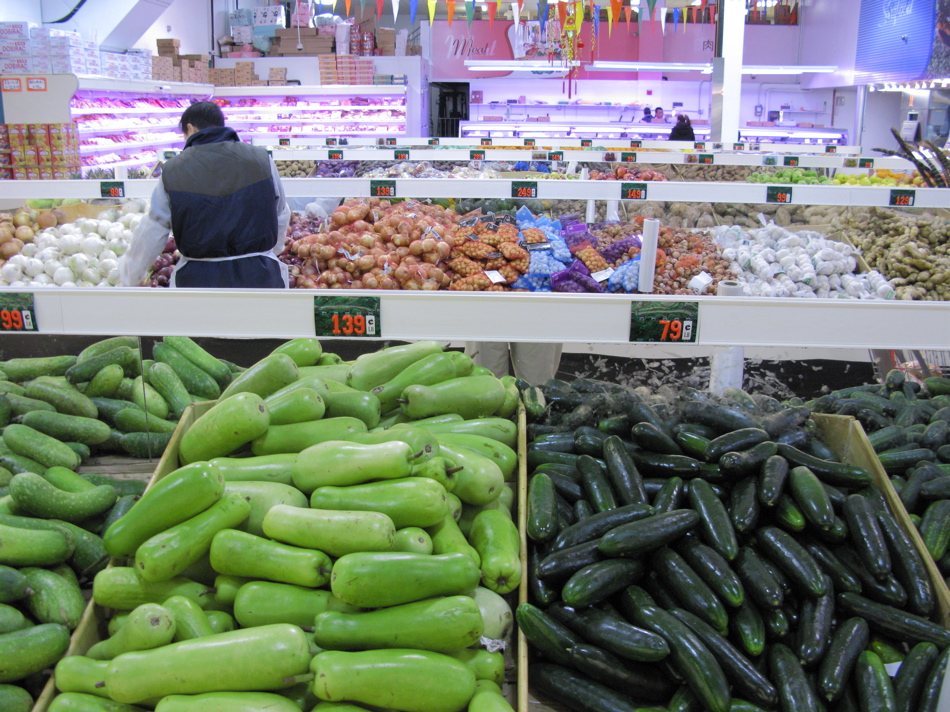
I'm only an occasional shopper at Asian markets, and have yet to try the big ones down on Washington Avenue, but I was more than suitably impressed in my visit today to Spring Garden Market at the corner of Spring Garden & Fourth with parking in rear. (If anyone has been to both the Spring Garden Market and those on Washington Avenue can provide a comparative analysis, I'd welcome it.)

The photos only show the produce/meat/fish area of the store; an area just has big holds dry goods and refrigerator and freezer cases chock full of ingredients and prepared foods. I've never seen such a collection of steamed buns! (I brought home Flower Scallion Buns to accompany dinner tonight.)

Although I spotted some Filipino-style frozen items, and Japanese noodles, most of the stock is devoted to Chinese foodstuffs.

I refrained from purchasing protein since my larder at home is pretty full, but I will be back. Nicely meaty pork bellies were selling for less than $2/pound; you could get sliced fresh belly for just a little bit more. The range of pork parts was immense: everything from feet, snouts and ears to kidneys, hearts and blood. In the frozen section was an even wider variety of pork, beef and lamb, some of it pre-sliced: thinly sliced leg of lamb, for example, at $5.99/pound. And if you want to make cheese steaks, they've got sliced rib eye, too.

You want Portuguese sardines for the grill? They have them in the frozen section, whole and ungutted. Probably better than anything you can get "fresh" in a fish store. The long fresh fish counter didn't look bad, with the fish properly under ice. (I do wish they would remove the dead fish hanging out in the live tanks under the counter, though.) The fresh mackeral was about 50-cents cheaper per pound that at the Reading Terminal, and looked at least as fresh.

The poultry was plentiful, too, especially duck at reasonable prices. Almost as many different duck parts as pig parts: tongues, feet, gizzards, etc.

By looks alone, the most of the protein looked of decent quality; I will definitely return for taste tests.

Sunday, February 24, 2008

Earl Doing Cartwheels Over His New Cart

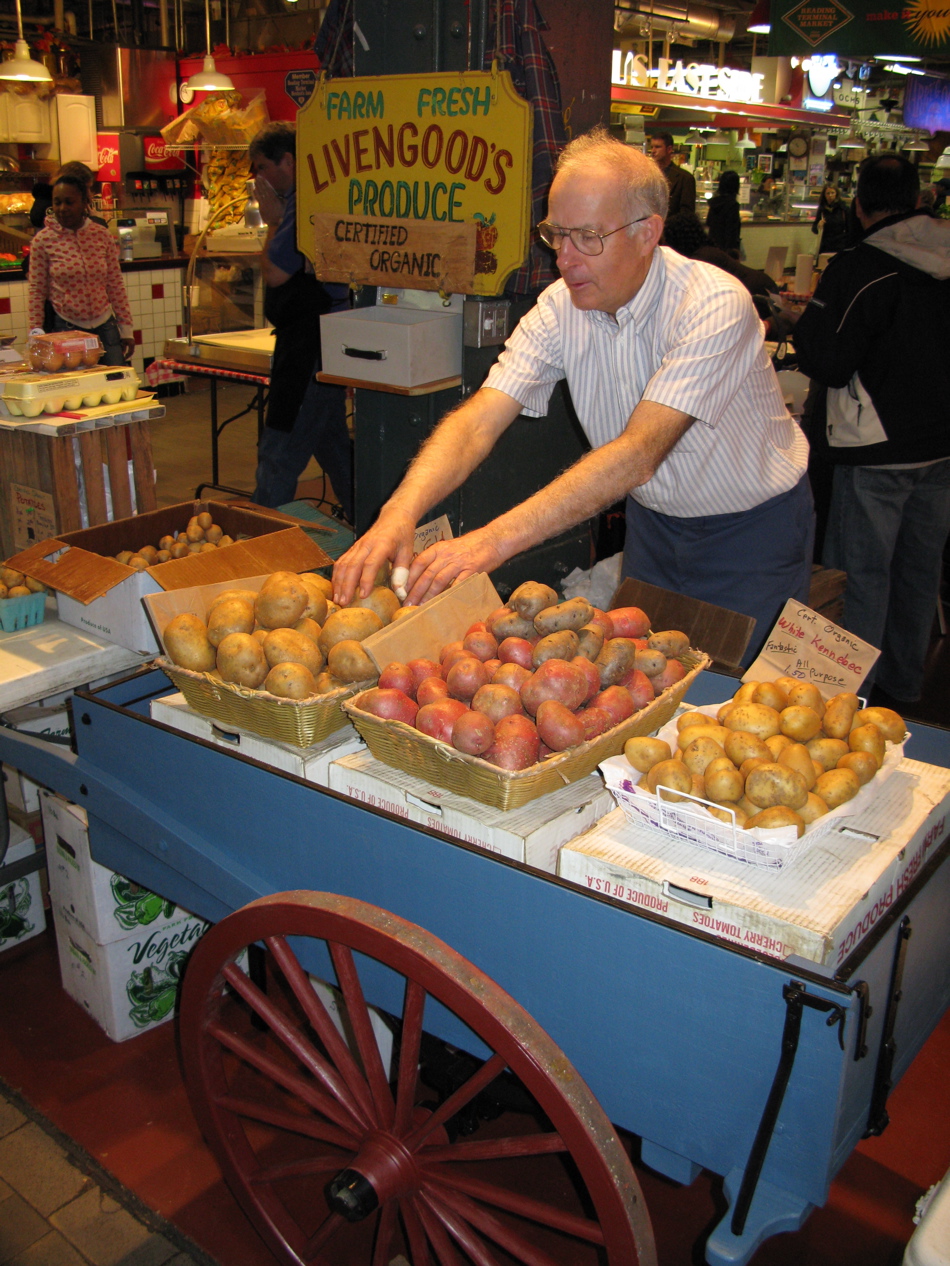
Earl Livengood this past Saturday unveiled a project he's been working on for two winters: a new cart. The steel-blue, wooden-wheeled vehicle (photo at right) displayed potatoes this week at Earl's regular Reading Terminal Market location. Although the spring crop has yet to be planted (other than seedings Earl and son Dwain have started in the greenhouse), we soon might start seeing the pokeweed Earl's friend Sam Consylman buries in sand each fall.

You will no longer regularly find baked goods from Haegele's at Dutch Country Meats. Purveyor Jake Fisher's lease specifies meat, so when one of the other vendors complained about DCM's carrying baked goods, GM Paul Steinke had no choice but to crack down. Fisher said, however, that he'll be allowed to sell a few specialty baked items at holiday time. (My wish would be for Haegele's to rent daystall space on Saturdays at the market to sell their goodies, which really have no competition in terms of specific items and quality with any of the existing the baked goods sellers at the market.

Expansion of product line beyond what's authorized in leases has been a bone of contention before. It's one of the issues which contributed to the departure of Siegfried's, the Germany specialty store whose Große Schuhe Dutch Country Meats is trying to fill. All was fine at Siggy's until his son, who managed the stall, tried to expand into serving lunch items items for on-premises consumption; that was a no-no, since the store 's lease classified it as a purveyor, not a lunch stand.

Even though it's the height of the citrus season, certain fruits have climbed in price. Over at Iovine this past weekend, a lime or lemon would have cost you 50 cents apiece. That's a far cry from summer, when either can sometimes go for a dime apiece.

Reasonably-sized navel oranges, however, can be had for 25 cents, and there are similar prices for tangelos, tangerines, etc. A relative bargain are the Chilean grapes; both red and green seedless varieties are selling for $1.99/pound. Grapefruit prices vary by size and variety, but they are pretty much as inexpensive as they get.

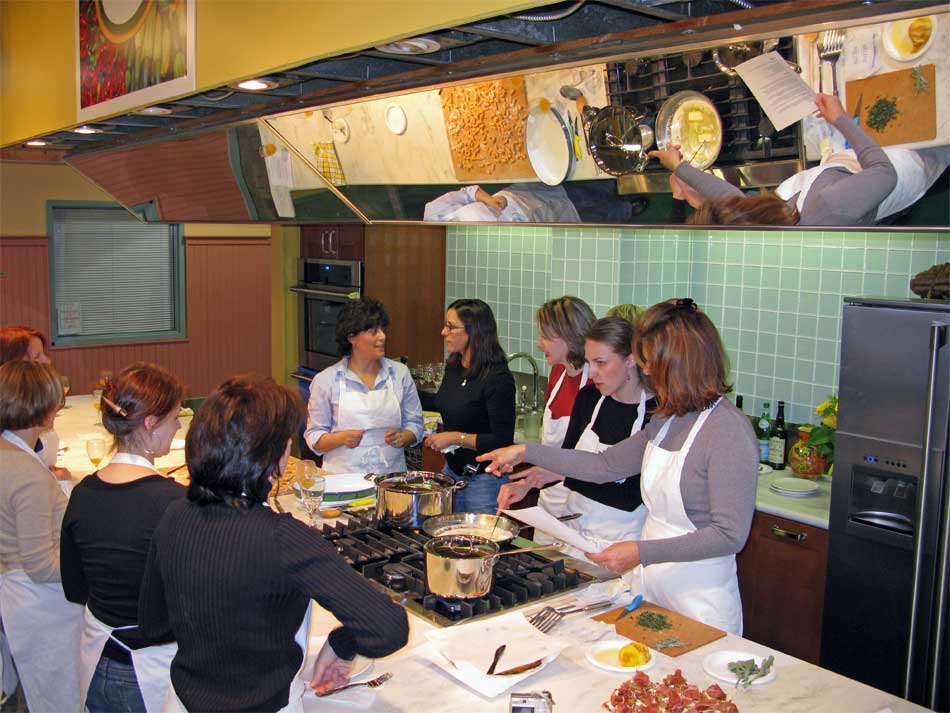
After a week's delay, La Cucina is open for business. In photo at right, Anna Florio leads a class Saturday. Florio offers independent classes as well as programs offered in conjunction with Temple University at the newly requipped kitchen.

There will be a formal "grand opening" ceremony in March, when the market will recognize the donations to the new kitchen of Electrolux IKON appliances from Airs Appliances, countertop material from DuPont and installation from Unique Designs, and cabinetry from Ikea.

Saturday, February 23, 2008

Souper Bowl Swimming Success

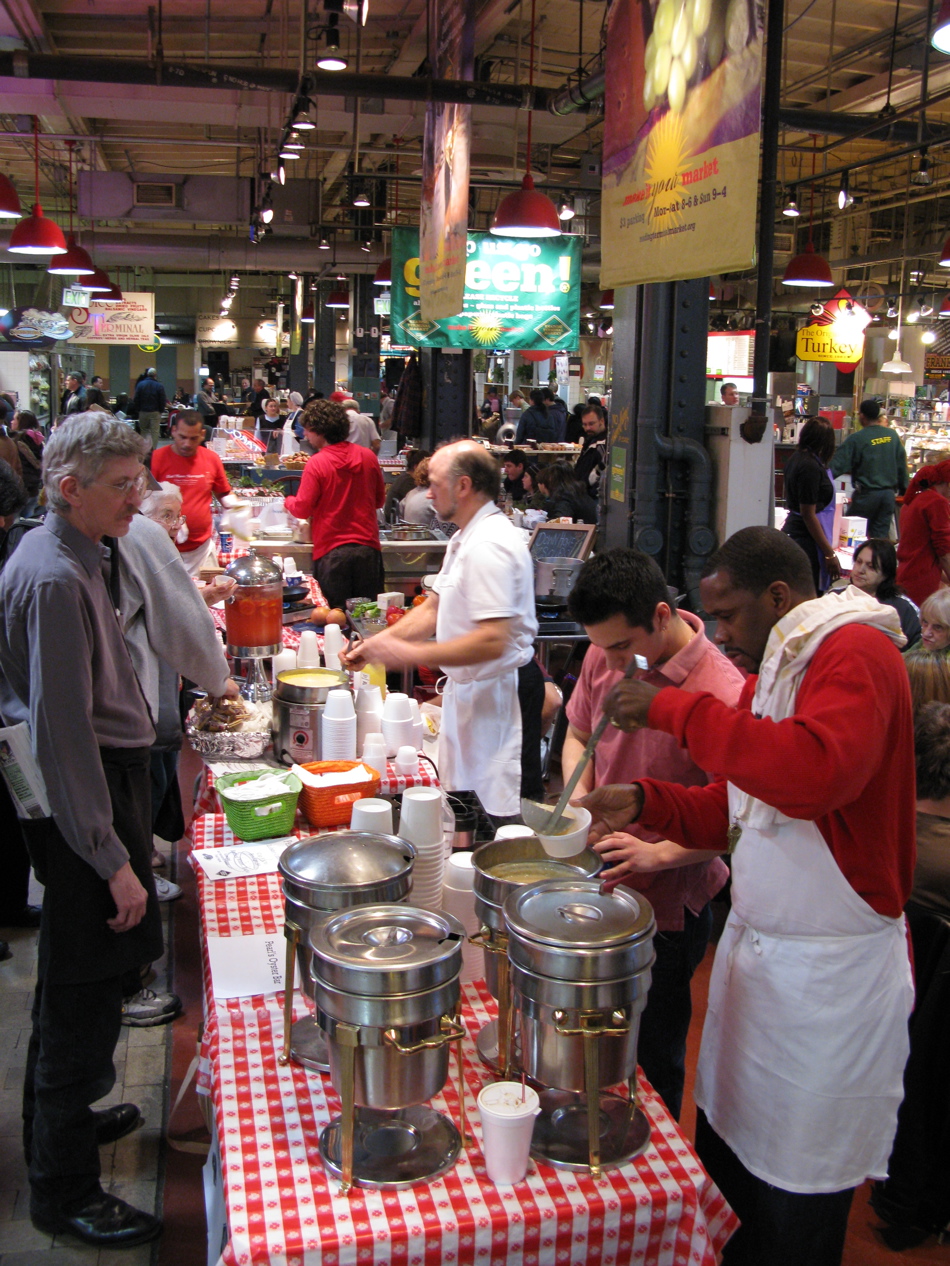
Things that swim were clearly favored by the judges at today's Souper Bowl contest at the Reading Terminal Market. The first, second and third place winners, from among eleven entries cooked up by market merchants, all involved creatures that like to hang out by sea or river.

The Souper Bowl was part of the market's Comfort Food Festival.

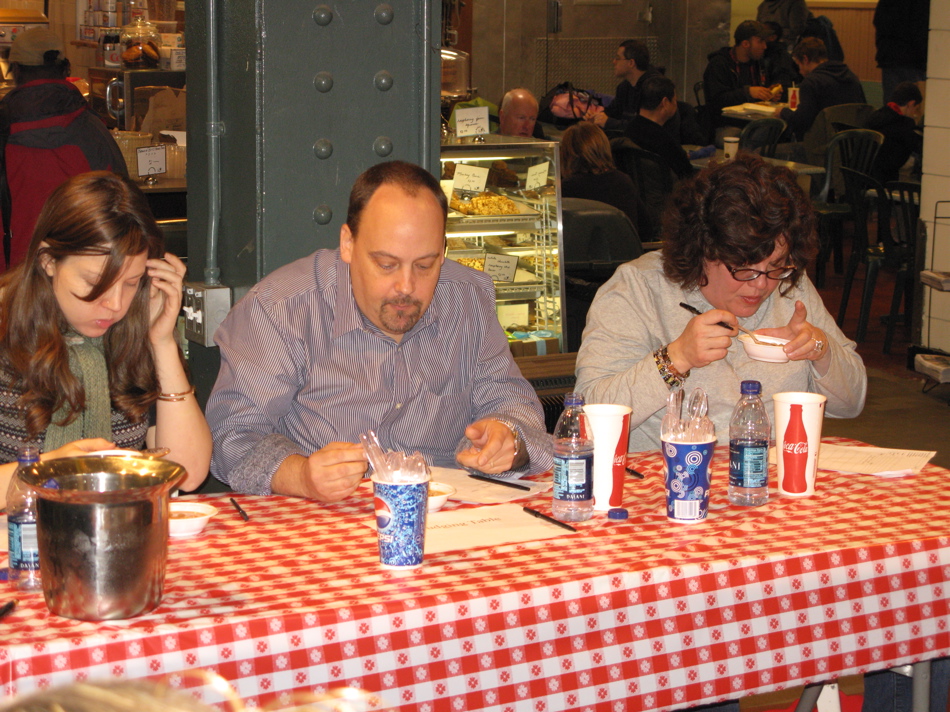
Top honors went to a snapper soup sold by Dutch Country Meats. Pearl's Oyster Bar earned second place for its lobster and crab bisque, while the Down Home Diner's clam chowder took third. The seafood-loving judges were April White of Philadelphia magazine, Ken Foster of Foster's Urban Homeware, and Laura Burkhardt of Where Philadelphia magazine.

I tasted most of the soups entered, and there wasn't a clunker among them, including the two pasta fagiole entries, but I can't argue with the winners. The snapper soup, a Philadelphia classic, had its richness balanced by the traditional shot of sherry. The bisque was just about the seafood, as it should be. Although cream-based, no New Englander would have recognized the clam chowder, since it featured some unusual and intense seasonings, but thoroughly enjoyable. Other soups entered included a golden potato, sweet and sour cabbage, matzah ball, turkey chili, and Italian wedding. (That adds up to 10; can't remember the 11th). Although some merchants who don't usually prepare soup made them special for this event (like DiNic's pasta fagiole), most of the soups are regularly available. The winning snapper soup is sold by Dutch Country Meats from the stock of goods they bring in from Rieker's, a German specialty store in the Northeast; starting next week it will be made on premises from the Rieker's recipe.

I also made the rounds tasting just a few of the offerings from merchants at the Comfort Food Festival, served at tables around the market's center court. Most offered free small tastes, but were also selling larger servings. I enjoyed the chicken from Nanee's Kitchen and the German frank with Kraut from Dutch Country Meats, but there were plenty of other goodies, including waffles and ice cream from Fisher's, one of the few "sweet" comfort foods highlighted.

Here are some photos from the event (as always, click on a photo to see a larger version):

At the Comfort Food Festival,
Pearl's Oyster Bar dishes out samples


Judging the Souper Bowl, from left: April White, Ken Foster, Laura Burkhardt

Jake Fisher, proprietor of Dutch Country Meats, has his arms raised in
Souper Bowl victory by RTM General Manager Paul Steinke

Friday, February 15, 2008

Coupons from RTM merchants

Reading Terminal Market merchants are distributing coupons to customers through the market's subscriber e-mails. You can sign up for the mailings by clicking on the "Mailing List" link at the bottom of the market's home page.

Among the coupons on this month's missive:
  • 12th Street Cantina: chicken dinner for two to go, $9.95
  • Bee Natural, $1 lip balm
  • By George, heart-shaped cheese ravioli with vodka sauce, garlic bread loaf, $21.95 ($25 regularly)
  • Contessa's French Linens, 10 percent discount.
  • Fisher's Soft Pretzels, free hot drink with breakfast roll-up.
  • Franks A Lot, 10 percent off minimum $5 purchase, 15 percent off minimum $10 purchase.
  • Hatville Deli, deli and sandwich counter specials
  • Mezze, hot entree with rice, veg, small soup $10 ($11.50 regularly) after 4 p.m.
  • Old City Coffee, reduced prices on Africa coffees during Black History Month.
  • Rick's Steaks, free soda with purchase of cheese steak with fries.
  • Salumeria, free box of crackers with half pound of Toma Blu, and free small fountain soda with regular hoagie.
Should anything be divined about the future of Rick's Steaks in the market from his inclusion in the coupon promotion, given the current litigation between the market and the steak seller?

No.

According to RTM GM Paul Steinke, so long as the case is pending before the courts and Rick's remains in the market, he's being treated the same as other merchants with respect to promotional opportunities, day-to-day operations, etc.

Saturday, February 09, 2008

Is That an Egg
or an Avocado?


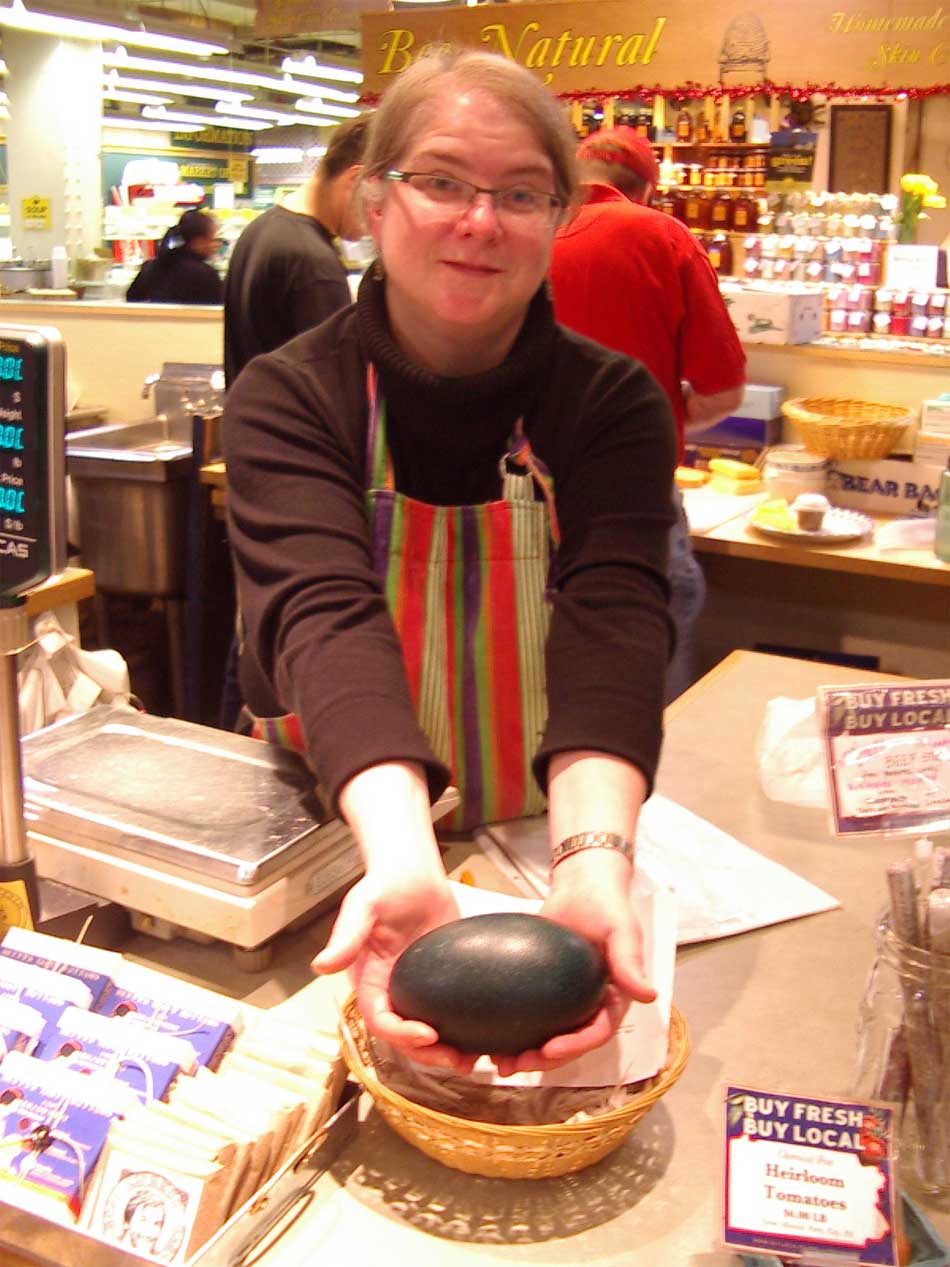
That's a 22-ounce emu egg Fair Food Farmstand volunteer Erin Wieand is holding. The $8 egg, from Boody Mill Emu Ranch in South Jersey, will make a very, very large omelet.

The Farmstand has gone more than a week without a freezer, which means no meats or chicken pot pies. The freezer has been repaired, but now a problem has been discovered in the electrical supply. The dairy refrigerator case is just fine.

Earl Livengood returned to the market today, offering root vegetables, winter squash, potatoes and dried herbs. But planning for summer is well underway: Earl said son Dwayne was spending the day planting tomato seeds so seedlings can be grown then placed in the ground this spring.

Lots more variety of sausages at Dutch Country Meats, all from Rieker's: fresh bratwursts, smoked Hungarian brats, Bavarian brats, kielbasa, weisswurst, knockwurst, München weisswurst, coarse mettwurst, fine mettwurst, calve's liverwurst, and German-style wieners, all $5.99/pound. They also had landjaeger at $1.79 a stick and rauchbeischen (smoked bit) sausage at $6.29/pound. Not much selection in the baked goods from Haegele's; the few hot cross buns I saw at 8:30 a.m. were gone by the time I left the market two hours later.

Jim Iovine of Iovine Brothers Produce enjoyed a New Year's trip to Italy last month, including a visit to a namesake winery in the shadow of Vesuvius. He also learned that in Italy, his name is pronounced YO-vin-EE. Just like how he'd shout out to his brother Vincent: "Yo, Vinny!"

There's a shortage of bike racks at the market, but six new ones will soon be placed on the Arch Street side. RTM Manager Paul Steinke said a shortage of bike racks is a good problem to have, but one that is being addressed.

The market has also ordered 5,000 cloth bags for distribution to customers as part of its Green efforts. RTM management and the merchants' association are trying to figure out the best way to get them to customers who will use them instead of just tossing them in a closet. One wag suggested exchanging them for the Whole Food cloth bags some RTM shoppers carry.

Wednesday, February 06, 2008

Shad and Rack of Peaches

A surer sign that spring will eventually arrive than any groundhog's shadow vision is the first shad of the season at local fish markets. Here, roe and buck shad are displayed at John Yi at the Reading Terminal Market. We're three months away from Delaware River shad.

Over at Iovine Brothers Produce, Brother Vinnie was raving today over the quality of the Chilean stone fruit (where it's mid-summer now). I tasted a slice of peach Vinnie offered, and while it doesn't compare to fresh local orchard fruit from the peak of our season, it was plenty good; better, in fact, than the IQF slices I purchased at Wegman's last week. The Chilean cherries I picked up a week-and-a-half ago weren't bad, priced at $1.99 for a one-pound bag, the same price as the seedless green grapes. Vinnie said the Chilean plums and nectarines were also pretty good.

If you're in the market for Thai ingredients, Katie Loeb notes in this eGullet post that Little Thai Market is more than just a lunch stand: they offer a planoply of necessary goodies if you wish to cook in the Thai style. The search for kaffir lime leaves led Katie to this discovery.

Until today, I always stuck with the roast pork with provolone and greens at DiNic's, but today I experimented with the brisket (with rabe, which I consumed as a kind of first course before digging in the sandwich, but no cheese, though I topped it with a helping of hot peppers from the containers on the counter). It was a tender, beefy sandwich, and one Tommy said he personally prefers. Still, as good as the sandwich was, it's hard for me to order anything but the pork, though I've got friends who swear by the sausage, too.

Saturday, February 02, 2008

Great steak, great price

During today's Reading Terminal Market trip (see previous item for details), I picked up a couple his 'n her steaks at Guinta's Prime Shop today, and lit the Weber Silver B to grill 'em just before sundown.

I say his 'n her because I like mine fatty, she likes hers lean. So for SWMBO I bought a tenderloin filet, priced at about $13 or $14 a pound. My choice was signed as a "cowboy" steak at $7.95/pound. It was a rib steak on the bone with only the excess fat trimmed away, so that there was plenty of extra-fatty meat along the perimeter, which I love, as well as the marbled rib eye.

Both steaks were superb (somehow I managed to cook them to our respective preferred donenesses). SWMBO thought her tenderloin was one of the best steaks she's ever had. Mine had deep beefy taste (not liver-y) and savory richness from all the luscious marbling.

Now, it certainly was not prime that was dry-aged for an exceedingly long period of time; in fact, I think both cuts were wet-aged, though I didn't ask before buying. (Giunta's displayed each individual cut in its own sealed vacuum bag which is why I think they were wet-aged, though that's not conclusive evidence.) As good as the steaks were, Harry Ochs' premium dry-aged steaks and prime rib roasts (the ones that have aged for six weeks rather than four) are superior; however, they cost about 30 or 40 percent more.

Bottom-line, my experience tonight confirms that Guinta's Prime Shop offers exceptional value in very good quality meat. In addition to the steaks tonight, I've bought hanger, flank, skirt and sirloins for grilling. I've enjoyed Guinta's loin and rib lamb chops, shanks, leg, and breasts; ducks and chickens (I've yet to try the veal, but it's on my list). None has disappointed and some, like tonight's steaks, have been extraordinary. The fact that Charles Guinta sells only all-natural, hormone-free, grass-fed beef is almost irrelevant; it just tastes darned good.

Does Guinta's Prime Shop offer the absolutely very best meat you can buy? No. But I am hard-pressed to think of another butcher that offers better meat for the price.
Super Bowl and Souper Bowl

Super Bowl Sunday is tomorrow, and if you want wings to feed your crowd, Guinta's Prime Shop has deal for you: a 40-pound case for $59.95, or $1.50/pound. If your group can't consume that many wings, Guinta's and other butchers at the Reading Terminal Market will sell you them at prices ranging from $2.49-$2.69/pound.

If you're making your own guacamole, the price of avocados and limes are up with demand: the Hass avocados are $1.49 at Iovine Brothers, the limes three for a buck, or $1.69 and four for a buck, respectively, at O.K. Lee.

Earl Livengood took the day off today, which was just as well as far as the market's lunch vendors are concerned, since the space the Lancaster County farmer normally occupies can be used for additional table capacity, given that it's opening day for the auto show. Tom DiNicolosi, proprietor of Tommy DiNic's, expects today to be the busiest day of the year.

Among the hot items Hershel's has to help fill your platter of brisket or any of their other delicacies is kasha varnishkes, a noodle-buckwheat groat combination usually served with gravy.

La Cucina plans to begin cooking classes Feb. 12, with the instruction under the banner of the Temple Center City's Institute for Continuing Studies. Most of the classes La Cucina's RTM demonstration kitchen are for Italian cooking, although other topics are covered in some classes, including a special class for young chefs (ages 9-12) March 8. Most of Temple's basic instructional courses, as well as a number of special chef demonstration classes, will be held at Foster's new store at Fourth and Market, with others at Center City restaurants. Here's the web page listing Temple's classes this semester, some of which are already sold out.

The RTM inaugurates its International Comfort Food Festival on Saturday, Feb. 23 from 10 a.m. to 4 p.m. Samples prepared by market merchants will be available of homey foods from different world cultures, including African-American, Italian, Middle Eastern, South Asian, and Jewish. The big event of the day will be a "Souper Bowl" contest to determine which RTM merchant makes the best soup; judges are expected to be local food writers. Live jazz and children's activites will also be part of the festivities.

Weddings are performed every Valentine's Day in center court, and this year is no exception. Six local couples will tie the knot on Feb. 14 in ceremonies officiated by Judge Jeffrrey P. Minehart. The Kraft Trio will play the Mendelssohn.

As reported in an earlier post, Dutch Country Meats will sell Fastnachts, the German Shrove Tuesday delicacy baked by Haegele's of the Northeast -- but only for one day, Tuesday, Feb. 5. Haegele's version is different from the plain fried potato dough Fastnacht served in Pennsylvania Dutch country; after frying, Haegele's soaks them in cream, according to Dutch Country Meats proprietor Jake Fisher.

Monday, January 28, 2008

Brewer's Plate Expands, Moves

The Brewer's Plate, an annual fund-raiser for the Fair Food Project, will change its venue and alter its structure slightly this year.

For the fourth edition of the foodbrew fest, the schedule was moved up month, from April to March, to coordinate with Philly Beer Week, said Kathryn Hauge, event coordinator. That means it will take place on Sunday, March 9 which, coincidentally or not, is also the last day of the Philadelphia Flower Show.

Hauge said that with more brewers and restaurants on tap than last year, growing attendance, and the overlap with the humongous horticultural event at the convention center, White Dog sought a larger, more workable venue, hence this year's event moves over to the Independence Visitor Center from the Reading Terminal Market, site of the previous three Brewer's Plates.

The basic idea is unchanged: brewers will be paired with restaurants, whose chefs will match food to the brews offered. In past years, two different beers were offered for each restaurant. This year, with the number of participating brewers and restaurants growing to 21 apiece (not counting DiBruno Bros. – more about that later) each brewer will present one beer paired to one restaurant's dish.

Tickets are $50. That gets you general admission, all the food and beer you can consume (without becoming inebriated) and a souvenir tasting cup. Designated drivers pay $40.

But for the price of a VIP ticket ($100, or $80 for designated drivers) you get admission a half hour earlier, so you can attack the food and beer stalls in a slightly more leisurely environment, live music on the heated, tented terrace, special seating in the ballroom (vs. crowded high top tables on the grand hall), live jazz, gift bag to take home (along with specially selected beers to take home, too). Also, a curated beer list, different from those available in the main hall, and additional food catered by DiBruno's will be served.

If your thirst extends to knowledge, VIP ticket holders can have it quenched it can be quenched through beer tutorials led by Marnie Olds and Garrett Oliver. Olds is a regarded as one of Philadelphia's top wine educators who has extended her expertise to beer. Oliver is brewmaster of Brooklyn Brewery and the author of "The Brewmaster's Table".

Details – including list of the 21 participating brewers and 21 participating restaurants – can be found at The Brewer's Plate website. If you want to find out what else is happening beer-wise that week, visit the Philadelphia Beer Week website.

Sunday, January 27, 2008

Brisket and Fastnachts

With the Home Show finishing up today, the RTM lunch merchants are looking forward to the new convention and show season, with the auto show opening on Groundhog Day, the big crafts buyers show in mid-February and the Flower Show two weeks later in early March. If you want to avoid the crowds, stay away from the RTM during lunch hours those days!

Folks have been asking for platters at Hershel's East Side Deli, so they are obliging. You can get that brisket on a plate with mashed potatoes and other veggies or starches, instead of on a sandwich or accompanied by slaw or salad. If you haven't tried the brisket, do. It's moist and flavorful, and Andy will cut it for you lean or fatty, as your preference dictates. (Andy cooks his brisket whole, not just the lean flat portion, so if you like the fatty deckel like I do, you can get it.)

Speaking of fatty food, expect to see Fastnachts, a pre-Lenten South German/Pennsylvania Dutch donut, at Dutch Country Meats by next weekend. The Fastnachts will come from Haegele's and are traditionally made with mashed potatoes added to the flour, and frequently prepared hole-less.

Jake Fisher, the shop's proprietor, told me he plans to go whole hog into German foods. Although the Dutch Country Meats has de-emphasized fresh pork cuts and only displays a limited selection, you will occasionally spy a piggy item that's otherwise hard to find. This week it was salt-cured pork belly. (Okay, that's really not a fresh cut, but it wasn't smoked so it's close enough.) If you don't see something, ask. Not all the available cuts are in the display cases; they might have what you want in their walk-in fridge.

This week I purchased the Wien Kuchen, Bienstiche Kuchen, Zweibel Kuchen (all from Haegele's), double-smoked pork butt (from Rieker's), and sauerkraut. The Zweibel Kuchen from Haegele's was unexpected, since it wasn't a sweet treat. Instead, a savory egg-onion-sour cream pie (in this version, sans-crust). I'll re-heat the Zweibel Kuchen to go along with the Carbonnade Flammande I braised yesterday from Harry Och's lean chuck.

Saturday, January 19, 2008

Haegele's Baked Goods Now At RTM

Earlier this week I wrote of Dutch Country Meats' de-emphasis of fresh pork products in favor of German-style deli goods and other prepared foods, including a nice selection from Rieker's, the sausage and deli emporium in the Far Northest. The shop has taken another big step away from fresh pork with the addition of this week of baked goods from Haegele's, a superior bakery in another Northeast neighborhood, Tacony.

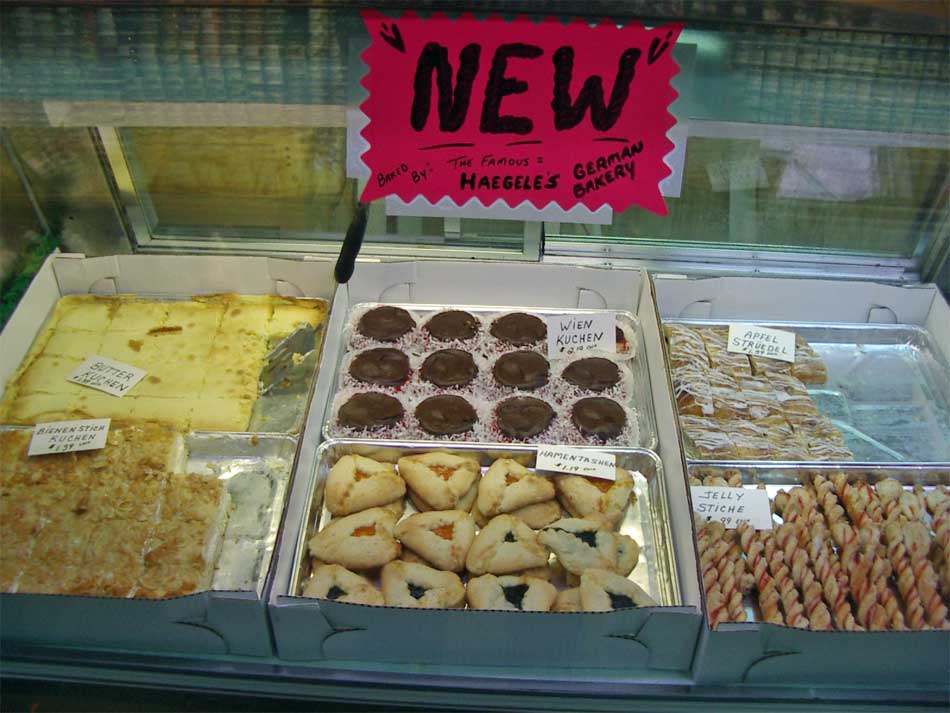
Today they featured six of Haegele's product seen below: butter kuchen (butter cake), bienenstich kuchen (bee sting cake, with a custardy filling, and a sugar or honey almond topping), Wien kuchen (Vienna cake, which appears to be chocolate with a filling I couldn't identify just by looking at it -- a taste test is in order!), hamantaschen, apple strudel, and jelly stiche (jelly stings?).


Across the aisle, at Kauffman's Lancaster County Produce, Benuel Kauffman is now selling unpasteurized cup cheese, made by a neighbor from his two Jersey cows. Ben explained that it's used as a spread, usually on bread of crackers with some jam or preserves. I've checked recipes to find out exactly what it is, but the ones I googled were quite different, though many involve heating milk, adding butter and egg and finishing with cream. The consistency is more liquid than sour cream, hence it is served in cups. I tried a sample from Ben on a cracker with jam, and it was quite pleasant. He's selling it for about $4 a container (I didn't check the per pound price).

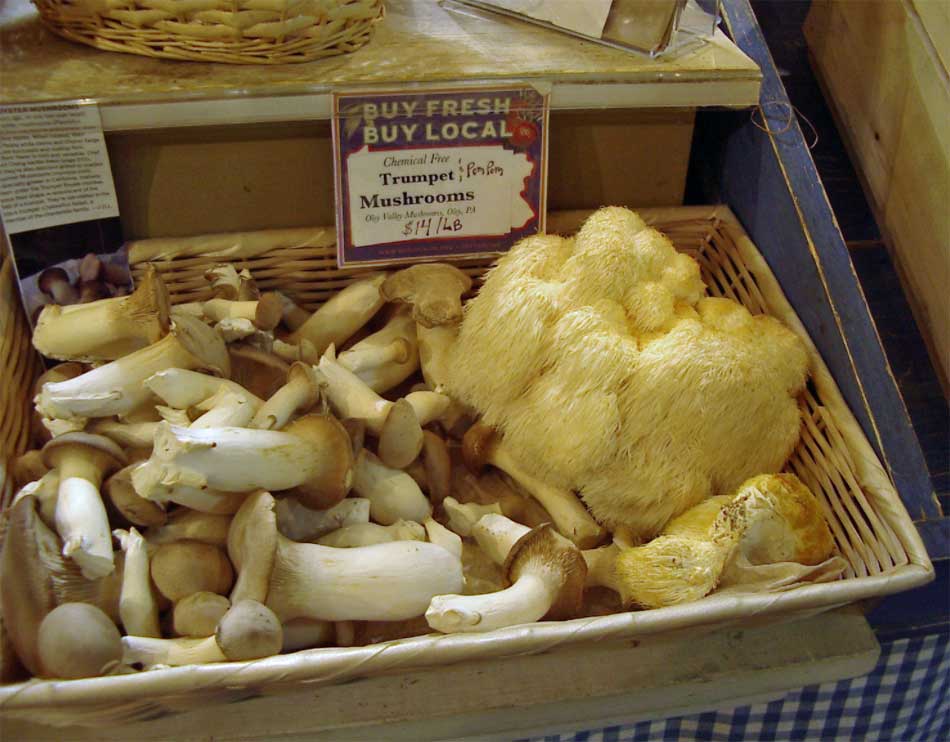
A mushroom I've only occasionally seen in stores made an appearance today at the Fair Food Farmstand. It's the "pom pom" pictured here from Oley Valley Mushroom Farm. Pom pom is just one of the names this fungus goes by. It's scientific name is Hericium erinaceus. Less marketable names (hence the use of "pom pom" in retail settings) this delicate fungus goes by include lion's mane, monkey's head, elf abalone, Bear's Head, Old Man's Beard, and Satyr's Beard. I've enjoyed this choice mushroom sliced and sauteed, and I wouldn't argue with those who think its taste suggests mild seafood, like lobster or scallop. It was available today for $14/pound.

Oley Valley Mushrooms was among the winners at this year's Pennsylvania Farm Show, as was the Livengood Family Farm, which sells at its own center court stand on Saturdays.

Joyce Livengood bested competitors in four vegetable sub-categories to win the Grand Champion Vegetable Market Basket, repeating her victory of last year. Her Grand Champion entry was in the subcategory for eight-piece displays of in- and out-of-season vegetables. She aslo took home second place for her entry in the sub-category for five-item, in-season, Pennsylvania grown vegetables.

Oley Valley earned first and second place in two different shitake categories, first and third place in two different oyster mushroom categories, and second place in the "other" mushroom category.

Fair Food Farmstand can't find room for the boxes used by farmers to deliver their goods (photo below), so they're stacked along the perimeter of the stall. Seems now that winter is here, the farmers haven't been around to pick up their wooden containers. Co-manager Sarah Cain says visitors to the Home Show have sought to purchase them. Just make her an offer and see if she'll bite.


Fair Food's space problems aren't limited to storing wooden boxes. They'd love more refrigerated storage space and additional selling space. Expansion into the adjacent seating area or a move within the market is within the realm of possibility (though by no means a certainty) by the peak of the 2008 season growing.

La Cuchina expects Electrolux to install the new kitchen appliances within the next two weeks, and will open its cooking class schedule shortly thereafter.

Thursday, January 17, 2008

Visit Eastern Europe . . . Without a Passport

I made another trip to Bell's Market in Northeast Philadelphia this morning and left wishing I had a lot more refrigerator and pantry space.

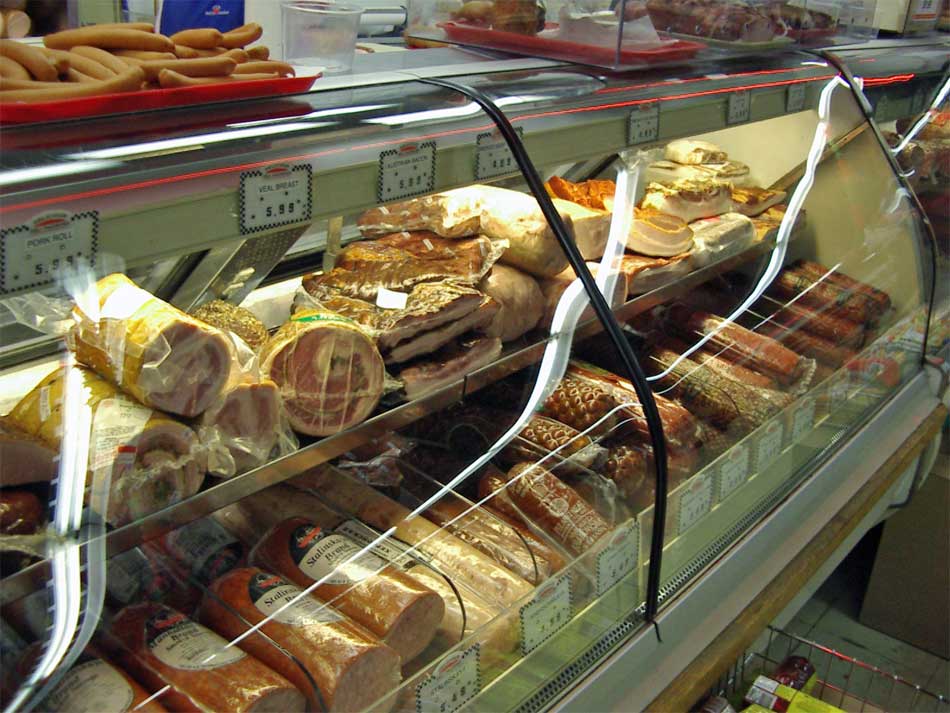
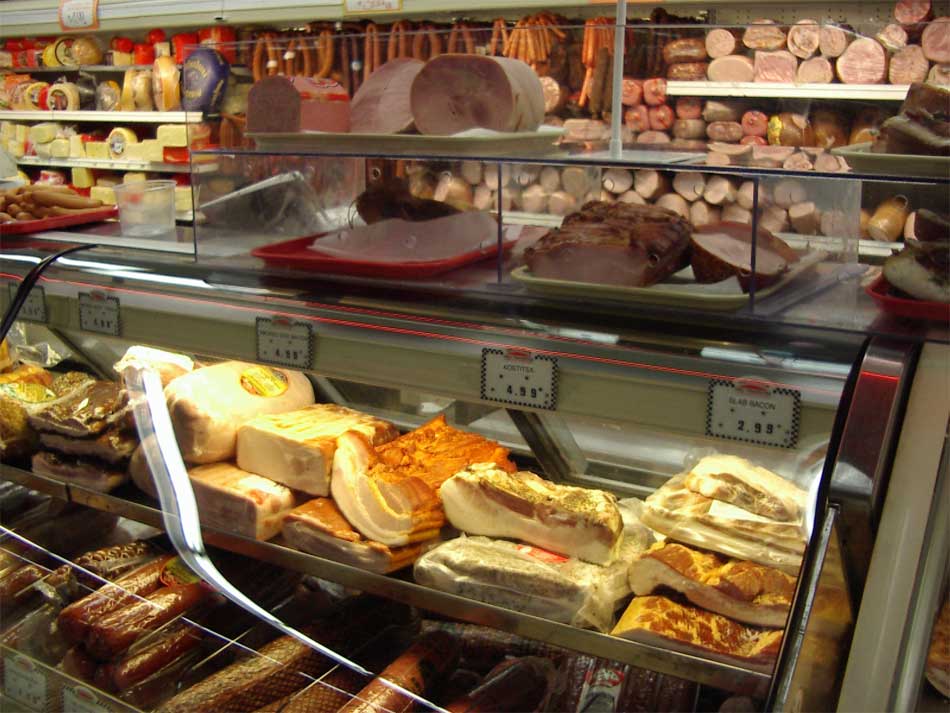
A main attraction for me is the wide expanse of deli cases filled with all manner of Eastern European salamis, sausages, pressed and rolled meats, hams, bacons, etc. The photos below (please excuse the fluorescent glare) provide some idea of the variety.

Salami central. I left with half a pound of a sliced Ukrainian salami, a fat-studded, emulsified and medium smoky stick sliced at an extreme diagonal for a lengthy oval.

Various pressed and rolled cold cuts are available, so I purchased a veal breast roll, which I have yet to taste.

Yummmm, bacon! The lady behind the counter offered me a sample of the fully-cooked Hungarian bacon when I asked what it was compared to others; that was much simpler for her than trying to describe it in English. Very mildly smoked and seasoned, but pleasant. I bought a pound for $3.99. From a self-serve deli case I picked up a pack of Russian-style knockwurst made by a wurstgeschaeft I used to frequent, Gaiser's Pork Store of Union, N.J.

I restrained myself at the smoked fish counter, filled with fish you never heard of as well as whitefish, trout, mackerel, salmon, etc. This is the place for hard-core smoked and preserved fish lovers like me. I'll save major fish buying for my next visit, but I needed some herring so picked up a small jar of Canadian fillet tidbits marinated in dill sauce. There must have been eight or nine different brands/sizes of matjes herring.

The only other fish product I bought was small jar of taramasalata. Here, the jar that would set you back $6 or $7 at Whole Foods sells for $3.50.

Packaged grocery goods offer savings, too. The cocktail-size packages of Rubschlager rye and pumpernickel go for $1.79 and $1.89, vs. $2.50 at supermarkets and $3 at specialty stores like the Reading Terminal Market's Downtown Cheese.

An entire aisle of pickled vegetables and related condiment is a veritable preserved garden. I escaped with one of my more extravagant purchases, an $8.79 large glass jar filled with marinated bolete mushrooms (porcini, just from Latvia instead of Italy) and a jar of red pepper-eggplant spread.

She Who Must Be Obeyed spent most of her time in the chocolate and cookie aisle where a full complement of European staple sweets can be had. SWMBO walked away with a box of Fidelios (hazelnut-encrusted cylindrical cookies), a box of waffle cakes (napoleon-type cookies), industrial packaged croissants filled with apricot jam, and some German chocolates. I couldn't resist a 700 gram (1.5 pound) box of Turkish halvah with pistachios, priced at $6.59. Lots of different varieties of Turkish delights, too.

From the bakery (just around the corner from the salads and smoked fish) I purchased a slab of what appears to be a variety of Dobish torte, $5.95/pound. Across from there was a variety of packaged breads and breads from other bakeries, including a full range of Teixiera portuguese rolls. I found a round Turkish bread topped with white and black sesame seeds, still warm from the oven.

Among the items I want to try in the future are the various dumplings from the salad cases, especially the pelmeni (a Siberian style meat dumpling) and the cherry dumplings. Bell's Crossing also offers a wide variety of yogurts and other dairy products and beverages that you'll be hard-pressed to find anywhere else in town.

Since many of the ladies behind counters have only rudimentary English skills (though their English is far superior to my Russian), finding out what intriguing-looking items are can sometimes be a challenge. But even if you're mistaken and find out what you've taken home isn't quite what you thought it was, it's still going to be delicious. Since it wasn't too busy this morning the staff, which can occasionally be brusque, tried to help when they could.

Wednesday, January 16, 2008

No Meatballs No More

I've been neglectful in posting notes and news of the RTM lately, so it's catch-up time.

DiNic's has given up on Meatball Sundays. Too much work for too little profit, according to Joe.

Michael Pollan, in town last week to promote his new book with a talk in the Free Library author series, visited the Reading Terminal Market in the tow of the Inky's Rick Nichols. Sarah Cain, co-manager of the Fair Food Farmstand, reports in her weekly newsletter that Pollan visited the stand "goofing around with [our] Hubbard squash".

Contessa's French Linens, which set up in the temporary "Christmas Market" area, has decided to make a permanent go at it. Right now they are located in the former Amy's Place stall. If RTM Manager Paul Steinke gets a new vendor to take over that space and the adjacent former Le Bus stall (he says he's got a likely prospect, but no deal yet), Contessa's would move to another spot.

Under its new ownership, Dutch Country Meats continues to de-emphasize fresh pork products in favor of smoked, cured and prepared offerings. The selection of German-style provisions from Rieker's has expanded nicely and even includes their Snapper Soup, a decidedly Philadelphia, rather than German, dish. Fresh pork products represent no more than one-quarter of their case space, perhaps less. The only fresh pig they were selling last Saturday were center cut chops, baby back ribs, tenderloin, city dressed pork belly, and feet. Didn't see any shoulders or butt portions in the display cases, nor any variety in the types of chops.

Electrolux, the Swedish appliance manufacturer (famous for their vacuum cleaners!) is making a push to sell their consumer ovens, cook-tops, refrigerators and dishwashers in the U.S. That's why they will be re-equipping the market' s kitchen. The kitchen will serve as both a demonstration area and as a cooking school. The school will open soon as La Cuchina and will be operated as a separate business by an instructor from Temple; as of last Saturday it looked like that had a little work to do before they could open for classes.

My cooking extravaganza during the holidays was duck-induced. I started out with two Peking ducks from Giunta's Prime Shop, which set me back about $35 (about $3.50/pound).

The ducks came from the Joe Jurgielewicz & Son Farm in Berks County. The Jurgielewicz family started out raising ducks in the 1930s on Long Island, and one branch of the family continues to operate a major duck farm there. Another of the founder's grandsons, veterinarian Joe Jurgielewicz, established the Pennsylvania operation where the company breeds, hatches, raises and processes their own ducks on the farm, rather than contracting with other farmers to supply them with harvestable birds.

From these two plump birds I butchered out the breasts and the legs, with the breasts going into the freezer for future use and the legs and wings reserved for confit/rillettes. The fat from the two birds rendered into enough for the confit which now sits in the fridge as rillettes. The carcass was roasted, then turned into stock with a small onion and celery stalk. I used the livers, hearts and gizzards, along with pickings from the carcass, to create a variation of Jerusalem Grill for a couple of lunches. Jerusalem Grill is fatty lamb trimmings and chicken innards griddled with onions, garlic and various seasonings (cumin, coriander, black and red pepper, allspice, etc.), then served on or with a pita, perhaps with a smear of hummus. I didn't have lamb trimmings, so I just used the duck innards and trimmings. Delish.

Tuesday, December 18, 2007

Night of the Seven Fishes

The goods are in for the Night of the Seven Fishes at the Reading Terminal Market. Both Golden and John Yi featured fresh sardines (herring) at $3 and $3.99/pound, respectively, though at least by today's display, Golden's were superior creatures. Yi also had spearling at $4.99, Golden some rather large langoustines, a.k.a. Dublin prawns. All the other usual suspects, too, including bacalao.

I've been having a blast enjoying fresh oysters now that I've purchased an oyster knife and learned to use it (very carefully). The oysters available at the RTM fishmongers are all from Virginia and the Chesapeake, the usually price being 50-cents apiece; I've only seen oysters from Maine, Massachusetts and Canadian Maritime waters at Wegman's in Cherry Hill, where they are nearly twice that price, but worth it. (When I asked one RTM vendor which oyster he had, he said they were Blue Points . . . from Virginia. Which, of course, is an impossibility. Since the HAACP tag said Virginia, they weren't Blue Points, which only come from Long Island.)

If you need a fruitcake, either as a gift or a weapon, Iovine Brothers Produce has Claxton cakes in the reefer case by the checkout closest to Filbert Street. Only the regular version, not the dark (which I prefer). Priced at $3.99 per one-pound brick. These fruitcakes are more fruit and nut than cake by a wide margin.

Although Iovine had Hass avocados available at a buck apiece, they were either far from ready or over-the-hill. Instead, I picked up one of the Florida/Carribean fruits, which tend to be considerably larger. I'm not sure they'd make as good a guacamole, because they tend to be less rich/buttery, but they are excellent in salads. I used some tonight in a tortilla wrap with chicken, Mexican white cheese, cilantro, lettuce and salsa.

Ducks and geese: Nice selections at a number of butchers. Godshall's has both (including Eberly's geese), L. Halteman has Muscovy ducks, Giunta's Prime Shop Long Island (Peking) ducks and can order the Eberly's geese. If the dark meat birds don't interest you, yet you want a big bird but not turkey, consider a capon from Godshalls or Giunta's. The latter carries surgically caponized birds from Eberly; I don't know whether Godshall's are surgically or chemically caponized. In either case, capons are larger chickens (ex-roosters, actually) that tend to run about 8-12 pounds and have a preponderence of breast meat, which stays moister than the usual chicken's.

Saturday, December 15, 2007

We made our annual trip to The Great Northeast yesterday in search of holiday baked goods and a few other delectables. For those who do not reside in Philadelphia, The Great Northeast is a wide swath of the furthest reaches of the city, halfway to Trenton, where a great many of its residents reside. The Great Northeast is to Philadelphia what Queens is to New York City, and the size and design of the homes isn't much different from a Forest Hills rowhouse.

Click on "View Larger Map" for a key to the push pin symbols, which reflect both the vendors we visited and others we have tried in the past or are on our list for a future trip.


View Larger Map

Our first stop was to try and find Moish's Addision Bakery from a previous trip a few years back. Alas, it appears to be of of business, even though there's a web site. We journeyed all the way up to Red Lion Road in search of this classic kosher bakery, which to our taste did onion rolls and salt sticks as well as it did babka and rugelach.

Disappointed, we headed south and detoured off Bustleton Avenue to the Krewstown Shopping Centger and Steve Stein's Famous Deli. It was late on a busy Friday morning and you had to take a number for servide, but that only gave us about five minutes to peruse the plethora of smoked fishes and salads in the cases. We walked out the door with whitefish salad, lox, red potato salad, hummus with pine nuts (pre-packaged), and a Bartlett pear from the produce aisle. The whitefish salad was quite good, but a bit too smooth and low in fish flavor to my taste, though I think many would be find these characteristics to their liking; I just prefer mine fish salads fishy. The very good price of $3.99/pound probably accounts for the high proportion of mayo to fish. I am saving the lox I purchased until Sunday morning, but it looks like it was carved expertly. I selected regular (salty) lox, and both regular and nova are available in either belly or regular cuts; the belly cut is fattier and prices, $9.99/half pound, vs. $7.99 for regular cut.

Back on Bustleton and heading south, we passed Bell's Market, saving this palace of all tasty things Eastern European for another trip, and switched over to Castor Avenue. We made two quick stops at Lipkin's and Hesh's Eclair Bakery, finding nothing compelling (other than challahs, which we wern't in the market for today) at Lipkin's, and limiting ourselves to some stick raspberry sticks and onion board (a flatbread which I used to hold the whitefish salad when I got home)at Hesh's. At Weiss, Bakery which I think is the best of the Kosher bakeries along this stretch of the Northeast, we picked up seven layer cake (a variant on Doboshtort) and some assorted cookies.

Our last stop was in the Northeast's Tacony section, at a German old-style, neighborhood bakery, Haegele's. You can find photos and notes from last year's visit here. This year we walked off with assorted Christmas cookies, anise springerle, and a brownie for She Who Must Be Obeyed. I had to restrain myself from also purchasing one of their evil buttercakes.

Sunday, December 09, 2007

Headhouse season nears close

Today's Headhouse Square Market doubled the number of vendors from last week, when only seven braved the snow to trek into the depths of Philadelphia. Showing up this week were:
  • A.T. Buzby, produce
  • Birchrun Hills Farm, cheese
  • Betty's Tasty Buttons, fudge
  • Demarah, soaps
  • Griggstown Quail Farm & Market
  • Hillacres Cheese
  • Queens Farm, produce
  • Margerum's Herbs
  • Mountain View Poultry
  • Old Earth Farm, produce
  • Stargazer Vineyard
  • Three Springs Fruit Farm
  • Versaille Baking
  • Woodland Produce
This was only the second week for Woodland Produce, but if their first week is any example, it will be a profitable one. Last week owner Maury Sheets sold out an hour before market closing. He specializes in greenhouse-grown, hydroponic salad greens (although some root veggies and squashes were also on the table this week), primarily selling to Philadelphia restaurants, as well as through the Fair Food Farmstand at the Reading Terminal Market.

Noel Margerum was selling fall veggies as well as preserves, relishes and dried herbs. Noel and her sister Carole rotate among the city's farm markets, including Clark Park and Fairmount.

Although the market continues for the next two Sundays, this week was probably the last of the season for Three Springs Fruit Farm (the Wenk family). Their orchard fruit is also available at the Fair Food Farmstand. Today I bought a couple of huge Rome apples which I plan to simply bake with some brown sugar or honey.

Old Earth Farm is out of stock of meat, at least for a month or so until their piglets reach market size. Since Headhouse will be closed then, you can call the farm or get on its mail list to be notified when their Tamworth porkers are is available: www.oldearthfarm.com or 610 779-9035.

If you've become hooked on those pot pies from Griggstown, fear not when Headhouse Square closes for the season. Like the output of many other vendors, these, too, are available at Fair Food Farmstand.

What I won't be able to find elsewhere once the market closes for the season are the wonderful baguettes and croisssants from Versailles Baking. The Pennsauken boulanger only sells retail at the Headhouse and Haddonfield markets. Otherwise all their customers are wholesale accounts.

Saturday, December 08, 2007

Orange you glad it's citrus season?

Good citrus fruit is back in force. Jim Iovine of Iovine Brothers Produce said the grapefruit he was selling at three for a dollar (medium sized) was the best of the bunch, though he said the other citrus fruit have finally reached high-season flavor, too. I picked up some four-for-a-buck navel oranges, but the sample tangerine sections also tasted good. Limes continue at 10/$1, though lemons are 3/$1.

Over at the Fair Food Farmstand I couldn't resist trying a watermelon radish. Not at all peppery, even slightly sweet and carrot-like. Made an intersting contrast on the plate. Earl Livengood's curly endive ($2.50/head) made a great salad to go along with that radish.

The first of the holiday seasonal fish has started to appear. Both Golden and Wan are selling fresh whole sardines (herring) for $3.99 and $3.49/pound, respectively. Last year they sold for $1.99-$2.99. Maybe the price will come down after New Year's. Expect to see greater variety as we get closer to Christmas. What I'd love to see would be the Maine shrimp johnnyd touts on eGullet; I'll have to check Whole Foods which sometimes gets them.

DiNic's began extended hours to 6 p.m. this past week, so if you're craving a roast pork sandwich after work or for a late afternoon snack, you can satisfy your hunger.

Wednesday, December 05, 2007

Fair Food Farmstand news

Two items about the Fair Food Farmstand at the Reading Terminal Market to pass along:

Country Time pork will be delivered tomorrow (Thursday, Dec. 6) for the first time in more than a month, when the owners, the Crivellaros, were involved in a traffic accident.

This week's farmstand e-mail newsletter includes fascinating information from manager Sarah Cain about integrated pest management. I learned an awful lot about the subject from it. I couldn't find a link to a web archive of the article, so below are the relevant portions.

* * *

Fair Food Farmstand newsletter, Dec. 4-9

At the Farmstand, we have always used the term 'Low Spray' in our signage as a way of signifying that a farm is using sustainable, but not organic, growing practices. However, the correct term for the growing method these farms use is IPM, or Integrated Pest Management, and we are now going to be using this term in our signage instead of 'Low Spray.'

IPM was developed in the late 1950's as a response to a boll weevil outbreak in the southern United States. It was found that by interrupting the life cycles of pests and diseases, farmers could control breeding and proliferation and dramatically reduce crop damage. The IPM program is multi-faceted, and the last resort is the spraying of any chemicals. The four main controls are Mechanical, Biological, Cultural and Chemical. Mechanical controls include the continual scouting for pests and damage, trapping with simple glue traps, hand picking, providing barriers of mesh or agricultural fabric to protect the crop, and pheromone lures to disrupt pest mating patterns. Besides scouting on the individual farm, there's some pretty hi-tech help out there. The Penn State Entomology Department even has a real-time radar system that tracks the migration across the state of different pests, called Insect Prediction Maps, it's fascinating. Biological controls involve the use of beneficial insects (think the hard working Lady Bug, who is a ferocious eater, see above), the natural predators, who help to keep the pest insect population down. Actually, "of the [more than] 7 million species of insects in the world, only 350 are considered pests," says the Pennsylvania Integrated Pest Management Program Program. The Cultural control involves giving your plant or crop the inputs it needs to thrive -improved soil, correct amounts of water and light, etc. The best defense against pests is a plant with a healthy immune system, so to speak.

The spraying of chemicals is mandated to be the last control, and all non-toxic methods have to have been exhausted before the use of any herbicide or pesticide. Once chemicals are introduced, they have to be done so in stages, starting with the least toxic option, and then gaining in strength. Though there is currently no certification that growers are required to have as IPM practitioners, they do keep their own records. At the bottom of this email you can read a quick interview I did with Ben Wenk, of Three Springs Fruit Farm, about his experiences with IPM.

IPM is not just practiced in agricultural production either, but also in decorative landscaping, on municipal lands and by home gardeners. It gives the grower many tools that are environmentally sensitive, but does not tie them to strictly organic methods should a grower feel he is in danger of loosing his crop to infestation or disease. We're proud to offer many products that are sustainably raised using IPM methods, and hope that you appreciate our new, more accurate labeling.

Sarah Cain interviews farmer Ben Wenk about IPM

Sarah: Could you give me a few quotes about some of the methods you use within the program?

Ben: Gladly. We strive to be able to look our customers in the eye and confidently and truthfully tell them that we grow everything in a responsible and sustainable way. And what this means specifically is practices like extensive monitoring of disease and insects (one of my jobs on the farm). We sync my findings with models of the lifecycles of the pests that affect our crops so that our sprays are as few as possible and as effective as possible (we can wait till populations are most vulnerable).

In regards to what we spray, our first choice would be a product that uses more environmentally friendly or "soft" modes of action. A mode of action is the chemistry term for what is eliminating the pest. Older products (and usually cheaper products) are simply neurotoxins and will affect all of the members of the agroecosystem. When such a product is available, we'll use a product that will affect the morphology or fecundity of a specific organism that's a pest of our crop. In other words, if we detect a large population of Tufted Apple Budmoth, we have a product that will keep its mouthparts from forming – problem solved, they can't eat our apples, they're eliminated while all the other members of the ecosystem thrive (including the ones who are natural enemies of the moth and who will tolerate the application and be abundant when the moth population rebounds – biological control!)

We also work hand in hand with research in innovative and sustainable research being done at Penn State, working as a cooperating grower in a few of their experiments. One project is devoted to studying the area-wide effects of what's called "mating disruption". This pest control disperses naturally-occurring insect sex pheromones all over the orchards, causing the male moths to be very "confused" and unable to mate. No mating = no moths. No spraying = win, win. After all, spraying is costly and time-consuming, and if it were all the same to us, we wouldn't do it. However, the eastern U.S. climate all but requires that we must spray (rain = rot).

Sarah: Who do you show your records to?

Ben: All of our processing fruit buyers receive our spray records and our larger, local wholesale accounts do as well. We stand behind what spraying we do (see above).

Sarah: What are some of the challenges your orchard has faced over the last few years?

Ben: We've been fortunate to have had a consistent pool of labor so far, but that's certainly the biggest challenge that awaits not only us, but everyone in American agriculture.

Our fields were quarantined as part of the state and federal program to quarantine the Plum Pox virus (PPV). Plum pox is a virus that causes a fruit finish problem in some stone fruits (peaches, plums, nectarines, etc.) but poses no threat to human health. I actually had a job testing imported Chilean stone fruits for PPV as an undergrad, so I'm particularly familiar with it. It's a very significant pest in Europe and there is no treatment. PPV was found in a neighbor's orchard and this prevented us from planting new peach trees for a number of years (when we really wanted to be planting peach trees). That's just one example – this job is a new challenge every day.

Sunday, December 02, 2007

Seven vendors brave weather

Only seven vendors braved the weather today at Head House Square: one baker, three produce sellers, a coffee seller, a confectioner and one other I can't recall. I was glad to see the baker, Versailles; they make the most authentic baguettes around, and their pastries ain't chopped liver, either. Market Manager Nicky Uy expects a more complete roster next Sunday and other Sundays through Dec. 23.

RTM's Paul Steinke believes the addition of the model train display in the terminal's headhouse, organized by the RTM, boosts overall traffic at the market itself.

Bill Kingsley, who was a leader in efforts to preserve the market in the 1980s when its existence was threatened by the then-proposed convention center died last week. Steinke said he was a regular visitor at the market until he took ill. Kingsley was 73.

To my mind, the building of the convention center has been a mixed blessing for the RTM. The push to build the center directly led to the availability of funds to rehabilitate the market (before the rebuilding water leaked from the trainshed above and puddled all over the market floor, among other significant structural problems), and the presence of conventineers has provided a good source of revenue for many of the merchants; at the same time, this has created pressure for more lunch stands and trinket-sellers rather than the market's traditional vendor base of butchers, bakers, fish mongers, cheese mongers and produce sellers and other fresh food purveyors. The convention center's impact on Center City, including the Reading Terminal Market, will be explored by reporter Tom Belden in an Inquirer article in the near future.

RTM Briefs

It's not exactly margarita weather, but this was the week to buy limes at Iovine Brothers Produce: 10 for a buck. Recently they've been three for a buck . . . . I'm still waiting for the expanded variety of seafood to start showing up for the holiday among the fish mongers . . . . Stephen Starr stopped by Hershel's and proclaimed the corned beef sandwich the best he's ever had. He instructed five of his chefs to stop there to learn how to make a proper sandwich. (If they add it to the menu at Jones, it might hurt Kibbitz across the street.) . . . . Hershel's expects to start carrying Gus's pickles and kraut this week or next . . . . Amy's is open at the new location, and nearly half a dozen stalls have replaced it and other relocated vendor to form a holiday market selling gift item through the holidays. They include
The Clay Place (pottery), Desert Designs (Egyptian imports), Contessa's French Linens, Jootz (glass giftware and pet beds), Nimba Traders (decor items from Indonesia and Thailand), and Siberia Creations (birch bark boxes, etc.) . . . . Charles Giunta of Giunta's Prime Shop is complaining that he's having difficulty selling veal because not enough people are willing to pay the price he needs to carry it . . . . DiNic's probably will extend its hours to 6 p.m. weekdays this week . . . . Hendricks Farm and Griggstown Quail Farm didn't make it to Headhouse Square this week, but you can find their cheese and pot pies, respectively, at the Fair Food Farmstand, which is open every day but Monday at the RTM . . . .