Friday, July 12, 2013

Peachy-Keen

Peaches and pineapples at Iovine's: only one is local.

Ben Wenk restocks peaches
Time to shift to peach pie from cherry.

With the sour cherry season essentially over (you might find a few quarts this weekend if you're lucky) peaches have taken over the fresh produce stalls at area farmers markets. Local peaches can even be found at Iovine's Urban Produce at the Reading Terminal Market, where Jersey peaches were selling for 99 cents a pound recently.

Ben Wenk of Three Springs Fruit Farm had them at his family's stall last Sunday at Headhouse Square, and all the other orchardists are likely to show off their whites and yellows this weekend. Nectarines won't be far behind, and apricots have already made their appearance. Plums of various persuasions (and perhaps even early apples, like Lodi) will show up in the stalls over the next few weeks.


Lamb Hash


Why settle for plain hash, when you can get lamb thrown into the bargain. The lamb hash, oniony with a touch of pepper heat and topped with a fried egg, is a popular breakfast item at the Border Springs Lamb Farm stall at the Reading Terminal Market. An even bigger seller is their lamb taco for lunch; they'll be serving it from a whole animal they'll roast at tomorrow's Sidewalk Sizzle and Ice Cream Freeze along Filbert Street.

Monday, July 01, 2013

Cherries and Berries

Pie cherries from Beechwood Orchards at Headhouse Square Farmers Market

Sweet red and golden cherries from Three
Springs, also at Headhouse Square market

 From The Belly of Paris, by Émile Zola:
The cherries, ranged one by one, resembled the short lips of smiling Chinese girls; the Montmorencies suggested the dumpy mouths of buxom women; the English ones were longer and graver-looking; the common black ones seemed as though they had been bruised and crushed by kisses; while the white- hearts, with their patches of rose and white, appeared to smile with mingled merriment and vexation.
Okay, so I'm sucker for cherries, sweet or tart. I've gone through a couple of quarts of dark red sweets in the last week and a half nibbling them straight. And a couple of quarts of pie cherries, mostly in sorbet, but also a cobbler. I'll probably make a pie this week.

In the meantime, I've gone through many half pints of black raspberries making one of my favorite ice creams. Here's how it's done:

Take two half-pints of black raspberries (about 3 to 4 cups) and place them in a bowl with half a cup of granulated white sugar. Toss and crush, then let them sit for two hours of so.

After two hours, place berries and rendered juice in fine mesh strainer over a bowl, and press with a stiff spatula or other device of your choosing to render out the rest of the juice, leaving behind (and discarding) the seeds and the pulp that clings to it and just won't go through the mesh. Transfer juice to small pot and reduce slightly.

Meanwhile, heat a cup of cream (pasteurized, but not ultra-pasteurized: you can find it Lancaster County Dairy at the Reading Terminal or Whole Foods; Trader Joe's might have it, also) gently with a cup of sugar, stirring until sugar is dissolved. If you have it, stir in a couple tablespoons of plain -- not high fructose -- corn syrup. (I use Karo Light, as opposed to Karo Lite, which I do not recommend.) Combine the cream/sugar mix and raspberry juice, stirring in a tablespoon of vodka. If you have it, use a raspberry eau die vie (Framboise) instead. The addition of the corn syrup helps prevent the finished ice cream from forming large ice crystals. The alcohol lowers the freezing point of the mix, helping keep it scoopable.

Let the mix sit overnight in the refrigerator. Then prepare in your ice cream maker according to the manufacturer's directions. When done, pack into containers, lightly press plastic wrap into the ice cream (it will be pretty soft), cover and let ripen in the freezer for four hours before serving.

For a real treat, mix in a half- to three-quarters cup of mini chocolate chips or the smallest chunks you can find during the last few minutes in the ice cream machine.

At Headhouse and other farmers markets, black raspberries have been selling for about $4.50 a half-pint. Cherries, sweet or sour, are anywhere from $7 to $9 a quart. Blueberries, which have also started to appear, sell for $3 a half-pint or $5 a pint, making them a berry bargain: they'll be my next ice cream or sorbet, and they make the best cobbler. Prices are about the same at Kauffman's Lancaster County Produce at the Reading Terminal Market though, as usual, L. Halteman Family undersells just about everyone: black raspberries were $3.99 a half-pint there last week, cherries $6.49/quart. I used their black raspberries for my first batch of ice cream, and they were superb.

More Fruit and Veg Photos

From the last two Sundays at Headhouse:

Rainbow Chard from Blooming Glen
Red and Green Kohlrabi, grate and it makes a nice slaw
Or make potato salad from these Savoie Farms gems
Or these Happy Cat 'taters
On to the fruit. Beechwood had the season's first apricots Sunday
Red raspberries and cherries at Beechwood
Culton's $5 beans
Tom Culton obscured by his produce
Culton has also featured celery the last two weeks

A.T. Buzy was first to market with local corn a few weeks
ago, but I think I'll wait until later in July


Reading Terminal Market Fests

For the past few years the Reading Terminal Market has devoted a mid-July Saturday to an ice cream festival. Before that the market sponsored a Sidewalk Sizzle with meats on grills.This year they've been combined into a -- surprise -- "Sidewalk Sizzle and Ice Cream Freeze", to be held July 13 on Filbert Street, a.k.a. Harry Ochs Way.

On the menu (besides ice cream): $1 hot dogs, turkey legs, kabobs, shrimp skewers, grilled pizza, hamburgers, Amish sausages, and Bavarian pork sandwiches. I'll be making a bee-line, however, to the whole lamb provided by Border Springs. Other merchants participating include Bassetts Ice Cream, Beck’s Cajun Café, By George, Hatville Deli, Miller’s Twist, Nanee’s Kitchen, Original Turkey and Wursthaus Schmitz.

The annual Pennsylvania Dutch Festival is scheduled for Aug. 8-10, the Harvest Festival Oct. 12 and Scrapple Fest Nov. 12.

Saturday, June 22, 2013

Sumer Is Icumen In

If you're into English medieval music, you'll recognize the title Sumer Is Icumen In as a little ditty probably dating to about 1260. You might even recall Alan Hale's Little John whistling it in the 1938 Errol Flynn classic Robin Hood.

Translated from Middle English it pretty much means what you think: Summer Has Arrived. Nowhere can that be seen more clearly that at local markets.

The produce of spring -- strawberries, asparagus -- are still around but fading fast. Instead, cherries made their first local appearance this past week, with more to come over the next few weeks. Jersey blueberries will be plentiful soon, and it won't be long until we see apricots, raspberries and other summer sweet fruits.

Here's a sampling of what I've found recently:

Kauffman's Lancaster County Produce, Reading Terminal market:
Strawberries, sweet red cherries, Queen Anne cherries

Cylindrical beets at Kauffman's

Strawberries from Beechwood Orchards, Fairmount Farmers Market

Also at Fairmount, favas from Queen Farm

Snow peas from Queen Farm, Fairmount

Hull peas from Queen, which also sells at Headhouse Square


Farmer Leaves Reading Terminal Market

Steve Bowes, the organic farmer who occupied space in the piano court for the past few years, has left the Reading Terminal Market. Instead he's concentrating on wholesaling to local restaurants and his Community Supported Agriculture (CSA) program. Among his wholesale customers, and headquarters for his CSA in Philadelphia, is Russet Restaurant on Spruce Street.

Bowes started out at the market three years ago when it briefly, and unsuccessfully, partnered with Farm to City to operate a traditional farmers' market across 12th Street. After that effort failed, Bowes elected to sell directly inside the market, using day tables set up in the piano court opposite Metropolitan Bakery. Bowes filled a gap in the market's offerings when Livengood Family left center court.

Paul Steinke, general manager of the Reading Terminal Market, said there's no active search for a replacement. Instead, market shoppers will have to rely on local produce sold by eisting produce vendors:
  • Fair Food Farmstand sells the widest variety of local produce, from some of the same growers who populate the city's farmers' markets, as well as items from coops.
  • Kauffman's Lancaster County Produce, operated by Benuel Kauffman, gets most of his fruits and vegetables from the Leola Produce Auction or his neighbors, though some items occasionally come from his wife's garden.
  • L. Halteman Family primarily sells meats, but also offers seasonal local produce, frequently at the best prices you'll see.
  • Iovine Brothers Produce has been displaying local produce prominently in recent years. Most of the local items are vegetables, particularly greens from larger growers in Maryland and South Jersey, but they also work with smaller farmers like Shady Brook in Bucks County, which supplies corn in addition to other items. 
  • OK Lee will feature local produce, though not as extensively as Iovine's.

Livengood's Sticks to Suburbs

Earl Livengood at the Fairmount Market in 2010
The Livengood Family Farm won't be selling their produce within Philadelphia's city limits this season.

The Livengoods -- Earl and Joyce and their son Dwain -- were mainstays at Reading Terminal Market's Center Court until 2010. At that time they continued to sell their certified organic produce at the South & Passyunk, Fairmount and Clark Park farmers markets until this year. Now they're limiting their presence to the Bala Cynwyd and East Goshen markets on Thursdays, and the Saturday markets at Artisans Exchange in West Chester, Upper Merion, and Bryn Mawr.

Dwain Livengood hopes to continue at the Saturday Clark Park winter after Thanksgiving.

The South & Passyunk market, by the way, has switched from Tuesdays to Saturdays. It's the oldest of the current farmers markets in the city.

Thursday, June 06, 2013

Lotsa Meatballs at Reading Terminal Market


The trays of meatballs are almost ready for the oven at Tommy DiNic's at the Reading Terminal Market. DiNic's makes them from a lean cut of beef round augmented with just the right amount of of fatty pork trimmings.

More About Border Springs

Those riblets from Border Springs Lamb Farm I wrote about two weeks ago were every bit as good as hoped. Meaty but still enough tasty fat. They were among the hits of the Memorial Day block party. I simmered them in plenty of salted water for about half an hour then drained and stuck them in the 'fridge until the next day when I charred them over the fire, constantly basting with a glaze and turning until nicely browned but not burned. The glaze was a cup of orange marmalade, half a cup of Dijoin mustard, two tablespoons of red wine vinegar (apple cider would work, but I wouldn't use an expensive balsamic or sherry vinegar on this), and two teaspoons of whole cumin seeds which I then ground after toasting.

Border Springs now has its kitchen up and (mostly) running. I haven't tried any of the lunch dishes, and whether or not they serve breakfast was still a bit hit-and-miss as of yesterday. But the taste of biscuit with gravy and sausage Aaron offered last Saturday was superb, almost like a cream of lamb sausage soup. The only off-note was a too heavy hand with the black pepper, which Aaron said he'd be lightening up. This version of Rich Man's Gravy needs black pepper, it was just a tad too much when I tasted it.

At least one of the market's other butchers has already responded to Border Springs by lowering its price on shoulder chops. Martin's, which until recently charged $6.99/pound, was selling them for $4.99 last weekend, vs. $7.50-$8 at Border Springs, depending on the particular section of shoulder used. Martin's Brother Charles Giunta (Giunta's Prime Shop) was selling them for $6.99, while BJ's Warehouse had them for $5.99. Martin also dropped his price on ground lamb. Border Springs' loin chops are priced at $15, about two bucks more a pound than at Martin's and Giunta's. 


Saturday, May 25, 2013

Lamb Shop Arrives at Reading Terminal Market

Breast of lamb, cut into riblets, a.k.a. Denver Ribs
Border Springs Lamb Farm opened its Reading Terminal Market retail outlet about a month later than planned, but the Virginia sheepery appears to be worth the wait, based on the fresh breast of lamb I purchased this morning.

For the moment they are only selling fresh lamb and sausages, but they hope to offer prepared foods sometime next week. And the prepared foods have me salivating -- see the menu synopsis at the end of this post.

I was taken aback when I asked the price of the lamb breast, a cut I adore. At Martin's and Giunta's the going price is less than $4/pound; Border Springs charged nearly $8. But before walking away I asked Aaron, one of the folks behind the counter, to open up a pack so I could examine it. Upon inspection I quickly agreed to purchase two breasts (four pounds) for my Fairmount block's Memorial Day party. These were the meatiest breasts of lamb I've ever encountered, but with still enough fat to endear them to me. Just look at the accompanying photo and see if you agree. On the package the whole breast is identified as "short ribs". When cut into riblets they're often called Denver Ribs, since much of the U.S. lamb industry is based in Colorado.

Since lamb ribs, even these relatively lean ones, tend to flare up on the grill, I'll be simmering these in water to pre-cook. Once the block party begins I'll finish on the grill with a sweet cumin-inflected sauce to give them the desired char.

Boneless, the breast of lamb (a.k.a. lamb belly) is an excellent meat to baconize, something I did a few years go with success. But since Border Springs will be selling lamb bacon, I may let them do the curing and smoking in the future.

Other than the breast, overall prices at Border Springs are close to what you'll pay for the commodity lamb found at supermarkets and most butchers. (And I'm not disparaging the "commodity" product; lamb from high volume producers is one of the best quality and least processed red meats you can find.) The rack of lamb and loin chops are $15/pound, about what you'd pay elsewhere. Bone-in leg is $9, also competitively priced. Shoulder chops are $7.50-$8, vs. $7 at most other establishments. So the premium, where it exists at all, is negligible if the quality is as good as it looks to be.

When they start cooking next week, Border Springs will even offer breakfast dishes:
lamb hash with potatoes, onions, peppers and friend egg or lamb sausage with gravy and biscuits, $6.50. Lunch sandwiches will include gyro or sausage at $7.25-$7.50, or meatloaf, pulled shoulder, or smoked leg at $9.50, lamb burger for $11. Eat-in or take-out items will include pot pie or lamb rice and chick pea bowl at $11, lamb stew at $10, and kebabs in Korean marinade at $5 apiece or two for $9.

I plan to work my way through the menu with gusto.


Strawberries and Snap Peas

Lettuce deal at Iovine Brothers, Reading Terminal
For the past two Sundays there have been strawberries at the Headhouse Square Farmers Market, courtesy of South Jersey grower A.T. Buzby. They've been deep red, inside and out, with decent but not knock-your-socks-off flavor. I've had some leftover in the 'fridge for nearly a week, without too much deterioration.

The relative refrigerator longevity derives from the design of the berry, introduced about a dozen years ago in Florida for its commercial industry. It was created for its ability to withstand the rigors of long-distance shipping and still retain good color, shape and flavor.

In coming weeks we'll see plenty of other stawberries with deeper flavor, if sometimes less perfect shape and a more diminutive size. But as a harbinger of things to come, Buzby's product was much welcomed, and delicious atop fresh-baked Bisquik short cakes with fresh whipped cream.

Asparagus has come into its own, and what I've had has been good. Two weeks ago Tom Culton had both cultivated and wild asparagus. Tender spring greens are easy to find, too, including dandelion greens suitable for adding raw to salads or cooking.

Another welcome returnee at last Sunday's Headhouse market was a snow pea variety of sugar snap peas at Culton's stall. The regular sugar snaps should be appearing soon, too.

Farmers' markets don't have a monopoly on local produce. At the Reading Terminal Market Iovine Brothers Produce has been featuring local lettuces. Earlier this week there were gorgeous heads of Boston lettuce for 89 cents a pound. Today I spied baby romaine heads at 99 cents. Both come from Flaim Farm, a large grower in South Jersey. In addition, the Fair Food Farmstand at the RTM offers plenty of local produce, including those strawberries from A.T.Buzby.

Sunday, May 05, 2013

Headhouse Opens, Shy Some Delayed Vendors

Opening day shoppers at Headhouse Square

Culton's black salsify
Five vendors didn't make the opening bell for the first 2013 session of the Headhouse Square Farmers Market, including Happy Cat Farm and Queens Farm.

The culprit was traffic. If the morning closure of the Broad Street exits of the Schuykill Expressway and I-95 because of the Broad Street run wasn't enough, a tractor-trailer crash on the northbound interstate made sure the five vendors -- and thousands of other travelers -- didn't reach their destinations on time. Shortly after the opening Katy Wich, manager of the market for the sponsoring Food Trust, said all were expected to show up, just later in the day.

There were some produce gems to be had from the growers who made it on time.

Tom Culton featured scorzonera, also known as black salsify, and some over-wintered parsnips with gorgeous celery-like tops, as well as some early aliums.

Blooming Glen's radishes
Blooming Glen Farm had a nice variety of greens, including Russian red kale and broccoli rabe, along with a huge mound of pristine French breakfast radishes.

Other produce vendors included A.T. Buzby, with plenty of Jersey asparagus as well as hothouse tomatoes; Three Springs Fruit Farm with plenty of storage apples; Weaver's Way; and Root Mass Farm.

Among other vendors at today's market were Frecon Farms, selling hard cider and apple vinegar; Porc Salt, with Matt Ridgway's charcuterie; Sue Miller's Birchrun Hills with her cheese, veal and pork; Griggstown Qual Farm; Hillacres Pride, cheese, poultry, eggs and beef; Otolith Sustainable Seafood; and Weaver's Way. Market Day Canele and Wildflour were the two bakers who showed up on time (Ric's was delayed by the traffic).

Headhouse wasn't the first of the seasonal markets to open in May. On Thursday the Fairmount Market, also sponsored by the Food Trust, opened for the season. New to that market this year is Queen's Farm, replacing Earl Livengood.


Border Springs Plans May Opening

Rendering of Border Springs Farm's new stall
Border Springs Farm hopes to open its Reading Terminal Market stall selling fresh lamb and prepared products before the end of May. Its website is still saying April.

It doesn't look like much is happening in the stall, across from Godshall's Poultry and Franks-a-Lot, other than the plastic sheeting covering the spot. But RTM General Manager Paul Steinke said that's because all the millwork is being built off-site for installation when completed.


Cheese at the Reading Terminal Market

Fair Food always has an enticing display of artisinal cheeses
With the opening earlier this year of Valley Shepherd Creamery it's easy to forget other vendors also offer fine examples of this basic foodstuff at the Reading Terminal Market.

Longtime vendors Ed Sciamanna of Salumeria and Jack Morgan of Downtown Cheese are the go-to stalls when your tastebuds crave a fine brie, traditional geitost, genuine Swiss emmentaler or many of the world's other great cheeses. Fair Food concentrates on cheeses made within a half-day's drive of Philadelphia which you would otherwise have to obtain by visiting the farm or seeking out at one of the city farmers' markets. (Before Valley Shepherd opened its RTM shop Fair Food frequently carried one or two of that North Jersey producers varieties.)

Sometimes, however, it's not the fancy, $26 a pound cheese you crave, but that flavored spread for crackers, or just some sliced domestic Swiss for your sandwich. If that's the case, head over to either Hatville Deli or Riehl Deli (L. Halteman Family), two Pennsylvania Dutch vendors. The pimento spread at Riehl's makes a fine, easy and cheap accompaniment to a bottle of beer while watching the game.

A more limited but specialized selection can be found at Wursthaus Schmitz, with a few German dairy products, like Quark.

Another spot for specialized ethnic cheeses is 12th Street Cantina, with a strong inventory of essential Mexican cheeses if you plan on making queso fundida or other South of the Border dinners.

And Hershel's East Side Deli will cut you a hunk of creamy cheese to bring home to accompany their smoked fish.

Doughnut Taste Test

There are two camps when it comes to doughnut-lovers: those who adore raised yeast doughnuts, and those who prefer cake doughnuts.

I'm among the latter, with a taste acquired in childhood through the local "donut man" who sold either plain or powdered doughnuts, fried in lard, out of a World War II Army surplus bus. You had to eat these fresh out of the fryer, otherwise they were leaden.

While the new Bieler's Doughnuts at the Reading Terminal Market can't compete with childhood memories, its cake doughnuts (at least the plain and powder sugared varieties) make a fine pairing with coffee. And unlike the doughnuts of my youth, Bieler's says properly packed its doughnuts will stay fresh considerably longer. I'll leave the analysis of the raised doughnuts to aficionados of the yeast version.

My only complaint is the same one I have for all of Bieler's baked goods, and it's the same one I hold for all Pennsylvania Dutch baked goods: they are simply too sweet for my taste. I also find the various flavorings altogether too commercial, i.e., artificial, even when they aren't. But lots of folks do enjoy the highly sweet Amish-style baked goods, and if you count yourself among this throng, you will enjoy Bieler's donuts.

Bieler's outdoes Dunkin' Donuts and Tim Horton's when it comes to sheer variety. For each style, cake or raised, there are a plethora of frostings, fillings and flavors. I did find the fruity-filling in one I tried early on excessively runny, but a foodie friend raved about the creme filling (note the spelling is creme, not cream). Alvin Bieler said he and son Kevin, who runs the stall, are making about 40 varieties.

When they first opened more than two weeks ago, Bielers did have some issues with their fryer's temperature control. The first batch I sampled were way too greasy. Since then they've got the fryer temperature under control, and the result is a doughnut you can enjoy, if not guilt-free, at least dripping grease-free.


Monday, April 22, 2013

More Days for Beignets At Reading Terminal

Bill Beck has doubled the availability of beignets at Beck's Cajun Café at the Reading Terminal Market. They're now available (while they last) on Mondays, Wednesdays, Fridays and Sundays.

Until about a month ago they could only be had on Wednesdays and Sundays.

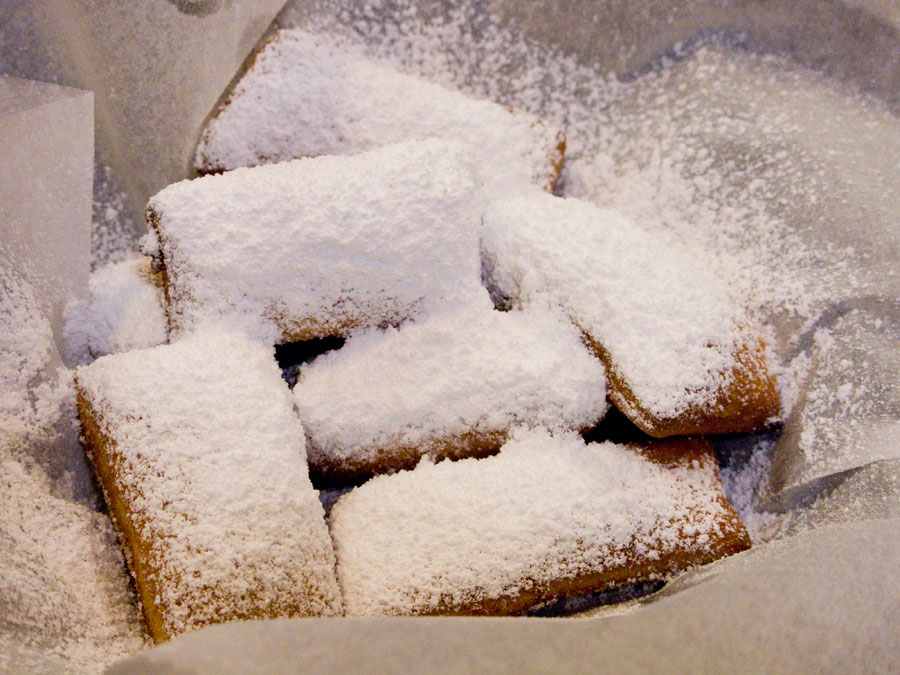
The beignets are cooked to order and served very hot, topped with confectioners sugar. If you're ordering them to take to seating elsewhere in the market, don't let Beck's counter server put a lid on top; they're so hot the escaping steam will transform these delights into a heavy, soggy mess. Besides, these are best consumed hot out of the fryer, with a cup of coffee.

They are best ordered as early as possible in the morning. Beck's Reading Terminal Market outpost has only one deep fryer, and by lunchtime it's being used for fried seafood.

Bieler's Doughnut Stall Opens


Bieler's Doughnuts & Salads opened Friday in the spot formerly known as AJ's Pickle Patch at the Reading Terminal Market. Proprietor Alvin Bieler, who also owns the eponymous bakery across the market's "11th Avenue" aisle, kept all of his AJ's products except packaged goods, so you can still get barrel pickles, sauerkraut and salads.

Tuesday, April 16, 2013

Bargain Ramps = Pesto

My visit to the Philly Farm and Food Fest Sunday resulted not only in renewing acquaintances with farmers and fellow foodies not seen since the seasonal farmers' markets closed last fall, but a big score in ramps.

Wild foods gatherer David Siller posted himself and his collection of ramps, fiddleheads and other early spring edibles with Cobblestone Krautery at the Convention Center conclave of hungry people. I couldn't resist leaving without buying two pounds of ramps at the bargain price of $14/pound. Considering that a single bunch weighing maybe two ounce goes for $3.99 at Iovine Brothers Produce at the Reading Terminal Market, that was a savings of about 60 percent! I also picked up a considerably lesser quantity of fiddleheads.

Of course, David's ramps had a fair amount of soil still clinging to them, but it still took me only about 10 minutes to separate the roots from the bulbs and the bulbs from the leaves, then another 10 minutes to go through the leaves to discard about 20 percent because they were a bit too fibrous and rinse off the bulbs.

The bulbs are now sitting in a glass jar in the fridge in my slightly sweet pickling liquid -- they should be ready to accompany some grilled meat or fish by next weekend, and they'll last at least a month.

The leaves required a bit further cleaning to dislodge larger particles of dirt. I set aside about a dozen leaves which will go into pilaf tonight. But yesterday, after a triple wash through my salad spinner, I concocted some ramp pesto.

A perusal of recipes on the web found a number of recommendations to blanch the leaves first to inhibit browning. After shocking the blanched ramp leaves in a bowl of iced water, I laid them in a kitchen towel, pressed as much excess water out as I could, then repeated in paper toweling. Once dry, I roughly chopped them.

After pulsing about a cup and a half of grated parmesan and about a cup of chopped walnuts with a little table salt and a teaspoon or so of dried oregano in the food processor, I added the leaves and pulsed a bit more. Then I drizzled in extra virgin olive oil until I reached my desired consistency, stopping the process once to scrape down the sides of the bowl. I didn't measure but I'd guess the pesto took about a cup of oil. (I would have used less oil if I wanted a spread rather than a pasta sauce.)

I served some over penne rigate last night and froze the rest for future use.

The resulting pesto was quite herbal rather than oniony. Had I included half a dozen or so chopped ramp bulbs it would have had more kick. But it was delicious as prepared.


Sunday, April 14, 2013

Bieler's: 40 Varieties of Doughnuts

Doughnut shop under construction
Alvin Bieler says he'll be offering 40 varieties of doughnuts when AJ's Pickle Patch reopens -- perhaps as early as next weekend -- As Bieler's Doughnuts.

By yesterday some of the equipment had been rolled in, but there are still cases to install and plenty of finishing work to accomplish.

Bieler said the variety will be achieved through a variety of toppings and fillings.

He also said he's learned some of the finer points of doughnut making recently from a master of the trade, and says his product won't quickly go stale when it's stored properly in a sealed container.

As previously reported, the stall will continue to sell prepared salads and pickles when it reopens under the new name.