Saturday, April 28, 2012

Morel Bonanza


Found these morels this morning at Dane County Farmer's Market, Madison Wisconsin. $35/pound. Bought the forager out (1.75 pounds), they're now cooked and frozen, ready for transport back to Philadelphia in my dry-ice powered cooler. Most of the morels were over four inches long, a couple looked to be about six inches long.

Thursday, April 12, 2012

Dinic's vs Katz's vs Primanti's

Adam Richman
In early March I reported that Adam Richman was back at the Reading Terminal Market to tape a segment at DiNic's for a new show: Adam Richman's Best Sandwich in America. The show's first episode on June 6 (9 p.m., Travel Channel) will feature DiNic's in competition with Katz's Deli of the Lower East Side and Primanti Brothers of Pittsburgh.

Each episode will feature three competing sandwiches from a given region, with America's best crowned in the finale from among the 10 regional winners and two "wild cards" voted on by viewers. In the case of the June 6 installment, it's sandwiches of the Northeast.

For the first show Richman will sample Dinic's roast pork with aged provolone and peppers, forgoing the greens. Katz's entry will be a corned beef-pastrami combo on rye with cole slaw and Russian dressing. From Primanti's he'll try the Cap & Egg, a behemoth featuring capicola, runny egg, cole slaw, tomato and hand-cut french fries on sliced Italian bread.

That's pretty stiff competition for Dinic's, especially Katz's, where I usually go for the straight pastrami on rye with mustard. Nonetheless, Richman's combo is well-known to deli enthusiasts in New York and New Jersey. At one deli I frequented, the pastrami-CB with russian and slaw was known as the "No. 5" combo, where at another it was the "No. 4". Who's to quibble over a number, it's a great combo sandwich.

I've never been to Primanti's, though I'll have to add it to my wish list. Still, to me it sounds like the "Cap & Egg" looses it when you add the tomatoes, slaw and fries: not just simply too massive, but out of flavor balance.

So I think it will come down to a battle between DiNic's and Katz's. The conventional wisdom says Katz's -- by virtue of its celebrity, the "When Harry Met Sally" scene filmed there, and that fact that it's the New York City entry -- will run away with the prize for this episode.

While I love a good pastrami sandwich (and Katz's makes a great one), I'll be rooting for our local hero. The roast pork that Tom and Joe Nicolosi and crew concoct can go toe-to-toe with Katz's anytime. Their brisket and pulled pork aren't too shabby, either, and I've got friends who skip all of that in favor of the sausage with peppers.

The second episode, at 9:30 p.m. the same night, will be a battle of Gulf Coast sandwiches: a shrimp po' boy form New Orleans, and two entries from Tampa, a variation on the Cuban, and a Grouper reuben.


Saturday, April 07, 2012

The Tubby Olive Signs On at RTM

The Tubby Olive, a Newtown, Bucks County, purveyor of on-tap vinegars and olive oils, has signed on to occupy one of the new spaces at the Reading Terminal Market made available through the Avenue D expansion project. The shop will be located along the market's Avenue D wall across from Molly Molloy's.

The Tubby Olive's web site lists three dozen varieties of traditional, organic and flavor-infused olive oils and a similar number and variety of vinegars. Most are priced at $29 for 750 ml (25.4 ounces) and $15.95 for 375 ml (12.7 ounces), with organic oils going for $2 and $1 additional. (Regarding the vinegars, although most are listed as "balsamic", at those prices they won't be the finest, the kind where just a few drops can raise simple foods like ice creams or strawberries to whole new level. Classic balsamic vinegars like these would retail for about four times the price of the Tubby Olive's. What the shop sells, however, appears, to be perfectly fine vinegars for a wide variety of uses, though from the flavor list on the web site there are few I'd purchase. Does anyone really need or Dark Chocolate Balsamic Vinegar?)

Tubby Olive is the fourth new merchant to sign up for space made available by the market's Avenue D project, joining Wursthaus Schmitz, the Head Nut and Valley Shepherd Creamery. RTM General Manager has a few other new spaces still to fill, as well as the recently vacated Coastal Cave stll along Avenue C. In addition, he's still waiting to hear from the bankruptcy trustee for Delilah's to see what we become of that space; when Delilah's was shut in mid-March, the trustee told the market they expected to reopen in just a few weeks.

The entire imrovement project is running along at top speed, with Flying Monkey Bakery now relocated and the new merchants expected to open in phases between May April and early summer. L. Halteman Family Country Food to shift to their new footprint by the end of the month.

Steinke said the new multi-purpose room, named in honor of former Philadelphia Inquirer food columnist Rick Nichols, should be finished in the next few weeks. By next weekend, all the chairs and tables in center court and the piano court, which have been showing signs of wear, will be replaced to match what will be going into the Nichols Room.

Tuesday, April 03, 2012

Farmers' Report: Early Asparagus, Some Apple Damage

A mild winter and very warm spring caused Mother Nature to alter her schedule for regional farmers.

Two regular farmers' market stalwarts, Dave Garretson of Beechwood Orchards, and Ben Wenk of Three Springs Fruit Farm, both indicated that while frosts after blossoming caused some damage to their groves of apple, pear and cherry trees, the loss will be noticeable but not devastating. I spoke with them Sunday at the Philadelphia Farm & Food Fest at the convention center, co-sponsored by Fair Food and the Pennsylvania Association for Sustainable Agriculture.

Wenk has already harvested a little asparagus for his family's use, but expects to cut a lot more beginning this week. It's conceivable, he said, that it will be all gone by the time the Headhouse Square farmers' market opens May 6. If the season extends by a week or so, he will still have asparagus available then.

Tom Culton, also at the festival, said he does expect to still have asparagus when Headhouse opens.

If you're hankering for local asparagus now -- the supermarkets are full of thin stalks from Mexico -- maybe a trip Saturday to either the Clark Park or Fitler Square year-round markets will be in order.

And unless the weather intervenes, you can expect to see strawberries in early May.

Garretson said he's altering the Philadelphia farmers' markets he'll be attending this season. He's leaving the Tuesday market at South & Passyunk sponsored by Farm to City, but joining the Thursday afternoon Food Trust market at Fairmount and 22nd Street, where he takes over from Orchard Hill Farm of Bloomsburg. Beechwood will continue to sell at University Square on Wednesdays, Rittenhouse Square on Saturdays, and Swarthmore on Saturdays.

Sunday, April 01, 2012

Coastal Cave Closes at RTM

Coastal Cave, a long-time purveyor of live lobster, Dungeness crab and smoked seafood delicacies, ends its tenure at the Reading Terminal Market with the close of business today.

I wasn't able to speak with him personally but proprietor Steven Cho is retiring from the market. His family also operates Ritz Seafood in Voorhees, New Jersey.

Coastal Cave's departure leaves another big hole for the market to fill. Last month Delilah's closed (reportedly temporarily) due to bankruptcy proceedings.

For the past year or so Coastal Cave updated its menu with some unusual sandwiches. Among them: pickled herring, smoked salmon and sardine Vietnamese sandwiches (bahn mi). Until Herschel's East Side Deli opened Coastal Cave was my source for Sunday morning lox.

RTM General Manager Paul Steinke has dozens of businesses that would love to locate to the high-traffic market. But many want to sell "carnival" foods that the market won't permit: popcorn, funnel cake, etc.

Update, Tuesday, April 3

Steinke's first order of business will be finding a home for the lobsters and lobster tank, which remain crawling and bubbling away, respectively, in the now otherwise empty stall.

The RTM plans to ask the three full-service fishmongers at the market -- Golden Fish, John Yi Fish Market, and Wan's Seafood -- to bid on the tanks. Expect one of them to jump at the chance to take over this part of Coastal's business.

When I visited the market this morning, I had expected to see the lobsters gone, since proprietor Steven Cho's family operates a restaurant, Ritz Seafood, in Voorhees, New Jersey, where they could be put to good use. But they were still on display.

Spring Arrives: Spinach, Fiddleheads & Gefilte Fish


Fiddleheads from Fair Food Farmstand
Signs of spring at the Reading Terminal Market this past week: local spinach, fiddlehead ferns, and carp and yellow pike for gefilte fish.

The spinach could be obtained from any one of the market's produce vendors: Iovine's, Fair Food, Kauffman's. OK Lee, and L. Halteman. I didn't check, but farmer Steve Bowes might have had some at his day stall in the piano court. Most were priced at about $2 a bunch. With few exceptions, the spinach didn't look super attractive for a raw salad (that's usually true for overwintered spinach), but they were all perfect for sautés or any other cooking method you choose. Many folks prefer the taste of overwintered spinach to the new crop that will appear later in the spring. Butch Dougherty of Iovine's Produce said they were great cooked and used to top a sandwich.

The Japanese painted fern in a planter in my backyard patio sprouted up with a vengeance this week, and the same is happening along the streamsides of Chester, Delaware and Bucks County (heck, probably along tributaries of the Wissahickon in Fairmount Park, too). That means commercial foragers are bringing their fiddlehead fern finds to local restaurants and specialty produce vendors. Fair Food had some rather pristine samples this week (pictured above). Frequently when you find fiddleheads in stores, they'll have some brownish, papery edges to them which is easily enough cleaned off. These, however, had none of the brown tinges. You can pretty much use them wherever you'd use asparagus, and cook them the same way. As an accompaniment to protein, I think they work better with fish and poultry than beef or lamb. And they excel as a stir-fry veg in Chinese cooking. Just don't go overboard on your consumption, and cook them thoroughly: Fiddleheads contain low levels of toxins which can cause nausea and diarrhea. Sustained heat usually kills any toxin (health authorities recommend boiling or steaming for 10-15 minutes). I usually do a light steaming or par-boiling before sautéeing and have yet to experience any symptoms.

John Yi featured carp and yellow pike in its dislplay case this week, priced at $3.99 and $7.99/pound, respectively. Either or both fish are the traditional base of gefilte fish, a traditional but non-Biblically mandated first course for the Passover seder. I could not find, however, a live carp to place in the bathtub, as was traditional in olden days to assure a fresh fish for the holiday table.

Iovine's continues to stock ramps. They looked a bit better today than last week, but they'll continue to be dear at $1.99 a bunch, which makes for maybe one serving.

Two items I've enjoyed all winter long from Iovine's have now disappeared: fresh chick poeas and temple oranges. There are still plenty of other orange varieties available, but the peak season is starting to fade, even though they're available pretty much year round.

Saturday, March 24, 2012

Things Change: Expected and Unexpected

You go away for a week and things change.

Like the sudden pullout of Delilah Winder from the Reading Terminal Market. Or the arrival of spring.

Officially, the market hopes to welcome back Delilah when her bankruptcy/financial issues are resolved. Market GM Paul Steinke would love to see Delilah back -- the bankruptcy court told him Delilah's could be re-open in just a few weeks -- given Delilah's high visibility through her Oprah connection and Food Network exposure. But he's got to be thinking of bringing in another soul food restauranteur if that doesn't happen.

Another change, this one no surprise: Flying Monkey Bakery moved to its new location in the former Spataro's spot this past week. Which reminds me: I neglected to pick up some whoopie pies this morning!

Flying Monkey's move clears the way for a faster pace of work on the remainder of the Avenue D improvement project at the market, especially the Rick Nichols Room, the multi-purpose room to be located behind the bakery's old spot and adjacent to La Cuchina at the Market, Anna Florio's institution of higher culinary education.

Work should begin next month on Wursthaus Schmitz in what's now seating space behind Flying Monkey, with opening hoped for before Memorial Day, the official start of grilling season. The connection? Bratwurst!

A bit later on the schedule will be Valley Shepherd Creamery, which will locate along Avenue D across from Molly Molloy's. They aim to open in late spring. Chief Shepherd Eran Wajswol and crew are busy right now with lambing. They expect 800 little ones to join the flock this spring.

Another sure sign of spring is the arrival of ramps. Iovine's had them today, $1.99 for a small bunch (enough for two servings as a flavor accompaniment to your eggs or just about anything other protein. Alas, they had traveled too far and were in less than pristine condition. I'll wait a few weeks.

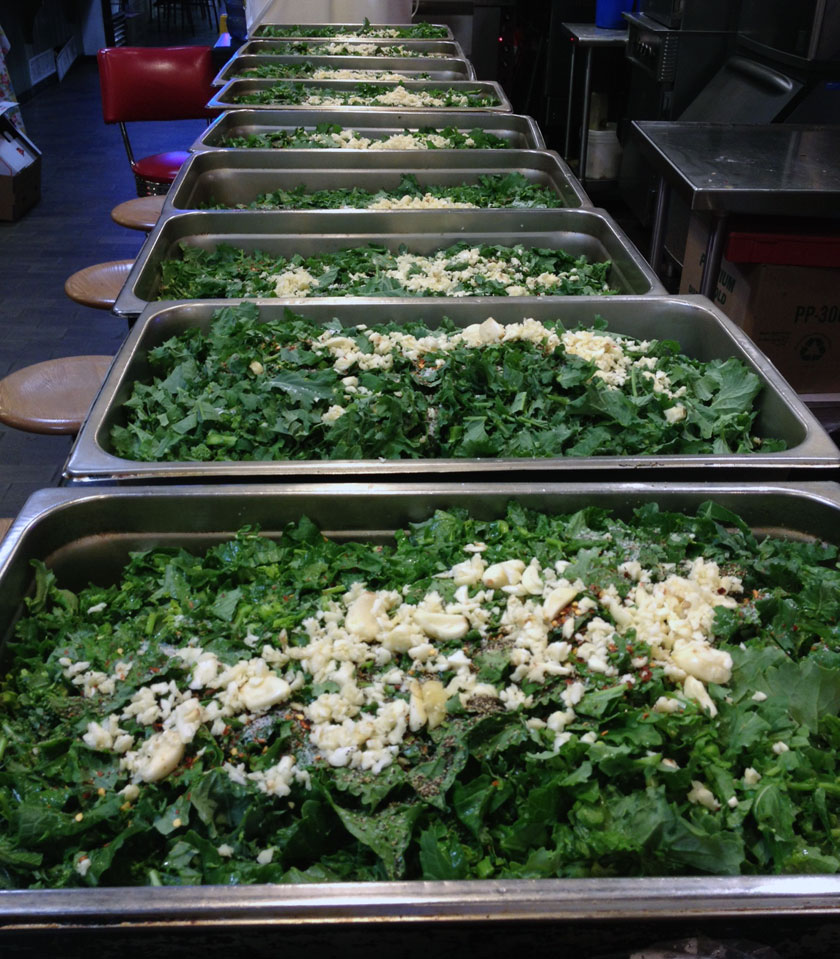
Greens and garlic await oven at Dinic's
Dinic's has got new menu boards up and, as reported earlier, scallopine is gone and meatballs are in. Joe Nicolosi says they pretty much have the meatballs every day, though they might occasionally skip a day.

Bobby Fisher, chef at Molly Molloy's, has been missing in action due to surgery, according to Jim Iovine, proprietor. Best wishes for a speedy recovery, Bobby.

Like J.P. Morgan's yacht, if you have to ask the price you probably can't afford it, but the jamón ibérico de bellota (Spanish acorn ham) at Jack Morgan's Downtown Cheese is like eating ham butter. It puts the best prosciutto to shame.

The American version of dry aged ham can be obtained at L. Halteman Family. It's also priced dearly (though not nearly as high as the Spanish pig). You can buy some of the Smithfield ham slices (vacuum packed on premises) for a bit over $5, enough to make three or four sandwiches. The Riehl family, operators of the stall, will be shifting their footprint closer to Avenue C next month, also part of the market's current improvement project.

Steinke will be off to Los Angeles late next week for the annual conference of National Association of Produce Market Managers, the professional association of managers of permanent wholesale produce markets, retail farmers' markets, and public markets. He'll make a presentation about the RTM's current Avenue D improvement project.

Leveling Up To Pay

A significant number of Reading Terminal Market merchants accept the Level Up payment system, in which a QR code on your smartphone is linked to your credit card. Besides ease of use, most merchants offer customers credits for using the service.

You'll need to rack up $30 to $100 in cumulative purchases before the credits kick in, which usually work out to 5 to 10 percent, depending on the merchant. There are also occasional special days -- like the market's 120th anniversary February 22, when any purchase earned you an immediate $10 credit. (I was thrilled that day with a $10.50 cheese purchase that cost me 50 cents.) I've been using the system since it was introduced last November and have racked up $60 in discounts since.

It's a lot easier than fumbling for the discount cards offered by some merchants, like Old City Coffee and Metropolitan Bakery. Most of the merchants I've spoken with like the system, which doesn't cost them much more than other credit card transactions and takes less time. Just hold the smart phone with the code on the screen in front of the reader and it's done. You'll get an immediate email message confirming your purchase. On your credit card bill it shows up as a charge to Level Up, but you can always go to the Level up website to review the particulars.

About 300 area merchants use the system, most in Center City.

Mike Holahan, co-owner of the Pennsylvania General Store and president of the RTM Merchants Association, finds it both amusing and forward-looking that Philadelphia's 19th century public market is a 21st century technological leader.

Philadelphia is Level Up's largest market, but it also has a significant presence in Boston, New York and San Francisco. It's also been introduced in Atlanta, San Diego, Seattle, Chicago and St. Louis.

You can learn more and sign up for Level Up at its website: https://www.thelevelup.com.

In a related development, RTM General Manager Paul Steinke says the market is well along with its plan to replace its Market Money gift program with a gift card. The cards would be similar to credit cards and be processed by First Data Merchants Services, which currently provides credit card processing for about a quarter of the market's merchants. Steinke said about half of the merchants are on board with the gift card program, but he won't go ahead until at least three-quarters agree. He hopes the system can go on line sometime this summer. Merchants who don't use First Data for their credit cards would have to add another device to read the gift cards. Not everyone is happy about that, given the limited space they've got for their payment terminals, cash registers and Level Up devices.

Fair Food, RTM Plan Festivals

March and April have shaped up as a busy time for foodies.

Just a couple of weeks ago, Fair Food held its annual Brewers' Plate bash, pairing local and regional breweries and restaurants. This year it was held at the National Constitution Center.

Fair Food has another big event, the Philly Farm & Food Fest, scheduled for Sunday. April 1, at the Pennsylvania Convention Center. It's an outgrowth of the non-profit organization's Local Grower/Local Buyer event, held in recent years to bring together restaurant and institutional food buyers with farmers and food producers. But where the previous event was limited to "the trade", the new one is open to all. (Though there will be a "trade only" buyers reception as part of it.)

The public event runs from 11 a.m. to 4 p.m., with about 100 producers exhibiting their food products (many offering sample), ready to discuss what they do and how they do it. You can also learn about the various Community Supported Agriculture  (CSA) offerings, wherein you can buy a "share" of a farm's output, guaranteeing yourself a supply of farm fresh foods. Fair Food farmstand staffer Albert Yee, an accomplished foodie fotog, will be on hand to guide you through his "The Hands That Feed Us" photo series.

There will also be a series of workshops (attendance limited) and presentations on a range of subjects, from "Land Use Planning & Policy for Farmers" to "Tasty Small Grains" and "The ABCs of Bee Keeping".

Advance ticket sales are $15 or $20 on the day of the event. You can get them at the Brown Paper Tickets website. General information about the event can be found at the Philly Farm & Food Fest website. The event is co-sponsored by the Pennslvania Association for Sustainable Agriculture.

Later in the month the Reading Terminal Market begins its festival season with its Festa Italiana. It's scheduled for Saturday, April 21, from 10 a.m. to 4 p.m. At last year's event center court was filled with tables displaying and dispensing Italian goodies, from espresso from Old City Coffee to Italian style beef chuck roast from Dinic's and roast pig.

At last year's festival the roast pig almost wasn't. The city's Health Department insisted that rather than being displayed whole and cut when served the entire animal be pre-cut in a kitchen. This year, according to Paul Steinke, the RTM's general manager, things have been worked out with the Health Department and a whole pig will be served as such. Last year the pig came from the Italian Market's Cannuli's House of Park, but this year the market's own Martin's Quality Meats & Sausages will provide the porker.

Also on tap for the festa, a mandolin orchestra. Steinke says the event is being planned with help from Judy Saye, formerly of the Book and the Cook, who has also helped organize the Italian Market's annual festival.

St. Louis Landmark


My week in St. Louis ended this past Wednesday, but not before a visit Ted Drewes, the landmark custard stand in the city's south side on Chippewaw Avenue, a.k.a. Route 66.

Since the temperatures were in the low 80s, the frozen dessert hit the spot. Only one flavor, vanilla, but you can have it mixed with a couple of dozen different flavors, or build various sundaes. Along with gooey butter cake and "toasted" ravioli, Ted Drewes is one of the Gateway City's great contributions to the American culinary tradition. (Wisconsin is big on frozen custard, too, and I'll try that late next month.)

The other culinary high points of my visit: chicken feet at dim sum at Lulu's (as good as any I've had in Philadelphia's or Vancouver's Chinatowns) and a lamb burger at the Schlafly Tap Room, a brewpub downtown, which makes a far better brew than its larger St. Louis competitor.

A decided miss was the pastrami served by Lester's Sports Bar & Grill. I was sent there by a local who original hails from central New Jersey. He claimed Lester's pastrami was better than Carnegie Deli's. I doubted that, but I still should have known better. Even though the restaurant is owned by a Brooklyn-born octagenarian millionaire, the pastrami was a royal flop. The flavor wasn't terrible but the meat was all wrong. Where Carnegie, Katz's and our own Herschel's and Famous use beef navel, Lester uses brisket. Good for corned beef. Wrong for pastrami.

A Busier Market

January and February at the Reading Terminal Market were nearly 7 percent busier than the prior year. That may be due largely to the impact of last year's big snowstorms, which cut down traffic, but the 934,00 visitors during January and February made for a busy market.

Thursday, March 01, 2012

Scallopine? Fugetdaboutit. Meatballs? Yeah!

Over the past few weeks meatball sandwiches have occasionally appeared on the menu at Dinic's at the Reading Terminal Market. Starting after the flower show the new sandwich will gain a permanent place among the offerings.

To make room, Dinic's will forgo the scallopine sandwiches, made from thin cuts of pork. Joe Nicolosi, who runs the stall with his father Tom, said they sell fewer than half a dozen scallopines daily.

Although a handful of other market lunch vendors sell meatballs, Dinic's is the only one made on premises -- all the others come from commercial suppliers, according to Joe.

For their meatballs the Nicolosis start out with a lean beef chuck, for about 70 percent of the weight. They make it succulent by using trimmings from their pork before it gets roasted for the roast pork and pulled pork sandwiches for the remaining 30 percent. They grind the meat at the store and also make their own sauce.

The meat balls were available today for lunch, but don't expect them once the flower show starts Saturday for a nine-day run: the thick crowds and demand for the pork sandwiches will take up all their available time.

Another TV Bow for Dinic's

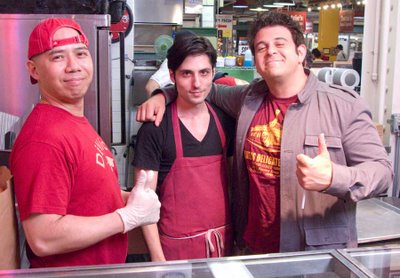
Adam Richman (right) with sandwich maker Jun and Joe Nicolosi at 2009 taping
Is Dinic's roast pork classic one of the 30 best sandwiches in the nation?

Adam Richman thinks so. He and a production crew from the Travel Channel were back at the Reading Terminal Market early last week watching Tom and Joe Nicolosi show how they prepare their fresh hams and other appurtenances that go into the sandwich.

Dinic's will be featured as one of three eateries on an epside of a new 10-show series highlighting the 30 top sandwiches. Episodes are scheduled to begin airing on the cable channel in June.

Richman got his first taste of Dinic's roast pork nearly three years ago when taping a segment for his Man Vs. Food show; in addition to repeats a re-edited version is part of his Amazing Eats episode on pork.


Tuesday, February 21, 2012

NJ Creamery To Make, Age Cheese at RTM

Although there's some food manufacturing going on today in the Reading Terminal Market, Eran Wajswol will take it in a new direction when his Valley Shepherd Creamery opens later this year.

Wajswol plans on bringing 24,000 pounds of raw milk to the market each week to make about a ton of hard or semi-soft cheese. With that much cheese, it will age both in the market's basement and back in the creamery's caves in Long Valley, in northwestern New Jersey. In addition to making, aging and selling cheese, Valley Shepherd will serve lunchers cheese paninis and offer an olive bar.

"We are designing and gathering equipment now to determine if we can, indeed, do what we want," Wajswol replied to your blogger's email inquiry. "In a few weeks we will know more."

Friday Architects, the Philadelphia planning and architecture firm which created the market's Avenue D renovation plan, will visit the farm and dairy next week to begin its design work on the RTM outlet, which Wajswol describes as "very complex, because there are four elements to the space, each requiring design, equipment and talented folks."

The first element will be sourcing and transporting the milk to the market in three weekly 8,000-pound shipments. It will be unloaded into basement tanks for storage, then pumped back upstairs as needed in the cheesemaking operations behind glass for visitors to watch.

Wajswol decided against making fresh cheeses, like mozzarella or quark, because a pasteurization system would be required. With only 610 square feet for retail sales, panini-making and cheese-making, there's simply no room.

The lunch menu will be based on paninis or, as Wajswol calls them, Maninis. He said they are "being conceived by some infamous food truck people and will be tested and redesigned by local Philadelphia food talent (which we are finding amazing)."

Using milk from sheep, Jersey and Guernsey cows, and goats, Valley Shepherd's cheeses cover a wide range of styles and traditions: fresh, soft-ripened, blue, hard, semi-hard, and washed-rind. You can read a full menu of the cheeses at Valley Shepherd's website. The store also plans to sell a few cheeses from "several family farms we know and love," Wojswol said. 

There will be additional brined products beyond olives on the olive bar, he said, "featuring products from several countries with a strong emphasis on brined products from that most foreign country called Brooklyn."

Brooklyn is no accident, since last year Valley Shepherd opened a retail store in the borough's Park Slope neighborhood after closing a Manhattan outlet.

A limited variety of Valley Shepherd cheeses has been available for the past few years at the Fair Food Farmstand of the Reading Terminal Market. Other than at a few farmers' markets, the Park Slope store, the farm, and a handful of retail outlets in New Jersey and New York City, the only other places you're likely to find its products are cheese plates at upscale restaurants.

Who makes food today at the RTM, besides the restaurants and lunch stalls?

Herschel's East Side Deli takes fresh meat and turns it into brined corned beef and cured pastrami in the basement. And Giunta's produces some of its sausages on site. Otherwise, food production is centered on baked goods and sweets: cookies at Famous Fourth Street and the Pennsylvania General Store, baked goods at Beiler's Bakery and Flying Monkey Bakery, pretzels at Miller's Twist, fudge at Sweet as Fudge Candy Shop, and molded and dipped chocolate items at Chocolates by Mueller.

Saturday, February 18, 2012

Another Lunch Vendor Wants Market Stall

Mural at South Street pizza shop
Rick Olivieri of Rick's Steaks isn't the only hawker of street food who'd like to set up shop in the Reading Terminal Market. Lorenzo & Son Pizza of South Street also wants in.

Lorenzo's is among a backlog of businesses who have submitted applications to rent space at the landmark public market.

Neither Rick nor Lorenzo has much of a chance. By its own count, 31 of the market's 76 vendors are "food court" businesses, which are technically limited to no more than the greater of one-third of the number of vendors or one-third of the floor space of the market. Since the raw numbers show 40 percent of the merchants to be in the "food court" category, the market manages to stay within the guidelines only by virtue of the square footage numbers.

Even though Paul Steinke, the market's general manager, told me earlier this month that the market was well within these guidelines, he'd be hard-pressed to bring in another vendor dedicated to the lunch crowd. Steinke has to keep his focus on bringing in sellers of food for consumption at home if the market is to retain its 120-year-old tradition as well as public and political support. If the balance tips too far in favor of the food court merchants, the market would be a considerably less attractive place for thousands of shoppers like me who buy regularly from its meat, seafood, produce, dairy and other food product vendors.

The only types of businesses selling food for on-premises consumption that have a chance would be those offering either something now unavilable or that also devotes considerable space and effort to selling food for preparing or eating at home. Neither Rick's nor Lorenzo's would fit either criteria.

There's good reason why Rick's wants to return and Lorenzo's wants in: traffic. Last year's 6.35 million visitors translates to 122,000 potential patrons a week, most of them hungry tourists and Center City workers. With that kind of traffic you could make a considerable profit selling chocolate-covered dust bunnies. (I think Chocolate by Mueller does; if not, you could have bought a chocolate heart -- with aorta and veins -- for Valentine's Day at Mueller's.)

Of the five categories of merchants at the market the Food Court vendors showed the biggest sales gain last year, up more than 13 percent. The Purveyors (produce, seafood, meat, etc.) recorded the least growth at 2.3 percent. Pennsylvania Dutch merchants saw their sales increase 9.0 percent. Food Basket vendors (sellers of other grocery items, including dairy products, coffee, baked goods, spices) had sales growth of 8.3 percent, while Mercantile (non-food) vendors were up 8.0 percent.


Vendor Adds Spices

Jonathan Best, the closest vendor to a general grocery store at the Reading Terminal Market, expanded its stock of bottled herbs and spices immediately after the late January closing of The Spice Terminal. They'll get competition when The Head Nut opens in early June, selling bulk herbs and spices, coffee, teas, etc.

White Asparagus from Peru

White asparagus from Peru at Iovine Brothers
Prominently displayed at Iovine Brothers at the Reading Terminal Market today is white asparagus, $1.99/bunch.

Since it's about two months until the first local asparagus (green) pokes its spears through the dirt, these have to come from a more distant clime. In this case it's Peru where, since the South American nation is mostly south of the equator, even if just barely, it's now late summer. But it must be cooler in those mountain valleys.

Peru is no johnny-come-lately to asparagus growing. Commercial growers harvested their first crops in the early 1950s, initially planting a white variety for canning. Peru now sells to the frozen and fresh-chilled markets as well.

Last week's imports of persimmons from Span flew off the shelves at Iovine, even priced at $7.95 a basket for about half a dozen fruits.

The Chilean fruit I picked previously was so-so. The black plums were way too astringent and hard. The nectarines (after some time in a paper bag) were sweet and tasted like nectarines, even though the texture was a bit off. The Bartlett pears were the best of the bunch: they ripened nicely in the bag and had typical Barlett flavor and texture: not the most complex flavor among the pears, but straightforward, sweet and satisfying.

First Flush at the Market

Next Saturday evening, Feb. 25, will be another edition of the Valentine to the Market, the fund-raiser renewed after a bit of a hiatus to benefit the Reading Terminal Market Preservation Fund.

It will be worth the price of admission ($125, or $300 for VIP tickets) just to see how the market celebrates the opening of its new restrooms, which are scheduled to be completed just in time for the event. Who gets the first flush? You can purchase your ticket here.

Carlolyn Wyman, who writes for the market's newsletter and website, has a nice article about the event here. Among the interesting points of the article:
This year’s party is actually a revival of a February fundraiser first held in the early ’90s to fund the legal fight to help save the Market from physical decline and development threats. In the later years of the Valentine’s ’90s run, monies raised were used to build the Market’s demo kitchen and to bring Market produce out to far-flung neighborhoods (an outreach that spun-off into today’s independent nonprofit Food Trust).
The new restrooms are a major component of the Avenue D renovation program at the market. New family/accessible restrooms opened a couple months ago. With the opening of new facilities for men and women, construction activity will pick up along Avenue D, including the new multi-purpose room to be named in honor of former Inquirer scribe Rick Nichols. (The market had hoped to have the Nichols Room open in time for the party, but that didn't work out.)

With Spataro's move Friday across Avenue C along center court, Flying Monkey will begin outfitting the old Spataro's spot (and a bit of the old Spice Terminal) as its new digs. L. Halteman Family Country Foods (soon to be Riehl Deli & Cheese) plans to shift its stall to Avenue C by April 1 if all goes well.

Tuesday, February 14, 2012

Spataro's To Move This Week


Spataro's, the oldest sandwich business within the Reading Terminal Market, could move to its new Center Court location as early as Thursday.

When Spataro's moves across the aisle to the spot formerly home to Dinic's, that clears the way for Flying Monkey Bakery to take over the Spataro's stall, all part of the Avenue D renovation project at the market.

Spataro's, whose pater familia Dominic Spataro died at the age of 94 last month, remains the home of the bargain lunch at the market, even though pricier cheese steaks and hoagies are also available. Still on the menu are two sandwiches priced at $4.50: liverwurst & onion, and egg & tomato. The closest competition is the Hatville Deli in the Pennsylvania Dutch section of the market, where a plain cheese or liverwurst sandwich also sells for $4.50.

Thursday, February 09, 2012

RTM's Leasing Strategy Works Against Rick's Return

With the market's renovation program centered along Avenue D opening up space for four new merchants, General Manager Paul Steinke's emphasis has been to fill those slots with "purveyors" who primarily sell foods for cooking or eating at home. That's why the chances of any new pure lunch vendor of getting one of the two remaining stalls is slim at best and why Rick Olivieri's attempt to reenter the market with his Rick's Steaks business will fail.

It's certainly possible, though, that a vendor selling for both on- and off-premises consumption could get that nod. I think the only chance for a new vendor to primarily sell for on-premises consumption would be to offer something not now available from other lunch counters. Hot donuts, anyone?

Only one of the three new vendors announced so far will sell food for eating within the market, but it will also offer groceries and other food products to take home: Wursthaus Schmitz would carry German groceries and cold cuts as well as hot foods for eating either within the market or at home.

The second new vendor would be artisinal cheese maker Valley Shepherd Creamery, which is expected to sign a letter of intent within a few weeks. The latter's product would be overwhelmingly for off-premises consumption, though there's no reason why someone couldn't have a sheep milk yogurt for lunch in center court. A third new vendor, The Head Nut will essentially replicate the offerings of The Spice Terminal, which declined to renew its lease.

That leaves two remaining spaces for new vendors: one along the Avenue D wall, another in a small space on center court adjacent to where Wursthaus Schmitz will be located.

The market's operating policy guidelines require that no more than the greater of one-third of the number of vendors or one-third of the floor space go to businesses "which offer food intended primarily or exclusively for consumption within the Market."

While Steinke is comfortable that the current breakdown of merchants is well within that restriction, by my subjective count 36 of the 77 existing merchants exclusively or primarily fall into the "on-premises consumption" category.

Let me emphasize the subjective nature of determining whose "primary" business is for off-premises consumption or not. As an example, take 12th Street Cantina, which I consider among those who "primarily" sell for on-premises conception but Steinke does not. Steinke says this business a "two-sided" purveyor that doesn't count against the operating policy ratios because of the many take-home Mexican groceries and prepared foods they sell. My opinion is influenced by the fact that 12th Street Cantina has a seating area for diners. (I've got to admit, though, nearly all of my purchases there have been for ingredients to use at home.)

The same debate could be held about any number of other vendors, from Kamal's Middle Eastern Specialties to By George! Pizza, Pasta and Cheeseteaks, both of which also sell plenty of items for consumption and/or cooking at home, but also earn money as lunch vendors. (Indeed, the line for cheese steaks at By George! at lunchtime frequently blocks the aisle.) The key metric in making any such determination as to whether a business is "primarily" engaged in sales for off-premises consumption would be to know the revenue breakdowns, but neither Steinke nor I have access to that proprietary information.

Getting back to Olivieri, another factor why he has little chance of reestablishing his cheese-steakerie in the market are the three existing vendors who depend upon cheese steak sales, and two others who find it a highly profitable sideline. Although Steinke said he couldn't give a "blanket answer" to a hypothetical question about allowing a new merchant to compete with the same product of five existing merchants, it's hard to imagine him adding another tourist-centric cheese steak stall. He acknowledged to Dan Gross of the Daily News, who broke the Olivieri story Wednesday, that cheese steaks were not the market's "highest priority".

When Olivieri's lease was not renewed in 2008, the market allowed two additional vendors to sell cheese steaks: Carmen's Famous and By George! (Spataro's earlier had been permitted to add cheese steaks when they moved to a new center court location.) Today all three businesses incorporate "cheese steaks" into their formal names. In addition, the Down Home Diner sells cheese steaks, as does the new Molly Molloy's.

Rick's Steaks loss of its lease in 2008 followed Olivieri's vociferious leadership of the Reading Terminal Market Merchants Association when the market was restructuring lease agreements and fee structure. You can find earlier stories about the Olivieri-RTM clash here and here.