Saturday, March 24, 2012

Things Change: Expected and Unexpected

You go away for a week and things change.

Like the sudden pullout of Delilah Winder from the Reading Terminal Market. Or the arrival of spring.

Officially, the market hopes to welcome back Delilah when her bankruptcy/financial issues are resolved. Market GM Paul Steinke would love to see Delilah back -- the bankruptcy court told him Delilah's could be re-open in just a few weeks -- given Delilah's high visibility through her Oprah connection and Food Network exposure. But he's got to be thinking of bringing in another soul food restauranteur if that doesn't happen.

Another change, this one no surprise: Flying Monkey Bakery moved to its new location in the former Spataro's spot this past week. Which reminds me: I neglected to pick up some whoopie pies this morning!

Flying Monkey's move clears the way for a faster pace of work on the remainder of the Avenue D improvement project at the market, especially the Rick Nichols Room, the multi-purpose room to be located behind the bakery's old spot and adjacent to La Cuchina at the Market, Anna Florio's institution of higher culinary education.

Work should begin next month on Wursthaus Schmitz in what's now seating space behind Flying Monkey, with opening hoped for before Memorial Day, the official start of grilling season. The connection? Bratwurst!

A bit later on the schedule will be Valley Shepherd Creamery, which will locate along Avenue D across from Molly Molloy's. They aim to open in late spring. Chief Shepherd Eran Wajswol and crew are busy right now with lambing. They expect 800 little ones to join the flock this spring.

Another sure sign of spring is the arrival of ramps. Iovine's had them today, $1.99 for a small bunch (enough for two servings as a flavor accompaniment to your eggs or just about anything other protein. Alas, they had traveled too far and were in less than pristine condition. I'll wait a few weeks.
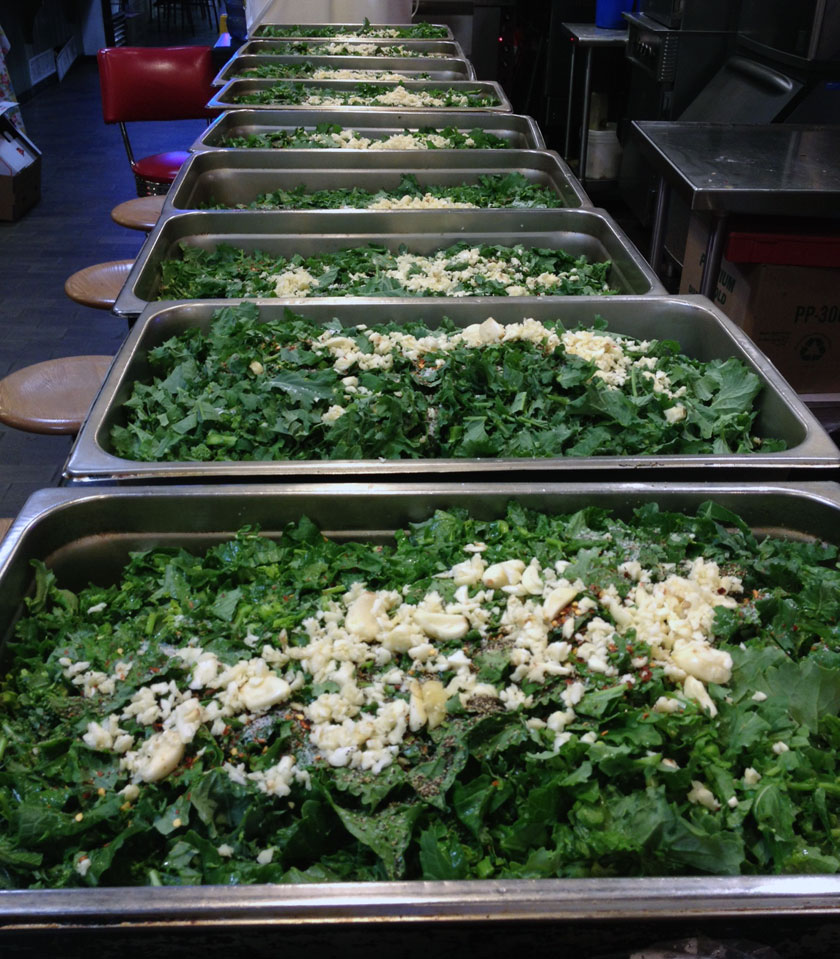
Greens and garlic await oven at Dinic's
Dinic's has got new menu boards up and, as reported earlier, scallopine is gone and meatballs are in. Joe Nicolosi says they pretty much have the meatballs every day, though they might occasionally skip a day.

Bobby Fisher, chef at Molly Molloy's, has been missing in action due to surgery, according to Jim Iovine, proprietor. Best wishes for a speedy recovery, Bobby.

Like J.P. Morgan's yacht, if you have to ask the price you probably can't afford it, but the jamón ibérico de bellota (Spanish acorn ham) at Jack Morgan's Downtown Cheese is like eating ham butter. It puts the best prosciutto to shame.

The American version of dry aged ham can be obtained at L. Halteman Family. It's also priced dearly (though not nearly as high as the Spanish pig). You can buy some of the Smithfield ham slices (vacuum packed on premises) for a bit over $5, enough to make three or four sandwiches. The Riehl family, operators of the stall, will be shifting their footprint closer to Avenue C next month, also part of the market's current improvement project.

Steinke will be off to Los Angeles late next week for the annual conference of National Association of Produce Market Managers, the professional association of managers of permanent wholesale produce markets, retail farmers' markets, and public markets. He'll make a presentation about the RTM's current Avenue D improvement project.

Leveling Up To Pay

A significant number of Reading Terminal Market merchants accept the Level Up payment system, in which a QR code on your smartphone is linked to your credit card. Besides ease of use, most merchants offer customers credits for using the service.

You'll need to rack up $30 to $100 in cumulative purchases before the credits kick in, which usually work out to 5 to 10 percent, depending on the merchant. There are also occasional special days -- like the market's 120th anniversary February 22, when any purchase earned you an immediate $10 credit. (I was thrilled that day with a $10.50 cheese purchase that cost me 50 cents.) I've been using the system since it was introduced last November and have racked up $60 in discounts since.

It's a lot easier than fumbling for the discount cards offered by some merchants, like Old City Coffee and Metropolitan Bakery. Most of the merchants I've spoken with like the system, which doesn't cost them much more than other credit card transactions and takes less time. Just hold the smart phone with the code on the screen in front of the reader and it's done. You'll get an immediate email message confirming your purchase. On your credit card bill it shows up as a charge to Level Up, but you can always go to the Level up website to review the particulars.

About 300 area merchants use the system, most in Center City.

Mike Holahan, co-owner of the Pennsylvania General Store and president of the RTM Merchants Association, finds it both amusing and forward-looking that Philadelphia's 19th century public market is a 21st century technological leader.

Philadelphia is Level Up's largest market, but it also has a significant presence in Boston, New York and San Francisco. It's also been introduced in Atlanta, San Diego, Seattle, Chicago and St. Louis.

You can learn more and sign up for Level Up at its website: https://www.thelevelup.com.

In a related development, RTM General Manager Paul Steinke says the market is well along with its plan to replace its Market Money gift program with a gift card. The cards would be similar to credit cards and be processed by First Data Merchants Services, which currently provides credit card processing for about a quarter of the market's merchants. Steinke said about half of the merchants are on board with the gift card program, but he won't go ahead until at least three-quarters agree. He hopes the system can go on line sometime this summer. Merchants who don't use First Data for their credit cards would have to add another device to read the gift cards. Not everyone is happy about that, given the limited space they've got for their payment terminals, cash registers and Level Up devices.

Fair Food, RTM Plan Festivals

March and April have shaped up as a busy time for foodies.

Just a couple of weeks ago, Fair Food held its annual Brewers' Plate bash, pairing local and regional breweries and restaurants. This year it was held at the National Constitution Center.

Fair Food has another big event, the Philly Farm & Food Fest, scheduled for Sunday. April 1, at the Pennsylvania Convention Center. It's an outgrowth of the non-profit organization's Local Grower/Local Buyer event, held in recent years to bring together restaurant and institutional food buyers with farmers and food producers. But where the previous event was limited to "the trade", the new one is open to all. (Though there will be a "trade only" buyers reception as part of it.)

The public event runs from 11 a.m. to 4 p.m., with about 100 producers exhibiting their food products (many offering sample), ready to discuss what they do and how they do it. You can also learn about the various Community Supported Agriculture  (CSA) offerings, wherein you can buy a "share" of a farm's output, guaranteeing yourself a supply of farm fresh foods. Fair Food farmstand staffer Albert Yee, an accomplished foodie fotog, will be on hand to guide you through his "The Hands That Feed Us" photo series.

There will also be a series of workshops (attendance limited) and presentations on a range of subjects, from "Land Use Planning & Policy for Farmers" to "Tasty Small Grains" and "The ABCs of Bee Keeping".

Advance ticket sales are $15 or $20 on the day of the event. You can get them at the Brown Paper Tickets website. General information about the event can be found at the Philly Farm & Food Fest website. The event is co-sponsored by the Pennslvania Association for Sustainable Agriculture.

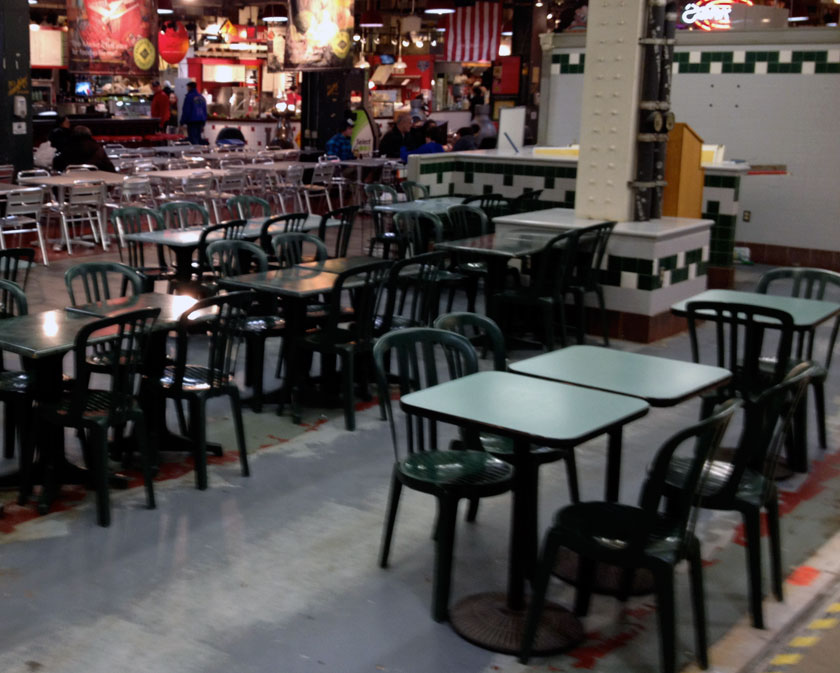
Later in the month the Reading Terminal Market begins its festival season with its Festa Italiana. It's scheduled for Saturday, April 21, from 10 a.m. to 4 p.m. At last year's event center court was filled with tables displaying and dispensing Italian goodies, from espresso from Old City Coffee to Italian style beef chuck roast from Dinic's and roast pig.

At last year's festival the roast pig almost wasn't. The city's Health Department insisted that rather than being displayed whole and cut when served the entire animal be pre-cut in a kitchen. This year, according to Paul Steinke, the RTM's general manager, things have been worked out with the Health Department and a whole pig will be served as such. Last year the pig came from the Italian Market's Cannuli's House of Park, but this year the market's own Martin's Quality Meats & Sausages will provide the porker.

Also on tap for the festa, a mandolin orchestra. Steinke says the event is being planned with help from Judy Saye, formerly of the Book and the Cook, who has also helped organize the Italian Market's annual festival.

St. Louis Landmark


My week in St. Louis ended this past Wednesday, but not before a visit Ted Drewes, the landmark custard stand in the city's south side on Chippewaw Avenue, a.k.a. Route 66.

Since the temperatures were in the low 80s, the frozen dessert hit the spot. Only one flavor, vanilla, but you can have it mixed with a couple of dozen different flavors, or build various sundaes. Along with gooey butter cake and "toasted" ravioli, Ted Drewes is one of the Gateway City's great contributions to the American culinary tradition. (Wisconsin is big on frozen custard, too, and I'll try that late next month.)

The other culinary high points of my visit: chicken feet at dim sum at Lulu's (as good as any I've had in Philadelphia's or Vancouver's Chinatowns) and a lamb burger at the Schlafly Tap Room, a brewpub downtown, which makes a far better brew than its larger St. Louis competitor.

A decided miss was the pastrami served by Lester's Sports Bar & Grill. I was sent there by a local who original hails from central New Jersey. He claimed Lester's pastrami was better than Carnegie Deli's. I doubted that, but I still should have known better. Even though the restaurant is owned by a Brooklyn-born octagenarian millionaire, the pastrami was a royal flop. The flavor wasn't terrible but the meat was all wrong. Where Carnegie, Katz's and our own Herschel's and Famous use beef navel, Lester uses brisket. Good for corned beef. Wrong for pastrami.

A Busier Market

January and February at the Reading Terminal Market were nearly 7 percent busier than the prior year. That may be due largely to the impact of last year's big snowstorms, which cut down traffic, but the 934,00 visitors during January and February made for a busy market.

Thursday, March 01, 2012

Scallopine? Fugetdaboutit. Meatballs? Yeah!

Over the past few weeks meatball sandwiches have occasionally appeared on the menu at Dinic's at the Reading Terminal Market. Starting after the flower show the new sandwich will gain a permanent place among the offerings.

To make room, Dinic's will forgo the scallopine sandwiches, made from thin cuts of pork. Joe Nicolosi, who runs the stall with his father Tom, said they sell fewer than half a dozen scallopines daily.

Although a handful of other market lunch vendors sell meatballs, Dinic's is the only one made on premises -- all the others come from commercial suppliers, according to Joe.

For their meatballs the Nicolosis start out with a lean beef chuck, for about 70 percent of the weight. They make it succulent by using trimmings from their pork before it gets roasted for the roast pork and pulled pork sandwiches for the remaining 30 percent. They grind the meat at the store and also make their own sauce.

The meat balls were available today for lunch, but don't expect them once the flower show starts Saturday for a nine-day run: the thick crowds and demand for the pork sandwiches will take up all their available time.

Another TV Bow for Dinic's

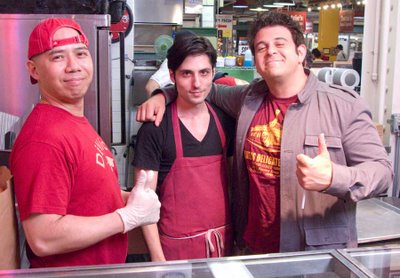
Adam Richman (right) with sandwich maker Jun and Joe Nicolosi at 2009 taping
Is Dinic's roast pork classic one of the 30 best sandwiches in the nation?

Adam Richman thinks so. He and a production crew from the Travel Channel were back at the Reading Terminal Market early last week watching Tom and Joe Nicolosi show how they prepare their fresh hams and other appurtenances that go into the sandwich.

Dinic's will be featured as one of three eateries on an epside of a new 10-show series highlighting the 30 top sandwiches. Episodes are scheduled to begin airing on the cable channel in June.

Richman got his first taste of Dinic's roast pork nearly three years ago when taping a segment for his Man Vs. Food show; in addition to repeats a re-edited version is part of his Amazing Eats episode on pork.


Tuesday, February 21, 2012

NJ Creamery To Make, Age Cheese at RTM

Although there's some food manufacturing going on today in the Reading Terminal Market, Eran Wajswol will take it in a new direction when his Valley Shepherd Creamery opens later this year.

Wajswol plans on bringing 24,000 pounds of raw milk to the market each week to make about a ton of hard or semi-soft cheese. With that much cheese, it will age both in the market's basement and back in the creamery's caves in Long Valley, in northwestern New Jersey. In addition to making, aging and selling cheese, Valley Shepherd will serve lunchers cheese paninis and offer an olive bar.

"We are designing and gathering equipment now to determine if we can, indeed, do what we want," Wajswol replied to your blogger's email inquiry. "In a few weeks we will know more."

Friday Architects, the Philadelphia planning and architecture firm which created the market's Avenue D renovation plan, will visit the farm and dairy next week to begin its design work on the RTM outlet, which Wajswol describes as "very complex, because there are four elements to the space, each requiring design, equipment and talented folks."

The first element will be sourcing and transporting the milk to the market in three weekly 8,000-pound shipments. It will be unloaded into basement tanks for storage, then pumped back upstairs as needed in the cheesemaking operations behind glass for visitors to watch.

Wajswol decided against making fresh cheeses, like mozzarella or quark, because a pasteurization system would be required. With only 610 square feet for retail sales, panini-making and cheese-making, there's simply no room.

The lunch menu will be based on paninis or, as Wajswol calls them, Maninis. He said they are "being conceived by some infamous food truck people and will be tested and redesigned by local Philadelphia food talent (which we are finding amazing)."

Using milk from sheep, Jersey and Guernsey cows, and goats, Valley Shepherd's cheeses cover a wide range of styles and traditions: fresh, soft-ripened, blue, hard, semi-hard, and washed-rind. You can read a full menu of the cheeses at Valley Shepherd's website. The store also plans to sell a few cheeses from "several family farms we know and love," Wojswol said. 

There will be additional brined products beyond olives on the olive bar, he said, "featuring products from several countries with a strong emphasis on brined products from that most foreign country called Brooklyn."

Brooklyn is no accident, since last year Valley Shepherd opened a retail store in the borough's Park Slope neighborhood after closing a Manhattan outlet.

A limited variety of Valley Shepherd cheeses has been available for the past few years at the Fair Food Farmstand of the Reading Terminal Market. Other than at a few farmers' markets, the Park Slope store, the farm, and a handful of retail outlets in New Jersey and New York City, the only other places you're likely to find its products are cheese plates at upscale restaurants.

Who makes food today at the RTM, besides the restaurants and lunch stalls?

Herschel's East Side Deli takes fresh meat and turns it into brined corned beef and cured pastrami in the basement. And Giunta's produces some of its sausages on site. Otherwise, food production is centered on baked goods and sweets: cookies at Famous Fourth Street and the Pennsylvania General Store, baked goods at Beiler's Bakery and Flying Monkey Bakery, pretzels at Miller's Twist, fudge at Sweet as Fudge Candy Shop, and molded and dipped chocolate items at Chocolates by Mueller.

Saturday, February 18, 2012

Another Lunch Vendor Wants Market Stall

Mural at South Street pizza shop
Rick Olivieri of Rick's Steaks isn't the only hawker of street food who'd like to set up shop in the Reading Terminal Market. Lorenzo & Son Pizza of South Street also wants in.

Lorenzo's is among a backlog of businesses who have submitted applications to rent space at the landmark public market.

Neither Rick nor Lorenzo has much of a chance. By its own count, 31 of the market's 76 vendors are "food court" businesses, which are technically limited to no more than the greater of one-third of the number of vendors or one-third of the floor space of the market. Since the raw numbers show 40 percent of the merchants to be in the "food court" category, the market manages to stay within the guidelines only by virtue of the square footage numbers.

Even though Paul Steinke, the market's general manager, told me earlier this month that the market was well within these guidelines, he'd be hard-pressed to bring in another vendor dedicated to the lunch crowd. Steinke has to keep his focus on bringing in sellers of food for consumption at home if the market is to retain its 120-year-old tradition as well as public and political support. If the balance tips too far in favor of the food court merchants, the market would be a considerably less attractive place for thousands of shoppers like me who buy regularly from its meat, seafood, produce, dairy and other food product vendors.

The only types of businesses selling food for on-premises consumption that have a chance would be those offering either something now unavilable or that also devotes considerable space and effort to selling food for preparing or eating at home. Neither Rick's nor Lorenzo's would fit either criteria.

There's good reason why Rick's wants to return and Lorenzo's wants in: traffic. Last year's 6.35 million visitors translates to 122,000 potential patrons a week, most of them hungry tourists and Center City workers. With that kind of traffic you could make a considerable profit selling chocolate-covered dust bunnies. (I think Chocolate by Mueller does; if not, you could have bought a chocolate heart -- with aorta and veins -- for Valentine's Day at Mueller's.)

Of the five categories of merchants at the market the Food Court vendors showed the biggest sales gain last year, up more than 13 percent. The Purveyors (produce, seafood, meat, etc.) recorded the least growth at 2.3 percent. Pennsylvania Dutch merchants saw their sales increase 9.0 percent. Food Basket vendors (sellers of other grocery items, including dairy products, coffee, baked goods, spices) had sales growth of 8.3 percent, while Mercantile (non-food) vendors were up 8.0 percent.


Vendor Adds Spices

Jonathan Best, the closest vendor to a general grocery store at the Reading Terminal Market, expanded its stock of bottled herbs and spices immediately after the late January closing of The Spice Terminal. They'll get competition when The Head Nut opens in early June, selling bulk herbs and spices, coffee, teas, etc.

White Asparagus from Peru

White asparagus from Peru at Iovine Brothers
Prominently displayed at Iovine Brothers at the Reading Terminal Market today is white asparagus, $1.99/bunch.

Since it's about two months until the first local asparagus (green) pokes its spears through the dirt, these have to come from a more distant clime. In this case it's Peru where, since the South American nation is mostly south of the equator, even if just barely, it's now late summer. But it must be cooler in those mountain valleys.

Peru is no johnny-come-lately to asparagus growing. Commercial growers harvested their first crops in the early 1950s, initially planting a white variety for canning. Peru now sells to the frozen and fresh-chilled markets as well.

Last week's imports of persimmons from Span flew off the shelves at Iovine, even priced at $7.95 a basket for about half a dozen fruits.

The Chilean fruit I picked previously was so-so. The black plums were way too astringent and hard. The nectarines (after some time in a paper bag) were sweet and tasted like nectarines, even though the texture was a bit off. The Bartlett pears were the best of the bunch: they ripened nicely in the bag and had typical Barlett flavor and texture: not the most complex flavor among the pears, but straightforward, sweet and satisfying.

First Flush at the Market

Next Saturday evening, Feb. 25, will be another edition of the Valentine to the Market, the fund-raiser renewed after a bit of a hiatus to benefit the Reading Terminal Market Preservation Fund.

It will be worth the price of admission ($125, or $300 for VIP tickets) just to see how the market celebrates the opening of its new restrooms, which are scheduled to be completed just in time for the event. Who gets the first flush? You can purchase your ticket here.

Carlolyn Wyman, who writes for the market's newsletter and website, has a nice article about the event here. Among the interesting points of the article:
This year’s party is actually a revival of a February fundraiser first held in the early ’90s to fund the legal fight to help save the Market from physical decline and development threats. In the later years of the Valentine’s ’90s run, monies raised were used to build the Market’s demo kitchen and to bring Market produce out to far-flung neighborhoods (an outreach that spun-off into today’s independent nonprofit Food Trust).
The new restrooms are a major component of the Avenue D renovation program at the market. New family/accessible restrooms opened a couple months ago. With the opening of new facilities for men and women, construction activity will pick up along Avenue D, including the new multi-purpose room to be named in honor of former Inquirer scribe Rick Nichols. (The market had hoped to have the Nichols Room open in time for the party, but that didn't work out.)

With Spataro's move Friday across Avenue C along center court, Flying Monkey will begin outfitting the old Spataro's spot (and a bit of the old Spice Terminal) as its new digs. L. Halteman Family Country Foods (soon to be Riehl Deli & Cheese) plans to shift its stall to Avenue C by April 1 if all goes well.

Tuesday, February 14, 2012

Spataro's To Move This Week


Spataro's, the oldest sandwich business within the Reading Terminal Market, could move to its new Center Court location as early as Thursday.

When Spataro's moves across the aisle to the spot formerly home to Dinic's, that clears the way for Flying Monkey Bakery to take over the Spataro's stall, all part of the Avenue D renovation project at the market.

Spataro's, whose pater familia Dominic Spataro died at the age of 94 last month, remains the home of the bargain lunch at the market, even though pricier cheese steaks and hoagies are also available. Still on the menu are two sandwiches priced at $4.50: liverwurst & onion, and egg & tomato. The closest competition is the Hatville Deli in the Pennsylvania Dutch section of the market, where a plain cheese or liverwurst sandwich also sells for $4.50.

Thursday, February 09, 2012

RTM's Leasing Strategy Works Against Rick's Return

With the market's renovation program centered along Avenue D opening up space for four new merchants, General Manager Paul Steinke's emphasis has been to fill those slots with "purveyors" who primarily sell foods for cooking or eating at home. That's why the chances of any new pure lunch vendor of getting one of the two remaining stalls is slim at best and why Rick Olivieri's attempt to reenter the market with his Rick's Steaks business will fail.

It's certainly possible, though, that a vendor selling for both on- and off-premises consumption could get that nod. I think the only chance for a new vendor to primarily sell for on-premises consumption would be to offer something not now available from other lunch counters. Hot donuts, anyone?

Only one of the three new vendors announced so far will sell food for eating within the market, but it will also offer groceries and other food products to take home: Wursthaus Schmitz would carry German groceries and cold cuts as well as hot foods for eating either within the market or at home.

The second new vendor would be artisinal cheese maker Valley Shepherd Creamery, which is expected to sign a letter of intent within a few weeks. The latter's product would be overwhelmingly for off-premises consumption, though there's no reason why someone couldn't have a sheep milk yogurt for lunch in center court. A third new vendor, The Head Nut will essentially replicate the offerings of The Spice Terminal, which declined to renew its lease.

That leaves two remaining spaces for new vendors: one along the Avenue D wall, another in a small space on center court adjacent to where Wursthaus Schmitz will be located.

The market's operating policy guidelines require that no more than the greater of one-third of the number of vendors or one-third of the floor space go to businesses "which offer food intended primarily or exclusively for consumption within the Market."

While Steinke is comfortable that the current breakdown of merchants is well within that restriction, by my subjective count 36 of the 77 existing merchants exclusively or primarily fall into the "on-premises consumption" category.

Let me emphasize the subjective nature of determining whose "primary" business is for off-premises consumption or not. As an example, take 12th Street Cantina, which I consider among those who "primarily" sell for on-premises conception but Steinke does not. Steinke says this business a "two-sided" purveyor that doesn't count against the operating policy ratios because of the many take-home Mexican groceries and prepared foods they sell. My opinion is influenced by the fact that 12th Street Cantina has a seating area for diners. (I've got to admit, though, nearly all of my purchases there have been for ingredients to use at home.)

The same debate could be held about any number of other vendors, from Kamal's Middle Eastern Specialties to By George! Pizza, Pasta and Cheeseteaks, both of which also sell plenty of items for consumption and/or cooking at home, but also earn money as lunch vendors. (Indeed, the line for cheese steaks at By George! at lunchtime frequently blocks the aisle.) The key metric in making any such determination as to whether a business is "primarily" engaged in sales for off-premises consumption would be to know the revenue breakdowns, but neither Steinke nor I have access to that proprietary information.

Getting back to Olivieri, another factor why he has little chance of reestablishing his cheese-steakerie in the market are the three existing vendors who depend upon cheese steak sales, and two others who find it a highly profitable sideline. Although Steinke said he couldn't give a "blanket answer" to a hypothetical question about allowing a new merchant to compete with the same product of five existing merchants, it's hard to imagine him adding another tourist-centric cheese steak stall. He acknowledged to Dan Gross of the Daily News, who broke the Olivieri story Wednesday, that cheese steaks were not the market's "highest priority".

When Olivieri's lease was not renewed in 2008, the market allowed two additional vendors to sell cheese steaks: Carmen's Famous and By George! (Spataro's earlier had been permitted to add cheese steaks when they moved to a new center court location.) Today all three businesses incorporate "cheese steaks" into their formal names. In addition, the Down Home Diner sells cheese steaks, as does the new Molly Molloy's.

Rick's Steaks loss of its lease in 2008 followed Olivieri's vociferious leadership of the Reading Terminal Market Merchants Association when the market was restructuring lease agreements and fee structure. You can find earlier stories about the Olivieri-RTM clash here and here.

A Man Dedicated To Piggies: Drew Shattuck

Drew Shattuck, who until yesterday served as butcher at Dinic's roast pork emporium at the Reading Terminal Market, shows off his pig and fry pan tatoos. Drew, who managed the stall when Tom and Joe Nicolosi took days off at the same time, is moving back to the formal restaurant scene, taking a line job at The Capital Grille. Before joining Dinics about two years ago Drew shucked oysters at the late Oceanaire and worked in other high-end restaurant kitchens.

Wednesday, February 08, 2012

John Yi, RTM Fishmonger, Dies

John Yi, who with wife Susie Kim owned John Yi Fish Market at the Reading Terminal Market, died over the weekend of injuries sustained in a motor vehicle accident last month. Mr. Yi was 80 years old.

Until the accident he could been seen almost every day behind the counter of the fish stall on center court. Because of the businesses' bright neon sign -- "John Yi Fish Market | Eat Fish Live Longer" -- his was one of the most visible names in the market.

To the best of anyone's recollection, he established the business in the mid 1980s.

Tuesday, February 07, 2012

Head Nut To Supply RTM Shoppers With Bulk Spices, Nuts, Coffee

Narrow aisle at The Head Nut devoted to condiments
The Head Nut of Ardmore, which traces its history to 1945 with the founding of Temp Tee Nuts, will succeed The Spice Terminal as vendor of spices, herbs, nuts, baking ingredients and other bulk goods at the Reading Terminal Market. The shop plans to open in late spring or early summer in space underneath the market's administrative offices.

RTM General Manager Paul Steinke confirmed that The Head Nut signed a letter of intent today; the actual lease agreement is still subject to negotiation.

In visiting the Ardmore store on Haverford Avenue today I was impressed by the breadth of stock in its meandering warrens of shelves, everything from G-strings made of candy to Norwegian cod liver oil. Bigger sellers, no doubt, are the store's spices and herbs, baking and cooking ingredients (flours, dried fruits, vinegars, oils, condiments), teas and coffees, nuts and snacks, candies and jams.

In addition to the main store in Ardmore, The Head Nut sells at the Wayne Farmers Market. The website also lists locations in Swarthmore and West Chester.

Sunday, February 05, 2012

The Riehl Deli Deal: L. Halteman Stall Name, Location Change

Sign is up preparing for move and renaming of L Halteman
For nearly 70 years, a stall has operated under the Reading Terminal Market under the Halteman name. At one time, there were even two Halteman's: A.A. Halteman, selling meat and eggs, and L. Halteman, specializing in game and poultry.

A.A. closed in 2006, but L. Halteman Country Store continued, though since the 1980s its offerings changed, with the game and specialized poultry receding in favor of more popular varieties of bird, deli meats and cheeses, especially with Lester Halteman's retirement and the subsequent sale of the business to the Riehl family.

Although the Riehls have operated the stall for a number of years, they're finally getting around to slowly renaming at least the deli and cheese part of the business, concurrent with a location shift to Avenue C, part of the market's current renovation program. The deli offerings will be expanded with the move about 15 feet west to make room for a relocated Avenue D, but they will continue to sell fresh cuts of beef and pork along with the poultry, too. They move isn't expected to be complete until mid-spring.

I always check out the top of the meat case, because that's where they display various preserved meats that can enliven winter meals. I've used their smoked short ribs to add depth to chili, and last week some dices of country ham (Smithfield) along with wood-smoked kielbasa completed baked beans.They also offer a great, reasonably priced thick-cut, deeply smoky and porky bacon.

Beck's Beignets

Beck's Cajun Cafe at the Reading Terminal Market continues to offer fresh, hot beignets on Wednesdays and Sundays as long as they last.

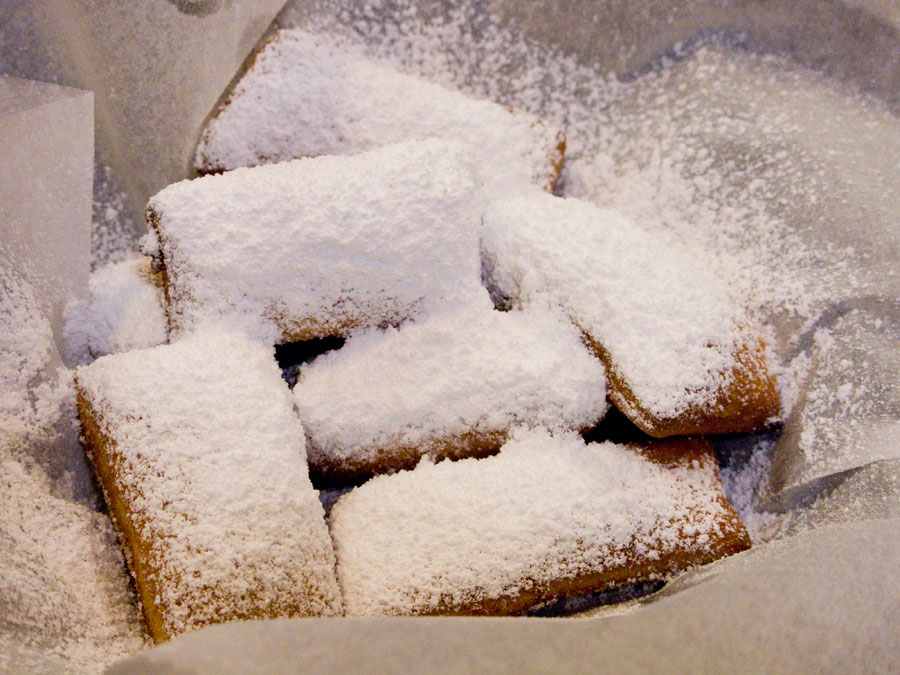
When Bill Beck first offered beignets soon after opening his mecca to Louisiana foods their quality was hit-and-miss. But I've had them thrice over the past month or so, and they've hit the mark each time: crispy exterior, light interior, exactly what fried dough should be. Get a cup of chickory-inflected Community Coffee to go with an order of six of these large rectangular doughnuts doused in confectioners' sugar.

If I don't make it up to Haegele's Bakery in Tacony for Fastnachts on Fat Tuesday, I hope Beck makes the beignets a day early that week.

Newton Pippins Redux, and other Winter Fruit Tales

It's been nearly three months since I purchased my Newtown Pippin apples from North Star Orchards at the Headhouse Square farmers's market, and I'm down to my last four apples.

These great storage apples have gotten better with the time spent in the crisper drawer. Their skins are still shiny and waxy with little sign of age, and the flesh is a deep sweet-tart flavor, just juicy enough. I'm amazed I paced my consumption to still have a handful left, but glad to have this taste of autumn in mid-winter. Man cannot live by oranges alone.

Speaking of which, Iovine Brothers' Produce at the Reading Terminal Market has a wide selection of Chilean fruit. The bagged seedless green grapes I picked up last week were worth it at $2 for a bag weighing about a pound and a half. This week I selected two blemish-free Bartlett pears, a nectarine and a black plum. They're all sitting in a paper bag ripening on the counter, we'll see how they taste in a couple of days.

I also picked up some Temple oranges, which have come down in price to 4/$1, down from 3/$1. Very juicy, easy to peel but a tad more difficult to section than the last batch I bought. Limes eased in price to 4/$1, and avocados, which usually see their price increase dramatically for Superbowl Sunday, were a reasonable 2/$1.49 -- anytime they're less than a buck apiece I consider a bargain.

Saturday, February 04, 2012

Vendors Lining Up For RTM: Wursthaus Schmitz, Nut Vendor

New temporary seating to become Wursthaus Schmitz
With work on additional leaseable vendor space at the Reading Terminal Market scheduled to wrap up by early April as part of the Avenue D project, General Manager Paul Steinke is busy lining up vendors to fill the new spots.

The latest announcement is that the owners of Brauhus Schmitz will open a German food shop -- Wursthaus Schmitz -- in the general area of where the Spice Terminal had been located, at the intersection of Center Court and Avenue D, opposite the new La Cuchina at the Market. They'll sell prepared food for consumption at the market and take-away, deli meats, as well as imported products, including mustards.

The market has been without wide-ranging German food products (beyond the limited Pennsylvania Dutch merchant offerings) since Siegfried's departed in 1990. Steinke has sought to fill that niche for years (Rieker's of Fox Chase declined the opportunity shortly after Siegfried closed). 

Owners Kelly Schmitz-Hager and Doug Hager are hot to trot and hope to be open by Memorial Day.

(I heartily welcome the renewal of a German food purveyor at the market, but it raises a question about the sudden mushrooming of German restaurants in center city. Once upon a time the only German restaurant around was Ludwig's Garten on Sansom. When it closed we were Gemütlichkeit-less. Now, however, we've got Brauhaus Schmitz, Frankford Hall, and the newly opened Bierstube in Old City. Even Jose Garces and has threatened to get into the act with a Wurstmacher in the old Letti Deli on 13th Street.) 

Spice Terminal Successor Nears Dotted Line

Although negotiations are not completed, Steinke is optimistic to sign a new bulk spice vendor, who would occupy space beneath the market's administrative offices one aisle north of center court. The prospect is a long-standing suburban vendor of nuts, spices, herbs, coffee, grains, and condiments -- the same lines carried by the Spice Terminal. Looking at the potential vendor's existing website, it appears this outfit has greater depth of stock than Spice Terminal's.

Steinke said he decided to go after the suburban vendor because of its 30 years of experience, which trumped an otherwise attractive offer from employees of the Spice Terminal. He acknowledged that part of his decision mix was the tens of thousands of dollars it would cost the market to move the Spice Terminal to a new location, as required by the Avenue D Project. Extensive carpentry for the shelving would have accounted for much of that cost; a new vendor under a new lease is responsible for those costs.

Steinke also expects to sign Valley Shepherd Creamery within the next few week. In addition to selling its great artisinal cheeses (primarily sheep, but some cow and goat and mixed milk cheeses), Valley Shepherd plans to make fresh cheese on-premises.

With Spice Terminal's closing last Sunday, Steinke made quick work to turn it into additional seating, if only on a temporary basis, just in time for the last two days of the auto show. The extra seating will stay in place for the flower show in early March, than give way for Wursthaus Schmitz.

Name That Fish!

Fish display at John Yi, Reading Terminal Market
You can't tell a fish by its name. Sea trout is not a trout, it's weakfish, a type of croaker or drum.
But silver trout is whiting, which is really hake, part of the cod family. I haven't the foggiest idea about mountain trout, though it certainly isn't a trout and it certainly doesn't come from a mountain stream or lake. Striped bass and rockfish? They're the same, except when they're not.

Confused yet?

You'll find all these items at the fish mongers at the Reading Terminal Market, but it's hard to know what the actual species is. More than any other food, fishes tend to have very local names.

The weakfish, for example, has been called bastard trout, squwteague, sea trout, grey trout, sand trout, shecutts, silver sea trout, squeteague and squit.

In culinary terms, however, nomenclature is secondary. Just pick the broad type of fish you're hungry for (white flesh or oily, large or thin) and buy the freshest you can find. Most recipes for cod work just as well with whiting or haddock. Fluke or flounder? Doesn't matter! Mackerel or Spanish mackerel? There's a bit of a size difference, and while you might be able to distinguish their flavors, it's not that big a difference.

Rockfish and striped bass are the same, delicious, meaty fish, it's just that rockfish is the name in the Chesapeake and striped bass on the Hudson River northwards (New Jersey seems to be the dividing line between the names). With one big caveat. Some striped bass are true striped bass, caught in the wild. Others, under either name, may be a factory or farm raised hybrid of striped bass and white bass. The former is anadronmous, living most of its life at sea but spawning in fresh or brackish rivers; the latter is strictly a fresh water variety. Whether wild or hybrid, both have a good, meaty taste. You can usually tell the difference because the wild striped bass has a blue tag affixed to its jaw; also, the "stripes" on the hybrid tend to be jagged, and the fish are frequently smaller than the striped bass.

If you're as fascinated by culinary fish as I and would like to learn more about the denizens of the sea off Mid-Atlantic waters, I highly recommend Alan Davidson's North Atlantic Seafood. This British diplomat's tome covers fish on both sides of the Atlantic, is chock full of great stories, local recipes from Denmark to South Carolina, and entries for each North Atlantic food fish with discussions of range, best cooking methods, and names in various languages; before he died in 2003 he wrote similar books about the fish of the Mediterranean and South-East Asia, and was the editor of the Oxford Companion to Food.

Thursday, February 02, 2012

Auto Show Crowds

Dinic's (in accompanying photo), Carmen's, Herschel's and all the other lunch vendors at the Reading Terminal Market have welcomed the auto show crowds this week. Joe Nicolosi of DiNic's says auto show week and flower show week are the two busiest of the year. So expect big crowds all day long for Saturday and Sunday's auto show finale.

Thursday, January 26, 2012

Spataro's Founder Dies, 94

Original 'Buttermilk' sign at old Spataro's
Domenic C. Spataro, who started the eponymous sandwich stall in the Reading Terminal Market in 1947, died overnight at the age of 94.

Mr. Spataro was "a legend of longevity at the Market, having worked here continuously since 1930 except for a military stint during World War II," wrote Paul Steinke, the market's general manager, in an email this morning to market followers.  He opened his own sandwich shop in the Market  in 1947, which continues in business to this day. "Up until the end, he had a near photographic memory of the Market and its people from the past 80+ years. His passion was his family and his work at the Market," wrote Steinke.

My first purchase at Spataro's -- in the early 1980s when they occupied a stall now housing Terralyn's Bath Body Spirit -- was lekvar, the Eastern European prune butter which they sold in bulk. But their specialty, loudly proclaimed on a sign that still stands at the original location, was buttermilk.

Spataro's had always been the home of an inexpensive lunch sandwich, simple stuff like cream cheese and jelly, priced for the lowly store clerk, not foodie. In more recent years the menu expanded, especially with the move about two years ago to center court and the addition of a grill for cheese steaks. The stall. operated by son Domenic, will soon move to the former Dinic's spot across Avenue C.

Tuesday, January 24, 2012

Valentine to the Market

This year's version of the Valentine to the Market will be held Saturday, Feb. 25, and if it's up to last year's standards another great evening is in store for party-goers. The shindig benefits the Reading Terminal Market Preservation Fund.

In addition to two bars, two stages with entertainment and great food from the market's merchants Philadelphia Brewing Company will present a special beer in honor of the market's 120th anniversary. (The RTM opened its doors in 1892, the successor to two earlier markets at 12th and Market.)

The event runs from 8 to 11 p.m. with tickets at $125 apiece. The pre-party VIP event, with a celebrity chef cook-off, cocktails and hors d'oeurves, begins at 7 p.m. ($300 tickets).

Tickets and more info here.

Monkey's Buttercake

I couldn't resist trying Flying Monkey Bakery's buttercake. It's not your German Großmutter's buttercake, but it's darned good. 

The big difference, to me, is that this cake is practically candy. Same flavor, same sugar and butter intensity. But it's set atop a shortbread-like base and creates an instant sugar high. Take a break from a cupcake or brownie and try this treat. Do enjoy it with a cup of Flying Monkey's coffee; I forget the roaster's name, but it's the tastiest coffee at the RTM.

If you want a comparison with a traditional German style buttercake, take a trip to Tacony, where Haegele's bakery offers the classic version.

First Sign of Spring

So what if it comes from way down south. The appearance of shad at the Reading Terminal Market is a surer sign that spring will eventually reach Philadelphia than any western Pennsylvania groundhog. The local spring run won't hit the Delaware (Lambertville is the center of local action, though Fishtown also holds a festival dedicated to the fish) in late April.

The first of the species could be found at John Yi's  "Eat Fish Live Longer" stall off center court. As always, the roe-laden females are a buck pricier than the bucks. I've got to admit I'm not a big fan of this herring-family variety due to its exceedingly complicated and fine bone structure; but when it comes to shad, it's all about the roe.

All three fishmongers at the market still have sardines in their display cases. Prices range from $1.99 to $5.99, with the cleaned fish commanding a higher price (though the whole fish really aren't that difficult to clean at home). Golden Fish Market (the one closest to Arch Street) also has some salt herring and mackerel available, the latter in filets. I've cooked the salt mackerels (after many changes of water to leach out the excess sodium) and enjoyed them immensely. They can be broiled, baked or pan-fried (sauté meunière).

Saturday, January 14, 2012

La Cuchina Next RTM Move

New La Cuchina, with view toward center court
La Cuchina at the Market, the cooking school and event venue operated by Anna Florio at the Reading Terminal Market, has just a few finishes touches and health department inspection to go before it can open at its new spot, perhaps as early as later next week.

Although plenty more works needs to be done on the market's Avenue D project, the opening of La Cuchina provides a preview of the new look for this end of center court, which will also include the Rick Nichols Room, a multi-purpose venue, adjacent to La Cuchina. The Nichols Room and La Cuchina will be separated by a removal wall so that large scale cooking demonstrations can be held.

Spataro's Starts Construction

Work begins on new Spataro's stall

Sign at old Spataro's stall when they used to specialize
in buttermilk and lekvar (prune butter)
Dinic's move to its new home in the Reading Terminal Market cleared the way for Spataro's to begin construction in the former's stall.

This will be at least the fourth location within the market for Spataro's. Once upon a time it was located where Terralyn's Bath Body Spirit shop now stands. Then it moved to center court where Hershel's East Side Deli now holds down the fort before shifting a few years ago to a different center court stall.

Once Spataro's moves to its new spot Flying Monkey Bakery shifts to where Spataro has been.

Monday, January 09, 2012

First Day at Dinics

Joe and Tom Nicolosi pose with meat they're prepping for first day at new location

Nothing is easy or goes without bumps.

In moving from old to new location within the Reading Terminal Market last night, the staff at Dinic's found that one of the ovens simply wouldn't fit through the opening in the old counter. So out came the sledgehammer to create a suitable opening.

"I almost cried," said Tom Nicolosi, proprietor of Dinic's.

But that wasn't the end of the oven problems. Because of electrical box issues, the electric ovens wouldn't work at all, and the gas oven needs electricity to drive its fan. Undaunted -- and with assurances from the electrician that all would be well soon -- Nicolosi, son Joe and the rest of the crew still planned to be serving their pork and beef sandwiches for lunch.

Sunday, January 08, 2012

DiNics Makes Move

DiNic's got its Health Department okay today and, as I write, is moving equipment over to its new location within the Reading Terminal Market.
More About Those Meat Hooks

I've still to photographically document the Moyers' Pork signage over Benuel Kauffman's Lancaster County Produce stall, but here are a few other original signposts/meat hook apparatus spotted at the Reading Terminal Market yesterday.

The meat hooks are largely gone but Kamal Barouki has kept the signboards
above Kamal's Middle Eastern Specialties as an integral part of the stall.
Note the stall numbers.
Over at L. Halteman Family the otherwise unadorned signboards are
painted baby pink and baby blue, but the hooks are put to good use as
shopping bag dispensers and apron hooks. They also serve to store spare
fluorescent light bulbs.


Hershel's East Side Deli uses the old meat hooks for hanging up cooking equipment.

Wednesday, January 04, 2012


Dinic's Remembers Market's Butchers

When Dinic's moves into its new stall at the Reading Terminal Market (perhaps as early as later this week, if the city's Health Department can schedule its inspection), it will be adorned with signs remembering the stall's predecessors in vending meats at this spot. Though Tom Nicolosi is a purveyor of cooked meats, he knows it all starts with the butcher.

Most folks know that Dinic's will occupy space vacated last year by Harry G. Ochs & Son Prime Butchers. But that's only half the story. Until the early 1970s, while one side of the stall was occupied by Ochs, the other was home to another market butcher, G.M. Yerger. When Yerger went out of business, Ochs expanded to span the entire space along Avenue B between the market's Fifth and Sixth Avenues (aisles) .

The signs, by the way, date back to the market's beginnings under the Reading Railroad's train shed. Wander and you'll see a number of them over what had originally been hooks to hang meat and other vittles. At Kaufman's Lancaster County Produce, for example, you'll see a sign for Eugene M. Moyers & Son, which left the market in the mid-1980s (but still makes killer ham under its Blooming Glen brand in the village of the same name between Doylestown and Quakertown).

Before yesterday, the soon-to-be-home of roast pork, beef, brisket, pulled pork and pork cutlet sandwiches was shrouded in plastic, looking as if the artist Christo had arisen from the dead and moved into the Reading Terminal Market.

With Dinic's move, Spataro's will begin work to move across the aisle. When that work is done, Flying Monkey will take over Spataro's space.

Avenue D Project Running Late

The musical chairs involving the sandwich makers and baker is just one aspect of the Avenue D Project, which will create additional leaseable space for more vendors and a multi-purpose room for meetings and other gatherings (as well as additional seating during lunch hour). The entire project was originally envisioned to be completed by late February, just in time for the Flower Show when hordes from across the Northeast and Mid Atlantic descend for an early fix of springtime.

Like most construction projects, however, this one fell of its initial schedule. Although the revamped rest rooms should be open by late February, the rest of the construction won't be completed until late April.

Cardoons at Iovine's


If it's winter, then Iovine Brothers Produce has cardoons for sale at its Reading Terminal Market fruit and vegetable emporium. Cardoons may look like extra-large bunches of celery, but they are more closely related to to tdhe artichoke. You can find them in the same bin at Iovine's, along with beets, parsnips, turnips and black radishes.

Tuesday, January 03, 2012

Giunta's Prime Shop

At least one reader of this blog complained in the past about the name of this butcher shop at the Reading Terminal Market, objecting to the use of "Prime" for a shop that doesn't sell prime beef. Technically, the critique is on-target: Charles Giunta does not sell USDA prime grade beef.

But I don't care. His beef may be "only" USDA Choice, but his eye in picking out primals and his hereditary butchering skills have won my regular patronage. For what it's worth, overall his meats are far better than that sold by Ochs in its last few years at the market.

For the holidays I picked up a small prime standing rib roast (prime as in the definition of the cut, not the USDA grade). Even though he was exceedingly busy on the Friday before Christmas he took the time to get a new full rib from his walk-in refrigerator and asked me how many ribs and from which end, i.e., chuck end or loin end. When I asked for his recommendation, he suggested the chuck end, which he thought more flavorful than the loin end though it can be a slightly tougher part of the full seven-rib cut. He did a great job of a trimming my two-rib roast, leaving just the right amount of fat, semi-separating the bones for easy carving and expertly tying it all together, ready for the oven.
 
It made a superb meal on Christmas Day. No doubt it was helped by the fact that it sat it in the fridge for two days, unwrapped except for some wax paper loosely placed over the top, a do-it-yourself aging technique which will improve almost any piece of beef. I took the meat out of the fridge a few hours before cooking so it would lose some of its refrigerator cool, then seared all sides of the meat stovetop in a roasting pan (no need for additional fat). After about 10-12 minutes of browning I simply salted and peppered before placing the standing rib in a 200F oven. It cooked on a rack in the roasting pan at this low temperature until my digital probe registered 135F (this took about 150 minutes). After resting half an hour while I prepped the rest of our meal I carved the meat, and it was perfectly medium rare (quite rosy, but not red) through and through, from just below the outer crust to the deepest part of the interior. Best of all, it tasted absolutely yummy with plenty of beef flavor, with the tenderness one would expect from USDA Prime. The five-pound roast priced at $10.95/pound could be considered dear, but I thought it great value for a superior hunk of protein.

Steaks cut from the same primal are a favorite of mine and I've always been satisfied by Giunta's rib steaks on the bone. But I've also cooked his filet mignon, flank steak and hanger steak and never been disappointed. Ditto for pieces of chuck I've braised in a variety of fashions, as well as short ribs.

In recent weeks I've cooked up two ground meat dishes from Giunta. I used his pre-ground (on premises, not from a wholesaler) meatloaf mix -- beef, veal and and pork -- to make meatballs. Last week I asked him to grind chuck to my order, which went into an all-beef meatloaf (it was assisted by my addition of half a teaspoon of unflavored gelatin to mimic the collagen veal would have provided). We enjoyed both.

Lamb is one of those meats that's pretty good no matter where you buy it, so sometimes I obtain it from Giunta's and other times from his brother Martin. (Both learned their trade in the family butcher shop in the Italian Market.) Giunta's ducks are superb, offering the classic Long Island style duckling raised and packed by Joe Jurgielewicz & Son of Berks County. (For Muscovy duck visit Godshall's Poultry.)

Best of all, Giunta's prices are competitive -- rarely more expensive than what you'd pay in a supermarket, and frequently much better value.

Sunday, December 25, 2011

Vendors Interested in Spice Terminal

Spice Terminal adjacent to Center Court
It seems there are a few potential entrepreneurs interested in taking over the Spice Terminal.

Paul Steinke, the Reading Terminal Market's general manager, reports there are three existing vendors and two outsiders who have expressed interest.

In the meantime, Jonathan Best is widening its spice and herb selection.
WiFi Back Up at RTM

WiFi service, suspended since early fall when work on the Avenue D project displaced the market's office, came back on line last week. Good coverage in center court and the piano court (where the holiday train display has temporarily displaced seating), but spotty around the market's perimeter.
Cheeses On Parade

The Fair Food Farmstand at the Reading Terminal Market added
a new display case just for cheese last week, much to the
delight of cheesemonger Paul Lawler.

Seven Fishes

The cases at John Yi ('Eat Fish Live Longer') at the Reading Terminal Market
were chock full of piscatorian delights for the Feast of the Seven Fishes
before Christmas, including these sardines, a.k.a. herring

Thursday, December 22, 2011

Spice Terminal To Close

Rendering of what would have been
the Spice Terminal's new stall
The cupboards are getting barer and barer at the Spice Terminal, and not just because bakers are grabbing spices for their Christmas cookies and cakes.

The long-time proprietor of the Spice Terminal, Al Starzi, died about a year and a half ago. With the stall scheduled to move to a space under the market office later this winter as part of the Avenue D redesign project Starzi's family decided to shut down at the end of next month. Once the decision to close was made they stopped restocking the shelves.

The Spice Terminal has been my go-to vendor for all sorts of seasonings, nuts, condiments and other special items for the nearly 30 years I've been a market regular. If I recall correctly, it was originally located on the Filbert Street side of the market before moving to center court with the mid-1980s renovation completed in connection with construction of the Pennsylvania Convention Center.

With the closing of the business the only vendor with a reasonable selection of similar merchandise in one space will be Jonathan Best, though some selected items are available at Salumeria, Kauffman's Lancaster County Produce, Iovine Brothers Produce and other stalls. It's possible these and other merchants may expand their offerings to take up the slack. The Spice Terminal also offered a decent selection of whole bean coffees as a competitor to Old City Coffee.

RTM GM Paul Steinke would love to see someone continue the business, but that appears unlikely.

Some of the Spice Terminal space will accommodate the relocated Flying Monkey Bakery, which will also take over Spataro's space when they move across the aisle where DiNic's now holds the fort. DiNic's hopes to open in mid to late-January in the former Harry Ochs stall. The remainder of the Spice Terminal space off center court is scheduled to be occupied by an as yet undetermined new merchant.

Talks are continuing with Valley Shepherd Creamery to occupy space along the back wall of Avenue D. The New Jersey cheese-maker recently opened its new store in Brooklyn's Park Slope neighborhood concurrent with the closing of its outlet in Manhattan.

In the past Steinke said he has a waiting list of potential vendors waiting to open businesses at the RTM. A major reason for the Avenue D project is to create more leaseable space.

Citrus Season!
Tangerines at Iovine Brothers now selling at 5/$1

Now that we're officially into winter, it's time to shift our fruity focus from pomes to citrus. Although I've got my full stock of Newtown Pippin apples in cold storage to get through January and, perhaps, February if I hoard my hoard, my fresh fruit purchases have turned to oranges and their close relations. (Alas, my statin regimen prevents indulging in grapefruits and other pomelos.)

Right now I'm working my way through Temple oranges I purchased at Iovine Brother's Produce in the Reading Terminal Market for a quarter apiece. Small navels tend to sell for the same price, as do tangerines (though this week they're featuring them at 20 cents). Large navels are 50 cents, but the gargantuan Jumanjis for over-stuffing a stocking call for a 99-cent investment.

Just eating them plain is a joy, especially the easy-to-peel temples, tangerines and other mandarins. The perfumes they exude upon peeling is right up there with good whiskey, bacon and vanilla in my olfactory Hall of Fame. After eating a spicy or rich entree, the sweet bite of citrus is a great palate-cleanser. No wonder so many Asian restaurants slip a few chunks of orange on the parting plate along with a fortune cookie.

Still, I think I'm game this season for doing a bit more than taking my oranges straight. Although I usually only make sorbets in warmer weather, the great looking juice oranges (usually the Hamlin variety) may prompt me to get out the juicer and make an icy winter treat.

Another option may be a composed salad where oranges and beets take center stage, perhaps with a sprinkling of walnuts and little bits of chevre in a plain vinaigrette (or, alternatively, using orange juice as the base of a vinaigrette to top the other ingredients).

If I'm more ambitious, there's the orange flan from Jose Garce's mom. But since I'm less ambitious there may be an orange chiffon cake in my future.

Besides orange-flavored beef, a staple at some Chinese restaurants, I'm hard-pressed to think of other meat-centric dishes incorporating oranges. If anyone has some ideas, please comment on this post.

For fish I might try Norwegian chef Andreas Viestad's variation on a sauté meunière wherein both the fish filets and orange sauce are spiked with ginger and cloves. 

Sunday, December 04, 2011

Pigs Outside!

As winter nears the number of vendors dwindle at the Headhouse Square Farmers' Market operated by the Food Trust. But that negative can be a positive: producers who can't get in during the height of the season can get a space.

That was the case today for Stryker Farm of Saylorsburg, Pennsylvania, which raises heritage breed pigs and meat goats. Young farmer Nolan Thevenet is new to farming, but he's enthusiastic. Because I had picked up enough meat for the week at the Reading Terminal yesterday, I abstained from indulging in pure pigmeat from Nolan, but couldn't resist picking up some scrapple.

Stryker Farms' scrapple, Nolan says, isn't made from innards like liver and heart, as is traditional, but from scrap meat, including jowls. Now, I have no objection to the innards in my scrapple, indeed, if you're going to keep it historic that's the way to go, adding a bit of livery savoriness. Still, I can't wait to fry up a couple slices tomorrow morning.

The farm raises their pigs out of doors and lets them forage in the fields and woods, supplementing their diet in winter with barley and grass feed, not corn. Like many heritage pig farmers Stryker Farm uses a Tamworth cross (in this case with Hereford), though Nolan said he'd like to get some Berkshire into his piggies' bloodlines.

Nolan plans to be at the final two Headhouse markets this season (the next two Sundays) and hopes to get a spot next season as well.

Black Radishes


With the season winding down, the offerings at Blooming Glen Farm's stall at the Headhouse Square Farmers' Market were slim today, but what they did have was choice, including these black radishes.

When you find them in supermarkets, black radishes tend to be the size of bocci balls. They're good, but the smaller, freshly dug versions are superior.

You can roast them like a turnip, but they're probably at their best raw. I like to grate mine and mix into soft sweet butter, then spread it on good pumpernickel or rye bread. But I've seen some salad recipes that look like they're worth trying. Most call for the radishes to be thinly sliced (a mandoline comes in handy), then tossed with apples or oranges, placed atop a bed of escarole or similar green, dressed with a simple vinaigrette. And the green tops can be treated like any other cooking green
Persimmon Season


We're at the tail end of the season for local persimmons, like these found at Culton Organics at today's Headhouse Square Farmers' Market.

The Fuyu variety can be eaten while still firm, but the Hachiya, which I prefer, must be allowed to ripen -- just shy of becoming rotten -- to be best enjoyed. I just lop off the stem end and dig in with a spoon, eating the gelatinous flesh like pudding.
Pepper Prep at DiNic's

Before those sweet bell peppers top your roast pork sandwich at DiNic's in the Reading Terminal Market, they've got to be prepped. Every morning Jun snaps out the cores before the peppers go into the oven with a light dressing of olive oil.

Earlier this week I had a hankering for one of Tommy's sandwiches and managed to order something other than the roast pork. Instead I opted for the brisket, which you should try. Tender and flavorful it's like beef done as pulled pork -- but even more succulent. I kept it simply topped with roasted hot peppers.

Tommy's partner and son, Joe Nicolosi, says they won't be rushing to open their new location in the former Harry Ochs stall, because they want to make sure they do it right. They're aiming for mid-January, so they can have some shake-down time before the auto show crowds descend.
Shane Confectionery Opens Tomorrow


The official grand opening is tomorrow, Monday, Dec. 5, for Shane Confectionery, the revitalized candy emporium from the Berley Brothers of Franklin Fountain. Except for the past year or so, the building at 110 Market Street has housed candy makers. Just in time for Christmas!