Saturday, May 07, 2011

Harry G. Ochs & Sons, 1906-2011

Nick "Ochs" Finocchio
Harry G. Ochs & Sons, a fixture at the Reading Terminal Market for more than 100 years, closed its counter for good last Monday evening, just days ahead of when the business would have been evicted for being $21,000 in arrears on rent.

I was out of state Monday when Nick "Ochs" Finocchio closed the shop, unannounced to employees, market management and fellow merchants. Since then I've had a chance to chat with some fellow market denizens and merchants, including its general manager, Paul Steinke.

In addition to the rent, two separate banks held judgments valued at more than $200,000 against the business. One merchant told me he was owned $8,000 which Nick never paid back for services rendered.

The problems started long before Harry "Ochs" Finocchio Sr. died in December 2009. Even when Harry owned the business, it was in trouble.

In an email to me and another market follower, Steinke said he worked hard to help the Ochs business succeed. "In fact, we have devoted more time to them than to any other merchant here," according to Steinke. "We met with them countless times. We arranged free consulting services for them with the Wharton Small Business Development Center. We offered them tenant improvement financing. We agreed to rent discounts that no other tenant was privy to. We offered numerous, generous payment plans (all of them broken)."

All this did little good, he admitted.

"As their account got further and further behind, we held off legal action for years in deference to the Ochs name and what they contributed to the Market, and later, because Harry was sick," Steinke said. Given the business's unlikely success, Steinke suggested that they call it quits, offering to host a large farewell party so they could exit the market in dignity, which Harry and Nick declined. "Once Harry died, however, we felt that it was time for the Ochs stand to carry its weight in the Market along with the other merchants. So we gave them one more chance," wrote Steinke.

The market and Nick negotiated and signed a new lease last summer but, according to Steinke, "he started falling behind almost immediately. So, after years of holding back, we finally had no choice but to initiate the legal process to enforce the lease. Nick filed for Chapter 11 protection in early April." When, two weeks later the court dismissed the filing, the writing was on the wall.

It was wrenching for Steinke and the market to lose the Ochs business, which moved there only 14 years after the market opened its doors in 1892. Nick's grandfather joined the business in the first half of the century and adopted the Ochs name when he took it over. Indeed, his son Harry was better known as Harry Ochs than as Harry Finocchio. When the market's future was threatened by the proposed construction of the Pennsylvania Convention Center, it was Harry Finocchio who was a key player in preserving the market and pressuring the center to renovate the then-dilapidated structure. Today, the block of Filbert Street astride the market is known as Harry Ochs Way.
 
"We are saddened by the loss of the Ochs name," wrote Steinke, "but I take solace in knowing we did all we could to help them and to maintain an environment conducive to their success. I also take solace in the general prosperity of the great majority of the rest of the Market’s merchants, who work hard, serve their customers well and pay their bills."
(The Finocchio family, like all of us, were not immune to tragedy. Nick's brother Harry died a few years ago, preceded in death by his young son Tim, who also worked at the store. When Harry Senior died he lost a two-year battle with cancer.)
There's no reason a butcher can't thrive in the market, as Charles Giunta has shown with his relatively new shop. Where Giunta's is strictly a butcher (having given up on his rotisserie chicken experiment), Ochs had tried to move into deli and prepared food -- at least half of the cases were filled with either items for reheating at home or Boar's Head cold cuts -- with little success.

Nick did less and less cutting meats to order in the last few years. I continued to shop there for chuck ground to my order for burgers, even as little as a pound which Nick and his staff happily provided. I would also occasionally buy a chicken breast or piece of lamb there, but Giunta (and to a lesser extent his brother Martin who operates his namesake stall as well as a wholesale sausage business) had won over a good hunk of my meat-buying loyalty. In addition, those who have more knowledge about the subject than I say that Nick's butchering skills, while good, just weren't up to the level of his father and late brother.

That move to prepared and deli items undoubtedly was an attempt to keep the business viable, since few people were prepared to pay the prices Ochs had to charge for his excellent prime, dry aged beef. And those who were willing to consider meat as an investment vehicle spent most of their dollars at Whole Foods -- my market sources tell me Ochs took a big hit in revenue when Whole Foods opened at Callowhill and 20th Street and never recovered.

There are neither heroes nor villains in this story. Just changing times that exempt no individual or institution from its demands.

What's next for the premium space Ochs vacated?

Steinke has yet to make a decision, but says he has plenty of businesses that want to locate in the market, which is currently 100 percent leased other than the Ochs stall. (More will become available when the market's renovation is completed late this year.)

One possibility I broached with Steinke would be for an existing lunch vendor to take over the space, which fronts on center court, and put a new purveyor of food to cook at home in that business's spot. Steine said that might be particularly attractive in light of the renovation of the market now underway and which will become more visible to shoppers this summer.

What you can be sure of is that no chain businesses will be allowed, nor will the market's ratio of purveyors (butchers, fish mongers, greengrocers, etc.) to other businesses be reduced.

* * *

Note: This version edited to correct earlier error to correct Finocchio family history in joining the business and adopted Ochs name.

Thursday, May 05, 2011

Fairmount Market Opens

Today is the first day of the 2011 season for my local farmers' market, every Thursday from now until the end of the season at 22nd and Fairmount.

On-hand this week: Livengood Family Produce, Orchard Hill Farm, Countryside Bakery, Wild Flour Bakery and Sunny Side Goat Dairy, Renaissance Sausage, Market Day Canele and My Better Butter (which sells nut butters, not dairy butter).

Ramps gathered by Earl Livengood's neighbor, Sam Consylman, quickly caught my attention. Pristine leaves, large, firm bulbs, these alliums will find a place on the dinner table tonight, somehow. Asparagus also had price of place in Livengood's display today.

Dwain Livengood is also selling meats at the stall, including lamb from a neighbor. He hopes to start a small flock of his own soon.

Sam Stolfus's Orchard Hill Farm had bibb and buttercrunch lettuce, asparagus, two types of radishes, greens and beats.

Market Canele is going beyond that heavenly treat this season. Baker Gil is adding tarts and ia starting the season with the savory variety. This week asparagus was featured. Once the berry season gets underway expect to see sweet tarts. His pastry crust uses a mix of leaf lard and butter.
Milwaukee Public Market

On Tuesday, the last full day of our Wisconsin sojourn, I briefly stopped at the Milwaukee Public Market, whose huge sign I spotted from the interstate en route to  meet friends atthe nearby Milwaukee Art Museum.

Alas, there's not much market at the Milwaukee Public  Market. One fish monger, one cheese monger, one butcher, two bakers. With the exception of the Mexican restaurant, which sold a few items, no fresh fruits and vegetables. There are also vendors for spices, coffee, chocolate, wine and flowers, but most of the vendors, including the fish monger who had an oyster bar, look to make most of their money from lunch and take-away prepared items. There's also a sushi bar, soup seller, and a handful of other lunch vendors.

It's too bad that the local demographics won't support a more cook-it-at-home public market. It's located pretty much what had been the gritty city's traditional market area.

This market is a fraction the size of the Reading Terminal Market, with only 20 full-time vendors, so even the presence of one butcher and one fish monger should be considered a plus. A weekly indoor/outdoor Saturday market accents crafts.

The market is located in Milwaukee's "Historic Third Ward", the city's self-proclaimed "Arts and Fashion District" just south of downtown, with most residences limited to office building and loft conversions.

The market is about a dozen blocks away from what is one of Milwaukee's food meccas: the Usingers sausage store.

Saturday, April 30, 2011

Meeting Mustard Royalty

Eric Rygg (left) wears his three medals after the presentation
by Barry Levenson, founder of the National Mustard Museum

Eric Rygg of Kelchner's Horseradish Products,  based in the Philly suburb of Dublin, is mustard royalty.

That honor was certified Friday night by none other than the Clown Prince of Mustard-dom, Barry Levenson, founder and Grand Poobah of the National Mustard Museum in Middleton, Wisconsin, just outside Madison.

The event celebrated the winners of the 2011 World Wide Mustard Competition and also featured the First Annual Iron Mustard Chefs Challenge. And no, I'm not kidding, though Levenson frequently does.

At the event Rygg accepted medals for three mustards produced by his family-owned business, which includes Kelchner's and Silver Spring Farms of Eau Claire, Wisconsin. Within the Horseradish/Wasabi Mustard competition Kelchener's Hot Mustard with Horseradish took the bronze medal, while gold went to Silver Spring's Beer 'n Brat Horseradish Mustard. (Brats, keep in mind, are almost as identified with Wisconsin as cheese curds and the Green Bay Packers.) Silver Spring's Organic Deli Mustard took the silver medal in the Organic Mustards category.

Rygg is president of Kelchner's, a firm which has another Philadelphia area connection since it markets condiments under the Bookbinder's brand, which it acquired a few years back. Kelchner's also has a substantial distribution business of products from other manufacturers, so they handle the oyster crackers you find filling the bowls at the Oyster House on Sansom Street, as well as providing the horseradish. (Rygg is trying to convince Sam Mink, owner of the Oyster House, to ice the tableside horseradish because the product rapidly loses pungency once opened and allowed to reach room temperature.)

It's horseradish, rather than mustard, however, that flows through Rygg's veins. In 1929 his great grand-father Ellis Huntsinger started Huntsinger Farms in Eau Claire. Today Huntsinger is the world's largest grower and processor of horseradish, so it was no accident that when Kelchner's was put up for sale a year or so ago the Wisconsin family firm acquired it.

Iron Mustard Chefs Challenge

As a string quartet serenaded visitors to the two-floor museum in beautiful downtown Middleton, attendees at the Evening of Mustard Royalty could sample the dishes cooked up by the chefs using some of the award-winnng condiments (ketchup was verbotten).

Culver's Pretzel Lobster with sweet potato
fries; Deviled Egg from The Cooper's
Tavern graces table also
My favorite entry, and the winner, was created by the Corporate Chef for Culver's, a Wisconsin-based hamburg and custard chain (and very good fast-food type burgers they are, with good custard, too). Jim Doak wowed the crowd and the judges with his Pretzel Lobsters. Even if he used slippery lobsters, a South Seas crustacean which is not a true lobster, it was nonetheless extremely delicious. Doak took the tail meat and dipped it into a batter with Aldrich Farms Sweet & Hot Mustard (the gold medal winner in the Pepper Hot Mustards division) which included finely ground pretzel, with crunchier pretzel pieces added. It was then deep fried and served with sweet potato fries and accompanying mustard-enhanced sauce. For a second dish, and a glorious dessert, Doak served Culver's custard spiked with more mustard (just enough for a back bite after a few spoonfulls) and crushed pretzels. Neither dish, he admits, will appear on the chain's menu anytime soon, but he had great fun putting it together.

Another standout from the chefs was a pulled pork dish created by David Heide of Liliana's Restaurant in the Madison suburb of Fitchburg. The meat filled a crepe topped with sour cream and Terrapin Ridge's Blueberry Honey Mustard, the gold medalist among the Fruit Mustards.

Rod Ladson of Johnny's Italian Steakhouse in Middleton forwent red meat in favor of chicken. He prepared parts bathed in a combination of mustard-infused black beans served with orzo (sorry, I didn't note the mustard used).

Two restaurants whipped up deviled egg dishes. Alas, I'm not an egg eater, so I can't comment on anything other than the artistic, colorful beauty of the finger food, especially the pastel-hued eggs created by Tim Larsen, executive chef at one of my favorite Madison restaurants, The Cooper's Tavern, where there's a dish of of pork belly and mac 'n cheese with my name on it for dinner tonight. (Tim also does an out of sight marrow bone dish at this detour-worthy gastro pub on Capitol Square.)

About the Museum

I first visited the museum with SWMBO, a Wisconsin native, about 10 years ago when it was located in Mount Horeb, some 20 miles outside Madison. Two years ago Barry Levenson moved the mustard mecca to Middleton. Levenson founded the museum while serving as an assistant attorney general for the state; he now devotes his full-time energies to this one-of-a-kind shrine to the seed and its offspring.

Friday night's event was a kick-off fund-raiser to convert the museum into a registered non-profit, since Levenson will quickly note that it's a passion from which you cannot make money. Going non-profit will allow Levenson, a native of Worcester, Massachusetts, who retains his New England accent in the face of all the Wisconsin-ese talkers surrounding him, to go after grant money as well as public donations.

Crack commemorating 1939 visit
by King George VI to Canada
While the main floor of the museum offers plenty of mustard and mustard-related tschochkas for sale as well as exhibits, the lower floor is crammed with thousands of mustard jars and paraphernalia Levenson has collected in his life-long obsession. One wall is covered with glass cases filled with mustards arranged by state and nation of origin. He's also got a collection of ceramic mustard pots, and during the ceremony made special note, given the morning's royal wedding, of a crock commemorating King George VI's 1939 visit to Canada.

More than 5,600 jars of mustard fill the museum, and I have no doubt Levenson has tasted them all. About 500 mustards can be purchased at the museum. Since the Madison area is dominated by the University of Wisconsin, you can also purchase a "Poupon U" t-shirt, which gives some indication of Levenson's standard of humor.

During his legal tenure Levenson had the occasion to argue before the nation's highest court on behalf of the state. “I argued a case before the Supreme Court with a mustard jar in my left pocket,” he says. “We won.”

There's no lack of levity in Levenson's approach to mustard. If you like low humor, by all means subscribe to The Proper Mustard Newsletter, where sharp wit and bad puns spice up mustard lore.
Ramps at the Dane County Farmers Market
(Click on photo for enlarged version)
Back To Madison
I wake up early for the Dane County Farmers Market

This weekend marks my annual trip to Madison, and that means Saturday morning at the Dane County Farmers' Market.

A few weeks ago, visitors to the market site would have had to deal with thousands of protestors, since the market is located on the square surrounding the Wisconsin state capitol building. With the protestors (mostly) gone, the Saturday morning market takes center stage.

Of course, with Wisconsin being almost three weeks behind Philadelphia in terms of growing season, not much in the way of fresh produce could be found. The queen of those items, at least for me, were the ramps, which only one of the roughly 100 vendors featured. These, as you can see in the photo, were near-pristine, with broad, clean leaves and healthy bulbs. To bad I don't have a kitchen available during my stay. They were priced at $3/bunch, but given that a bunch was about 50-70 percent larger than a bunch I'd pay $1.99 for at Iovine's, it was at least comparable in price, maybe better.

The same stall also featured black radishes, Jerusalem artichokes, burdick and other winter roots.

Over-wintered Spinach and green onions, with an occasional appearance of rhubarb, predominated at the produce stands, especially the Asian farmers, whose presence I failed to not in my previous visits; this year there were at least half a dozen. At other stalls you could purchase hothouse lettuces, greens, parsnips and hydroponic tomatoes and cucumbers. One farmer specialized in potatoes.

At 7 a.m., an hour after the market
opens, shoppers seek the best produce
One counter-culturist produce grower specialized in herbs and roots for tea, including fresh dug comfrey, and nettle leaves.

Otherwise, bakeries, cheese-makers, meat-sellers and horticultural stalls filled up the sidewalks along the capital building.

Wednesday, April 20, 2011

Asparagus Arrives

Two vendors at the Reading Terminal Market offered locally-grown asparagus last weekend.

Ben Kauffman of Lancaster County Produce was selling his for $3.99 pound, but he only brought about two pounds to market and was sold out before 8:30 a.m. on Saturday. He had a more plentiful supply today, as shown in the photo.

Steve Bowes, the farmer who sets up his stall Fridays, Saturdays and Sundays in the piano court, offered his priced by the bunch, the price worked out to nearly double Kauffman's.

Expect to see more asparagus this weekend at the same stalls, as well as at the Rittenhouse Square and Clark Park farmers markets on Saturday. Maybe Fair Food will have some at the RTM as well. And, of course, Headhouse Square when that farmer market begins the 2011 season on Sunday, May 1.
LCB Glitch Delays Booze at Markets

A purported computer glitch at the Pennsylvania Liquor Control Board is holding up two transactions related to Philadelphia markets.

The LCB has temporarily "lost" applications of Blue Mountain Vineyards and Molloy Molloy's. The former is seeking to sell its wine at the Rittenhouse Square farmers' market. The latter, as previously reported here, is a venture of the Iovine brothers to take over the Beer Garden at the Reading Terminal Market and recast it as a gastro pub. The computer glitch is expected to delay each of the endeavors by a couple of weeks.

Tuesday, April 05, 2011

 Ramps are Back! Spinach Deal!

Clockwise from top left: spring
onions, leeks, ramps
Ramps and morels are sure signs that spring is here -- even if they have to be "imported" from other states.

Iovine Brother's Produce had them Saturday. The ramps, as you can see from this photo, were thin on the leaves, but the bulbs were nice. Great to add to home fries made in bacon fat. I used the morels (along with hedgehogs and chanterelles) to surround a de-ramekened portion of crustless quiche; I topped the fungi with a shallot-inflected beurre blanc. That and a good baguette welcomed spring to my kitchen. The ramps were priced at $1.99 for a small bunch, which, IIRC, is a better deal than last season.

Bagged flat leaf spinach at Iovines was a big seller last week at the Reading Terminal Market. Given how much spinach cooks down, if you had a hankering for creamed spinach to accompany some steak this deal would have been hard to resist. Other good deals at Iovine's over the weekend included Texas sweet onions, 69 cents (pretty good while you're waiting for Vidalia season), both lemons and limes at a more reasonable 25 cents apiece, and two heads of Iceberg lettuce for a buck.

The Chilean grapes have yet to reach bargain levels so far this winter, but with the season peaking south of the Equator, maybe they will soon. The best price I've seen for seedless whites has been $1.49, but they're usually $1.99; reds and blacks are $2.49 and up. I actually found a better deal for bigger seedless whites at Whole Foods a couple of weeks ago: that's a rare occurence given than Iovines usually beats WF on both quality and price for just about everything.

Spinach deal at Iovine's last weekend
Farmers Markets: May 1 Start

City farmers market organizers are gearing up for the 2011 season, which starts Sunday, May 1, at Headhouse Square, followed on Thursday, May 5 with the Fairmount market

All winter long you could have taken advantage of the Saturday markets at Rittenhouse Square (operated by Farm to City) and Clark Park (operated by the Food Trust).

Root vegetables, of course, are prime fare at the winter and early spring markets. Rineer's Family Farm had some exceptionally sweet over-wintered parsnips and carrots when I stopped by Rittenhouse in late March. (The latter I consumed raw, the former as a parsnip rösti.) I also picked up some frozen Alaskan shrimp from Otolith ($16 a pound, shell on, IIRC). Although the roster changes each week at Rittenhouse, you can usually find a couple of produce stalls, a baker or two and some "value added" sellers.

This past Saturday at Clark Park included two bakers, Noel Margerum (produce and her delectable preserves, as well as a dry bean selection), and a couple of other produce vendors, including one with hoop house salad greens.

Not Old Order

This Amish Country Microwave Popcorn, found last weekend at Kauffman's Lancaster County Produce, wouldn't be too useful in an Old Order Amish home. Last time I checked, microwaves required electricity.

Cherry Grove Cheese at Salumeria

One of the region's better artisinal cheesemakers is Cherry Grove, located between Princeton and Trenton. The Fair Food Farmstand was the only stall where you could find Cherry Grove at the RTM, but now Salumeria has added their product. Cherry Grove also sells at a couple of the farmers markets, including Rittenhouse, which has been going strong all winter long.
Another Cheese Steak

Over at Passyunk and 23rd , not far from some big box stores, stands one of Philadelphia's myriad cheese steak joints.

Philip's is certainly worth a try before you head to BJ's, Home Depot, Staples or Shop Rite. I didn't try any of the other sandwiches, but the cheese steak, available with Whiz or sliced cheeses, was right up there.

The meat had a beefier flavor than lesser steaks. The portion of meat was generous enough, though certainly not overstuffed, providing the right ratio of meat to onions to bread. I ordered with sliced American instead of my usual Whiz last week and the dairy flavor was there but very subdued; in the past I've had the Whiz and prefer the sauce it makes, especially when you ladle hot sauce from the counter container onto your sandwich.

Friday, March 11, 2011

Post-Floral Repast

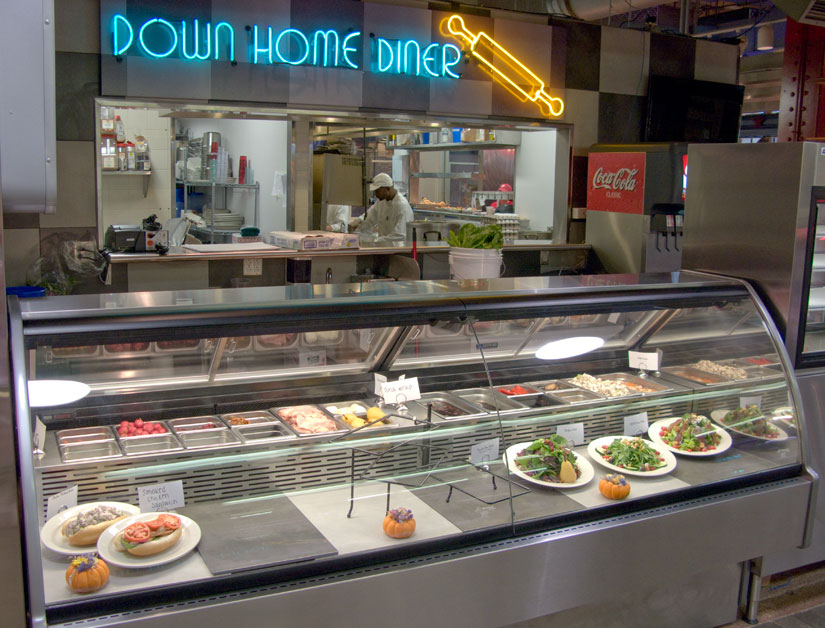
After wearing out my legs strolling through the Philadelphia Flower show late yesterday afternoon and early evening I visited the Down Home Diner for sustenance. There I found this chicken.

It shows on the menu as "Cast Iron Chicken", i.e., pan fried. Since it came to table within five minutes of ordering, no way was it cooked to order. Yet, it tasted as if it had. I don't know how they do it, but somehow Jack McDavid and his staff have found a way to hold the chicken and refresh it so it comes out perfectly.

This is no extra-spicy bird. The skin is delicately thin-crusted, but crisp. And it perfectly manages to hold in the juices. Ever piece -- thigh, drumstick, breast -- was plenty juicy. One strange note: I think of drumsticks as all dark meat, and thighs as half-dark, half-white; but through some fluke of nature, they all appeared white to my eye; maybe it was the lighting.

The accompaniments match the succulence of the bird. The collards had both acid tang and sweetness (lemon juice and raisins?), and the sweet potato fries were among the better examples of these I've had. While the interior of the fries were soft, the exteriors were crunchy (at least until they cooled off; I have them first).

For $8.99, a nice dinner plate. 

The Down Home Diner, on the Filbert Street side of the Reading Terminal Market, is open until 10 p.m. When the market is closed, enter via Filbert Street, a.k.a. Harry Ochs Way.

Wednesday, March 09, 2011

Truth in Advertising


Golden Fish Market's sign makes it clear, if only by implication: it's all farmed salmon right now. Also spied today at Golden, skate at $6.99/pound. Previously, only Wan's Seafood handled skate.

Saturday, March 05, 2011

Down Home Diner Adding Booze

Jack McDavid
Jack McDavid hopes to be serving alcoholic beverages in a few weeks at the Down Home Diner. With his restaurant now open until 10 p.m., that's got to be good for business. Although he won't have a bar serving freshly mixed drinks, do expect wine and and beer along with some bottled mixes.

McDavid reopened a rehabbed Down Home Diner last fall, giving up some seating in return for a larger kitchen and a take-out counter. The take-out business has been growing, though not as fast as McDavid would like. Although much of what he sells at the counter is for bringing back home, he also does a lunch business for those who would prefer to eat in center court (or bring back to the office). Among the items added are cheese steaks, which he has cut by Charles Giunta of Giunta's Prime Shop from top round.

Much of what Jack buys comes from market vendors. You can frequently see him chatting his produce suppliers, Vinnie and Jimmy Iovine. He's also been buying some meat from L. Halteman. And he's used Giunta's brother Martin for sausage since he opened the original Down Home Diner where Amy's Kitchen and La Cucina now stand.
Produce Prices: Yikes!

If it's from California, Arizona or Northern Mexico it's expensive.

Any produce shopper would have difficulty not noticing high prices of fruits and veggies from California and the Southwest.

Lettuce in particular has been hard-hit. Three weeks ago I paid $1 for a head at Iovine Brothers Produce. Today it was $3.99. A trade publication, The Produce News, said production "continues to be hampered" by weather problems": cold, wet and rainy weather in December  combined with more rain and cold temperatures over the past several weeks. Other lettuces and vegetables grown in the area are similarly afflicted.

The price pressure extended to South America: seedless green and black grapes which last week sold for $1.99/pound are now $2.49 and $2.99. Limes, from Mexico, are 99 cents apiece.

Some California crops are only minimally affected by the weather, including strawberries and oranges, though Florida production is more trouble-free and less pricey.
Another Sign of Spring

We're still a few weeks away from ramps, but another sign of spring appeared at one of the fish markets this week. Golden Fish was selling Spanish mackerel for $3.99/pound (the same price as sardines). Odds are they were from North Carolina or thereabout. When Boston mackerel show up, then I'll really know it's spring.

Tuesday, March 01, 2011

Valentine To The Market

Michael Schulson of Sampan was among the local
celebrity chefs demonstrating skills with mystery
ingredients at market party.
An event that's been among the missing for 15 years was renewed Saturday night, the Valentine to the Market gala. About 400 guests attended the festivities, which raised cash for the Reading Terminal Market Preservation Fund.

Tasty tidbits were supplied by many of the market's merchants. Martin's Quality Meats & Sausage doled out juicy portions from a whole roast pig. Tommy DiNic's offered pulled pork with an exceptionally garlicky broccoli rabe. Mini-reubens could be had at Hershel's East Side Deli.

One of my fav offerings came from Iovine Brothers Produce, which put together a beautiful colorful display of produce-based treats. Chef Bobby Fisher, who will handle the kitchen duties when the Iovines reopen the Beer Garden as Molly Molloy's, had a hit with his almond gazpacho; he also made a fruit terrine by gelatinizing prosecco, the slightly sweet bubbly from Italy.

Among the many other vendors supplying tastes were Old City Coffee. Pennsylvania General Store, Beck's Cajun Cafe, Pearl's Oyster Bar, Tootsie's Salad Bar, Bassetts Ice Cream, The Original Turkey, Shanghai Gourmet, Famous 4th Street Cookie, Franks-a-Lot, Tokyo Sushi, and Metropolitan Bakery.

Early in the evening, at the VIP pre-party held in La Cucina, four local chefs, paired with amateur assistants, tried their best to concoct edible food utilizing two mystery ingredients: cocoa puffs and marshmallows. Joe Poon and Delilah Winder took the prices. "Also rans" were Michael Schulson and Daniel Stern.

At the pre-party, Reading Terminal Market General Manager Paul Steinke announced that the new multi-purpose room to be built near center court, will be named after Rick Nichols, who is retiring from his columnist duties at the Philadelphia Inquirer.

Friday, February 25, 2011

RTM Unveils Avenue D Plan 
Work Could Be Complete By Autumn

Making Avenue D as lively and inviting as the other aisles in the Reading Terminal Market is the aim of a $2.7 million design unveiled Thursday. The detailed plans for the aisle which zigs and zags around the back wall and rest rooms in the rear of the market were shown at meetings with market merchants by Paul Steinke, the RTM general manger, and representatives of the designers, Friday Architects/Planners.

The construction could be completed as early as October.

Among the key components:
  • Expansion of Center Court through relocation of Flying Monkey Patisserie;
  • Addition of a multi-purpose area to be used for general public seating and for private meetings, in space currently housing Miscellanea Libri and merchant storage;
  • Relocation of the demonstration kitchen so as to visually become part of center court and serve as an extension of the multi-purpose room;
  • More than doubling the number of stalls in the women's rest room; and
  • Addition of about 1,300 square feet of leaseable space.
Steinke said the expansion of the rest rooms -- the fixture count will also be doubled in the men's room -- was critical given the growth of visitors to the market. Last year about 6.1 million shoppers, tourists and center city workers passed through the market's doors, making it a more popular attraction than the combined attendance of the Liberty Bell and Independence Hall.

The renovated rest rooms, along with two family rest rooms, will be built in space currently occupied by La Cucina and market operational, security and maintenance offices. Steinke said stalls in the women's rest room will increase to 16 from 7. There is frequently a line out the door of the facility, sometimes reaching as far as the shoe shine stand during peak periods.

Current Avenue D (right), redesign at left.
Click on image for enlargement.
If bids come in within budget, a construction manager will be named in early March, with major construction to start by mid-May. A six-month construction schedule is anticipated, which makes completion before the holiday shopping season starts possible if there are no significant delays.

Some work has already been completed: the activation of a new, second freight elevator last week is critical, because much of the existing dry and cold storage on the main floor used by merchants will be moved to a reconfigured basement, increasing the need for reliable basement access. A contractor is already lined up to install the new coolers and build the storage areas in the basement, which also provides an opportunity for merchants to expand their cool and dry storage. That work is expected to start in April.

Because of existing refrigeration equipment, ambient temperatures in the basement are frequently in excess of 80 degrees. A ventilation system is expected to lower the temperature to at least 75 degrees, utilizing the removed warmth in a water-heating system.

The multi-purpose area against the back wall at center court will have moveable glass walls, so that private groups can be accommodated while maintaining a visual openness. Most of the time, according to Steinke, the multi-purpose area would be used for public seating like the rest of center court, but the capability to rent to groups will enhance market income.

When the multi-purpose area is open there will be no net change in the number of seats available to the public. However, when it is rented out there will be a reduction of as much as 60 places. For that reason, some merchants have asked the market to commit to not leasing the multi-purpose room during peak periods like the Flower Show.

The demonstration kitchen, now housed as part of La Cucina, the cooking school business operated by Anna Florio, will be moved adjacent to the new multi-purpose room. She is expected to continue the business at the new location.

Steinke said the relocated kitchen will enhance special events at the market. As an example he cited last year's ice cream festival which, among other attractions, included a demonstration by Georges Perrier making cherries jubilee. The market had to construct a temporary, barely adequate kitchen in center court to handle the demonstration.

Avenue D takes a dog leg in the area adjoining Iovine Brothers Produce and L. Halteman. Originally Avenue D ran straight through the market from Filbert Street to Arch Street. However, the need to build fire stair towers in conjunction with construction of the Pennsylvania Convention Center, whose grand hall and many smaller meeting rooms occupy the space above the market, required the zig-zag. Halteman's will lose some space by the straightening of Avenue D, which would be made up by expanding into some of the space occupied by Market Blooms, which is leaving that space to concentrate on its Avenue A location along the 12th Street side of the market.

Under the plan Avenue D will continue in a straight line from its Filbert Street entrance to the area where the new lavatories will be located. This provides additional space for the multi-purpose room, demonstration kitchen, and new stalls along the north wall. Flying Monkey Patisserie will be moved to existing cold storage space, while the shoe shine stand and Miscellanea Libri will move to north along Avenue D.

Steinke told merchants at Thursday's meetings that they are welcome to submit proposals for the 1,300 square feet of added leaseable space. He said their proposals would be considered on the same basis as those already received from outsiders who wish to become market merchants. He emphasied that in judging the proposals the market would adhere to its guidelines: no chains, no franchises; only owner-operated businesses would be considered. Also, decisions would adhere to the market's goals of limiting Food Court (lunch) vendors to 30 percent of total RTM leaseable space.

The renovation program also includes an expansion of the market's management office space, currently located on a mezzanine. The space would be extended over Tootsie's Salad Bar to accommodate a conference room, which the market currently lacks, and create additional desk space.

The project will be financed by a combination of a low-interest loan from Philadelphia Industrial Development Corporation, bank financing, and the market's existing sinking fund. Proceeds from Saturday Night's "Valentine to the Market" party will also benefit the project.

Friday, February 18, 2011

EBT for Farm To City

Recipients of the SNAP -- the Supplemental Nutrition Assistance Program, which used to be called the Food Stamp program -- will be able to use their Electronic Benefits Transfer cards at Farm to City farmers' markets this summer. FTC's addition of the EBT reader machines follows the Food Trust's implementation of the program at most of its farmers' markets in recent years.

The Reading Terminal Market, which is in discussions with Farm To City's Bob Pierson to acquire the operation, served as conduit for the U.S. Department of Agriculture monies funding the EBT installations, a grant of about $100,000.

The market's proposed acquisition of Farm To City, announced in late summer, stalled late in the year, but Paul Steinke, the market's general manager, says talks have resumed. However, so much time has passed that the RTM has to start its "due diligence" all over again.
Up and Down At The Market

After months of work, a new freight elevator is open for business at the Reading Terminal Market. The elevator, and its older twin, provide access to the basement storage and prep areas of the market.

State inspectors approved the new lift for service on Tuesday. Without the second elevator, merchants were forced to lug their goods from the basement via stairs whenever the older one conked out.

Saturday, February 12, 2011

Ochs, RTM  Squabble Over Lease

As reported by the Philadelphila Inquirer and Daily News, Reading Terminal Market has sued butcher Harry G. Ochs & Sons over back rent. Nick Ochs, who runs the business, told me this morning that the dispute, in his view, is over when he should have started to pay higher rents under the lease he signed in August. Nick is optimistic that the matter will be resolved and he will remain in the market. RTM General Manager Paul Steinke has told one and all that if Nick makes a dent in the back rent, the suit will be withdrawn.

This may be a useful moment to understand how the market establishes rents for its tenants. In essence what the market terms "Purveyors" like Ochs -- vendors who sell meat, fish and produce -- are subsidized by the other merchants, especially the "Food Court" merchants (lunch stalls). I've prepared a separate entry on how this works. You can find it by clicking here or on the "RTM Lease Structure" Pages item in the navigation column.

At least one merchant I spoke with complained that it's not fair if the market doesn't seek to collect full rent, as agreed to in the lease, from Ochs; that means other Purveyors, as well as other vendors, will in essence be subsidizing him.
Another Beer Garden Update

The Iovine brothers still haven't closed their deal to take over the Beer Garden and convert it to Molly Molloy's, an Irish pub. The last big hurdle, according to Jim Iovine, is approval by the LCB of the design. When the deal concludes, the Beer Garden will shut down for reconstruction. Alas, no way they can accomplish all that in time for the Flower Show in early March. A mid-spring opening is probably the best the Iovines can hope for.

The layout of the pub will be considerably different than the Beer Garden's, with the main entrance repositioned to Center Court near Flying Monkey. The bar, which sits in the middle of the space, will be moved to the area where public seating can now be found. There will be a long banquette against the far wall opposite the rear of the L. Halteman butcher shop.
St. Louis in Philadelphia

Pasta By George added cheese steaks and french fries last year, and along with them is a food I associate most with St. Louis: toasted ravioli.

Of course the ravioli is not actually "toasted". It's deep fried. Think fried wonton.

It's not the first St. Louis connection at the market. When I first started shopping there nearly 30 years ago, Salumeria featured some Italian deli meats from Joseph Volpe of that city's "Hill" neighborhood, home to Yogi Berra, Joe Gargiola and the Gateway City's closest approximation of South Philly. You can still buy Volpe product at a number of stores in the area, including DiBruno's. Before the U.S. legalized importation of Italian prociutto, Volpe's was one of the best you could buy; it's still an excellent product with good value.

Another St. Louis-Philadelphia similarity: German buttercake. Not all that surprising considering both cities have long-established German-American communities. But St. Louisans (who call their version Gooey Buttercake) are much more passionate about this baked good than we are. It comes in all sorts of different varieties. If you want to try it locally, take a trip to Haegele's Bakery in the Lower Northeast (Tacony), just two blocks off Frankford at the corner of Erdrick and Barnett.
Yes, We Have No Rotisserie Chickens

For more than a year Charlie Giunta fought Reading Terminal Market management for the right to sell rotisserie chicken at his butcher shop. He went so far as to win a court order last April upholding that right.

Giunta won in the law courts, but lost in the marketplace. His rotisserie machine has been unplugged for a couple months. Basically, Giunta didn't sell enough cooked chicken to justify the space the machine took up, so it's now awaiting pickup by its distributor.

Which is not to say you can't find rotisserie chicken at the market. Dienner's has a wall of it in the Amish section of the market, behind the Dutch Eating Place.

Tuesday, January 25, 2011

Beck's Opens Its Pantry

Beck's Cajun Cafe has gone retail. The Reading Terminal Market eatery is now packaging three different spice rubs and two sandwich spreads.

The rubs come in three varieties:

Angel Dust
, designed for chicken and seafood; Devil Dust, for those who like their meats or veggies a bit spicier; and Rub-A-Dub for grilled red meats and pork.

Proprietor/Chef Bill Beck is also offering Creole Mayo for use as a sandwich spread or dip, and Olive Salad condiment/relish, an essential ingredient in any mufaletta.

The three-ounce rub tins sell for $6.95, or $18 for a set of three. I don't have a price on the spreads.

For those who prefer to eat-in, Beck has a new sandwich on his menu just in time for the Auto Show, which opens Saturday: the Train Wreck Po' Boy. The $7.95 sandwich is loaded with andouille sausage, steak and salami, along with the regular standard lettuce, tomato, pickle and creole mayo fixings. The name of the sandwich doesn't do much for me, since for more than two decades I worked for a railroad and got early morning calls whenever there was a train wreck.

Saturday, January 22, 2011

Chick peas in the pod

And after shelling
Fresh Legumes

I love chick peas, a.k.a. garbanzos or ceci. So when I spied fresh chick peas in the pod at Iovine Brothers today, a grabbed them.

At $5.99/pound they are dear, and the yield of edible bean is only about 65-70 percent of the pod weight. Plus, since there are only one or sometimes two beans to a pod, a bit of work is involved in prepping; it took me nearly a quarter of an hour to shell five ounces of pods, which produced enough beans for one modest portion of 3-3/8 ounces before cooking.

When in doubt, I turn to Mark Bittman for cooking advice, which in this case suggested (for all fresh legumes) bringing the beans to a boil in water to cover, then simmering for 20 minutes before testing for doneness. (I added plenty of salt to the cooking liquid.) I pulled them after about 17 minutes cooking, and they probably could have been pulled two or three minutes earlier. Still, most of the beans retained the meaty mouth feel I associated with garbanzos as well as a fresh, more nuanced version of their characteristic flavor.

The salt in the cooking water, and a grind of black pepper over the drained beans, was a perfect seasoning, though there's no reason why you couldn't treat them like peas with some butter on top. I imagine they'd also do well mashed (a play on the Englishman's mushy peas) or pureed.

All in all this was a delightful vegetal treat to break up the winter root vegetable blahs.
Beer Garden Update

Iovine Brothers' acquisition of The Beer Garden should be completed within a few weeks, at which time reconstruction will begin, according to Jimmy Iovine. He adds that although not assured, he still thinks it is possible to obtain authority to sell beer for consumption in center court and other Reading Terminal Market seating areas. RTM management, however, has expressed concerned such a policy might negate the RTM's attractiveness to families with children.

When the transfer of ownership and licenses are completed, the Iovines will expand the Beer Garden to encompass the current public seating area and add a kitchen. Numerous taps for microbrews is part of the plan.

It's much too late for the work to be done before the auto show later this month, but the Iovines hope to have it all in place by Flower Show, which opens March 6.
Mid-Winter Catch-Up

It's been two months since my last report, due to some family health issues (well on their way to a successful outcome), holiday hectic-ness and my own laziness. I'll try to make up for it with this and subsequent reports.

Terre Madre Festival


On December 10 the RTM held its inaugural Terre Madre Day, named after the huge, artisinal food celebration/convention held every other year in Turin, Italy. Since Paul Steinke, the market's general manager, attended last fall's event in Italy, he brought a bit of it backby organizing a day to show off local foods here.

In the photo, food author Aliza Green, ably assisted by Betty Kaplan, cook up some flank steak from local beef for tasters, while Mike Holahan of Pennsylvania General Store passed out some of Uncle Jerry's Pretzels. Among the other participants: Bee Natural, Blue Mountain Vineyards, Metropolitan Bakery, Birch Run Hills Farm, Earth Bread + Brewing, and Cope’s Dried Corn.

Sunday, November 21, 2010

Yoder, Culton Join Forces

Matt Yoder, who after a couple seasons at the the Headhouse Square market tried Maine last season, is back in Pennsylvania. Starting next season he'll be growing alongside Tom Culton and they'll be marketing their products together, both at farmers' markets and to the trade. I particularly liked Matt's cowbeans (black eyed peas) which he sold fresh, not dried; made a tasty succotash with fresh corn in late summer.

Matt was at the market today (that's him in the plaid shirt in the top photo) helping Tom (far left) sell winter squash, black walnuts, various cauliflowers (including romanesco), beets, jerusalem artichokes and salsify.

Culton had plenty of exceedingly large winter squash, just in time for Thanksgiving, like the über squash in the photo on the right. He also had gigantic beets, pictured below with salsify that is much thicker than what I've seen before. The big beets are known as Mangle beets, and predominantly used for animal feed. But no reason why you can't eat them. Because of their size, I'd think they'd be great for grating and turning into rosti, which is basically latke made form beets. Instead, I purchased smaller cylindrical beets from Tom, which I'll compose into a salad with his shelled black walnuts (I tasted a few when I got home and they have a deep, walnut flavor) and some chevre from Patches of Star; I'll make a vinaigrette with some raspberry shrub to dress it.

Headhouse Thrives In Late Autumn

About 20 vendors are expected to continue to sell at the Headhouse Square Farmers' Market on Sundays until Christmas, according to Katie Wich, who manages the market for the Food Trust.

Vendors expected through the fall include Young's Garden for plants and flowers, Wildflour bakery, Joe's Coffee and Market Canele, Birchrun Hills Farm cheeses and meats, Talula's Table for charcuterie, Mountain View poultry and dairy, Patches of Star goat dairy products, Queens Farm produce, Three Springs Fruit Farm orchard fruit, Savoie produce, Rics Bread, Garces Trading Company, Blooming Glen Farm produce, Weavers Way produce, Culton Organics produce, John & Kira Chocolates, Beechwood Orchards, Love Bar, Taco de Pueblo Mexican food, Renaissance Sausage food truck, North Star Orchards (tree fruit and other produce), Margerum's (produce, preserves). 

Griggstown Quail Farm was at the market today, but it might be their last showing until next year. In the meantime, many of their products are available at the Fair Food Farmstand at the Reading Terminal Market.

Wednesday, November 17, 2010


Collards

Here's that pile of Maryland collard greens piled high at Iovine Brothers Produce, Reading Terminal Market. 99-cents  pound.

Saturday, November 13, 2010

Some Pa. Dutch Add Days at Market

A few of the Pennsylvania Dutch merchants at the Reading Terminal Market have increased the number of days they are at the market beyond the Wednesday-to-Saturday schedule that seems to have gone on forever.

It started with Moses Smucker proprietor of Smuckers Quality Meats and The Grill at Smuckers, who opens on Tuesdays. More recently, Hatville Deli and L. Halteman have added Tuesday hours. Roger Miller, proprietor of Miller's Twist, plans to go to a Monday-Saturday operation starting Jan. 3, although he won't be open for breakfast on the additional days.

Miller said the forthcoming opening of the Convention Center expansion prompted him to expand the schedule.

Smucker's move to Tuesday demonstrated to other Mennonite merchants that there are profits to be reaped on that day of the week.

Paul Steinke, the RTM's general manager, said he's been told that another reason is the desire on the part of at least one Amish merchant to provide additional employment opportunity for his community, which has felt the recession just like the rest of us.

Could this be a start of a new trend, as a younger generation of Pennsylvania Dutch merchants make their presence felt at the market?
Take-away at the Diner
 Cheese Steaks, Too


With his recent rehab of the Down Home Diner, Jack McDavid may have cut back slightly on his seating. But he probably created more business opportunity by carving out a take-away counter along the Reading Terminal Market's "Second Street" aisle.

In addition to sandwiches, salads and everything else on the diner's menu, McDavid added cheese steak to his offerings. I tried it last Monday. Although a disappointment, it shows potential, so I'll try it again in a few weeks.

The meat was quite different from the standard rib eye most steakeries serve. Although I didn't ask, it appeared to be a flank steak, which is all to the good. Unfortunately, it was considerably overcooked to the point of dryness. But the meat had excellent flavor, with a lot more beefiness than other cheese steaks I've consumed.

It's got the potential to be right up their with my favorite steak sandwich. That was at Syd's, now closed, in Union, N.J. It didn't pretend to be a Philly cheese steak. As I recall, it was skirt steak char broiled and served with garlic-infused cooked onions on an Italian roll with a bit more crusty bite than the typical hoagie roll. Basically, it was a Jewish Romanian steak on a bun.
Guacamole Season


I know we're in the heart of the gridiron season when Iovine Brothers' Produce features good prices on both limes and avocados. The avocados come from the Dominican Republic, the limes from Mexico.

Iovine's manager Charlie Gangloff was marvelling at the amount of collard greens they sell. During the week before and week of Thanksgiving last year they sold 90 cases, at 20-25 pounds per case. And that's not even counting the kale or mustard green. The collards mostly come from Richardson's Farm in Maryland, located about 15 miles northeast of Baltimore, and Gangloff said greens buyers love them because the stems are relatively small.

Iovine's also reports that California produce is becoming pricier; Charlie isn't sure they'll be able to hold the $1.99/pound price on green beans, a Turkey Day fav. He suggests considering asparagus. The produce guy was also gushing about the excellence of the honeydew melons; the canteloupes are good, too, he said, but very pricey. So the pre-mixed fruit containers sold in Iovine's refrigerator case is low in lopes, high in dews.

Wednesday, November 10, 2010

Irish Pub for Iovine's at Terminal

An Irish pub in the Reading Terminal Market? Owned by two guys whose names end in vowels?

Sure, why not? Especially when they're half-Irish.

Jim and Vin Iovine, proprietors of Iovine Brothers Produce, plan to take over the Beer Garden from Anthony Novelli, now in his early 80s, once their license comes through. They'll use their mom's maiden name for the establishment: Molly Molloy's. (Not Molly Maguire's, as reported by Michael Klein.)

They are particularly looking forward to obtaining a variance which will allow you buy beer and then carry it off to Center Court to enjoy with your lunch or snack from any of the market vendors. Right now. consumption is limited to "on premises," which means within the confines of the Beer Garden.

Jim Iovine said they plan a 20-tap bar featuring craft beers, as well as a big bottle selection. Under Novelli, the Beer Garden has pretty much stuck to the products of the big brewers. (And don't tell me Boston Brewing, i.e., Sam Adams, is not a big brewer; Boston is now the largest brewery in the U.S. under domestic ownership.) They'll have a full liquor license, so it won't be just beer. An expert mixlogist will be on staff for the cocktail-inclined, and the wine selection will be upgraded.

Getting the variance to allow consumption of beer elsewhere in the Reading Terminal Market is worth more to them than being open late into the evening, which isn't in the cards. Jim figures he can sell a lot more beer that way than through extended hours. Especially during Flower Show week when horticulturally-handicapped hubbies head to the terminal for a gustatory respite.

Iovine said while they would like to be open when the auto show opens in late January, early February may be a more realistic timeframe.

And although you'll be able to take your beer to Center Court if all goes as planned, the Iovines hope to entice you to stay with a new kitchen, under the culinary guidance of Bobby Fisher who cooked for the Iovines when they provided the food service at the Bala Golf Club.

Even with the addition of a kitchen, the Beer Garden will feature additional seating. The RTM has granted them permission to expand by taking over what is now public seating space behind the Beer Garden. The expansion will complement the market's redesign of Avenue D to provide modernized and expanded rest rooms as well as additional leaseable space.

Tuesday, October 26, 2010

Whoopie!

Elizabeth Halen, the new proprietor of Flying Monkey Patisserie at the Reading Terminal Market, has been getting plenty of ink (and electronic coverage) with her Pumpple Cake, including Monday on the fourth hour of the Today Show. The combination of pumpkin cake and appie pie sells for $8 a slice (though one slice can serve three).

A bit more manageable are Elizabeth's pumpkin Whoopie pies. It's a simple treat: buttercream filling in a hamburger-sized pumpkin cake bun. The cake is gently spiced and the buttercream rich but not overwhelming. At $2.50 apiece, a delightful splurge. And a tad less caloric than Elizabeth's Pumple Cake or Elvis Cake (banana-flavored butter cake, chocolate chips, peanut butter buttercream).

I saw lots of chocolate Whoopie pies during my recent trip to Maine where they are as much a part of the culinary landscape as lobsters.

Saturday, October 23, 2010

What were they thinking?

Go to the Reading Terminal Market's website and you'll find the market's logo proclaiming "Fresh & Local Every Day". The same phrase appears in many of the market's promotions and advertisements as it positions itself as the region's premier source of local foods.

So what was the market thinking allowing agro-industry giant General Mills to promote its Green Giant line of frozen produce at today's Harvest Festival? Green Giant even emblazoned its stall with the catchphrase "As Nutritious As Fresh!" (photo) directly across the hay-strewn asphalt of Harry Ochs Way (Filbert Street) from Iovine Brothers Produce's Harvest Festival display.

The RTM's general manager, Paul Steinke, was not available to provide an explanation. He was in Milan participating in this year's Terra Madre, the annual international event dedicated to local, fresh, sustainable artisinal foods sponsored by Slow Food International. That explanatory task was left to Sarah Levitsky, the RTM's marketing coordinator.

Basically, it was for the money. The Green Giant division approached the market looking for an opportunity to do an educational promotion extolling the nutritional value of its frozen vegetables. Although Levitsky didn't volunteer the dollar value she indicated that the fee helped underwrite the market's costs in staging the festival.

Now, I don't question the value and nutrition of frozen vegetables. Petite peas, for example, are a staple in my freezer. (BTW, canned petite peas were one of Green Giant's big hits in the early 20th century, when it was still the independent Minnesota Valley Canning Company based in LeSeur, Minnesota. The company was acquired by Pillsbury in 1979, which itself was gobbled up by General Mills in 2001.)

But if the market is going to promote itself as the year-round source of "Fresh & Local" foods, succumbing to General Mills' cash was regrettable. Especially so in light of the market's proposed acquisition of Farm to City, one of the region's major sponsors of farmers' markets.

One can't help but wonder what Fair Food, Iovine Brothers, O.K. Lee, L. Halteman Family, or Kauffman's Lancaster County Produce (all of which sell local produce) thought of the promotion. Even if they gave their assent, it just had to be grudgingly.

Urban Farmers

With Charlie Gangloff at the wheel and Billy Moehollen on bullhorn, visitors take a tour de marché during today's Harvest Festival at the Reading Terminal Market.

The hayrides around the block were arranged by Iovine Brother's Produce (Charlie and Billy are both managers there) using a spare Ford-New Holland tractor from Shady Brook Farm in Bucks County, one of Iovine's contract suppliers of local produce.

Harry Ochs Way, a.k.a. Filbert Street, was closed off to street traffic and spread with hay. At least half a dozen RTM merchants set up outdoor shop for the day. I sampled cinnamon doughnuts hot from the fryer featured at Bieler's stand. I left too early to get some meat off Jack McDavid's Down Home Diner portable barbeque truck. One of the funniest offerings was the "Harvest Platter" offered by one of the Chinese food vendors: skewered chicken, rice? Delicious, I'm sure, but not one of the first foods I conjure up when thinking "harvest" with hay at my feet.


Cactus Pears

O.K. Lee had some gorgeous cactus pears today at a bargain two for a buck. I've used them for sorbet, and also in margaritas, though I'd imagine they would work in other cocktails, including mojitos. The color of the juice is intense, making any beverage made from it a great showpiece. Four fruits should yield about a cup of juice.

You can find an illustrated guide to peeling and prepping these beauties (not at all hard) here.

Quick thought for another use: make a sugar syrup with it and drizzle atop vanilla ice cream.

Sunday, October 17, 2010


A Brief Vacation

Nothing demarcates the seasons quite as much travelling afar and returning home.

After a sojourn to the rocky coast of Down East Maine for much of the first half of October, I returned to Philadelphia this past week. At both the Reading Terminal Market Friday and the Headhouse Square farmers' market today I was innundated by the foods (and colors, like those of Margerum's preserves at Headhouse) or fall produce. Herewith, some photos and thoughts.

Brassicas, Brassicas, Brassicas

Autumn is prime time for cruciferious vegetables, which get their name from a resemblance, somewhere in their visible anatomical structure, to a cross. Most of the cruciferous veggies we see in the markets are brassicas (the few that aren't brassicas include wasabi, horseradish, radishes, arugula and the various cresses).


Broccoli and cauliflower, whatever the color, as well as the pointy romanesco, are all variations of brassica oleracea. These specimens were found at Benuel Kauffman's Lancaster County Produce at the Reading Terminal Market Friday.


Kale and collards (though not the chard in the foreground) are also cruciferous veggies. These could be purchased today at the North Star stall at the Headhouse market.


Cabbages galore at Iovine Brother's Produce Friday at the RTM. The plain green cabbage, at left, was selling for 50 cents a pound while the red and savoy were priced at 69 cents. All were from local farms in South Jersey.

Peppers Are Better In October


I think of peppers as a summer vegetable, even if they are, like tomatoes, technically fruits. Yet, the peppers I've tasted both in Maine and since returning are sweeter and more flavorful than those I sampled in August and September. Maybe it's those extra days in the sun.  The green frying peppers (left) and red varities pictured above at Iovine's all hail from South Jersey farms.


These peppers (as well as eggplants and tomatoes) filled the Three Springs Fruit Farm stall at Headhouse, along with lots of apples. Farmer Ben Wenk thinks the cooler weather of fall may cut down on the rate of water absorption by produce, making them sweeter ans more intense. He thinks its definitely true of the peaches, and probably for the eggplant and peppers as well.

That may have been the reason why the plum tomatoes I purchased at the Bar Harbor farmers' market two weeks were the best I've had all year: the naturally cooler climate of Maine coupled with long days of sun. Those tomatoes made the best pasta sauce I've prepared all season long.

Roots: Beets and Carrots


Weaver's Way, with some floral help, provided a colorful display of carrots and beets today at Headhouse. The carrots I bought at Bar Harbor also seemed particularly sweet and flavorful, again, perhaps due to the cooler climate and longer days of sunlight in more northerly climes.

Another Fall Veggie Standout


Blooming Glen Farm displayed these tender stalks of flavorful today, and I was quick up a bunch, both for the leaves and the ribs. I can't think of making tuna salad without copious amount of finely diced celery rib with added leaves. But tonight I may braise some stalks to accompany grilled chicken. Celery is a vegetable we don't usually think of cooking with, other than in soups or stews, but it's superb as a standalone side dish.

Quince: The Original Marmalade


The things you learn on Wikipedia! Quince (here displayed in the case at Beechwood Orchard's stall at Headhouse) is called Marmelo in Portoguese, hence, the jam made from it was called marmalade. Quince is a great addition to apple pies, providing even more pectin as well as a slightly different type of tartness. Quince marmalade is a traditional accompaniment to sharp cheeses.