New Avocado Source
A month or so ago, Chilean avocados appeared at Iovine Brothers Produce at the Reading Terminal Market. Today the $1 apiece fruits hailed from the Dominican Republican, which I had not seen before.
We seem to be in an interregnum as far as table grapes are concerned. All the varieties I looked at recently have been priced at $2.99/pound. We may not see significantly cheaper grapes until the Chilean harvest starts in late winter.
I picked up some nice, heavy-for-their-size navel oranges today, three for a buck. Not a bad price, but they should come down a bit as we get into winter.
Smoked Haddock
I started to use the smoked haddock I picked up a few weeks ago at Wegman's in Cherry Hill. I took about five or six ounces out of the one-pound filet and mashed them up with an equal amount of cream cheese (softened with about a tablespoon of sour cream), ground in some black pepper, and finished with a couple tablespoons of both onion and parsley. Very yummy on good rye bread.
Speaking of sour cream, I bought some at Fair Food. Although "all natural" it was full of vegetable gums, for no apparent reason. The Dairylead brand, available at some supermarkets, is made from nothing but cream. It may not be organic, but it's good.
One of my readers reports that he tried to find the smoked haddock, a.k.a. finnan haddie, at Wegman's, but they were all out. If you find it, don't pass it by.

Thursday, December 03, 2009


Sunday, November 22, 2009
Newtown Pippins
Dave Garretson of Beechwood Orchards, who sells at the Headhouse Square Farmers' Market, loves his apples, and this week he had one of the best, the Newtown Pippin.
This variety probably originated in the early 18th century in what is now the Elmhurst area of Queens, New York. (Take the Brooklyn-Queens Expressway and you'll cross Newtown Creek). It was beloved by Thomas Jefferson, Benjamin Franklin, and Queen Victoria.
The Newtown Pippin (unlike my favorite, the Cox Orange Pippin) is one of the great storage apples, which only gets better with age: I plan to delay the gratification of eating them until February, by which time their sugars will be fully formed and balance the tart, piney, citrusy, nutty flavor of this American classic; kept in cold storage with adequate air circulation (a perforated bag in your refrigerator's crisper), they'll probably keep until spring. Eat them now and you'll only get a glimmer of their complexity.
Today it's rare to find Newtown Pippins in the fresh market. Most are turned into juice, thanks to its clear, flavorful nature. If you've enjoyed Martinelli's sparking cider. you've consumed Newtown Pippins. Martinelli's purchases, at above market prices, have prevented the California plantings of Newtown Pippins from being uprooted in favor of other crops.
This revered variety was pushed out of the fresh market over the last 20 years by the Granny Smith, which offers only a hint of the wonders of the Newtown Pippin, but is more visually appealing than the frequently lopsided antique apple, whose countenance can appear marred because of natural russetting near the stem end.
In addition to California, the Newtown Pippin was a favored variety in tidewater Virginia, where the parochials renamed it the Albemarle Pippin, not wanting to keep the Yankee name. It was a major export item to England until the early 20th century when tariffs decimated that market.
Although the Newtown Pippin works well in pies, as well as apple sauce, it's highest uses are for cider and as a dessert (fresh eating) apple
Dave Garretson of Beechwood Orchards, who sells at the Headhouse Square Farmers' Market, loves his apples, and this week he had one of the best, the Newtown Pippin.
This variety probably originated in the early 18th century in what is now the Elmhurst area of Queens, New York. (Take the Brooklyn-Queens Expressway and you'll cross Newtown Creek). It was beloved by Thomas Jefferson, Benjamin Franklin, and Queen Victoria.
The Newtown Pippin (unlike my favorite, the Cox Orange Pippin) is one of the great storage apples, which only gets better with age: I plan to delay the gratification of eating them until February, by which time their sugars will be fully formed and balance the tart, piney, citrusy, nutty flavor of this American classic; kept in cold storage with adequate air circulation (a perforated bag in your refrigerator's crisper), they'll probably keep until spring. Eat them now and you'll only get a glimmer of their complexity.
Today it's rare to find Newtown Pippins in the fresh market. Most are turned into juice, thanks to its clear, flavorful nature. If you've enjoyed Martinelli's sparking cider. you've consumed Newtown Pippins. Martinelli's purchases, at above market prices, have prevented the California plantings of Newtown Pippins from being uprooted in favor of other crops.
This revered variety was pushed out of the fresh market over the last 20 years by the Granny Smith, which offers only a hint of the wonders of the Newtown Pippin, but is more visually appealing than the frequently lopsided antique apple, whose countenance can appear marred because of natural russetting near the stem end.
In addition to California, the Newtown Pippin was a favored variety in tidewater Virginia, where the parochials renamed it the Albemarle Pippin, not wanting to keep the Yankee name. It was a major export item to England until the early 20th century when tariffs decimated that market.
Although the Newtown Pippin works well in pies, as well as apple sauce, it's highest uses are for cider and as a dessert (fresh eating) apple
Saturday, November 21, 2009
 Side Dish Bargains
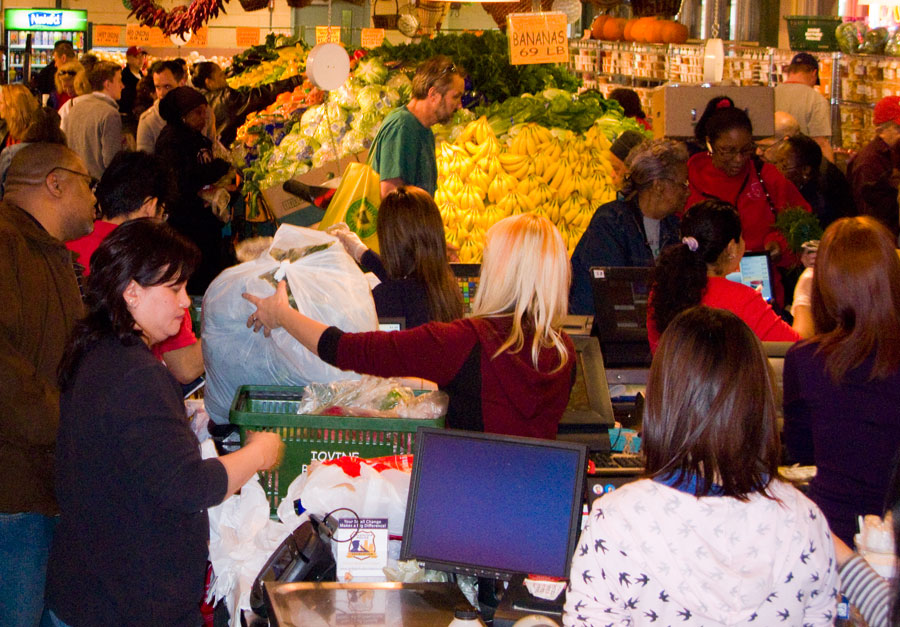
The aisles were crowded at Iovine Brother's Produce at the Reading Terminal Market this morning as shoppers sought veggies for their Thanksgiving tables. Once you managed to fight your way through the aisles, however, checkout was a snap: Jimmy and Vinnie Iovine rigged up a couple of additional registers, so there were an even dozen cashiers working.
Once reason for the crowds might have been the prices. White utility and Idaho potatoes, in five-pound bags, would set you back only $1.99. A 10-pound bag of non-Idaho russets were an even better deal, $2.99. Red potatoes were a relatively pricey, but still thrifty, $2.99 for a five-pound bag.
Onions were a good deal, too, at a buck for a two-pound bag (red or yellow). Three-pound bags of carrots were selling for two for $3. The green beans for your classic canned fried onion-topped casserole, however, were $1.99/pound, about twice as much as you'd pay at peak season. If you like some bay leaf in your stuffing, tray packs of fresh leaves were $1.99.
Among the non-Thanksgiving produce, limes have tripled in price, to 3 for $1. Hass avocados were two for $1.49.
June in November
When winter arrives, I'm a big fan of frozen fruit, particularly berries. Nothing like some tasty, sweet and tart blackberries to mash up with a full-fat yogurt for breakfast.
With its recent expansion the Fair Food Farmstand at the Reading Terminal Market has more room in its freezers, so it's added another fruit to its small frozen selection: strawberry puree. The one-pound packs from Green Meadow Farm, a delicious looking red, are priced at $5. I haven't tried them yet, but I can't imagine theyd be anything but excellent.
Another summer fruit you can enjoy in winter are peaches. Canned peaches from Three Springs Fruit Farm (one of the vendors at Headhouse) can also be found at Fair Food; I went through a few cans last winter and thoroughly enjoyed them.
When winter arrives, I'm a big fan of frozen fruit, particularly berries. Nothing like some tasty, sweet and tart blackberries to mash up with a full-fat yogurt for breakfast.
With its recent expansion the Fair Food Farmstand at the Reading Terminal Market has more room in its freezers, so it's added another fruit to its small frozen selection: strawberry puree. The one-pound packs from Green Meadow Farm, a delicious looking red, are priced at $5. I haven't tried them yet, but I can't imagine theyd be anything but excellent.
Another summer fruit you can enjoy in winter are peaches. Canned peaches from Three Springs Fruit Farm (one of the vendors at Headhouse) can also be found at Fair Food; I went through a few cans last winter and thoroughly enjoyed them.
Wednesday, November 18, 2009
Bookmark This!
Here's a description of my favorite public market that got me chuckling:
Here's a description of my favorite public market that got me chuckling:
Then I went to the Reading Terminal Market, which sounds like a sale room for old books...It comes from the blog of St. Clements Church, 20th and Cherry.
Pre-Bird Farmers' Markets
Six of The Food Trust farmers' markets will be open the day before Thanksgiving, Wednesday, Nov. 25.
Six of The Food Trust farmers' markets will be open the day before Thanksgiving, Wednesday, Nov. 25.
- Broad & South, 1 p.m. to 6 p.m.
- Clark Park, 43d and Baltimore, 10 a.m. to 4 p.m. or until vendors sell out
- Cliveden, Chew Avenue and Johnson Street, 2 p.m. to 6 p.m.
- Fairmount, 22nd Street and Fairmount, 10 a.m. to 4 p.m. or until vendors sell out
- Haddington, 52d and Haverford, 1 p.m. to 5 p.m.
- Headhouse, 10 a.m. to 4 p.m. or until vendors sell out
Tuesday, November 17, 2009
Finnan Haddie
Besides whisky, one of the Scots' great contributions to good eating is finan haddie, a.k.a. smoked haddock. Today I found some tasty examples at the Cherry Hill Wegman's, $8.99/pound for tray-packed fillets. The light smoking gives these small sides of haddock a long shelf-life; the pack I bought has a pull date of December 31.
In conversation with the knowledgeable fish manager at Wegman's, I learned these babies came from a Massachusetts supplier (New Bedford, iirc). He opened a pack so we could taste some. Haddock is a fish that needs to be lightly smoked, and the sample I tried was done right. The flesh was very firm, the pellicle lightly-colored and thin. It was smoked not quite as much as one of the classic Scottish varieties, Arbroath Smokies, but I don't find that a negative.
How to use the smoked haddock?
Since I'm fond of fish soups, Cullen Skink is one possibility. This classic Scottish milk-based chowder relies on mashed potato as its thickener, otherwise it's not at all that different from a classic New England fish chowder (done with milk, not thickened absurdly so a spoon can stand in it, as many fish house versions would have you believe).
I could also do fish on a shingle, i.e., prepare it the same way you could creamed chipped beef and serve over toast or home fries. Now that's a breakfast of champions!
Most likely I'll make a spread, mashing up the fillet with cream cheese, adding some onion, parsley and fresh ground pepper.
Sitting in the Wegman's refrigerator case next to the smoked haddock were packs of dressed and headless kippered herring. Another possibility for a champions' breakfast when served along scrambled eggs. Think of kippers as the bacon of the sea.
Besides whisky, one of the Scots' great contributions to good eating is finan haddie, a.k.a. smoked haddock. Today I found some tasty examples at the Cherry Hill Wegman's, $8.99/pound for tray-packed fillets. The light smoking gives these small sides of haddock a long shelf-life; the pack I bought has a pull date of December 31.
In conversation with the knowledgeable fish manager at Wegman's, I learned these babies came from a Massachusetts supplier (New Bedford, iirc). He opened a pack so we could taste some. Haddock is a fish that needs to be lightly smoked, and the sample I tried was done right. The flesh was very firm, the pellicle lightly-colored and thin. It was smoked not quite as much as one of the classic Scottish varieties, Arbroath Smokies, but I don't find that a negative.
How to use the smoked haddock?
Since I'm fond of fish soups, Cullen Skink is one possibility. This classic Scottish milk-based chowder relies on mashed potato as its thickener, otherwise it's not at all that different from a classic New England fish chowder (done with milk, not thickened absurdly so a spoon can stand in it, as many fish house versions would have you believe).
I could also do fish on a shingle, i.e., prepare it the same way you could creamed chipped beef and serve over toast or home fries. Now that's a breakfast of champions!
Most likely I'll make a spread, mashing up the fillet with cream cheese, adding some onion, parsley and fresh ground pepper.
Sitting in the Wegman's refrigerator case next to the smoked haddock were packs of dressed and headless kippered herring. Another possibility for a champions' breakfast when served along scrambled eggs. Think of kippers as the bacon of the sea.
Monday, November 16, 2009
Chateau de Philadelphia?
Almost. Anywhere there's an Italian community you are going to find winemakers. The grapes might not be local, but the talented winemakers are.
One of the most talented is Ralph Cipriano who won Best in Show honors at Philadelphia's Vendemmia festival. Ralph tells his wine-making journey in a new book, Garagista: A Home Winemaking Journal. The illustrated book wine chronicles the seasonal joys and labors of a Garagista (someone who makes wine in their garage).
The book starts with the Sunday dinner table at his grandparents' home, and ends with a recipe for a barrel of Zinfandel. And it's very good Zin. Or, as I call it, "Ralph's Pretty Good Wine".
Ralph Cipriano has been a reporter for more than 30 years, writing for the Philadelphia Inquirer, Los Angeles Times, and Philadelphia magazine, and is also the author of Courtroom Cowboy. His interest in homemade wine began while covering South Philadelphia as a reporter for the Inquirer. He’s made his own wine since 1992, turning it into a family enterprise that includes his wife and two sons. Ralph also competes in the annual winemaking competition at Philadelphia’s Vendemmia festival. This book details his journey from novice to Best of Show.
He'll be autographing copies this Saturday from 11 a.m. to 2 p.m. at Fante's in the Ninth Street Market. If you can't make it, you can pre-order a copy ($12.95) at Fante's web site. When you place the order on-line you can specify a dedication for the author to write into your copy.
Almost. Anywhere there's an Italian community you are going to find winemakers. The grapes might not be local, but the talented winemakers are.
One of the most talented is Ralph Cipriano who won Best in Show honors at Philadelphia's Vendemmia festival. Ralph tells his wine-making journey in a new book, Garagista: A Home Winemaking Journal. The illustrated book wine chronicles the seasonal joys and labors of a Garagista (someone who makes wine in their garage).
The book starts with the Sunday dinner table at his grandparents' home, and ends with a recipe for a barrel of Zinfandel. And it's very good Zin. Or, as I call it, "Ralph's Pretty Good Wine".
Ralph Cipriano has been a reporter for more than 30 years, writing for the Philadelphia Inquirer, Los Angeles Times, and Philadelphia magazine, and is also the author of Courtroom Cowboy. His interest in homemade wine began while covering South Philadelphia as a reporter for the Inquirer. He’s made his own wine since 1992, turning it into a family enterprise that includes his wife and two sons. Ralph also competes in the annual winemaking competition at Philadelphia’s Vendemmia festival. This book details his journey from novice to Best of Show.
He'll be autographing copies this Saturday from 11 a.m. to 2 p.m. at Fante's in the Ninth Street Market. If you can't make it, you can pre-order a copy ($12.95) at Fante's web site. When you place the order on-line you can specify a dedication for the author to write into your copy.
Sunday, November 15, 2009
 Beechwood Apple Pricing
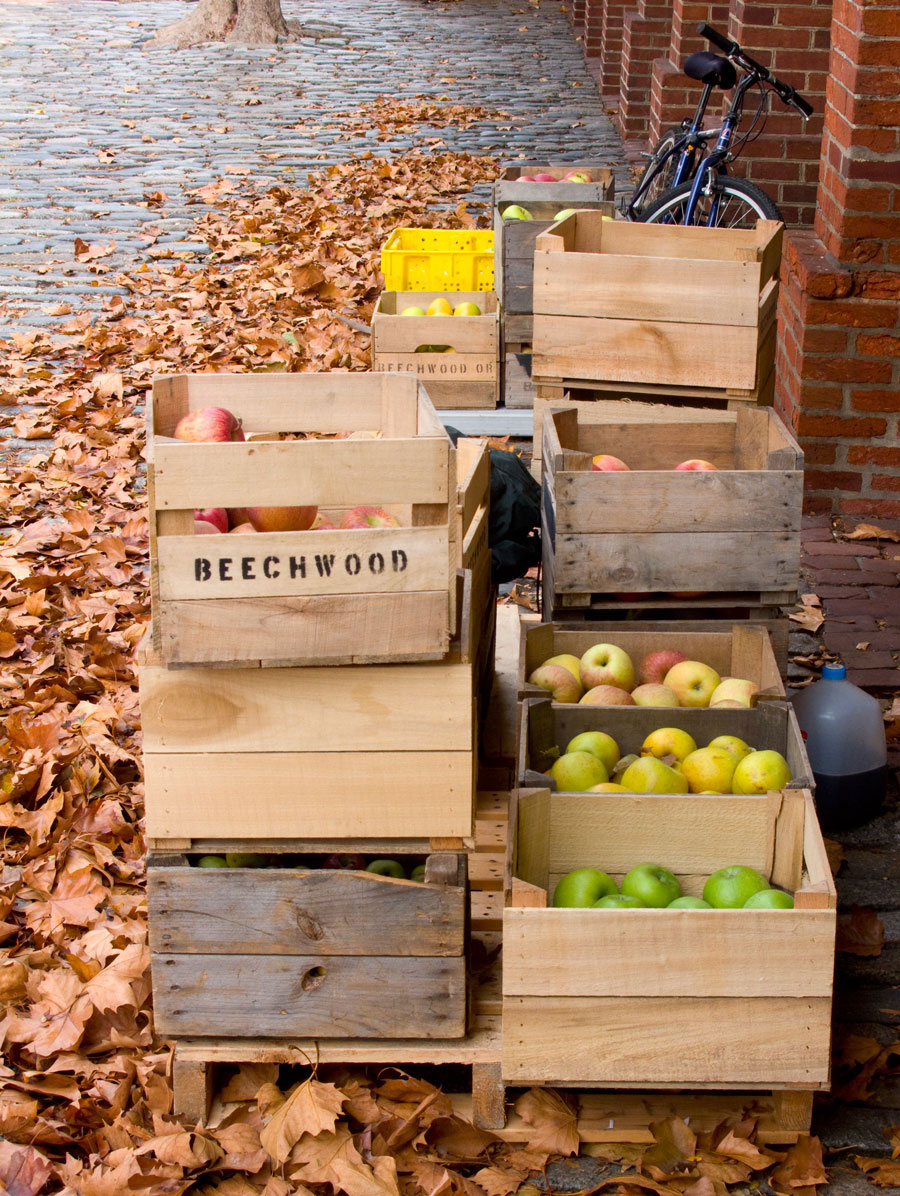
Dave Garretson of Beechwood Orchard, who sells at Headhouse Square, has changed his pricing system. Until this week, he priced his fruit by the pint or quart. It was always good value, but you had to take it home and weigh it out to get a good comparison with other vendors.
Starting today he switched to strict by-the-pound pricing. His apples were $2/pound, pretty much in line with other vendors.
And he's still got Cox Orange Pippins.
Dave's only fear is that he's going to have to restrain himself when picky customers threaten to bruise the fruit next peach season.
Quality Onions
The black dirt farm country of Orange County, New York, is ideal for growing onions. And Iovine Brothers Produce has them at the Reading Terminal Market. Yesterday Iovine's was selling two-pound bags of either yellow or red onions from that growing area for $1 a bag.
Also spied at Iovine's: Chilean avocados, two for $1.49; Brussels sprouts stalks, $1.99; red bell peppers, $1.49, which was less expensive than the green, orange or yellow bells, all $1.99; limes continued to be obtainable at a dime apiece.
Brussels sprouts stalks (they called them "trees" at Iovines) were available from some of the other farm vendors: $7.50 at Fair Food, $4.95-$5.95 at Earl Livengood's.
Fair Food featured what might be the last of the seasons local tomatoes, pints of organic cherry tomatoes for $4.50. The poblano peppers, $4.50/pound, looked good.
At Kauffman's Lancaster County Produce celery stalks were $1.99 ($2.49 for hearts). Livengood's celery and celeriac were both priced at $3.95/pound.
The black dirt farm country of Orange County, New York, is ideal for growing onions. And Iovine Brothers Produce has them at the Reading Terminal Market. Yesterday Iovine's was selling two-pound bags of either yellow or red onions from that growing area for $1 a bag.
Also spied at Iovine's: Chilean avocados, two for $1.49; Brussels sprouts stalks, $1.99; red bell peppers, $1.49, which was less expensive than the green, orange or yellow bells, all $1.99; limes continued to be obtainable at a dime apiece.
Brussels sprouts stalks (they called them "trees" at Iovines) were available from some of the other farm vendors: $7.50 at Fair Food, $4.95-$5.95 at Earl Livengood's.
Fair Food featured what might be the last of the seasons local tomatoes, pints of organic cherry tomatoes for $4.50. The poblano peppers, $4.50/pound, looked good.
At Kauffman's Lancaster County Produce celery stalks were $1.99 ($2.49 for hearts). Livengood's celery and celeriac were both priced at $3.95/pound.
Forgotten Foods Remembered
Yesterday's Forgotten Foods Festival at the Reading Terminal Market opened my eyes, and tastebuds, to some old-time flavors of Philadelphia and envir0ns. By the time I left the market shortly after 11 a.m. (the festival began an hour earlier), center court was crowded with regular shoppers, the normal passel of tourists, foodies drawn by the festival, and early Christmas shoppers attracted by the Philadelphia Museum of Art's annual crafts show across the street at the Convention Center.
A particular revelation to me was the Cape May Salts, an oyster brought back from oblivion a few years ago by Atlantic Cape Fisheries, a Cape May-based company. Once upon a time the Delaware Bay was teeming with oysters, hence the proliferation in the late 19th and early 20th centurys of oyster houses in Philadelphia, once as common as today's pizza parlors, according to Atlantic Cape. In the 1950s, disease wiped out the commercial oyster industry in Delaware Bay. It took the development of disease-resistant oysters by Rutgers University and Atlantic Capes to reestablish the commercial oyster in Delaware Bay. (The Cape Mays were dispensed by the Fair Food Farmstand's Forgotten Foods stall.)
Oysters from New England, the Northeast and Mid-Atlantic are traditionally briny, but the Cape May Salts deserve their adjectival moniker more than most. The salt flavor is pronounced and delicious; these would be perfectly accompanied by a local lager, say Yuenglings or Yards.
Oysters also appeared in one of the offerings from Pearl's Oyster Bar. I've haven't eaten at Pearl's recently because previous times I'd eaten there I was disappointed: the snapper soup was way too gloppy, and the breading on the fried seafood way too doughy. That wasn't the case with what I sampled yesterday. The large, Chesapeake-style oysters in the Oyster and Chicken Salad sample was more modestly breaded and perfectly fried, the chopped chicken bound with as little mayonnaise as possible. Put them together and you've got a ying-yang food with much appeal. The little sample of Snapper Soup also was unlike what I tried previously. It might have had some corn starch to give it body, but not much. Based on these two items I'm going to give Pearl's lunch counter another try.
Old style oyster crackers -- Old Trenton Crackers -- were the media used for conveying the freshly grated horseradish offered by Hershel's East Side Deli. The pungency of the fresh grated variety is head and shoulders over the jarred imitators. Because Hershel's used an electrically-powered mechanical grater, it lacked the frisson provided by the knuckle skin that found its way into the condiment that accompanied our gefilte fish during the Pesachs of my youth.
Another revelation could be found in the black walnut cupcakes sold by Fair Food. The cupcakes, made by Flying Monkey Patisserie, used black walnuts from Green Meadow Farm, one of Fair Food's suppliers. Topped with a cream cheese-buttercream frosting, these are among the best tasting "adult" cupcake I've ever sampled.
Another dessert offered was teaberry ice cream from Bassetts. While the small cup I tasted was as creamy and rich as any produced by Bassetts, the teaberry flavor (one I always enjoyed in gum) failed to impress as an ice cream. The flavor, much like wintergreen mint, was too bubble-gummy for me, especially with its neon pink color.
The only other item I tried as the festival was the corn pudding offered by Pennsylvania General Store, made with Copes corn, a dried, toasted Pennsylvania Dutch staple. Cooked to a bread-pudding like consistency and accented with what I took to be little bits of dried fruit, this was a wonderful combination of savory and sweet. It would make a fine addition to anyone's Thanksgiving table.
Among the items I missed was the liverwurst from S&B Meats and Down Home Diner's catfish on waffles, served by Jack McDavid. If anyone can report on those items, or any other I've missed, please do!
Yesterday's Forgotten Foods Festival at the Reading Terminal Market opened my eyes, and tastebuds, to some old-time flavors of Philadelphia and envir0ns. By the time I left the market shortly after 11 a.m. (the festival began an hour earlier), center court was crowded with regular shoppers, the normal passel of tourists, foodies drawn by the festival, and early Christmas shoppers attracted by the Philadelphia Museum of Art's annual crafts show across the street at the Convention Center.
A particular revelation to me was the Cape May Salts, an oyster brought back from oblivion a few years ago by Atlantic Cape Fisheries, a Cape May-based company. Once upon a time the Delaware Bay was teeming with oysters, hence the proliferation in the late 19th and early 20th centurys of oyster houses in Philadelphia, once as common as today's pizza parlors, according to Atlantic Cape. In the 1950s, disease wiped out the commercial oyster industry in Delaware Bay. It took the development of disease-resistant oysters by Rutgers University and Atlantic Capes to reestablish the commercial oyster in Delaware Bay. (The Cape Mays were dispensed by the Fair Food Farmstand's Forgotten Foods stall.)
Oysters from New England, the Northeast and Mid-Atlantic are traditionally briny, but the Cape May Salts deserve their adjectival moniker more than most. The salt flavor is pronounced and delicious; these would be perfectly accompanied by a local lager, say Yuenglings or Yards.
Oysters also appeared in one of the offerings from Pearl's Oyster Bar. I've haven't eaten at Pearl's recently because previous times I'd eaten there I was disappointed: the snapper soup was way too gloppy, and the breading on the fried seafood way too doughy. That wasn't the case with what I sampled yesterday. The large, Chesapeake-style oysters in the Oyster and Chicken Salad sample was more modestly breaded and perfectly fried, the chopped chicken bound with as little mayonnaise as possible. Put them together and you've got a ying-yang food with much appeal. The little sample of Snapper Soup also was unlike what I tried previously. It might have had some corn starch to give it body, but not much. Based on these two items I'm going to give Pearl's lunch counter another try.
Old style oyster crackers -- Old Trenton Crackers -- were the media used for conveying the freshly grated horseradish offered by Hershel's East Side Deli. The pungency of the fresh grated variety is head and shoulders over the jarred imitators. Because Hershel's used an electrically-powered mechanical grater, it lacked the frisson provided by the knuckle skin that found its way into the condiment that accompanied our gefilte fish during the Pesachs of my youth.
Another revelation could be found in the black walnut cupcakes sold by Fair Food. The cupcakes, made by Flying Monkey Patisserie, used black walnuts from Green Meadow Farm, one of Fair Food's suppliers. Topped with a cream cheese-buttercream frosting, these are among the best tasting "adult" cupcake I've ever sampled.
Another dessert offered was teaberry ice cream from Bassetts. While the small cup I tasted was as creamy and rich as any produced by Bassetts, the teaberry flavor (one I always enjoyed in gum) failed to impress as an ice cream. The flavor, much like wintergreen mint, was too bubble-gummy for me, especially with its neon pink color.
The only other item I tried as the festival was the corn pudding offered by Pennsylvania General Store, made with Copes corn, a dried, toasted Pennsylvania Dutch staple. Cooked to a bread-pudding like consistency and accented with what I took to be little bits of dried fruit, this was a wonderful combination of savory and sweet. It would make a fine addition to anyone's Thanksgiving table.
Among the items I missed was the liverwurst from S&B Meats and Down Home Diner's catfish on waffles, served by Jack McDavid. If anyone can report on those items, or any other I've missed, please do!
Sunday, November 08, 2009
 Apple
Appleof My Eye
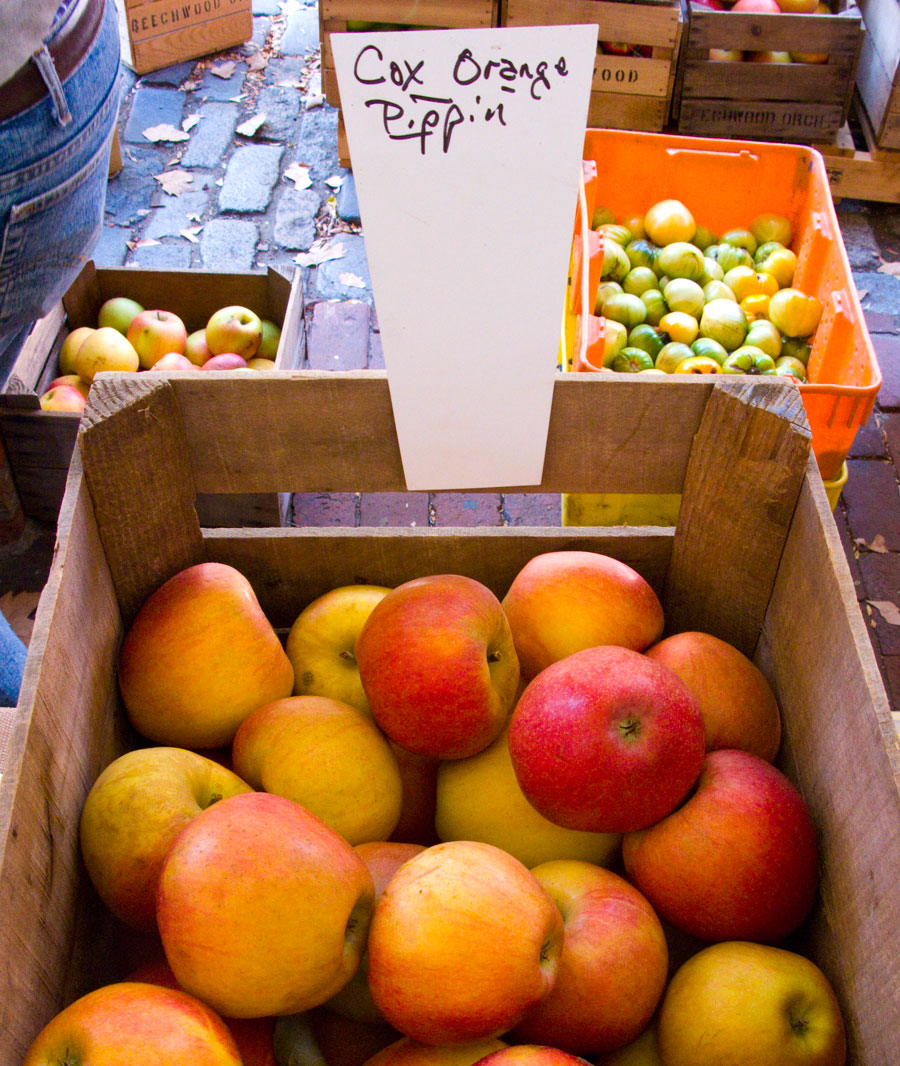
I've been telling Dave Garretson of Beechwood Orchards about Cox Orange Pippins for a couple of years now. This week he found some on a neighbor's orchard and brought them to Headhouse Square.
Although these apples were picked about a month ago and have been in storage, they've hardly lost anything. Indeed, this variety ripens best after picking. Cox Orange Pippins are only moderately crisp (those who insist on absolutely crunchy crispness will be disappointed), but their flavor is second to none, with a perfect balance of sweetness and tartness. Many believe, as I do, that it's the world's finest dessert apple, i.e., for eating uncooked. It's no wonder that Cox Orange Pippins are the most popular apple in the U.K., so much so that they're imported from South Africa in the off-season. (Alas, because they are more susceptible to disease, it's likely to lose this distinction soon, as more growers shift to other varieities.)
This variety first appeared in 1825 in England. And if you think the taste is vaguely familiar, you aren't imagining it. Today's Gala apple is a less flavorful but hardier descendant.
 Culton and his Broccoli
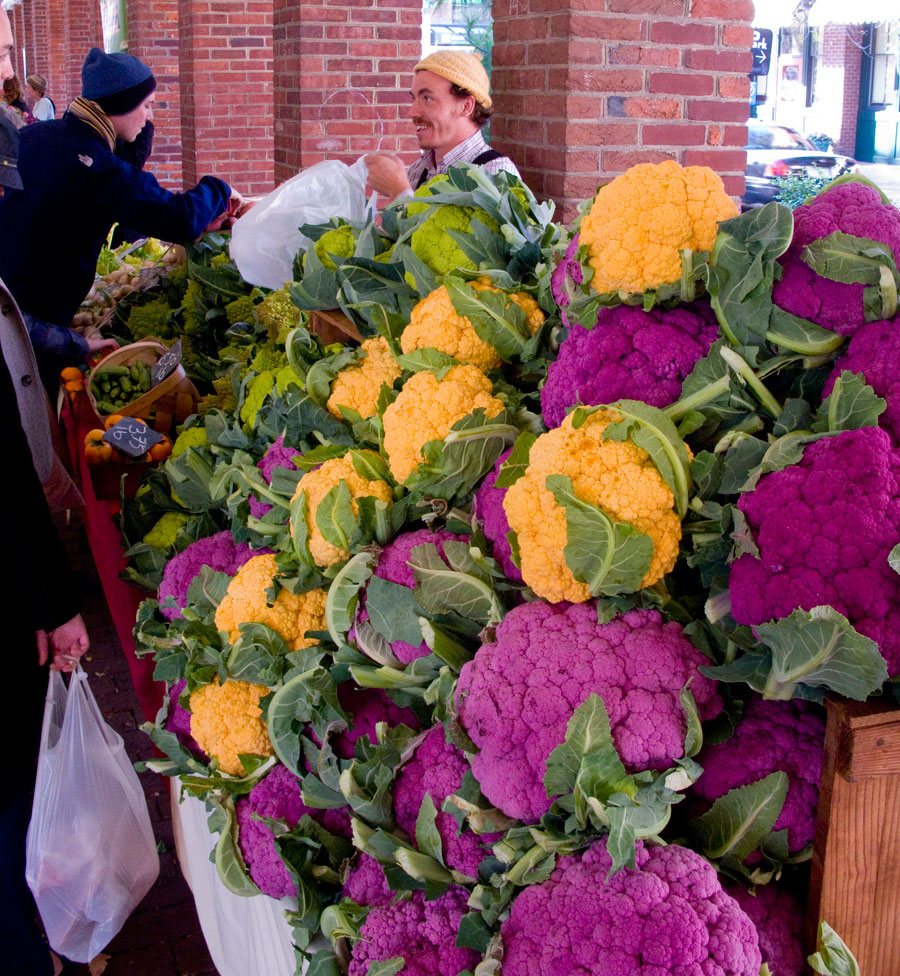
Tom Culton, shown today behind his Headhouse Farmers' Market stand laden with colorful cauliflower, loves produce in all its varieties. So much so that, according to an article in Citypaper this week, he raises 63 varieties of garlic. Read it here.
Transit Strike Hurts RTM
At least some merchants and the Reading Terminal Market have seen business fall off dramtically due to the SEPTA strike.
One of Iovine Brothers Produce's managers said volume was off 40 percent. On top of that, he and fellow managers had become a de facto taxi service, driving employees to and from work.
Other merchants saw lesser impacts. Over at the Fair Food Farmstand, while business was off a little, it wasn't devastating.
At least some merchants and the Reading Terminal Market have seen business fall off dramtically due to the SEPTA strike.
One of Iovine Brothers Produce's managers said volume was off 40 percent. On top of that, he and fellow managers had become a de facto taxi service, driving employees to and from work.
Other merchants saw lesser impacts. Over at the Fair Food Farmstand, while business was off a little, it wasn't devastating.
Save the Deli!
I'm only about a quarter into this book dedicated to the Jewish deli, but it is fascinating. Although author David Sax may have omitted reference to your favorite deli, anyone who enjoys a good pastrami sandwich or plate of kishke will say a b'rucha for this book.
I purchased the book last Tuesday at a signing in connection with Sax's appearance in the Free Library of Philadelphia's author series. Coincidentally, Tuesday was National Sandwich Day, the birthday of John Montague, reputed to be the inventor of the sandwich. (A blatant lie.)
In his talk, Sax outlined the two primary reasons why the Jewish deli is in such serious decline (from a couple thousand in the early part of the century in New York City to maybe a couple hundred today).
The first reason is simple economics. The traditional foods served by the deli have very high material costs. The margin on that $9 or $14 pastrami sandwich will be a buck at best. Add in high rents (especially in Manhattan) and labor costs and you've got a business challenge of the first order.
The second reason -- and the one Sax spent most of his time discussing -- is culture. He quickly touched on a variety of cultural reasons for the deli's decline (generational change, changes in food tastes, etc.), but I found one particularly interesting: No homeland for keeping the tradition alive. For example, the reason why Italian restaurants are still going strong, even though changes in U.S. immigration law largely shut off the Italians as much as the Jews in 1920, is that there is still an Italy with a thriving, evolving food culture. Same goes for the various Asian cuisines and just about any other ethnic cuisine you can think of. Not so Ashkenazi Jewish cuisine: the Holocaust wiped out the Ashkenazi Jews of Europe and, with it, the natural homeland of their cookery.
That's not true of the style of Jewish cuisine that has most recently taken root and thrived in America, Israeli/Middle Eastern cooking. Falafel stands are ubiquitous, as Israelis migrate to the U.S. and open restaurants offering their home cooking, as reinterpreted here in America. Because there is an Israel with its own cooking traditions (albeit, adapted from Arabic cultures, just as Ashkenazi cooking adapted from Polish, Germany, French and other european cultures), there is a living base from which to grow.
In his Philadelphia talk, Sax offered a number of possible solutions -- including his belief that delis should eschew buying finished corned beer and pastrami from the large processors, like Hebrew National (a unit of Conagra), and instead cure their own meats and make everything they can on premises. Since he was speaking in Philadelphia, he singled at Hershel's East Side Deli in the Reading Terminal Market as a fine example. (That's where he lunched.)
Sax is definitely going to be a big hit at all the pre-Hanukah Jewish Book Fairs around North America. The fact that he's from Toronto and has a passion for Montreal smoked meat, you shouldn't against him hold.
David's web site: Save the Deli
I'm only about a quarter into this book dedicated to the Jewish deli, but it is fascinating. Although author David Sax may have omitted reference to your favorite deli, anyone who enjoys a good pastrami sandwich or plate of kishke will say a b'rucha for this book.
I purchased the book last Tuesday at a signing in connection with Sax's appearance in the Free Library of Philadelphia's author series. Coincidentally, Tuesday was National Sandwich Day, the birthday of John Montague, reputed to be the inventor of the sandwich. (A blatant lie.)
In his talk, Sax outlined the two primary reasons why the Jewish deli is in such serious decline (from a couple thousand in the early part of the century in New York City to maybe a couple hundred today).
The first reason is simple economics. The traditional foods served by the deli have very high material costs. The margin on that $9 or $14 pastrami sandwich will be a buck at best. Add in high rents (especially in Manhattan) and labor costs and you've got a business challenge of the first order.
The second reason -- and the one Sax spent most of his time discussing -- is culture. He quickly touched on a variety of cultural reasons for the deli's decline (generational change, changes in food tastes, etc.), but I found one particularly interesting: No homeland for keeping the tradition alive. For example, the reason why Italian restaurants are still going strong, even though changes in U.S. immigration law largely shut off the Italians as much as the Jews in 1920, is that there is still an Italy with a thriving, evolving food culture. Same goes for the various Asian cuisines and just about any other ethnic cuisine you can think of. Not so Ashkenazi Jewish cuisine: the Holocaust wiped out the Ashkenazi Jews of Europe and, with it, the natural homeland of their cookery.
That's not true of the style of Jewish cuisine that has most recently taken root and thrived in America, Israeli/Middle Eastern cooking. Falafel stands are ubiquitous, as Israelis migrate to the U.S. and open restaurants offering their home cooking, as reinterpreted here in America. Because there is an Israel with its own cooking traditions (albeit, adapted from Arabic cultures, just as Ashkenazi cooking adapted from Polish, Germany, French and other european cultures), there is a living base from which to grow.
In his Philadelphia talk, Sax offered a number of possible solutions -- including his belief that delis should eschew buying finished corned beer and pastrami from the large processors, like Hebrew National (a unit of Conagra), and instead cure their own meats and make everything they can on premises. Since he was speaking in Philadelphia, he singled at Hershel's East Side Deli in the Reading Terminal Market as a fine example. (That's where he lunched.)
Sax is definitely going to be a big hit at all the pre-Hanukah Jewish Book Fairs around North America. The fact that he's from Toronto and has a passion for Montreal smoked meat, you shouldn't against him hold.
David's web site: Save the Deli
Tuesday, November 03, 2009
 The Commish
Visits the Deli
Bud Selig, MLB commissioner, stopped for lunch at the Reading Terminal Market Monday, ordering a sandwich at Hershel's Deli. He stopped by last year, too.
Selig is shown here with Steve Safron of Hershel's.
The RTM's general manager, Paul Steinke, remarked when he passed along the photo: "Guess he can’t get good corned beef in Milwaukee!"
No, you can't. Decent custard, burekas and wursts, but not corned beef or pastrami. Not even in Whitefish Bay, Milwaukee's predominantly Jewish suburb.
Sunday, November 01, 2009
Farmers' Markets Winding Down
 Many of the region's farmers' markets have closed down for the season, but a number are still going strong.
The Food Trust's Sunday market at Headhouse Square and Thursday market at Clark Park will continue through the week before Christmas. Both will be open the day before Thanksgiving, but closed the following weekend. They'll then continue in December until Christmas. Clark Park's Saturday market will continue year-round.
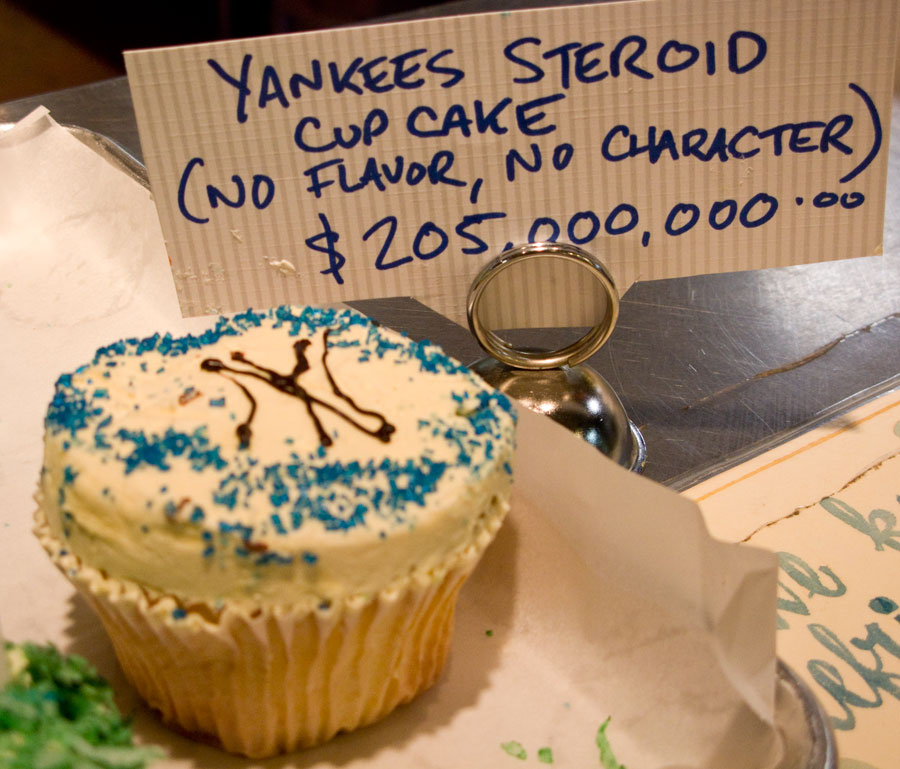
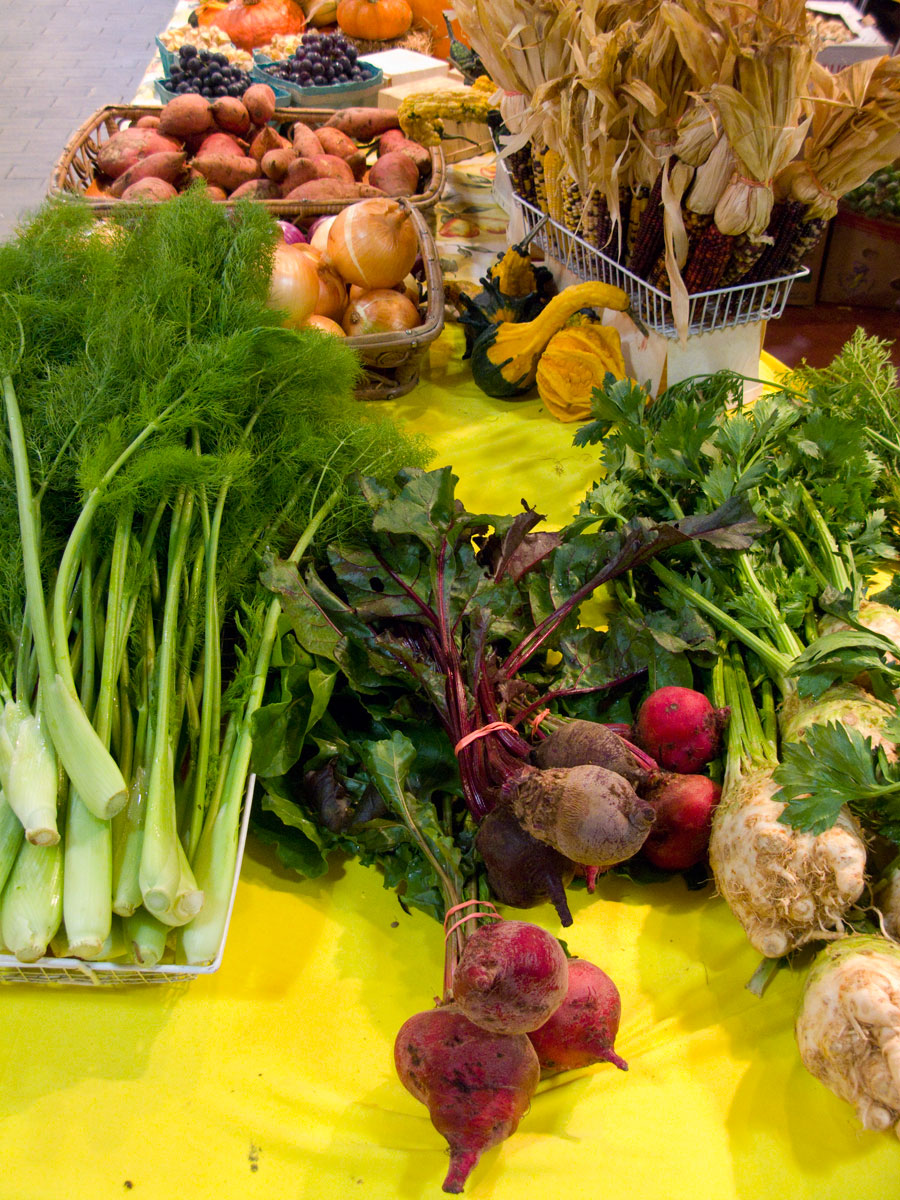
At Headhouse today, remaining produce vendors included Blooming Glen, Beechwood Orchads, North Star Orchards (photo), Weaver's Way, Three Springs Fruit Farm, Margerum's, Culton Organics, Queens Farm and Savoie Farm. Dark, leafy greens were particularly attractive at a number of the stands, and North Star, Beechwood and Three Spruings offered a nice variety of apples; Beechwood also was selling quinces ($5 quart) for those of you into apple pie making. Cabbages and other brassicas (turnips, brussells sprouts, cauliflower and romansco) were also prevalent. In addition to its usual fine selection of heirloom potatoes, Savoie featured some good looking lettuces.
 Many of the region's farmers' markets have closed down for the season, but a number are still going strong.
The Food Trust's Sunday market at Headhouse Square and Thursday market at Clark Park will continue through the week before Christmas. Both will be open the day before Thanksgiving, but closed the following weekend. They'll then continue in December until Christmas. Clark Park's Saturday market will continue year-round.
At Headhouse today, remaining produce vendors included Blooming Glen, Beechwood Orchads, North Star Orchards (photo), Weaver's Way, Three Springs Fruit Farm, Margerum's, Culton Organics, Queens Farm and Savoie Farm. Dark, leafy greens were particularly attractive at a number of the stands, and North Star, Beechwood and Three Spruings offered a nice variety of apples; Beechwood also was selling quinces ($5 quart) for those of you into apple pie making. Cabbages and other brassicas (turnips, brussells sprouts, cauliflower and romansco) were also prevalent. In addition to its usual fine selection of heirloom potatoes, Savoie featured some good looking lettuces.
Forgotten Foods at RTM
Forgotten foods of the region will be the focus of a festival at the Reading Terminal Market on Saturday, Nov. 14, from 10 a.m. to 4 p.m.
A number of merchants will be preparing some of these foods from our past, and they'll all be available for tasting at reasonable cost. (You'll probably buy tickets at a central point, then exchange the tickets for the tastes.)
Among the featured foods:
Dominic Spataro, whose sandwich shop has been a presence at the market for decades, said fresh grated horseradish brings back fond market memories for him. Nearly half a century ago a merchant named Franklin Field made it on premises for sale at the predecessor to today's Spice Terminal, where he also offered fresh grated coconut. His granted both by hand on a tool used by carpenters to bevel latticework, wearing a leather apron to protect himself from injury Another of Field's products that was quite popular was Irish dulse (seaweed). The tradition continued when Field's stall was taken over by Harvey Riley, who ran it until it closed in the late 1970s. The spice shop was located near where Iovine Brothers Produce stands today.
Poses: The Commissary At Home
Steve Poses, remembered by many as one of the movers creating Philadelphia's Restaurant Renaissance in the 1970s and 1980s through his Commissary restaurant, has spent his efforts since then with his catering business. Now he's published a book about home entertaining, At Home: A Caterer's Guide to Cooking & Entertaining.
Poses will be in the Piano Court next Saturday, Nov. 7, from 11 a.m. to 2 p.m. promoting the book and its companion web site and sharing his expertise and passion for home entertaining. He’ll present mini-courses designed to help plan a delicious and stress-free Thanksgiving. The book, usually sold only online (www.athomebysteveposes) will also be available for purchase.
Forgotten foods of the region will be the focus of a festival at the Reading Terminal Market on Saturday, Nov. 14, from 10 a.m. to 4 p.m.
A number of merchants will be preparing some of these foods from our past, and they'll all be available for tasting at reasonable cost. (You'll probably buy tickets at a central point, then exchange the tickets for the tastes.)
Among the featured foods:
- Copes Dried Corn, Wilbur Buds (the original from which Hershey derived his kisses), and Buttercreams from Pennsylvania General Store.
- Fried Catfish and Waffles, Pepperpot Soup from the Down Home Diner.
- Pepper Hash from AJ's Pickles.
- Fried Oysters from Pearl's served with Chicken Salad (probably from Hershel's).
- Snapper Soup from Pearl's.
- Cape May Salt Oysters, Cranberries and Black Walnuts from Fair Food Farmstand.
- Fresh Grated Horseradish from Hershel's.
Dominic Spataro, whose sandwich shop has been a presence at the market for decades, said fresh grated horseradish brings back fond market memories for him. Nearly half a century ago a merchant named Franklin Field made it on premises for sale at the predecessor to today's Spice Terminal, where he also offered fresh grated coconut. His granted both by hand on a tool used by carpenters to bevel latticework, wearing a leather apron to protect himself from injury Another of Field's products that was quite popular was Irish dulse (seaweed). The tradition continued when Field's stall was taken over by Harvey Riley, who ran it until it closed in the late 1970s. The spice shop was located near where Iovine Brothers Produce stands today.
Poses: The Commissary At Home
Steve Poses, remembered by many as one of the movers creating Philadelphia's Restaurant Renaissance in the 1970s and 1980s through his Commissary restaurant, has spent his efforts since then with his catering business. Now he's published a book about home entertaining, At Home: A Caterer's Guide to Cooking & Entertaining.
Poses will be in the Piano Court next Saturday, Nov. 7, from 11 a.m. to 2 p.m. promoting the book and its companion web site and sharing his expertise and passion for home entertaining. He’ll present mini-courses designed to help plan a delicious and stress-free Thanksgiving. The book, usually sold only online (www.athomebysteveposes) will also be available for purchase.
Save the Deli
There will be a bit of show and tell when author David Sax visits the Free Public Library Tuesday evening to promote his book, Save the Deli. A couple of local delis will be providing noshes, including pastrami of Hershel's Deli of the Reading Terminal Market. The program is free and begins at 7:30 p.m. at the Central Library, 19th and Vine.
There will be a bit of show and tell when author David Sax visits the Free Public Library Tuesday evening to promote his book, Save the Deli. A couple of local delis will be providing noshes, including pastrami of Hershel's Deli of the Reading Terminal Market. The program is free and begins at 7:30 p.m. at the Central Library, 19th and Vine.
Friday, October 30, 2009
Beck's Cajun Café opens
Want a muffaletta, or a Po' Boy? You can get them now at the Reading Terminal Market with the opening this past Monday of Beck's Cajun Café.
Alas, no beignets yet. Bill Beck, the proprietor, said he wasn't told when he ordered his mixer that it was on back order, but it is. So we'll have to wait to try this version of sweet fried dough.
She Who Must Be Obeyed and I visited the market today to sample Beck's fare. SWMBO ordered the muffaletta, I opted for the Oyster Po'Boy.
I didn't ask Bill where he got his bread, but the hoagie-style roll for the Po' Boy and the round, sesame seeded muffaletta bread were both excellent. (I can't compare to what you'd get in New Orleans, since I've never been there.) Although I generally like my hoagie rolls with a thin crispy crust, the soft-style long and round rolls were good protein holders.
SWMBO enjoyed the muffaletta, but she prefers the pressed style of this sandwich. Bill explained he modeled his on the version found at Central Grocery in New Orleans, which claims to be the home of this sandwich; Central's versions, and Beck's, is an unpressed sandwich filled with cold fixings. And the fixings are very good, indeed: mortadella, salami, tasso ham and aged provolone with a New Orleans style vinaigrette and adorned with an olive salad. And the sandwich is huge. The $8.95 "half" sandwich easily fills up two hearty eaters. SWMBO didn't eat half of a half; we took the remainder home and will press it on the stove between two cast iron skillets for lunch tomorrow.
Of course, the muffaletta is nothing more than a variant on the hero, sub or hoagie, something you'll find in any Italian-American community. The difference, to my mind, is in the breads and the garnishes. The olive salad on Beck's was superb, a mix of what seemed to be two or three different olives, including one that actually has a reddish cast.
My $7.59 Fried Oyster Po' Boy was a bit less massive, though it easily could feed two lighter eaters. The six large oysters were expertly fried with a breading of panko. They sat atop a hoagie style roll slathered in remoulade and garnished with lettuce and tomato.
If you're a root beer fan, be sure to order a bottle of the Abita root beer. It's a strong, herbal brew that will satisfy your root beer cravings. Just a whiff of it satisfies.
We also added the Cajun fries, which were tasty potato wedges spiked with onions and something to give them heat (maybe Tabasco or Crystal?).
Service at the counter (which seats about a dozen, I'd guess) was personable and fast.
Want a muffaletta, or a Po' Boy? You can get them now at the Reading Terminal Market with the opening this past Monday of Beck's Cajun Café.
Alas, no beignets yet. Bill Beck, the proprietor, said he wasn't told when he ordered his mixer that it was on back order, but it is. So we'll have to wait to try this version of sweet fried dough.
She Who Must Be Obeyed and I visited the market today to sample Beck's fare. SWMBO ordered the muffaletta, I opted for the Oyster Po'Boy.
I didn't ask Bill where he got his bread, but the hoagie-style roll for the Po' Boy and the round, sesame seeded muffaletta bread were both excellent. (I can't compare to what you'd get in New Orleans, since I've never been there.) Although I generally like my hoagie rolls with a thin crispy crust, the soft-style long and round rolls were good protein holders.
SWMBO enjoyed the muffaletta, but she prefers the pressed style of this sandwich. Bill explained he modeled his on the version found at Central Grocery in New Orleans, which claims to be the home of this sandwich; Central's versions, and Beck's, is an unpressed sandwich filled with cold fixings. And the fixings are very good, indeed: mortadella, salami, tasso ham and aged provolone with a New Orleans style vinaigrette and adorned with an olive salad. And the sandwich is huge. The $8.95 "half" sandwich easily fills up two hearty eaters. SWMBO didn't eat half of a half; we took the remainder home and will press it on the stove between two cast iron skillets for lunch tomorrow.
Of course, the muffaletta is nothing more than a variant on the hero, sub or hoagie, something you'll find in any Italian-American community. The difference, to my mind, is in the breads and the garnishes. The olive salad on Beck's was superb, a mix of what seemed to be two or three different olives, including one that actually has a reddish cast.
My $7.59 Fried Oyster Po' Boy was a bit less massive, though it easily could feed two lighter eaters. The six large oysters were expertly fried with a breading of panko. They sat atop a hoagie style roll slathered in remoulade and garnished with lettuce and tomato.
If you're a root beer fan, be sure to order a bottle of the Abita root beer. It's a strong, herbal brew that will satisfy your root beer cravings. Just a whiff of it satisfies.
We also added the Cajun fries, which were tasty potato wedges spiked with onions and something to give them heat (maybe Tabasco or Crystal?).
Service at the counter (which seats about a dozen, I'd guess) was personable and fast.
Guacamole Weekend
Super Bowl Sunday is usually the peak day for guacamole. But with the Eagles playing Sunday, and the Phillies in the World Series Saturday, Sunday and Monday, why not dip into some this weekend?
The price of avocados and limes at Iovine Brothers' Produce shouldn't stop you. Large, Chilean Hass avocados were selling for a buck apiece today, and a lime will set you back a dime. Today the avocados were a bit on the firm size and could use a day or two of ripening. But they'd certainly be ready by Sunday.
Charlie, one of the managers for Iovines, says the Chileans have been in the avocado business for a long time, but the California Avocado Board worked to keep them out of the U.S. for the past 10 years. Now they're back, which means competition for both California and Mexico, the world's largest exporter of Hass avocados.
Super Bowl Sunday is usually the peak day for guacamole. But with the Eagles playing Sunday, and the Phillies in the World Series Saturday, Sunday and Monday, why not dip into some this weekend?
The price of avocados and limes at Iovine Brothers' Produce shouldn't stop you. Large, Chilean Hass avocados were selling for a buck apiece today, and a lime will set you back a dime. Today the avocados were a bit on the firm size and could use a day or two of ripening. But they'd certainly be ready by Sunday.
Charlie, one of the managers for Iovines, says the Chileans have been in the avocado business for a long time, but the California Avocado Board worked to keep them out of the U.S. for the past 10 years. Now they're back, which means competition for both California and Mexico, the world's largest exporter of Hass avocados.
Monday, October 19, 2009
Headhouse Weathers Weather
At least for the hour after it opened, both vendors and customers were a tad scarce at the Headhouse Square Farmers' Market yesterday, each group deterred by the threats of the second successive Nor'Easter. Maybe it picked up after I left shortly before 11, when the weather appeared less threatening.
Although some merchants were among the missing because of the recent rains (Young's Flowers, for example, couldn't pick because of the South Jersey showers), most of the regulars were selling their goods. Tom Culton was back with his brassicas and winter banana apples, Beechwood, North Star and Three Springs showed off the fruits of their respective orchards, Savoie proudly displayed its variety of hard-to-find potatoes, Queen Farm put forth its usual enticing display of oyster mushrooms and specialty Asian vegetables, and tables of both Blooming Glen and Weaver's Way groaned under the burden of radishes, beets, turnips, chards, lettuces and other garden goodies, including some of the season's last tomatoes.
Birch Run's sign reminded me that, addition to intriguing cheeses, they also deal in veal. One cut that got my attention for future cooking was brisket, $9/pound. I've only had it once, at the expansive brunch served at Lacroix in the Rittenhouse Hotel. In that case it was corned (brined) before braising. Basically, it's meatiest part of a breast of veal without the bones.
At least for the hour after it opened, both vendors and customers were a tad scarce at the Headhouse Square Farmers' Market yesterday, each group deterred by the threats of the second successive Nor'Easter. Maybe it picked up after I left shortly before 11, when the weather appeared less threatening.
Although some merchants were among the missing because of the recent rains (Young's Flowers, for example, couldn't pick because of the South Jersey showers), most of the regulars were selling their goods. Tom Culton was back with his brassicas and winter banana apples, Beechwood, North Star and Three Springs showed off the fruits of their respective orchards, Savoie proudly displayed its variety of hard-to-find potatoes, Queen Farm put forth its usual enticing display of oyster mushrooms and specialty Asian vegetables, and tables of both Blooming Glen and Weaver's Way groaned under the burden of radishes, beets, turnips, chards, lettuces and other garden goodies, including some of the season's last tomatoes.
Birch Run's sign reminded me that, addition to intriguing cheeses, they also deal in veal. One cut that got my attention for future cooking was brisket, $9/pound. I've only had it once, at the expansive brunch served at Lacroix in the Rittenhouse Hotel. In that case it was corned (brined) before braising. Basically, it's meatiest part of a breast of veal without the bones.
Saturday, October 17, 2009
No Vacancies at the Market
If you want to start up a stall at the Reading Terminal Market, you'll have to wait for an existing vendor to fail.
With the recent move of the Fair Food Farmstand to the 12th Street side of the market, the opening of S&B Meats and Barb & Suzy's Kitchen, and next week's opening of Beck's Cajun Café all available space has been leased for the first time in a couple of years.
The move of Fair Food expands the available seating in the court closest to Arch Street, and it will remain that way, according to Paul Steinke, the market's general manager.
If you want to start up a stall at the Reading Terminal Market, you'll have to wait for an existing vendor to fail.
With the recent move of the Fair Food Farmstand to the 12th Street side of the market, the opening of S&B Meats and Barb & Suzy's Kitchen, and next week's opening of Beck's Cajun Café all available space has been leased for the first time in a couple of years.
The move of Fair Food expands the available seating in the court closest to Arch Street, and it will remain that way, according to Paul Steinke, the market's general manager.
 Jujubes and Kaffir Limes
When I think of Jujubes, I think of the tiny gummy candies from Heide's I would buy during my pre-adolescent years at the Saturday matinees at the Elmora Theater in Elizabeth, New Jersey, where I saw such classics as "X the Unknown" and "The Blob".
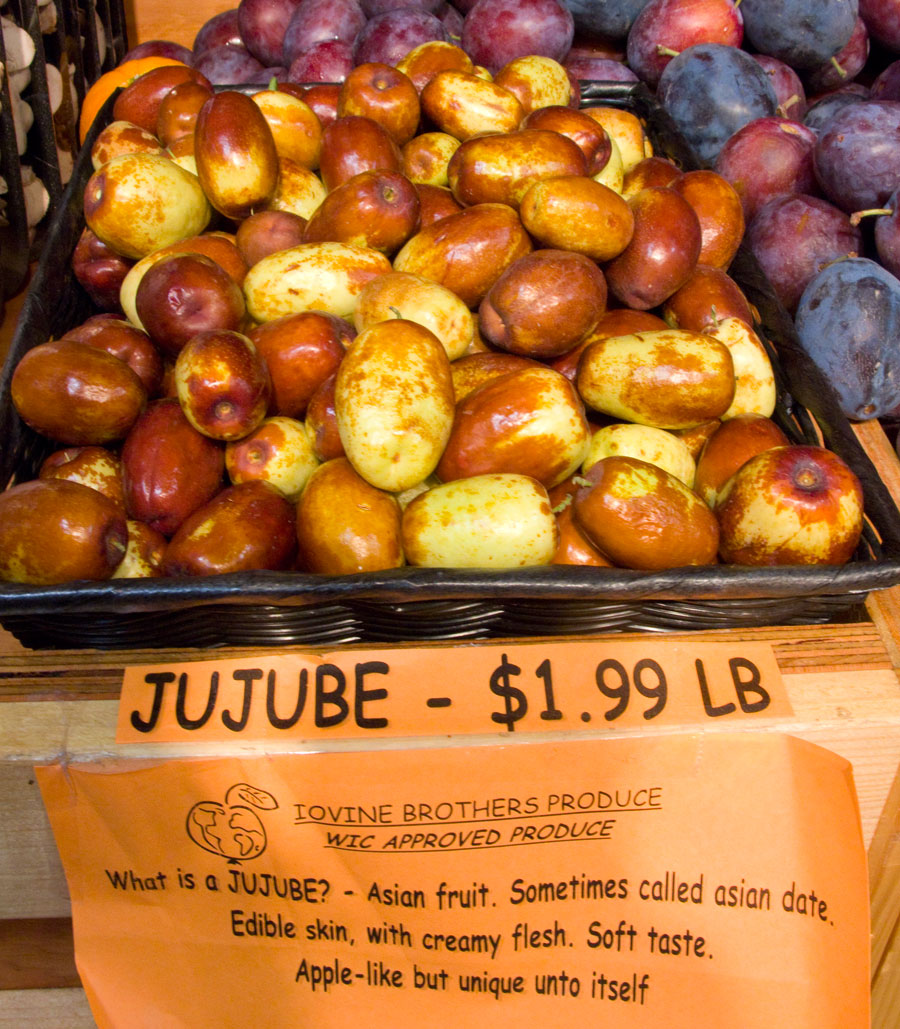
Little did I know there was another Jujube, which I found recently at Iovine Brothers' Produce at the Reading Termninal Market (photo top right). Unlike the sweet, sugary little pellets of my childhood, these Jujubes are alleged to have medicinal properties, as well as a more adult taste. They somewhat resemble dates and, indeed, are sometimes called Red Dates or Chinese Dates, though their origin is probably India. They have a wonderful scientific name: Ziziphus zizyphus. For those interested here's the Wikipedia entry.
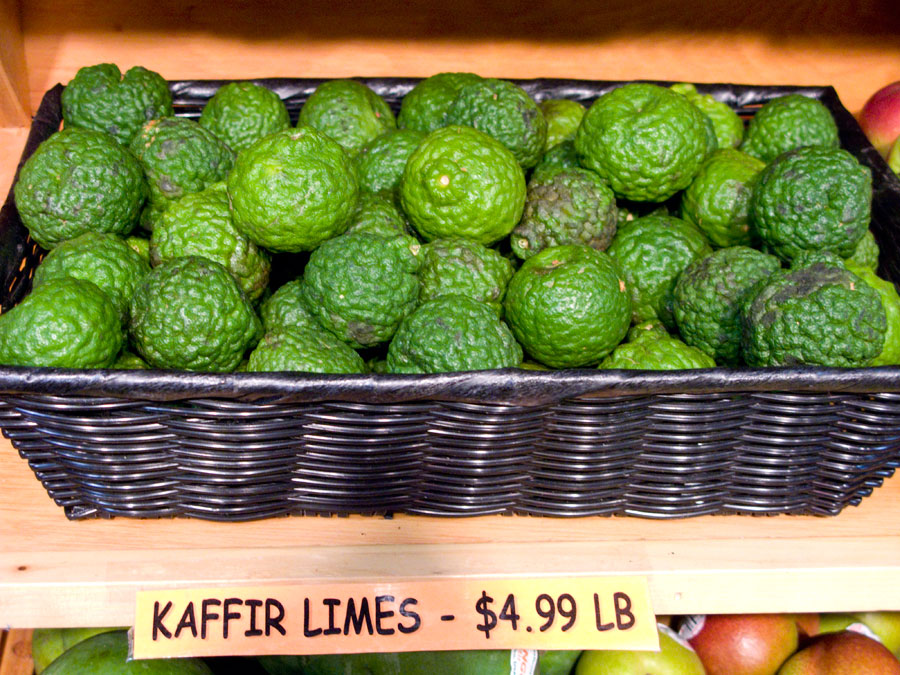 The kaffir limes (photo at right) are also purportedly medicinal and are primarily used in Southeast Asian and Indonesian cuisines, frequently in a curry paste. They are also available at Iovine's.
With the coming of winter (it sure seems close with our recent weather) Iovine's is bringing in more citrus fruit. This past week Valencia oranges were available in bags at a bargain price of $1.99 for a four-pound bag. Tangerines were six for a buck, and Florida navels were five for $2. Cara Cara oranges were 3 for $1. Limes were a bit less pricey today, 5 for a buck. Lemons were 3/$1, but they were heavy with juice. After a hiatus of a week or so, red and green cactus pears are back in stock.
Figs remain available, at least those from California. A pint box of about a dozen brown figs was selling for $4.99 at Iovines. Chile, which dominates the out-of-season fruit market in Philadelphia, is expanding into avocados to compete with Mexico. Iovines was selling medium sized fruits this week, 2 for $1.49; smaller ones were in a separate bin for a quarter apiece.
For as long as I've been shopping there Iovines has sold tofu, but only the medium firm type they package into plastic containers in water. This week they expanded tofu offerings to include three or four additional firm and super firm versions, including a "tofu cutlet" ready for cooking. You can find them in the refrigerated cases by the Filbert Street checkout.
 Unpasteurized cider is back in stock at Kauffman's Lancaster County Produce, available in pints and half-gallons. (In the past Ben Kauffman has also sold it in quarts; maybe he'll have those next week).
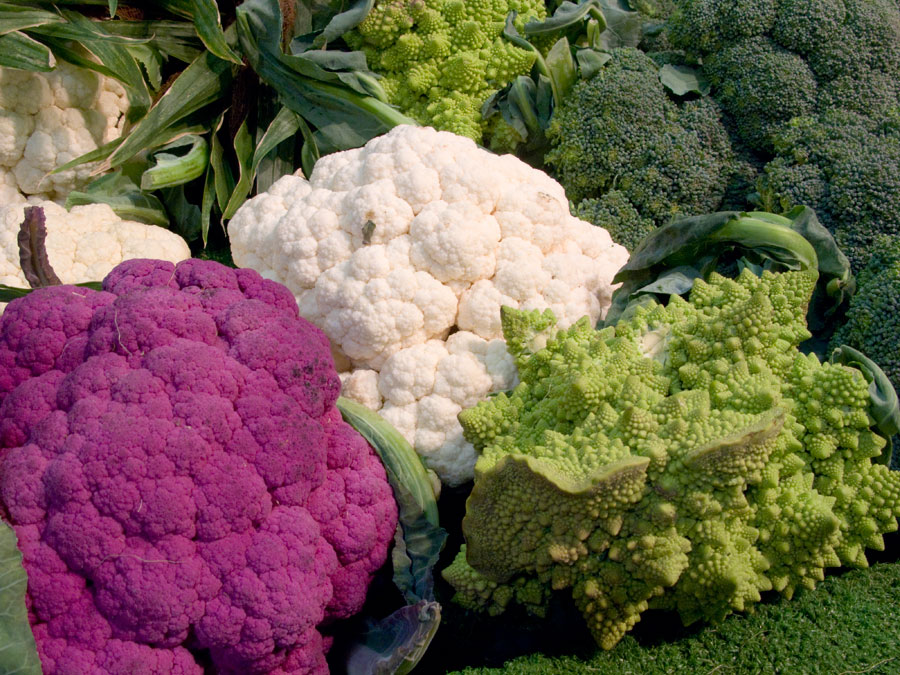
Kauffman's always has a nice selection of brassicas each fall, and this year is no exception, as demonstrated by the purple and white cauliflower, romanesco and broccoli in the photo at left.
One of the joys of Lancaster County in the fall is the appearance of local celery. Livingood's had them at the RTM this morning, $2 a bunch. The celery grown in Lancaster County is a tad less stalky and more leafy, but it's crispy freshness (versus the trans-continental California product) and deep green color make it welcome. I'll put some stalks on an old-fashioned relish tray, with a selection of olives, at dinner tonight. (Drat! I forgort to buy some fresh radishes to complete that tray.)
If we're lucky when we get closer to Thanksgiving we might see some white celery, which is the same thing as green celery except that the stalks are buried so they aren't exposed to light; the process is the same that produces white asparagus. This labor-intensive celery makes a wonderful side when braised in butter with a little white wine
Cheese Steaks Part 3: Spataro's
 When I first started visiting the Reading Terminal Market more than a quarter century ago, Spataro's was known as the place where you could stop for lunch and pay about as little for a sandwich as humanly possible. Inflation and menu upgrades have changed that, though Spataro's (which has since moved from one part of Center Court to another) still represents good value.
The addition of cheese steaks to Spataro's bill of fare earlier this year is partly responsible for the hike in average menu cost ($7 for a plain steak, iirc). Their version of the cheese steak represents the third and final entry in my RTM survey of this Philadelphia classic.
The best thing about Spataro's is the meat. Although it would take side-by-side comparisons to confirm this (I've spaced my tastings over the past five or six weeks), I thought their meat was the beefiest I've tried so far, when compared to By George and Carmen's. There was also a satisfactory taste of onions in my sandwich though I could have used a bit more. The bread was okay, the typical soft steak roll -- I'd like just a hint of crunch to the crust.
The main failing was the cheese: I couldn't taste it, let alone detect the cheesy, gooey mouth feel I want my cheese steak to convey. As best as I could determine, they used two thin slices of American, though provolone is also offered. Another failing is the unavailability of hot sauce.
Still, it's a fine representation of a cheese steak and you won't be disappointed when you crave this icon of our fair city's culinary heritage.
More About DiNic's Pulled Pork
This morning Joe Nicolosi offered me a taste of some of his pulled pork fresh out of the oven. Gotta say, while this sandwich is excellent eating any time of the day, it's better if you can get it fresh before the fat has a chance to re-congeal. It absolutely melted in the mouth, with textural contrast offered by the crunchy bits. As previously noted, don't confuse this version with what you're likely to find in North Carolina: the seasonings are Italian (with tons of garlic), not barbecue.
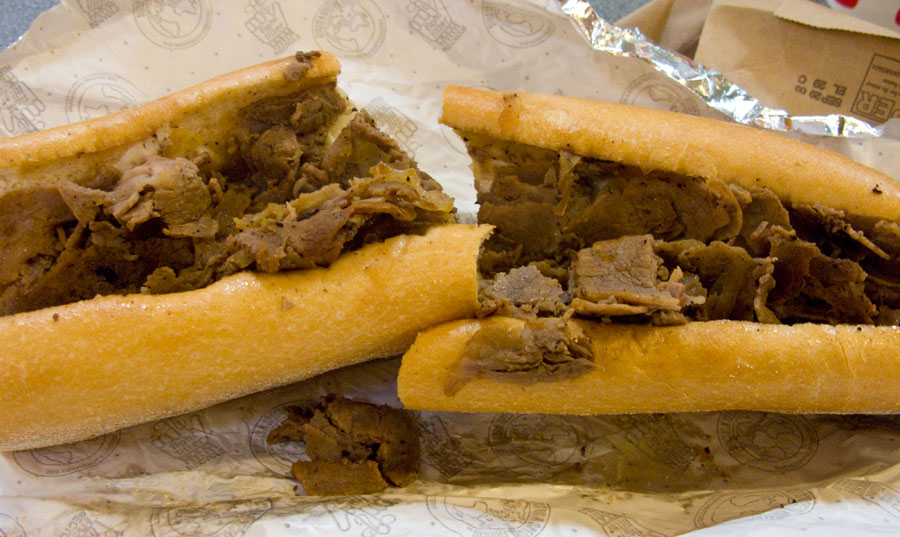 When I first started visiting the Reading Terminal Market more than a quarter century ago, Spataro's was known as the place where you could stop for lunch and pay about as little for a sandwich as humanly possible. Inflation and menu upgrades have changed that, though Spataro's (which has since moved from one part of Center Court to another) still represents good value.
The addition of cheese steaks to Spataro's bill of fare earlier this year is partly responsible for the hike in average menu cost ($7 for a plain steak, iirc). Their version of the cheese steak represents the third and final entry in my RTM survey of this Philadelphia classic.
The best thing about Spataro's is the meat. Although it would take side-by-side comparisons to confirm this (I've spaced my tastings over the past five or six weeks), I thought their meat was the beefiest I've tried so far, when compared to By George and Carmen's. There was also a satisfactory taste of onions in my sandwich though I could have used a bit more. The bread was okay, the typical soft steak roll -- I'd like just a hint of crunch to the crust.
The main failing was the cheese: I couldn't taste it, let alone detect the cheesy, gooey mouth feel I want my cheese steak to convey. As best as I could determine, they used two thin slices of American, though provolone is also offered. Another failing is the unavailability of hot sauce.
Still, it's a fine representation of a cheese steak and you won't be disappointed when you crave this icon of our fair city's culinary heritage.
More About DiNic's Pulled Pork
This morning Joe Nicolosi offered me a taste of some of his pulled pork fresh out of the oven. Gotta say, while this sandwich is excellent eating any time of the day, it's better if you can get it fresh before the fat has a chance to re-congeal. It absolutely melted in the mouth, with textural contrast offered by the crunchy bits. As previously noted, don't confuse this version with what you're likely to find in North Carolina: the seasonings are Italian (with tons of garlic), not barbecue.
 Autumn at Headhouse
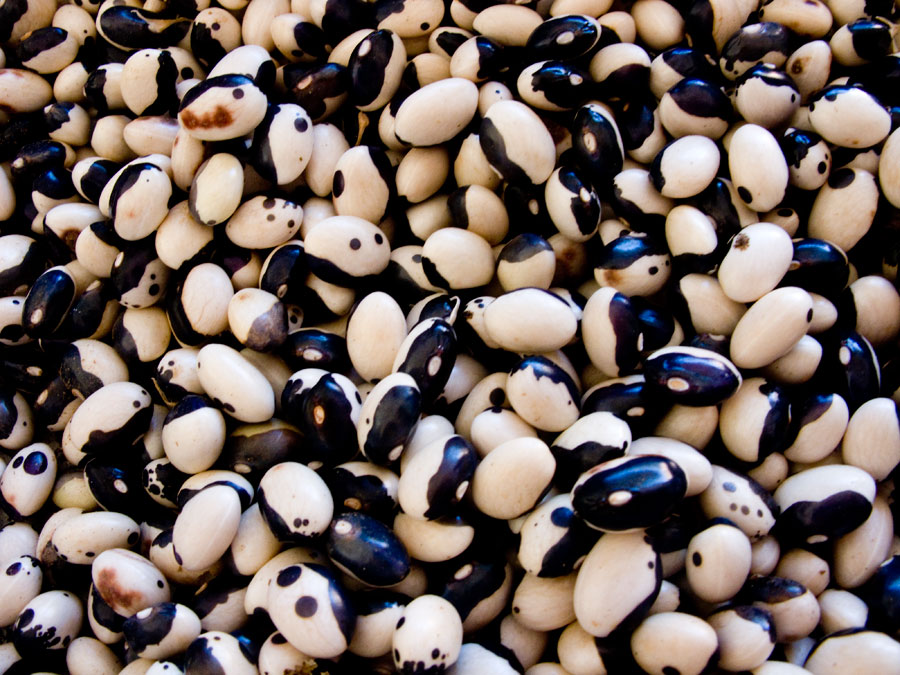
These Ying Yang dried beans from Culton Organics are just one of the many varieties of fall produce I found at Headhouse Square Farmers' Market last Sunday.
Tom also featured some delicious, though small, chestnuts. They roasted up perfectly (about 10 minutes in a 425 toaster oven; be sure to make a small 'x' on the flat side to avoid popping). Out of the first two dozen chestnuts I roasted, there were only two that were moldy/inedible.
Brussells sprouts have been making their appearance at local markets, too. Tom was selling his for $5 a quart. His white, purple or orange cauliflower and romanesco was $5 for medium-sized heads. Yellow string beans were $5/quart, sweet potatoes $2/pound. Among fruits, Tom had delicious Winter Banana apples as well as Asian pears; they were pricey at $1 apiece.
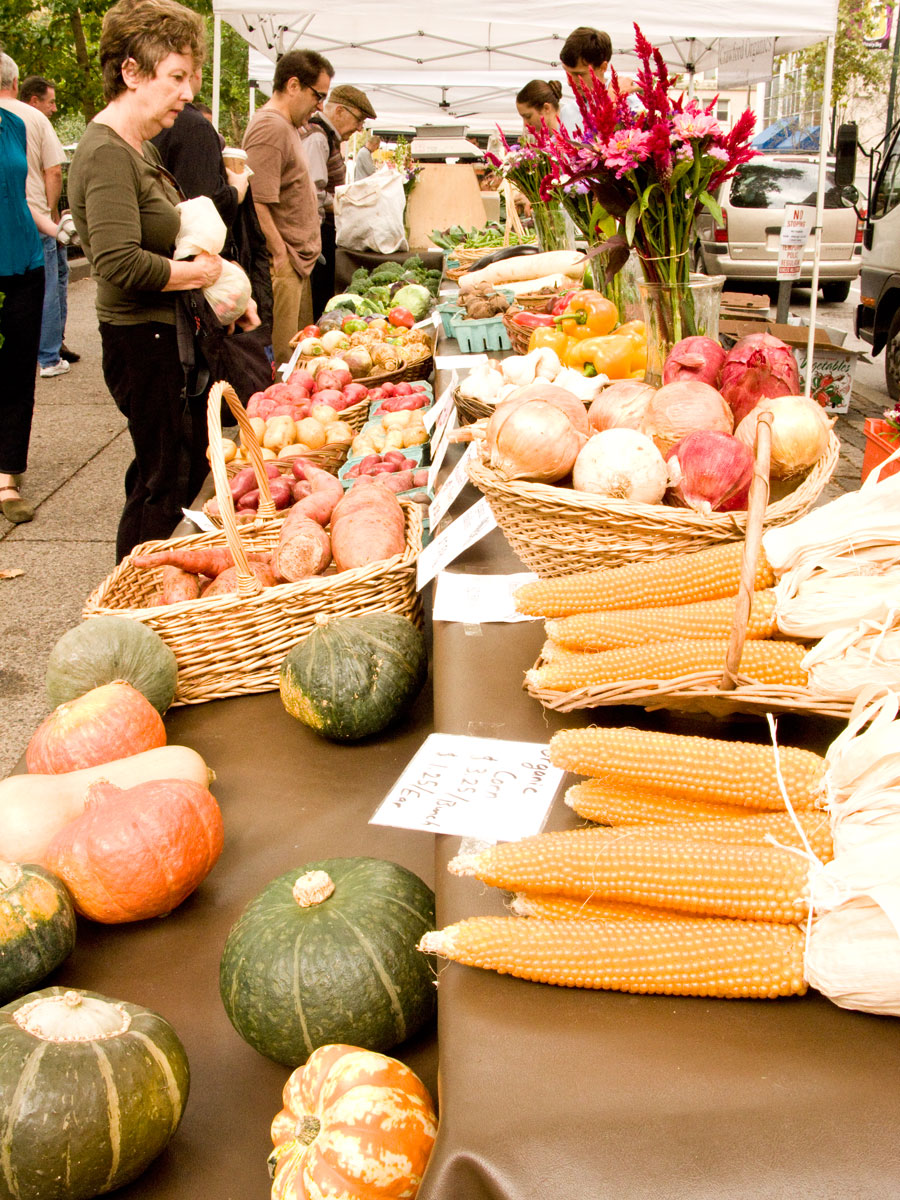
Pumpkins, as predicted in a previous post, are expensive this year. Blooming Glen's jack-o-lantern pumpkins were $8 apiece. Long Island cheese pumpkins, ideal for baking use, particularly pies, were $6 each; huge Blue Hubbard squashes were similarly priced. Butternut squash was more reasonable $1.25/pound, Delicata $1.50. Blooming Glen still had field tomatoes last Sunday for $3/pound. Potatoes, both all-purpose and small Russetts (baking) were $2/pound.
North Star Orchards' apples were all $2/pound, except the Honey Crisps, $2.50. Magness pears were $2.
Beechwood Orchards apples were $4/quart, $4.5o for Honey Crisps. Pears were $5/quart, chestnusts $6/quart.
Margarums also had potatoes, including $2/pound Russetts.
Farm To City In Winter
We're almost a month past the autumnal equinox, and that means farmers' markets will be shutting down for the season over the next month or so. What to do after that?
Well the Reading Terminal Market and its Fair Food Farmstand and the year-round Clark Park Market come to mind first. But Farm To City, Bob Pierson's organization, offers another option, Philadelphia Winter Harvest.
From November through April more than 500 food items are availble from this service, including organic produce, flavored vinegars and condiments, meat, poultry, eggs, raw and pasteurized milk, cream, yogurt, cheeses honey, maple syrup, canned and dried fruits, vegetables and herbs, breads, coffees and teas.
Under Philadelphia Winter Harvest, you can order once every two weeks for deliveries weekly (don't ask me to figure that out); deliveries are made to Old Pine Community Center where orders are available for pickup.
For more info visit http://www.farmtocity.org then click on Buying Clubs, Philadelphia Winter Harvest.
We're almost a month past the autumnal equinox, and that means farmers' markets will be shutting down for the season over the next month or so. What to do after that?
Well the Reading Terminal Market and its Fair Food Farmstand and the year-round Clark Park Market come to mind first. But Farm To City, Bob Pierson's organization, offers another option, Philadelphia Winter Harvest.
From November through April more than 500 food items are availble from this service, including organic produce, flavored vinegars and condiments, meat, poultry, eggs, raw and pasteurized milk, cream, yogurt, cheeses honey, maple syrup, canned and dried fruits, vegetables and herbs, breads, coffees and teas.
Under Philadelphia Winter Harvest, you can order once every two weeks for deliveries weekly (don't ask me to figure that out); deliveries are made to Old Pine Community Center where orders are available for pickup.
For more info visit http://www.farmtocity.org then click on Buying Clubs, Philadelphia Winter Harvest.
I'm baaack
Haven't been able to post for a few weeks because (1) host server had been shut down for a week for upgrading, and (2) the prior week I was enjoying early autumn in the Northern Berkshires where good food, while not impossible to find, seems to be scarce.
But I'm back now and will be posting more soon.
Haven't been able to post for a few weeks because (1) host server had been shut down for a week for upgrading, and (2) the prior week I was enjoying early autumn in the Northern Berkshires where good food, while not impossible to find, seems to be scarce.
But I'm back now and will be posting more soon.
Sunday, October 04, 2009
Halibut Update
That halibut I purchased a week ago at John Yi's in the Reading Terminal Market (about one and a third-pound) wound up providing the basis of five servings: three for dinner the first night, them two "leftover" portions of fish hash.
I first encountered fish hash at a so-so short-lived fish restaurant on Mount Desert Island near Acadia National Park. The restaurant, Bulger's, was replaced after a season or two by XYZ, one of my fav Mexican restaurants anywhere I've been in the U.S.
Fish hash is nothing more than leftover fish turned into a potato-onion hash. It's best with a mild, firm white flesh fish like halibut or haddock. Here's my recipe:
Fish Hash
All purpose potato, 1 to 1-1/2 pound
Fish filet (white flesh), 6-8 ounces, cooked and roughy flaked
Onion, one medium
Bell pepper, one medium
Bacon fat
Cayenne pepper to taste
Salt and pepper to taste
That halibut I purchased a week ago at John Yi's in the Reading Terminal Market (about one and a third-pound) wound up providing the basis of five servings: three for dinner the first night, them two "leftover" portions of fish hash.
I first encountered fish hash at a so-so short-lived fish restaurant on Mount Desert Island near Acadia National Park. The restaurant, Bulger's, was replaced after a season or two by XYZ, one of my fav Mexican restaurants anywhere I've been in the U.S.
Fish hash is nothing more than leftover fish turned into a potato-onion hash. It's best with a mild, firm white flesh fish like halibut or haddock. Here's my recipe:
Fish Hash
All purpose potato, 1 to 1-1/2 pound
Fish filet (white flesh), 6-8 ounces, cooked and roughy flaked
Onion, one medium
Bell pepper, one medium
Bacon fat
Cayenne pepper to taste
Salt and pepper to taste
- Prep washed, skin-on potatoes into half-inch cubes. Dice onion to roughly the same size.
- Melt 2-3 tablespoons bacon fat in 10-12 inch non-stick skillet over medium-high heat.
- When fat is hot, turn heat to high and add potatoes and cook, undisturbed after initial tossing, for five minutes.
- Return heat to medium-high, toss potatoes, add caynne, salt and pepper, layer onion and bell peppers on top. Cook for five minutes more undisturbed before tossing again. Continue cooking for about five minutes more, tossing occasionally to brown everything nicely. Add flaked fish, toss some more. When it's heated through, serve.
 Rittenhouse Plans Expansion
The Rittenhouse Square Farmers' Market, operated by Farm to City, is busting at its seams. The nearly 20 vendors I counted yesterday pretty much filled the north side of the square between 18th and West Rittenhouse.
To accommodate more stalls, Farm to City founder and director Bob Pierson has obtained the city's permission to expand the market along 18th Street, according to one of the vendors.
Although a couple of the stalls yesterday were promotional in nature (Zipcar, Otolith seafood CSA), most were selling the best of autumn's produce, dairy products and baked goods. Among them:
- Crawford Organics' (photo) filled their three-slot space with beets, celeriac and small, fresh rutabagas at $2.50/pound and small (and overpriced) romanesco at $3 a head, among other items.
- Hilltop Produce featured unpasteurized cider, $2/quart, $3/half-gallon, $4/gallon. Fahnestock Orchards' apple selection included Honey Crisps, Stayman Winesaps, McIntoshes, Empires, Jonagolds, Mutsus (a.k.a. Crispin), Cortlands and Fujis; all were $1.50/pound, except the Honey Crisps, $2.
- Rineer Family Farm (which also shows up at South Street and other farmers' markets) still had raspberries ($3.75/half-pint, two for $7), cherry tomatoes ($2.25/half-pint, two for $4), heirloom tomatoes ($3.50/pound), and field tomatoes ($2.99).
- Hails Family Farm showed up with a nice selection of dairy products, from milk to cheese spreads. They also stocked their all-natural cream cheese (no gums), which was briefly carried by Fair Food at the Reading Terminal Market; alas, the Wyalusing, Pennsylvania, dairy and produce farm no longer makes deliveries there.
- Le Baguette Bakery had a nice selection of breads and pastries. I took home a $5 stromboli (made from baguette dough, so it was far better than Stouffer's French Bread Pizza) with pepperoni and mozzarella. Reheated at home for five minutes in a 350-oven, it made for a light, crusty lunch for two.
Saturday, October 03, 2009
Autumn Events at RTM
Lots of events are on tap at the Reading Terminal Market this fall, starting out next Friday when The Reading Terminals, the market's own jazz combo, celebrates its' 25th anniversary.
The quartet is no ordinary group of part-time musicians. They're available for legal, political and medical consultations. Superior Court Judge Richard Klein bangs the skins. Ed Schwartz, former city councilman, tickles the ivories. Attorney Anthony Call plucks bass. Rounding out the combo is Dr. David Reider, assistant chief medical officer at Jeff, picking guitar. Before his death former City Councilman Thatcher Longstreth added vocals.
The Terminals technically celebrated their 25th back in August, but the market will officially observe their quarter century of jamming Friday, with special guest appearances from other Philadelphia jazz notables.
To learn more about the Reading Terminals, check out Dan Geringer's feature from the Daily News two months ago.
The RTM's annual Harvest Festival will be held for the ninth time on Saturday, Oct. 17. Filbert Street (a.k.a. Harry Ochs Way) will be transformed into an urban farm with bales of hay and corn stalks. The festival features seasonal foods, hay rides, a pumpkin patch, live music, pie eating contests, and more.
Throughout October, you can guess the weight of a giant pumpkin positioned in Center Court. The person who guesses closest without going over wins $100.
Old City Coffee roaster Art Dupras will lead a short conversation about the coffee roasting on Nov. 7 at 2 p.m. He'll showcase Old City's antique cast iron coffee roaster and demonstrate the complete roast cycle of a French roast. It's the free event is limited to eight attendees, so reserve your spot by sending an email to sandi@oldcitycoffee.com.
Rick Nichols' occasional columns in The Inquirer about the region's "forgotten foods" intrigued RTM General Manager Paul Steinke, who decided to stage a festival devoted to these traditional comestibles. It comes to fruition Nov. 14 when the market sponsors an all-day celebration of Pepper Hash, Snapper Soup, Cope’s Corn, Fried Catfish and Waffles, and many more goodies.
Lots of events are on tap at the Reading Terminal Market this fall, starting out next Friday when The Reading Terminals, the market's own jazz combo, celebrates its' 25th anniversary.
The quartet is no ordinary group of part-time musicians. They're available for legal, political and medical consultations. Superior Court Judge Richard Klein bangs the skins. Ed Schwartz, former city councilman, tickles the ivories. Attorney Anthony Call plucks bass. Rounding out the combo is Dr. David Reider, assistant chief medical officer at Jeff, picking guitar. Before his death former City Councilman Thatcher Longstreth added vocals.
The Terminals technically celebrated their 25th back in August, but the market will officially observe their quarter century of jamming Friday, with special guest appearances from other Philadelphia jazz notables.
To learn more about the Reading Terminals, check out Dan Geringer's feature from the Daily News two months ago.
The RTM's annual Harvest Festival will be held for the ninth time on Saturday, Oct. 17. Filbert Street (a.k.a. Harry Ochs Way) will be transformed into an urban farm with bales of hay and corn stalks. The festival features seasonal foods, hay rides, a pumpkin patch, live music, pie eating contests, and more.
Throughout October, you can guess the weight of a giant pumpkin positioned in Center Court. The person who guesses closest without going over wins $100.
Old City Coffee roaster Art Dupras will lead a short conversation about the coffee roasting on Nov. 7 at 2 p.m. He'll showcase Old City's antique cast iron coffee roaster and demonstrate the complete roast cycle of a French roast. It's the free event is limited to eight attendees, so reserve your spot by sending an email to sandi@oldcitycoffee.com.
Rick Nichols' occasional columns in The Inquirer about the region's "forgotten foods" intrigued RTM General Manager Paul Steinke, who decided to stage a festival devoted to these traditional comestibles. It comes to fruition Nov. 14 when the market sponsors an all-day celebration of Pepper Hash, Snapper Soup, Cope’s Corn, Fried Catfish and Waffles, and many more goodies.
Friday, October 02, 2009
Fair Food's Grand Opening
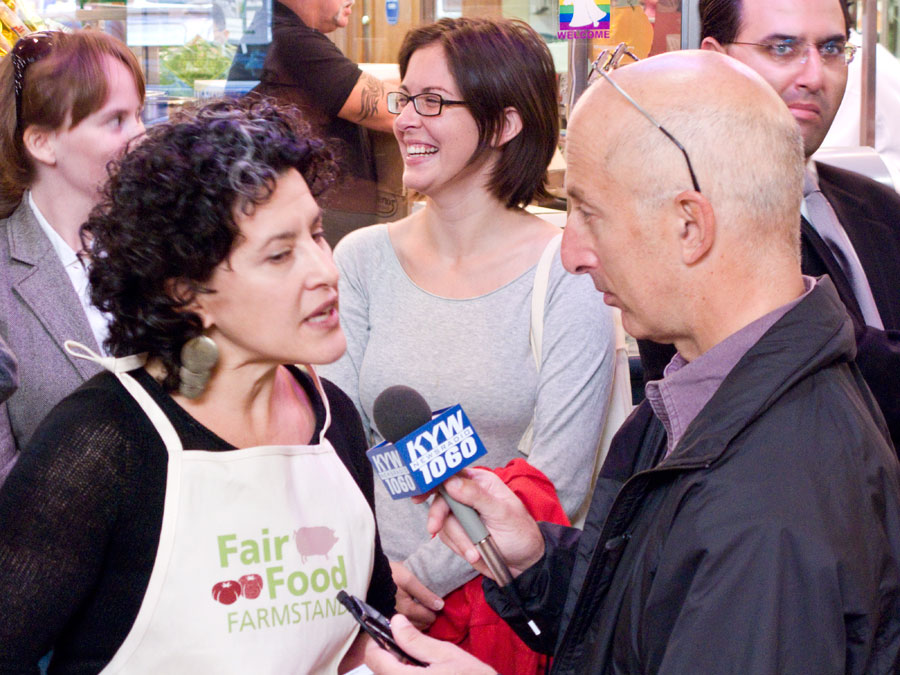
Fans of the Fair Food Farmstand crowded the aisles for today's grand opening of the non-profit group's new venue within the Reading Terminal Market.
The news media was also there, including three local tv stations and Steve Tawa of KYW radio, shown here interviewing Fair Food's executive director and founder Ann Karlen.
Marion Nestle, a professor at New York University and leading activitist for good food and good nutrition (she's the go-to source for reporters covering the subject) was the keynote speaker, as she was earlier this morning at the annual conference of Les Dames de L'Escoffier. In her brief remarks Nestle linked the revitalization of small farms with the health of American democracy, and praised the symbolic importance of Michelle Obama's support of a farmers' market near the White House.
The U.S. Department or Agriculture, which funded a grant to get the renovated Fair Food Farmstand rolling, sent James Barham, an economist with the department's Agricultural Marketing Service. Though agro-industry remains the primary focus of the department, small farmers are getting increased attention. Barham discussed how the department's promotion of "value chain collaboration" is working to develop relationships between food buyers (stores, distributors and institutions) and small-to-medium-sized farms.
 Although she didn't speak at the ceremony or sit with the assembled dignataries, a key presence at the event was Judy Wicks, founder of White Dog Cafe and the White Dog Cafe Foundation. It was under the sponsorship of the foundation that Fair Food got its start. Recently Fair Food was spun off as an independent, free-standing non-profit.
Some of the biggest cheers at the event were reserved for the farmers who attended the ceremony.
Mike Holahan, president of the Reading Terminal Market Merchants Association and proprietor of the Pennsylvania General Store, brought a bit of pointed humor to the proceedings in his brief remarks. Mike observed that when market merchants gather to discuss a new vendor, and question why the market needs a particular store, such as a non-profit vendor of local produce, you can be sure of its success.
The local locavore establishment was much in evidence. In addition to many of its loyal customers, attendees included staff and volunteers from both The Food Trust and Farm To City, which both operate farmers' markets in the region, and The Common Market, a non-profit wholesale operation trying to build markets for the area's small farmers.
Although the Farmstand is the most visible of Fair Food's progams, it's hardly the only one. Among its other activities:
- The Farmer Outreach Project, which assists limited-resource farmers by preparing them to sell products to the wholesale marketplace;
- Farm-to-Institution, an effort also involving the Food Trust, the Common Market and other non-profits, to encourage institutions, distributors, and mid-scale farmers to work together to fuel the local food system;
- Publications, including the Philadelphia Local Food Guide and Wholesale Guide to Local Farm Products;
- Participation in the Buy Fresh, Buy Local campaign; and
- The Restaurant Project, which encourages local establishments to source through local producers; Fair Food's twice-annual Farmer/Chef Gathering is an important part of this effort.
 The Produce Aisles
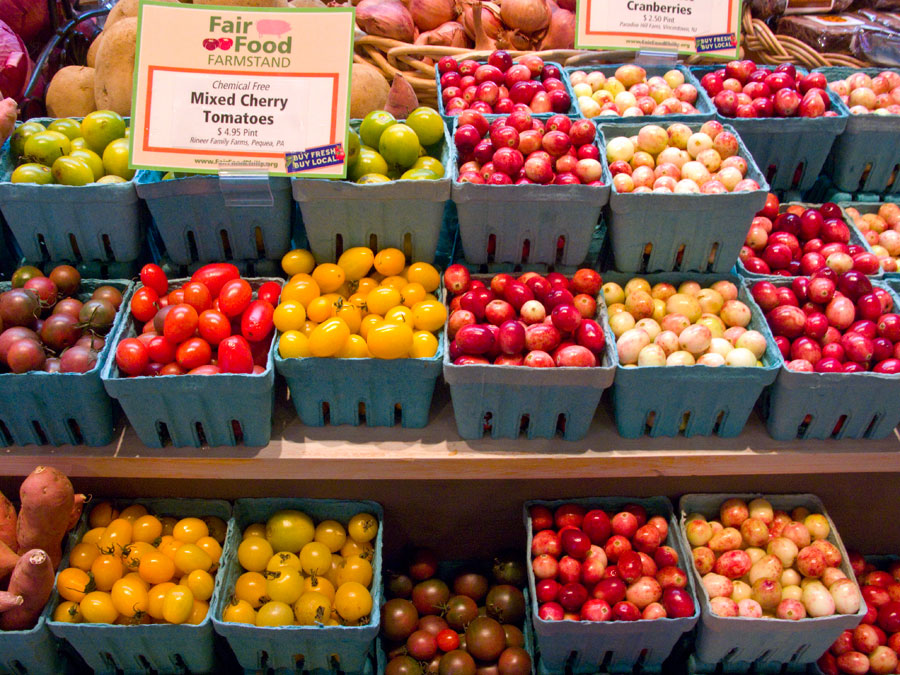
Before the grand opening ceremony for Fair Food's new stall I wandered its aisles to check out the latest offerings.
Thanksgiving may be nearly two months away, but white and red heirloom cranberries from Paradise Hill Farm in Vincentown, New Jersey are much in evidence, making a colorful display next to pints of cherry tomatoes. For those who want to learn how cranberries are grown and harvested, Fair Food is sponsoring its third annual visit to the bogs. It will be held Oct. 25. For more info, email Louisa at farmtours@fairfoodphilly.org. It's a popular tour and includes a look at the farm's antique cranberry-harvesting equipment, so sign up soon.
It's been a sad season for pumpkins, as heavy rains took their toll on the region's crop. Iovine Brother's Produce has been holding the line on price so far, but as we near Halloween expect to pay more for your jack-o-lantern than in past years.
Limes are also dear: the price went up to 50 cents apiece this week at Iovine's. Lemons were three for a buck. A relative bargain are organic green peppers, which were actually less expensive than the conventionally grown variety this week: 89 cents a pound vs 99. Conventional red peppers were $1.49, orange and yellow bells $1.99, frying and hot peppers 99 cents. Ripe Jersey tomatoes were 99 cents. Rutabagas and size of small canteloupes were 50 cents a pound. Red, Savoy and regular green cabbages were 50 cents a pound.
'Messy' Recommendation at DiNic's
 Messy of the Messy & Picky blog thinks the Italian pulled pork at DiNic's is the best sandwich around. I'm hard-pressed to place a single sandwich alone on a pedestal, even the No. 5 combo from Goodman's Deli of my youth, but DiNic's is certainly worthy of praise.
It's difficult to go for anything other than the roast pork with greens and aged provolone, though cases can certainly be made for other sandwiches at DiNic's. My buddy Ralphie the Winemaker raves about Tommy's cold roast beef with horseradish, roasted sweet peppers and provolone, and the Italian-style brisket is no less a masterpiece than the Jewish-style brisket (ask for it with extra fat) at Hershel's across center court.
Messy likes his pulled pork with horseradish and provolone. When I asked Joe Nicolosi what he'd recommend, he offered long hots and provlone. It was an excellent combination, even if the surplus of seeds in the pepper added a texture I could do without (the extra heat from the seeds was just fine). The only crunch I want on that sandwich is from the burned bits of meat, which the sandwich-makers make sure are mixed in with the tender, succulent, pulled-to-order meat. Just don't expect a barbeque style pulled pork. This pig sandwich is thoroughly Italian; those who abhore garlic should stay away.
So, next time you're at DiNic's, break out of the ordinary. Try your pork pulled.
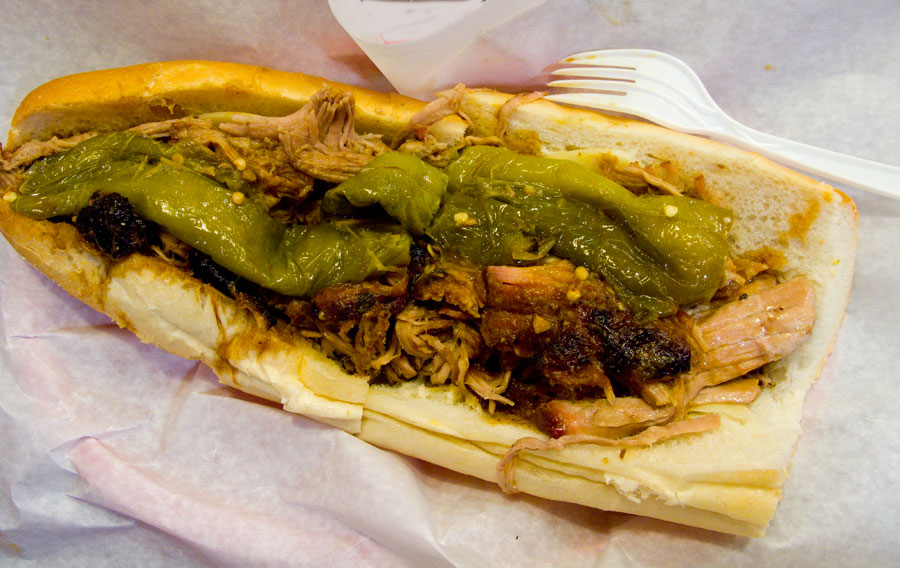 Messy of the Messy & Picky blog thinks the Italian pulled pork at DiNic's is the best sandwich around. I'm hard-pressed to place a single sandwich alone on a pedestal, even the No. 5 combo from Goodman's Deli of my youth, but DiNic's is certainly worthy of praise.
It's difficult to go for anything other than the roast pork with greens and aged provolone, though cases can certainly be made for other sandwiches at DiNic's. My buddy Ralphie the Winemaker raves about Tommy's cold roast beef with horseradish, roasted sweet peppers and provolone, and the Italian-style brisket is no less a masterpiece than the Jewish-style brisket (ask for it with extra fat) at Hershel's across center court.
Messy likes his pulled pork with horseradish and provolone. When I asked Joe Nicolosi what he'd recommend, he offered long hots and provlone. It was an excellent combination, even if the surplus of seeds in the pepper added a texture I could do without (the extra heat from the seeds was just fine). The only crunch I want on that sandwich is from the burned bits of meat, which the sandwich-makers make sure are mixed in with the tender, succulent, pulled-to-order meat. Just don't expect a barbeque style pulled pork. This pig sandwich is thoroughly Italian; those who abhore garlic should stay away.
So, next time you're at DiNic's, break out of the ordinary. Try your pork pulled.
Beck's Plans Oct. 14 opening
Bill Beck is getting closer to opening his Beck's Cajun Café at the Reading Terminal Market. A few weeks ago he advertised for help on Craig's List, stating the target for opening is Oct. 14. This week the counters are largely finished. There's even a Facebook page with photos of those beignets I'm keen to sample.
Bill Beck is getting closer to opening his Beck's Cajun Café at the Reading Terminal Market. A few weeks ago he advertised for help on Craig's List, stating the target for opening is Oct. 14. This week the counters are largely finished. There's even a Facebook page with photos of those beignets I'm keen to sample.
Sunday, September 27, 2009
Potatoes, Potatoes and More Potatoes
To my taste, the best potatos are the first fresh-dug spuds of spring. But the variety of potatoes that appeared at the Headhouse Square Farmers' Market today challenge that belief.
At North Star I found the Belgian Bintje variety, $2.50/pound. These are the classic potatoes used in the frites you find on streets throughout Brussels, though they are equally compatible with boiling or steaming. I intend to use them sautéd in either bacon or duck fat. I'll also try them in a fish chowder using leftover halibut (see previous post).
Savoie Farm featured a number of potatoes I had never seen before, including the All Blue ($5/pound), Rose Gold ($8), Island Sunshine ($5), Red Cloud ($4) and Onaway ($4).
 Noelle Margarum, doyenne of preserves and herbs at Headhouse, was selling Kennebecs and Potomac Reds at $2/quart. Her Kennebecs, however, were labelled "Kenny Backs". These potatoes undoubtedly originated in Kennbec County, Maine, though these flavorful all-purpose spuds are quite popular among Southeastern Pennsylvania farmers. Noelle also had a beautiful selection of winter squashes, as shown in this photo.
Blooming Glen also displayed Kennebecs, as well as Purple Vikings, Both were priced at $2/pound.
Beechwood Orchards still had raspberries, as well as the last of their peaches. In addition to apples and Asian pears, Beechwood displayed Seckel, Bosc and Bartlett pears ($5/quart) and concord grapes ($4 quart).
In yesterday's post I observed that local chestnuts, like those sold by Earl Livengood, tend to be smaller than the Italian imports we should start seeing a few weeks. Dave of Beechwood proves me wrong; his chestnuts were plump, big and blemish free, $3.50/quart. He expects to have them in future weeks and I intend to try them soon, even if I don't have an open fire available.
 As usual, Tom Culton had an interesting array of produce, including white, orange and purple cauliflower (right). He also featured the Italian variety of pears I wrote about a few weeks ago, big yellow tomatoes, and huge baskets of concord grapes.
A few merchants didn't make it to Headhouse today, including Yoder Heirlooms and Patch of Star goat dairy. They are expected back next week.
To my taste, the best potatos are the first fresh-dug spuds of spring. But the variety of potatoes that appeared at the Headhouse Square Farmers' Market today challenge that belief.
At North Star I found the Belgian Bintje variety, $2.50/pound. These are the classic potatoes used in the frites you find on streets throughout Brussels, though they are equally compatible with boiling or steaming. I intend to use them sautéd in either bacon or duck fat. I'll also try them in a fish chowder using leftover halibut (see previous post).
Savoie Farm featured a number of potatoes I had never seen before, including the All Blue ($5/pound), Rose Gold ($8), Island Sunshine ($5), Red Cloud ($4) and Onaway ($4).
 Noelle Margarum, doyenne of preserves and herbs at Headhouse, was selling Kennebecs and Potomac Reds at $2/quart. Her Kennebecs, however, were labelled "Kenny Backs". These potatoes undoubtedly originated in Kennbec County, Maine, though these flavorful all-purpose spuds are quite popular among Southeastern Pennsylvania farmers. Noelle also had a beautiful selection of winter squashes, as shown in this photo.
Blooming Glen also displayed Kennebecs, as well as Purple Vikings, Both were priced at $2/pound.
Beechwood Orchards still had raspberries, as well as the last of their peaches. In addition to apples and Asian pears, Beechwood displayed Seckel, Bosc and Bartlett pears ($5/quart) and concord grapes ($4 quart).
In yesterday's post I observed that local chestnuts, like those sold by Earl Livengood, tend to be smaller than the Italian imports we should start seeing a few weeks. Dave of Beechwood proves me wrong; his chestnuts were plump, big and blemish free, $3.50/quart. He expects to have them in future weeks and I intend to try them soon, even if I don't have an open fire available.
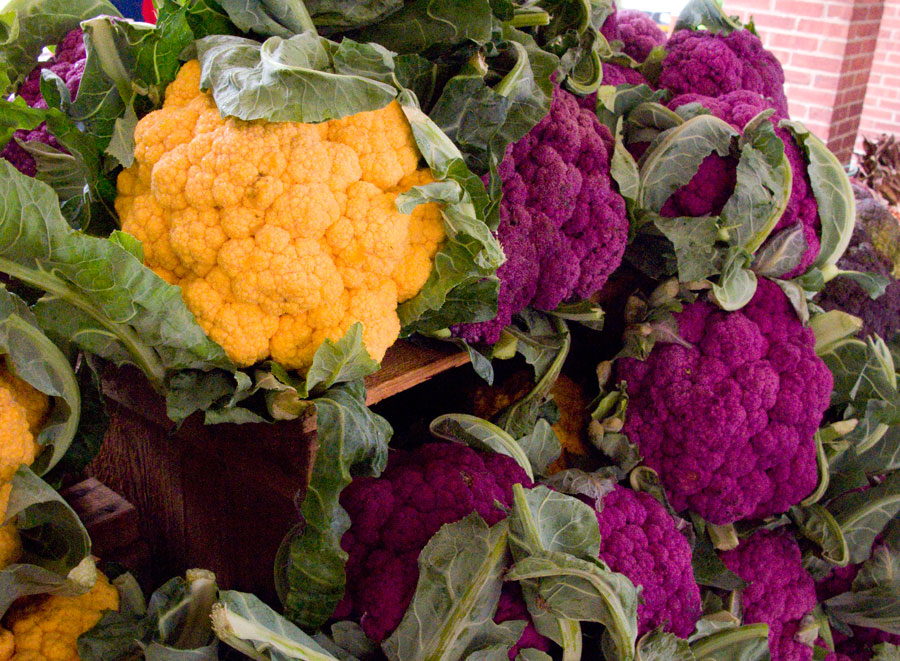 As usual, Tom Culton had an interesting array of produce, including white, orange and purple cauliflower (right). He also featured the Italian variety of pears I wrote about a few weeks ago, big yellow tomatoes, and huge baskets of concord grapes.
A few merchants didn't make it to Headhouse today, including Yoder Heirlooms and Patch of Star goat dairy. They are expected back next week.
Just For the Halibut
Sorry, couldn't resist that fisherman's pun just as I couldn't resist the halibut I reported on yesterday.
This was one of the most gorgeous pieces of fish I've had in a long time and it tasted as good as it looked. If you're heading over the Reading Terminal Market today (they close at 5 p.m.), get a hunk of it at John Yi's @ $12.99/pound.
I mostly cooked it as I reported in the previous post, the major difference is that I baked it in a foil-covered dish rather than en papillote using foil. Should anyone wish to try it, below is the recipe I used. The peppers I used were the bargains I bought from Tom Culton at Headhouse Square Farmers' Market a week ago; he was selling the eight-inch long sweet red peppers at three for a buck. I only used two of these babies in the recipe; with average-sized bell peppers you'd probably need three.
Halibut with Sweet Peppers
Ingredients
Sorry, couldn't resist that fisherman's pun just as I couldn't resist the halibut I reported on yesterday.
This was one of the most gorgeous pieces of fish I've had in a long time and it tasted as good as it looked. If you're heading over the Reading Terminal Market today (they close at 5 p.m.), get a hunk of it at John Yi's @ $12.99/pound.
I mostly cooked it as I reported in the previous post, the major difference is that I baked it in a foil-covered dish rather than en papillote using foil. Should anyone wish to try it, below is the recipe I used. The peppers I used were the bargains I bought from Tom Culton at Headhouse Square Farmers' Market a week ago; he was selling the eight-inch long sweet red peppers at three for a buck. I only used two of these babies in the recipe; with average-sized bell peppers you'd probably need three.
Halibut with Sweet Peppers
Ingredients
- Halibut filet (1 to 1.5 pounds); try to buy as thick a filet as you can find. One-and-a-half inches is idea, if you can find one.
- Sweet peppers (three medium sized bell peppers or equivalent, any color, or mixed colors for added eye appeal)
- One large shallot, roughly chopped (half a medium onion works, too)
- Olive oil
- Parsley, roughly chopped, about one-quarter to one-third of a bunch
- Flavorful vinegar (I used sherry vinegar), two tablespoons
- One lemon (juice from one half, slice other half thinly for garnish)
- Salt and pepper to taste
- Pre-heat oven to 450 F. Position a rack in the middle of the oven.
- Slice peppers into one-quarter inch thick sticks, 3-4 inches long.
- Sauté shallots and peppers in 2-3 tablespoons olive oil over medium high heat until peppers are softened, about 8-10 minutes. Just before it finishes, add salt to taste and a couple tablespoons of vinegar, turning heat to high to evaporate most of the vinegar.
- Transfer peppers and shallots to baking dish (8 or 9 inch square works, depending on size of fish; an oval baking dish would be even better if you have one that's big enough. Sprinkle about half the lemon juice and half the parsley over the peppers.
- Place fish atop the peppers, sprinkle with a tablespoon or two of olive oil, remaining lemon juice, and salt and pepper to taste.
- Cover baking dish with aluminum foil and place on middle rack in oven. Use the Canadian method of timing: in hot oven cook for 10 minutes for each inch of thickness; a 1.5-inch thick filet will take 15 minutes.
- Serve fish portions (they will probably flake a little) atop the peppers, sauce with the accumulated liquid from the baking dish. Garnish with lemon slices and remaining parsley.
Saturday, September 26, 2009
Brisk Business at Farmstand
Since opening at its new location within the Reading Terminal Market Wednesday, the Fair Food Farmstand has been doing brisk business. Although long-term trends cannot be divined from just three days' business, manager Sarah Cain reports increased traffic and revenue. Weekly volume should be bumped up when the stall begins seven-day-a-week operation Oct. 5; in recent years it has been closed on Mondays.
While much of the business has been from regular customers, many are new, including a few clueless folks who said they never knew the Fair Food Farmstand existed at its previous location within the market.
Don't expect to be able to order a quiche, sandwich or salad for consumption at the RTM from Fair Food anytime soon. Although Fair Food plans to eventually use some of its prep space to create items for lunchers and munchers, RTM General Manager Paul Steinke said serious talks about adding the additional line of business haven't even started. Fair Food didn't elect to hook up to the market's extensive exhaust and ventilation system, so they definitely won't be making cheesesteaks or roast pork sandwiches. But expect items that could be prepped and cooked in a convection oven, sandwich press, induction stove top and similar small appliances.
Other Vendors Spruce Up
Convex display cases are all the rage among merchants at the Reading Terminal Market. If I recall correctly, it started when John Yi redid its cases a year or so ago. More recently the new meat seller, S&B, installed similar cases. Over the last month L. Halteman and Termini's updated their stalls with the attractive cases.
At Termini's, the refrigerated cases greatly expands capacity to store and sell pastries requiring refrigeration. Stop by and you'll see a much larger selection of cakes and other goodies that must keep their cool.
Produce Report
If you want some paw paws, you'll save plenty by buying them at Earl Livengood's in center court vs. Fair Food. Both come from the same source -- Lancaster hunter-gatherer Sam Consylman who forages for them along the banks of local creeks -- but Earl's are sold for $3.95/pound, vs. $6.50 at Fair Food. No matter where you buy them, select the blackened, soft ugly ones if you plan on eating them in the next day or two. They've got to be mushy to be good. They will, however, ripen on the counter top. Paw paws can be eaten fresh, but their highest use is in ice cream, puddings, cookies or other baked goods. For recipes, see the web collection of Kentucky State University.
In addition to the paw paws, Fair Food had French breakfast radishes, $2.50/bunch. Kabocha squash was $1.95/pound, all others $1.75. They've still got yellow peaches, $1.75, and both heirloom and cherry and grape tomatoes. The first rutabagas of the season are $1.50/pound. Also in stock are canned peaches in light syrup from Three Springs Fruit Farm (a regular vendor at Headhouse); I stocked up on these delicious canned goods last winter. Fair Food also has South Jersey canned tomatoes.
Kauffman's Lancaster County Produce still has corn, 50-cents an ear. Broccoli and cauliflower are $1.75 and $4.95 a head, respectively, red sweet potatoes $1.99/pound, whites $2.49. Large concord grapes are $2.50/pint.
Corn, peaches, raspberries, tomatoes and lima beans are finishing out their season at Livengood's, but cool-weather greens are in abundance, as are Earl's potatoes. Chestnuts made their apperance last week for the first time, $2.95 for a half pint; the local chestnuts are a tad smaller than the large Italian imports we should start seeing soon.
I picked up some halibut filet at John Yi's for dinner tonight. I couldn't resist: the firm, snowy sides from Canada were priced at a relative bargain $12.99/pound. Porgys were $3.99, mackerel $2.99 and sea bass $5.99. I'll probably bake the halibut in foil with sweet red pepper julienne and herbs tonight.
I'm no pasta maker, so I rely on packaged dry product for most of my consumption. But every year at this time I indulge in pumpkin ravioli from Pasta by George. It's not cheap ($10.99 for a dozen), but it is good. They'll serve as the first course tonight in a brown butter sage sauce.
Since opening at its new location within the Reading Terminal Market Wednesday, the Fair Food Farmstand has been doing brisk business. Although long-term trends cannot be divined from just three days' business, manager Sarah Cain reports increased traffic and revenue. Weekly volume should be bumped up when the stall begins seven-day-a-week operation Oct. 5; in recent years it has been closed on Mondays.
While much of the business has been from regular customers, many are new, including a few clueless folks who said they never knew the Fair Food Farmstand existed at its previous location within the market.
Don't expect to be able to order a quiche, sandwich or salad for consumption at the RTM from Fair Food anytime soon. Although Fair Food plans to eventually use some of its prep space to create items for lunchers and munchers, RTM General Manager Paul Steinke said serious talks about adding the additional line of business haven't even started. Fair Food didn't elect to hook up to the market's extensive exhaust and ventilation system, so they definitely won't be making cheesesteaks or roast pork sandwiches. But expect items that could be prepped and cooked in a convection oven, sandwich press, induction stove top and similar small appliances.
Other Vendors Spruce Up
Convex display cases are all the rage among merchants at the Reading Terminal Market. If I recall correctly, it started when John Yi redid its cases a year or so ago. More recently the new meat seller, S&B, installed similar cases. Over the last month L. Halteman and Termini's updated their stalls with the attractive cases.
At Termini's, the refrigerated cases greatly expands capacity to store and sell pastries requiring refrigeration. Stop by and you'll see a much larger selection of cakes and other goodies that must keep their cool.
Produce Report
If you want some paw paws, you'll save plenty by buying them at Earl Livengood's in center court vs. Fair Food. Both come from the same source -- Lancaster hunter-gatherer Sam Consylman who forages for them along the banks of local creeks -- but Earl's are sold for $3.95/pound, vs. $6.50 at Fair Food. No matter where you buy them, select the blackened, soft ugly ones if you plan on eating them in the next day or two. They've got to be mushy to be good. They will, however, ripen on the counter top. Paw paws can be eaten fresh, but their highest use is in ice cream, puddings, cookies or other baked goods. For recipes, see the web collection of Kentucky State University.
In addition to the paw paws, Fair Food had French breakfast radishes, $2.50/bunch. Kabocha squash was $1.95/pound, all others $1.75. They've still got yellow peaches, $1.75, and both heirloom and cherry and grape tomatoes. The first rutabagas of the season are $1.50/pound. Also in stock are canned peaches in light syrup from Three Springs Fruit Farm (a regular vendor at Headhouse); I stocked up on these delicious canned goods last winter. Fair Food also has South Jersey canned tomatoes.
Kauffman's Lancaster County Produce still has corn, 50-cents an ear. Broccoli and cauliflower are $1.75 and $4.95 a head, respectively, red sweet potatoes $1.99/pound, whites $2.49. Large concord grapes are $2.50/pint.
Corn, peaches, raspberries, tomatoes and lima beans are finishing out their season at Livengood's, but cool-weather greens are in abundance, as are Earl's potatoes. Chestnuts made their apperance last week for the first time, $2.95 for a half pint; the local chestnuts are a tad smaller than the large Italian imports we should start seeing soon.
I picked up some halibut filet at John Yi's for dinner tonight. I couldn't resist: the firm, snowy sides from Canada were priced at a relative bargain $12.99/pound. Porgys were $3.99, mackerel $2.99 and sea bass $5.99. I'll probably bake the halibut in foil with sweet red pepper julienne and herbs tonight.
I'm no pasta maker, so I rely on packaged dry product for most of my consumption. But every year at this time I indulge in pumpkin ravioli from Pasta by George. It's not cheap ($10.99 for a dozen), but it is good. They'll serve as the first course tonight in a brown butter sage sauce.
Thursday, September 24, 2009
'Food Warrior' Nestle at Fair Food Grand Opening
Marion Nestle, dubbed "food warrior" by Time magazine for her intelligent, fact-based advocacy for good food and nutrition, will participate in the grand opening ceremony for the Fair Food Farmstand's new stall at the Reading Terminal Market. The event will be held Friday morning, Oct. 2.
Nestle, the Paulette Goddard Professor of Nutrition, Food Studies and Public Health at New York University, is the author of three prize-winning books: Food Politics: How the Food Industry Influences Nutrition and Health; Safe Food: Bacterial, Biotechnology, and Bioterrorism, and What to Eat.
Nestle will be heading over to the Fair Food event after giving the keynote speech at the annual conference of Les Dames d’Escoffierm, a world wide philanthropic society of professional women leaders in the fields of food, fine beverage and hospitality. The 1,400-plus member group will meet Oct. 1-4 at the Sofitel. The Philadelphia chapter of the group boasts 83 members.
After the Fair Food ceremony, the non-profit's executive director, Ann Karlen, will head back to the conference to join a panel on food system partnerships with, among others, Marilyn Anthony, Southeastern Regional Director of the Pennsylvania Association of Sustainable Agriculture.
Marion Nestle, dubbed "food warrior" by Time magazine for her intelligent, fact-based advocacy for good food and nutrition, will participate in the grand opening ceremony for the Fair Food Farmstand's new stall at the Reading Terminal Market. The event will be held Friday morning, Oct. 2.
Nestle, the Paulette Goddard Professor of Nutrition, Food Studies and Public Health at New York University, is the author of three prize-winning books: Food Politics: How the Food Industry Influences Nutrition and Health; Safe Food: Bacterial, Biotechnology, and Bioterrorism, and What to Eat.
Nestle will be heading over to the Fair Food event after giving the keynote speech at the annual conference of Les Dames d’Escoffierm, a world wide philanthropic society of professional women leaders in the fields of food, fine beverage and hospitality. The 1,400-plus member group will meet Oct. 1-4 at the Sofitel. The Philadelphia chapter of the group boasts 83 members.
After the Fair Food ceremony, the non-profit's executive director, Ann Karlen, will head back to the conference to join a panel on food system partnerships with, among others, Marilyn Anthony, Southeastern Regional Director of the Pennsylvania Association of Sustainable Agriculture.
Wednesday, September 23, 2009
Fair Food Makes Its Move
The Fair Food Farmstand opened for business today at its new location along the 12th Street side of the Reading Terminal Market. The space was last occupied by Rick's Steaks. The stall shut down at close of business Saturday to allow the staff to work over the weekend and through yesterday to prepare and move the stock.
With one reach-in refrigerator, two reach-in freezers, and an open shelf produce refrigerator, the new location offers plenty of additional cool capacity. That's in addition to the "arks" (the shelving which holds the produce at an angle), and tables painted with a milk-based paint, wood-finishing made from 40-year-old telephone poles, and chalkboard slate countertops. Although only one checkout was in operation today, there's a second checkout available to speed shoppers along. The west-facing windows brighten the space considerably, though additional lighting will be installed, according to Fair Food's Ann Karlen.
Fair Food as a way to go to take full advantage of the new space. The inventory that overflowed from the old stall doesn't come close to capacity now. Among the goodies you could have purchased today: heirloom tomatoes at $5/pound, organic field tomatoes at $2.50; Long Island "cheese" pumpkins (purportedly tops for making pumpkin pie), $1.70/pound; green Bartlett pears, $2; red Bartletts, $2.75; Seckel pears, $2.75; acorn, buttercup or butternut squashes, $1.75/pound.
Once the old freezer and refrigerator are removed from the former stall, RTM will convert it to a seating area.
I've got some photos of the new stall below; just click on a photo to see a larger image. For a fuller documentation of the move, visit Messy and Picky blog, co-authored by Albert Yee, one of the Fair Food Farmstand's staffers (that's Albert in the bottom photo, putting some finishes touches onto one of the "arks").


The Fair Food Farmstand opened for business today at its new location along the 12th Street side of the Reading Terminal Market. The space was last occupied by Rick's Steaks. The stall shut down at close of business Saturday to allow the staff to work over the weekend and through yesterday to prepare and move the stock.
With one reach-in refrigerator, two reach-in freezers, and an open shelf produce refrigerator, the new location offers plenty of additional cool capacity. That's in addition to the "arks" (the shelving which holds the produce at an angle), and tables painted with a milk-based paint, wood-finishing made from 40-year-old telephone poles, and chalkboard slate countertops. Although only one checkout was in operation today, there's a second checkout available to speed shoppers along. The west-facing windows brighten the space considerably, though additional lighting will be installed, according to Fair Food's Ann Karlen.
Fair Food as a way to go to take full advantage of the new space. The inventory that overflowed from the old stall doesn't come close to capacity now. Among the goodies you could have purchased today: heirloom tomatoes at $5/pound, organic field tomatoes at $2.50; Long Island "cheese" pumpkins (purportedly tops for making pumpkin pie), $1.70/pound; green Bartlett pears, $2; red Bartletts, $2.75; Seckel pears, $2.75; acorn, buttercup or butternut squashes, $1.75/pound.
Once the old freezer and refrigerator are removed from the former stall, RTM will convert it to a seating area.
I've got some photos of the new stall below; just click on a photo to see a larger image. For a fuller documentation of the move, visit Messy and Picky blog, co-authored by Albert Yee, one of the Fair Food Farmstand's staffers (that's Albert in the bottom photo, putting some finishes touches onto one of the "arks").
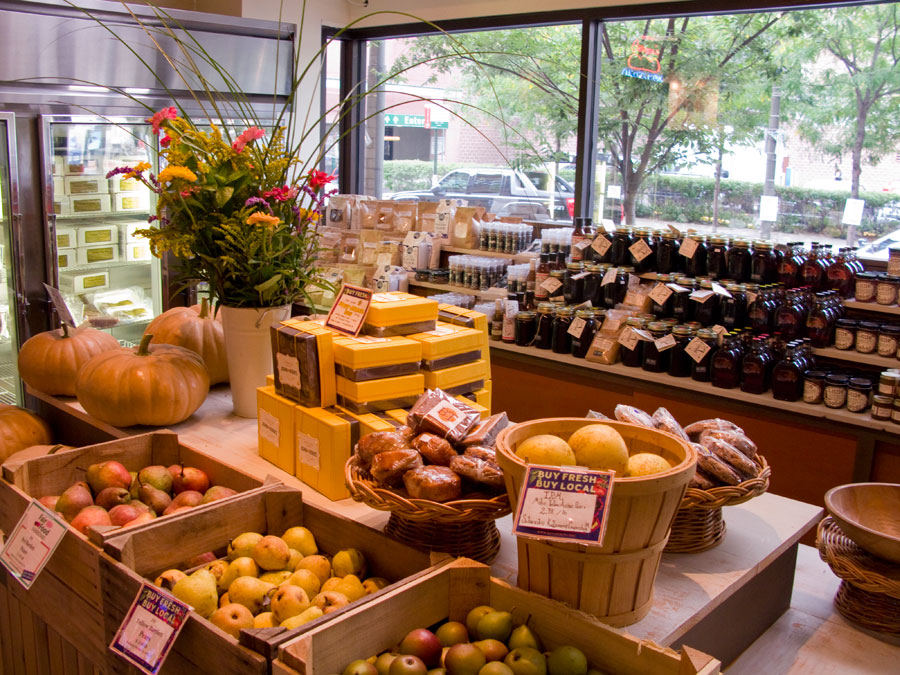

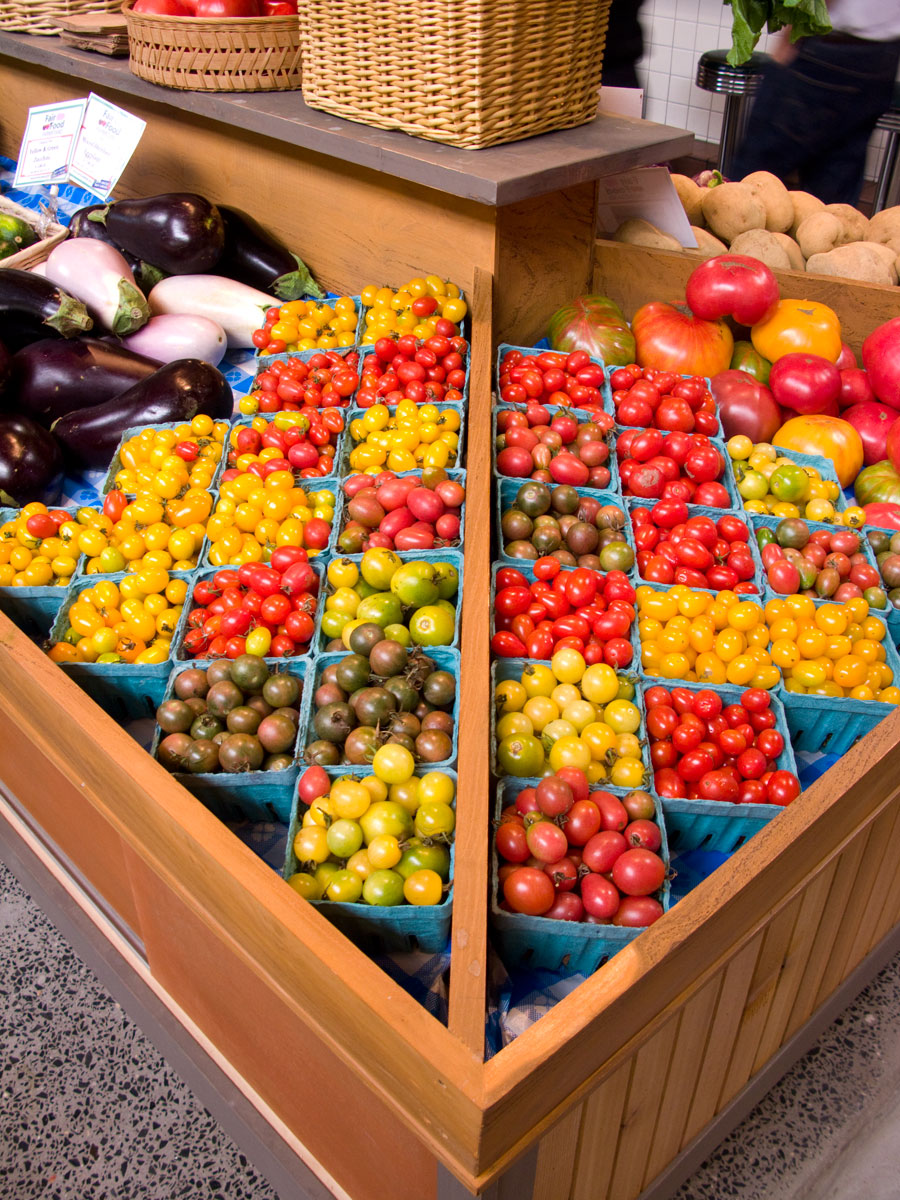
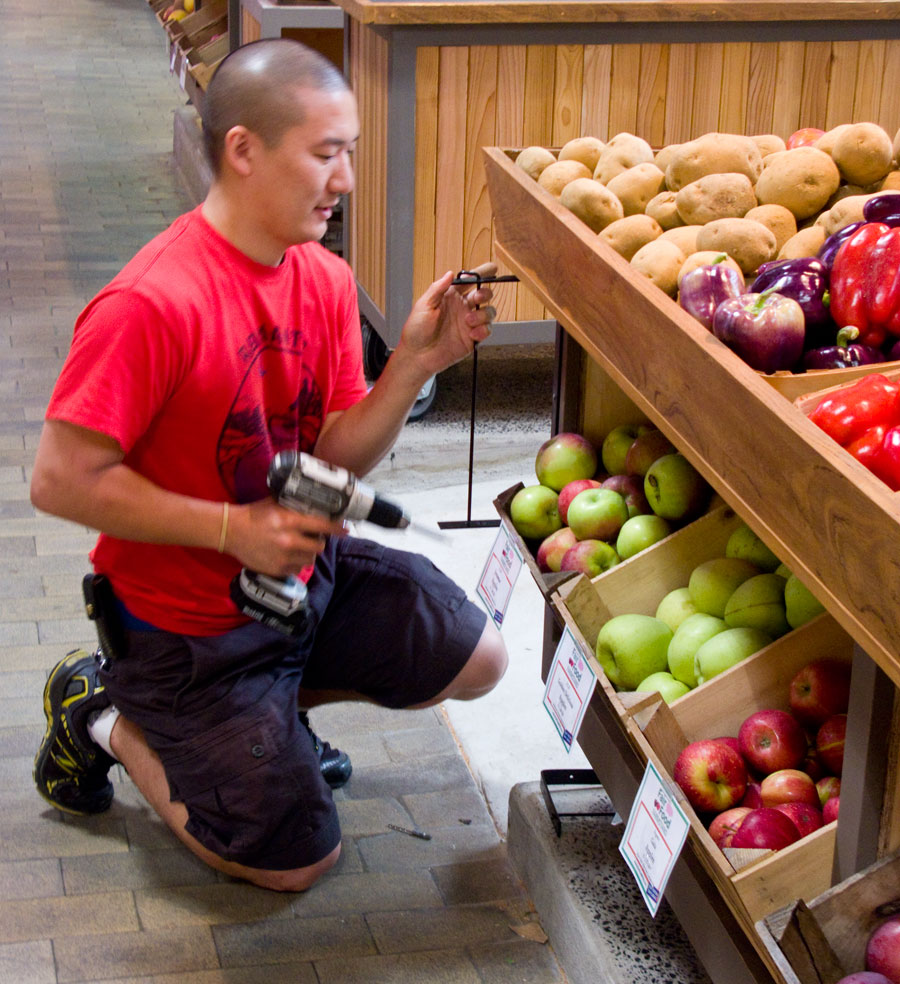
Sunday, September 20, 2009
Peaches Fading, Apples Gaining
 Dave Garretson of Beechwood Orchard was the only vendor at Headhouse Square Farmers' Market today who still had peaches, yellows or whites for $4/quart. Dave still expects to have them next week. He warns that while the flavor and texture are great, these won't be keepers; the late season peaches, he says, will dry out fairly quickly on the counter or in the fridge.
Dave still had plentious varieties of plums as well as late season raspberries. But apples are entering the peak season,which will continue into November. Beechwood's varieties today included Honey Crisp, the season's first Macouns (they'll only be here for a few weeks), Ginger Golds, Cortlands, Ida Reds, Jonathans, Jonagolds, Galas and Empires. The Honey Crisps were selling for $4.50/quart, the rest fror $4.
Northstar Orchards offered plenty of apples, too, as well as Asian pears. What attracted me most at this vendor, however, were the great yellow flat beans pictured above, a variety they called Marvel of Venice ($2.50/pound). This Italian heirloom pole bean had pods 3/4-inch wide and 7-9 inches long. Northstar's heads of endive ($2.50/bunch) also looked particularly good. A.T. Buzby's green string beans were healthy looking, $3.50/quart.
 The celeriac (celery root) at Culton Organics -- that's Tom Culton in the banded hat -- cried out "Eat me, eat me". So I bought a knob. I haven't yet decided whether to just julienne it and toss it in remoulade, or simmer with potatoes and puree them together. Using them with the potatoes elevates the puree considerably, giving the potatoes a superb fresh flavor and providing a light texture you don't expect. Just severely trim the bulbs; you may want to hold the cut up celeriac in acidulated water to forestall oxidation. The leaves are a welcome addition to a stock pot or any place else you want an herbal celery flavor. Culton also had many cases of gorgeous, long sweet peppers, mostly red but some with a tinge of green, priced at a bargain 3/$1.
Many of the vendors still have a good supply of tomatoes: field, heirloom or cherry. Corn is still available, as are eggplant in its many manisfestations. Produce that does well in cooler weather has been making a comeback in recent week, including cabbages and other members of the brassica family (cauliflower, broccoli, kale, collards and, soon, brussels sprouts), and radishes, among others. Yoder Heirlooms contiunues to offer those wonderful cowpeas (black eyed peas) I raved about a few weeks ago. And just about everyone's got winter squashes, including butternut, pumpkins and, in the case of at least one vendor, blue hubbard.
 Dave Garretson of Beechwood Orchard was the only vendor at Headhouse Square Farmers' Market today who still had peaches, yellows or whites for $4/quart. Dave still expects to have them next week. He warns that while the flavor and texture are great, these won't be keepers; the late season peaches, he says, will dry out fairly quickly on the counter or in the fridge.
Dave still had plentious varieties of plums as well as late season raspberries. But apples are entering the peak season,which will continue into November. Beechwood's varieties today included Honey Crisp, the season's first Macouns (they'll only be here for a few weeks), Ginger Golds, Cortlands, Ida Reds, Jonathans, Jonagolds, Galas and Empires. The Honey Crisps were selling for $4.50/quart, the rest fror $4.
Northstar Orchards offered plenty of apples, too, as well as Asian pears. What attracted me most at this vendor, however, were the great yellow flat beans pictured above, a variety they called Marvel of Venice ($2.50/pound). This Italian heirloom pole bean had pods 3/4-inch wide and 7-9 inches long. Northstar's heads of endive ($2.50/bunch) also looked particularly good. A.T. Buzby's green string beans were healthy looking, $3.50/quart.
The celeriac (celery root) at Culton Organics -- that's Tom Culton in the banded hat -- cried out "Eat me, eat me". So I bought a knob. I haven't yet decided whether to just julienne it and toss it in remoulade, or simmer with potatoes and puree them together. Using them with the potatoes elevates the puree considerably, giving the potatoes a superb fresh flavor and providing a light texture you don't expect. Just severely trim the bulbs; you may want to hold the cut up celeriac in acidulated water to forestall oxidation. The leaves are a welcome addition to a stock pot or any place else you want an herbal celery flavor. Culton also had many cases of gorgeous, long sweet peppers, mostly red but some with a tinge of green, priced at a bargain 3/$1.Many of the vendors still have a good supply of tomatoes: field, heirloom or cherry. Corn is still available, as are eggplant in its many manisfestations. Produce that does well in cooler weather has been making a comeback in recent week, including cabbages and other members of the brassica family (cauliflower, broccoli, kale, collards and, soon, brussels sprouts), and radishes, among others. Yoder Heirlooms contiunues to offer those wonderful cowpeas (black eyed peas) I raved about a few weeks ago. And just about everyone's got winter squashes, including butternut, pumpkins and, in the case of at least one vendor, blue hubbard.
Friday, September 18, 2009
 Edible Cacti
Iovine Brothers Produce at the Reading Terminal Market featured a nice selection of edibles from the prickly pear cactus plant. Both red and green cactus pears and cactus leaves (nopales) are shown here, along with Meyers lemons. the cactus pears were two for a buck, a very good price, and the nopales 89 cents pound.
Iovine's also offered limes at a bargain eight for a buck, and beautiful, large purple South Jersey eggplants at 89 cents a pound. New Jersey plum tomatoes were $1.49/pound. String beans were 99 cents, iirc. Avocados are a buck apiece, organic avocados $1.99.
Figs are still in season at Fair Foods. They're selling green figs gathered from a South Philly tree in egg cartons (six for $4). Plenty of apples and they've still got peaches.
Hershel's East Side Deli had plenty of cold brisket on hand for those who didn't want to cook their own for tonight's Rosh HaShana dinners. He also had sweet kugel, but not potato. Although they also sell hot brisket, the cold briskets allow the staff to slice it to whatever thickness you like.
In addition to bagels from New York's H&H, they also sell very good bialys. I buy them frozen then reheat for about 9 minutes in a 350-degree toaster oven. Plenty oniony and a great alternative to bagels.
New Stalls Under Construction
 At the Reading Terminal Market, visible progress has been made at Beck's Cajun Cafe (top photo), shooting for a late October debut.
Fair Food (bottom) figures they'll make their goal of moving to the new location by Tuesday.
 When Fair Food vacates their present location, it will be restored to its previous incarnation as a seating area.
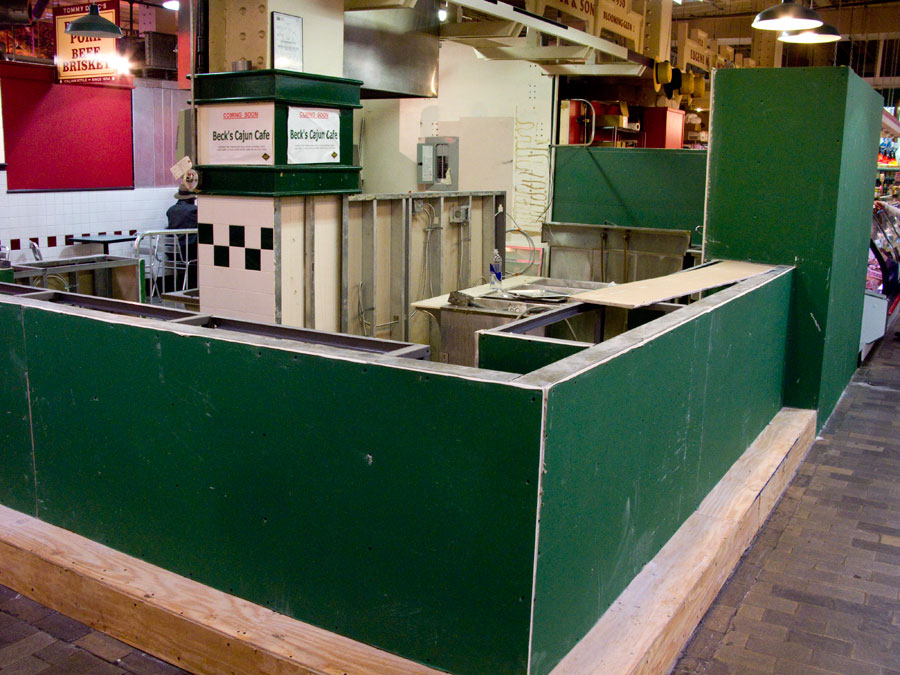 At the Reading Terminal Market, visible progress has been made at Beck's Cajun Cafe (top photo), shooting for a late October debut.
Fair Food (bottom) figures they'll make their goal of moving to the new location by Tuesday.
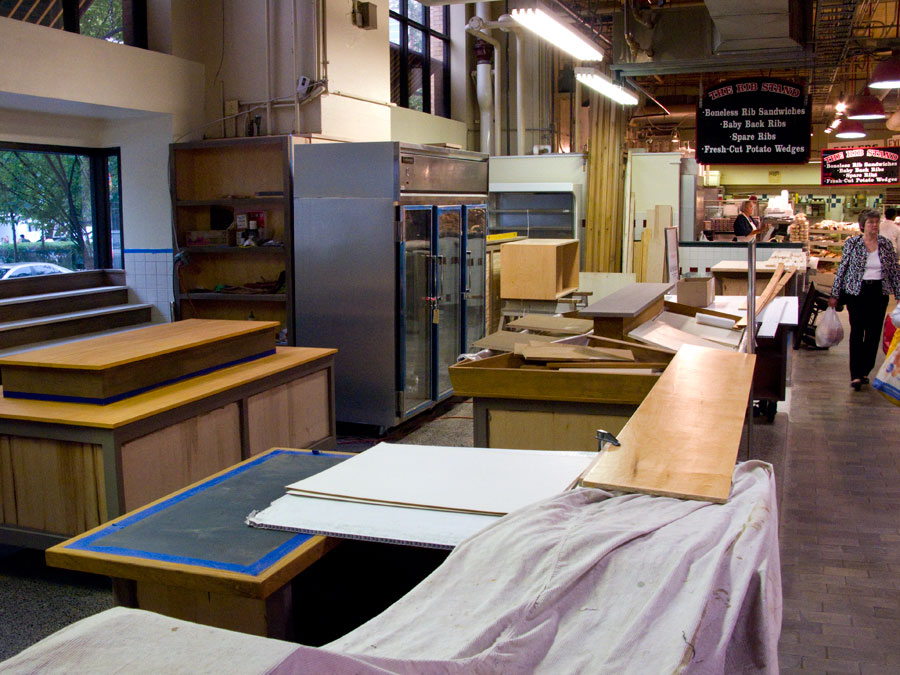 When Fair Food vacates their present location, it will be restored to its previous incarnation as a seating area.
Paw Paws Among Fairmount Treats
 Here are the paw paws offered by Livengood's yesterday at the Fairmount Farmers' Market. The more dark spotting they have, the better, since that indicates ripeness. A totally green paw paw is to be avoided. These were okay, but I like to see more coverage of dark spots.
As reported earlier, they should be available at Fair Food as well as the Livengood's Saturday at the Reading Terminal Market and Tuesday at the South & Passyunk market.
In addition to the paw paws (priced at $3.95/pound), yesterday Livengood's featured ground cherries at $3.50/pint, beets for either $2.50 a bunch with leaves or $2.50/pound without, scallions for $1.50/bunch, and concord grapes for $4.50/quart. Expect similar prices Saturday at the RTM.
The Fairmount market has been growing in popularity since it started about four or five years ago, and is now up to a regular complement of about half a dozen vendors. Dozens of customers were there shortly after its 3 p.m. opening yesterday. I'm sure the visitors getting off the tour buses there (it serves as the stop for Eastern State Penitentiary Historic Site) enjoyed the market's presence as much as the neighbors.
Sam Stolfus, the Amish produce vendor at Fairmount, offered good looking Bartlett pears at $3.50/quart, as well as a number of different apples. Plum tomatoes were $3.50/quart, regular field tomatoes $2/pound, and Asian pears $3.50/quart. His watermelons ranged in price from $3 to $7, depending on size. Of all the produce vendors, Sam provides the widest range of fruits and vegetables, as well as Amish baked goods (much too sweet for my taste, but many enjoy them, especially the moon pies.
Bill Weller's well-supplied produce stall had plenty of tomatoes and peaches, corn and melons. Other vendors at Fairmount yesterday included John & Kira's Chocoloates, Wild Flour Bakery, an Amish meat and egg vendor, and a flower stall.
 Here are the paw paws offered by Livengood's yesterday at the Fairmount Farmers' Market. The more dark spotting they have, the better, since that indicates ripeness. A totally green paw paw is to be avoided. These were okay, but I like to see more coverage of dark spots.
As reported earlier, they should be available at Fair Food as well as the Livengood's Saturday at the Reading Terminal Market and Tuesday at the South & Passyunk market.
In addition to the paw paws (priced at $3.95/pound), yesterday Livengood's featured ground cherries at $3.50/pint, beets for either $2.50 a bunch with leaves or $2.50/pound without, scallions for $1.50/bunch, and concord grapes for $4.50/quart. Expect similar prices Saturday at the RTM.
The Fairmount market has been growing in popularity since it started about four or five years ago, and is now up to a regular complement of about half a dozen vendors. Dozens of customers were there shortly after its 3 p.m. opening yesterday. I'm sure the visitors getting off the tour buses there (it serves as the stop for Eastern State Penitentiary Historic Site) enjoyed the market's presence as much as the neighbors.
Sam Stolfus, the Amish produce vendor at Fairmount, offered good looking Bartlett pears at $3.50/quart, as well as a number of different apples. Plum tomatoes were $3.50/quart, regular field tomatoes $2/pound, and Asian pears $3.50/quart. His watermelons ranged in price from $3 to $7, depending on size. Of all the produce vendors, Sam provides the widest range of fruits and vegetables, as well as Amish baked goods (much too sweet for my taste, but many enjoy them, especially the moon pies.
Bill Weller's well-supplied produce stall had plenty of tomatoes and peaches, corn and melons. Other vendors at Fairmount yesterday included John & Kira's Chocoloates, Wild Flour Bakery, an Amish meat and egg vendor, and a flower stall.
Wednesday, September 16, 2009
Fair Food Moves This Weekend
The Fair Food Farmstand expects to open at its new Reading Terminal Market location next Tuesday. They'll be closed this Sunday and Monday to make the move.
As we reported last Saturday, refrigerators and freezers were delivered, as well as all the shelving.
A formal grand opening celebration is planned for Friday, Oct. 2.
The Fair Food Farmstand expects to open at its new Reading Terminal Market location next Tuesday. They'll be closed this Sunday and Monday to make the move.
As we reported last Saturday, refrigerators and freezers were delivered, as well as all the shelving.
A formal grand opening celebration is planned for Friday, Oct. 2.
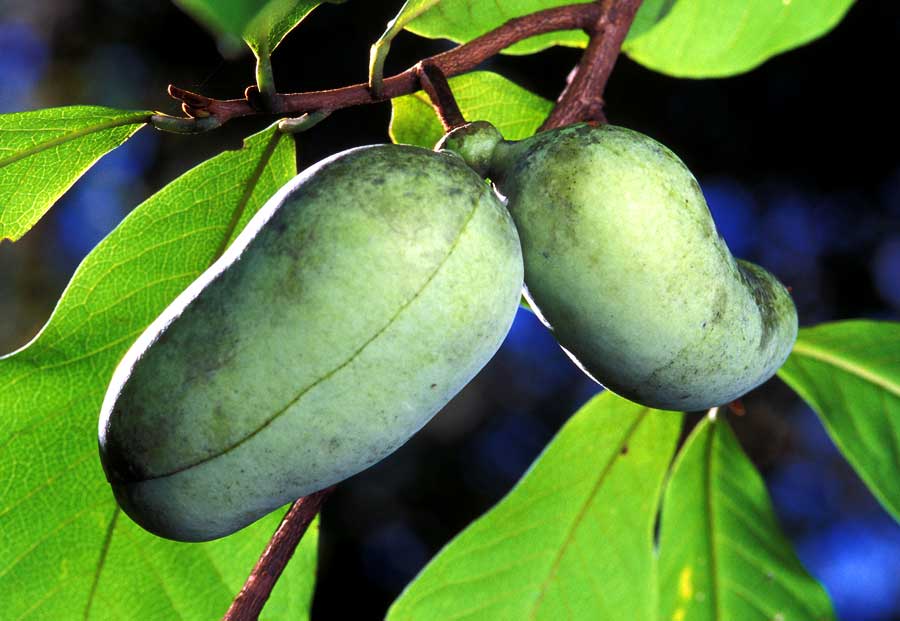 Paw Paws Arrive This Week
Ace gatherer Sam Consylman called to report that the paw paw season is underway, and the crop looks healthy.
The trees are laden with these custard apple-like fruits, and the rain predicted for tomorrow should put a lot on the ground. Sam forages for the paw paws by local creeks and aims to beat little critters to the fruit, who also enjoy its tropical flavor, even though it's native to North America's temperate climes. The fruits he gathered today are ripe, but he expects even more over the next few weeks.
(The photo, by the way, comes from the U.S. Department of Agriculture; photo by Scott Bauer.)
They'll be available tomorrow at Earl Livengood's stall at the Fairmount Farmers' Market, 22nd and Fairmount. Livengood's will also sell them Saturday at the Reading Terminal Market and the Bryn Mawr Farmers' Market, and again Tuesday afternoonn at the South & Passyunk venue. They'll also be available at the Fair Food Farmstand at the Reading Terminal Market, according to Sam.
If you need any recipes, Sam has them. He's usually at the South & Passyunk market on Tuesdays; just ask him and he'll pull out his book.
It's no coincidence that this weekend marks the annual Ohio Paw Paw Festival held outside of Athens. In addition to the usual paw paw puddings, pies, cakes and ice creams, expect to sample more savory dishes. There's also a paw paw beverage competition, including alcoholic beverages. Anyone for some Paw Paw Beer?
Saturday, September 12, 2009

Farmer Jim
The crew at Iovine Brothers Produce brought out a cake this past week for Jim Iovine (cartoon at right). The cake was adorned with the words “Congratulations Farmer Jim.”
The occasion was Jim’s closing on a 57-acre spread in Franiklinville, New Jersey, about 10 minutes this side of Vineland, complete with farmhouse. This winter Jim and brother Vinnie will be planning what to plant there. So, late next season, you might expect to see a little truly home-grown produce at Iovine Brothers.
Dinic's: You Want It Hot?
For the past few weeks, Dinic’s has added roasted long hot peppers to their offerings, in addition to the sweet roasted bell peppers. Joe Nicolosi says as long as the hot peppers are inexpensive, they’ll have them. But, given the pepper’s seasonal nature, don’t expect them when the wholesale case price escalates this winter.
For the past few weeks, Dinic’s has added roasted long hot peppers to their offerings, in addition to the sweet roasted bell peppers. Joe Nicolosi says as long as the hot peppers are inexpensive, they’ll have them. But, given the pepper’s seasonal nature, don’t expect them when the wholesale case price escalates this winter.
When Dinic’s roasts their peppers every morning, they add oil, garlic, salt and some hot pepper flakes. They omit the flakes for the mildly-firery long hots.
This Week at the Reading Terminal Market
Limes and grapes were among the bargains this morning at Iovine Brothers Produce. The limes were eight fror a buck. Two-pound bags of loose grapes were selling for $1.99, vs. a pound price of $1.99 for slightly larger grapes still (mostly) attached sold in tray packs.
Vinnie Iovine touted the quality and price of the mangoes this season. I didn’t check today’s price, but a week ago the large Kent mangoes were selling for two for a buck.
The number of different varieties of apples is widening as we approach the autumnal equinox, at Iovine’s, Fair Food, L. Halteman, O.K. Lee and Kauffman’s Lancaster County produce. Winter squashes of all sorts are plentiful. In addition to buttercup, butternuts and acorns, I spied gooseneck pumpkins (they’ve got coloration like a watermelon) at Iovine’s. Another good deal at Iovine’s were 10-pound bags of New Jersey all-purpose white potatoes for $3.99; that will make a lot of kugel.
Summer hangs on, though. Expect to see local corn, peaches, tomatoes and summer squashes through the end of the month.
Kauffman had some late summer strawberries this week. While not quite as flavorful as those we get in late May and early June, the $3.95 a half-pint local hothouse fruits were a lot more flavorful than winter berries. Ben’s also been selling blackberries for $4.95/pint (vs. $7.50 at Fair Food), but the season for these is just about done. Apple prices ranged from $1.99 (Galas) to $2.49 (Honey Crisps). Bartlett pears were $1.49. His pound price for peaches are $1.99 (yellow) and $2.99 (white).
Over at Fair Food, peaches were $1.75. They’ve also got a profusion of beets, with Red, Golden and Chioggas at $2/pound. Pluots and plums ranged from $2.50-$2.75, depending upon variety.
S&B meats is long on sausages and wursts, but short on fresh pork. Only the jost common cuts are available, including baby back ribs, tenderloins, sirloin roasts, filets, chops and stuffed chops.
A new variety of tomatoes has cropped up over the past couple weeks at both Fair Food and Headhouse: Golden Peach. They do look like small peaches. Livengood’s was selling them for $3.50/pint. Livengood’s also has Cape Gooseberries, also known as ground cherries. This relative of the tomatillo has the delightful taste of a combination of tomatoe and pineaple. (Useless fact: Cape Goosberries’ scientific name is physalis peruvianna; tomatillos are physalais philadelphica. Both, like tomatoes, are members of the nightshade family.)
Beck's, Fair Food Progress
The walls have started to rise at Beck’s Cajun Cafe in the Reading Terminal Market. The stall, which will feature Louisiana specialties from beignets to jambalaya, is located across from Tootsie’s Salad Express.
Refrigerators and freezers were delivered to the new Fair Food Farmstand along the market’s 12th Street windows. They’re at least a couple weeks away from moving into the new space. In the meantime, the Fair Food stall is working out of one chest freezer and one reach-in refrigerator.
Headhouse Report
Asian pears were back last week at the Headhouse Square Farmers’ Market. Hosui’s were selling for $2.50 at North Star Orchards. Culton Organics also offered Asian pears at $1 piece, and Beechwood Orhcards for $5/quart. Also at North Star last week were pears and apples at $2/pound and sweet peppers for $2.59
Asian pears were back last week at the Headhouse Square Farmers’ Market. Hosui’s were selling for $2.50 at North Star Orchards. Culton Organics also offered Asian pears at $1 piece, and Beechwood Orhcards for $5/quart. Also at North Star last week were pears and apples at $2/pound and sweet peppers for $2.59
Now that summer’s heat has relented, radishes are back in season. Weaver’s Way and Yoder’s Heirlooms had them for $2.50/bunch. Weaver’s also featured leeks, $2/pound.
Beechwood’s Macintosh and Honey Crisp appoes sold for $4.50/quart, pears were $5/quart, peaches $4 and nectarines $4.50. Plums and pluots were $6.50/quart, $3.50/pint.
Three Springs Fruit Farm was selling Gala and Ginger Gold apples and Bartlett pears for $1.99/pound. Honey Crisps were $2.49.
Ever wonder about Tom Culton’s small pieces of slate he uses for identifying and pricing his produce? They’re the remnants from his barn roof, which now sports a shiny aluminum top.
Subscribe to:
Posts (Atom)